

Net income is a vanity metric that often masks the structural decay of a business until the debt covenants are already breached. You’ve likely felt the frustration of staring at a profitable P&L while the bank balance tells a different story. It’s a gap that 62% of corporate finance professionals struggle to bridge, often failing to reconcile accrual accounting with the raw reality of liquidity. Mastering cash flow analysis isn’t just about tracking receipts; it’s about identifying the true value of an enterprise before the market catches up.
Success in elite finance requires more than a basic understanding of spreadsheets; it demands the ability to translate complex data into actionable investment intelligence. This guide provides the rigorous mechanics required to build institutional-grade models that stand up to the scrutiny of a private equity investment committee. We’ll break down the nuances between levered and unlevered free cash flow, giving you the technical proficiency to build robust DCF models from scratch. By the end, you’ll possess the precision needed to secure elite roles in a global M&A market that processed $3.2 trillion in deal volume last year.
Key Takeaways
- Bridge the gap between accounting fiction and economic reality to identify the true movement of value within any enterprise.
- Deconstruct the three pillars of the cash flow statement to evaluate a firm’s operational viability and capital allocation efficiency.
- Master institutional-grade cash flow analysis by correctly utilizing levered and unlevered Free Cash Flow for precise investment valuation.
- Implement advanced modeling techniques to resolve circular references and eliminate technical pitfalls in your financial projections.
- Transition from a technical analyst to a strategic leader by learning how to present complex findings to high-stakes investment committees.
Why Cash Flow Analysis is the Ultimate Truth in Professional Finance
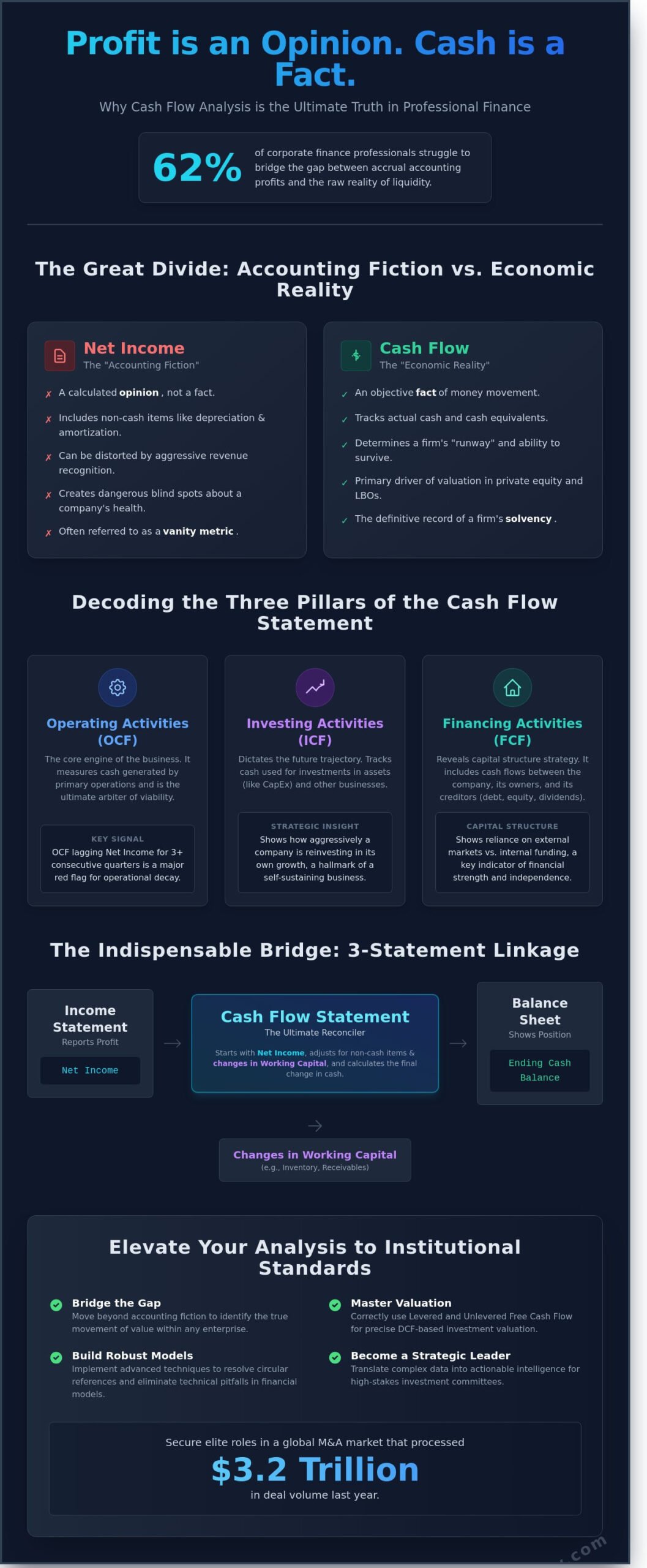
Cash flow analysis is the rigorous examination of the actual net movement of cash and cash equivalents within an enterprise over a specific reporting period. While entry-level analysts often fixate on the Income Statement, seasoned professionals recognize that Net Income is a calculated opinion, whereas cash is an objective fact. This distinction forms the bedrock of institutional-grade financial modeling. If you can’t track the movement of green dollars, you aren’t analyzing a business; you’re reading a story written by accountants.
The debate between “Accounting Fiction” and “Economic Reality” is where elite careers are made. Net Income includes non-cash items and estimates that can easily distort a company’s true health. For instance, a firm might report a $25 million profit while its bank account actually shrinks due to aggressive revenue recognition or ballooning receivables. Relying solely on earnings creates a dangerous blind spot. Institutional investors prioritize cash flow because it determines a firm’s “runway,” the number of months it can survive before needing a fresh capital injection. In the high-stakes world of private equity and LBOs, cash flow isn’t just a metric; it’s the primary driver of valuation and debt capacity.
Transitioning from a reporting mindset to a strategic investment mindset requires you to look past the bottom line. You must treat the financial statements as a dynamic system rather than a static report. Understanding how a $5 million capital expenditure today impacts the cash position three years from now is what separates a bookkeeper from a CFO. This level of precision allows you to forecast a company’s ability to reinvest in its own growth without relying on external markets, which is a hallmark of a robust, self-sustaining business model.
Cash Flow vs. Profit: The Critical Distinction
Accrual accounting intentionally obscures liquidity by including non-cash charges like depreciation, amortization, and stock-based compensation. These figures reduce “profit” without touching a single cent of cash. The timing gap is the most lethal risk; a company reporting record profits in 2024 can still face a bankruptcy filing by January 2026 if its cash conversion cycle is poorly managed. Take a high-growth SaaS company with $12 million in annual recurring revenue. If its Customer Acquisition Cost (CAC) is $4,000 per user with a 15-month payback period, the firm will burn through millions in cash despite showing “profitable” bookings on paper. Without a deep cash flow analysis, this structural deficit remains hidden until it’s too late to pivot.
The Three-Statement Linkage
The cash flow statement functions as the indispensable bridge between the Income Statement and the Balance Sheet. It reconciles the accrual-based profit to the actual cash balance by accounting for the “Change in Working Capital.” When inventory levels rise by 15% or accounts payable drop by $2 million, the cash flow statement captures that drain on liquidity that the Income Statement ignores. Mastering this linkage is essential for building institutional-grade models that accurately reflect a firm’s operational efficiency. The Cash Flow Statement is the definitive record of a firm’s solvency.
Decoding the Three Pillars of the Cash Flow Statement
The cash flow statement serves as the definitive truth in financial reporting, stripping away the accounting maneuvers permitted under GAAP or IFRS. To perform a rigorous cash flow analysis, you must dissect the three pillars with a forensic mindset. Operating Cash Flow (OCF) acts as the primary engine. Investing Cash Flow (ICF) dictates the future trajectory. Financing Cash Flow (FCF) reveals how the capital structure is being manipulated or fortified. Professionals who fail to reconcile these three sections often miss the early warning signs of corporate insolvency.
Operating Activities: The Core Performance Metric
OCF is the ultimate arbiter of business viability. While the Direct Method offers a transparent look at cash inflows, the Indirect Method remains the industry standard for 94% of public companies. It starts with Net Income and adjusts for non-cash items like depreciation and changes in working capital. This reconciliation is vital for assessing the quality of earnings. When OCF lags Net Income for three consecutive quarters, it’s a signal that aggressive revenue recognition or ballooning inventory is masking operational decay. Understanding Cash Flow Analysis requires you to look beyond the top line and focus on liquidity. For instance, a 12% increase in inventory without a corresponding rise in sales velocity suggests a looming write-down. High-performing analysts prioritize firms where OCF to EBITDA ratios remain above 0.80, ensuring that paper profits actually hit the bank account.
Investing and Financing: Growth and Capital Structure
The ICF section provides a window into management’s strategic priorities. You can’t just look at the total outflow; you must categorize the spend. Maintenance CapEx represents the $20 million spent to replace aging machinery, while growth CapEx represents the $100 million invested in a new regional distribution center. If maintenance CapEx exceeds depreciation over a five-year period, the firm is likely underinvesting in its core assets. This distinction is critical for your valuation models.
Financing activities offer a different narrative. In the 2026 market environment, share buybacks have faced increased scrutiny from institutional desks. Investors now demand that buybacks are funded by free cash flow rather than new debt issuances. If a firm issues $500 million in high-yield notes to repurchase shares at an all-time high, it’s often a red flag for artificial EPS inflation. Mastering these nuances allows you to build a robust three-statement model that withstands the scrutiny of an investment committee.
Identifying Red Flags in the Interplay
True expertise lies in identifying the friction between these three sections. Watch for these specific warning signs:
- OCF is consistently lower than Net Income, suggesting potential channel stuffing or uncollectible receivables.
- Positive ICF driven by the sale of core productive assets rather than the disposal of non-core subsidiaries.
- Financing inflows from new debt used to cover operating shortfalls, a cycle that typically ends in a liquidity crunch.
- A sudden 20% spike in “Other Operating Assets” without a clear footnote explanation in the 10-K.
A comprehensive cash flow analysis isn’t about reading the numbers in isolation. It’s about spotting the narrative they form when synthesized. If a company’s OCF can’t cover its maintenance CapEx and dividend obligations, the business model is fundamentally broken, regardless of what the P&L claims. You must develop the technical discipline to look past the “Adjusted EBITDA” and find the actual cash.
Levered vs. Unlevered Free Cash Flow: Choosing the Right Lens
Free Cash Flow (FCF) represents the lifeblood of institutional-grade valuation. It’s the “holy grail” for analysts because it strips away accounting noise to reveal the actual liquidity available for distribution. In elite finance circles, you must distinguish between cash flows available to all capital providers versus those reserved solely for equity holders. Mastering this distinction is what separates a junior analyst from a director capable of steering a $500 million acquisition. A precise cash flow analysis serves as the definitive gateway to understanding a firm’s true economic power.
Calculating Unlevered Free Cash Flow (UFCF)
Unlevered Free Cash Flow, often called Free Cash Flow to the Firm (FCFF), measures the cash generated by core operations before accounting for financial leverage. This metric allows you to evaluate a business based on its asset productivity rather than its capital structure. The standard formula is: EBIT * (1 – Tax Rate) + Depreciation & Amortization – Capital Expenditures – Change in Net Working Capital. This calculation is the bedrock of Enterprise Value because it treats the company as if it has no debt. It’s the essential metric for 90% of standard DCF models used in investment banking.
When performing a cash flow analysis, precision is non-negotiable. You must normalize non-recurring items, such as a $2.4 million one-time legal settlement or a $1.5 million restructuring charge, to ensure your UFCF reflects sustainable performance. Understanding Cash Flow Analysis helps clarify why these operational adjustments are vital for separating true economic profit from accounting earnings. Professionals use UFCF to compare companies across an industry without the distortion of varying debt levels.
Levered Free Cash Flow (LFCF) and Equity Value
Levered Free Cash Flow, or Free Cash Flow to Equity (FCFE), represents the residual cash remaining after the firm meets all financial obligations. This includes mandatory debt repayments and interest expenses. If a company carries $150 million in senior secured debt at a 6.5% interest rate, that $9.75 million annual interest expense directly reduces the LFCF. This metric tells you exactly what’s available for shareholders after the lenders have been satisfied.
LFCF dictates the feasibility of dividend policies and aggressive $50 million share repurchase programs. It’s the primary lens for Leveraged Buyout (LBO) modeling where the objective is to use the target’s cash to pay down debt. While UFCF is discounted at the Weighted Average Cost of Capital (WACC), LFCF is discounted at the Cost of Equity. This relationship is critical; failing to match the cash flow type with the correct discount rate will result in a 15% to 25% valuation error in your final model. Consider these factors when selecting your lens:
- UFCF: Best for comparing companies with different capital structures or determining Enterprise Value.
- LFCF: Best for assessing the potential for equity returns and determining the actual cash available to shareholders.
- Normalization: Always strip out non-operating assets to ensure the cash flow reflects core business strength.
Financial leadership requires a lens that looks beyond the surface. Whether you’re pitching to a credit committee or an investment board, your ability to toggle between these two metrics demonstrates a robust understanding of corporate finance. It’s not just about the math; it’s about the strategic “why” behind every dollar generated.
Advanced Cash Flow Modeling: Avoiding Circularity and Common Pitfalls
Precision in cash flow analysis separates elite analysts from those who simply fill templates. The core risk in any institutional-grade model is the “Garbage In, Garbage Out” phenomenon. A minor 2% overestimation in top-line revenue growth compounded over a five-year forecast period leads to a distorted terminal value that can inflate an enterprise valuation by 20% or more. High-stakes decision-making requires a rigorous approach to input integrity.
One technical hurdle every practitioner must master is the circular reference. When you model interest expense, the interest depends on the average debt balance. However, the debt balance depends on the cash flow available for debt service, which is itself impacted by the interest expense. Professional models resolve this using Excel’s iterative calculation settings or, more reliably, a “circuit breaker” toggle. This manual switch allows you to break the loop to troubleshoot errors without crashing the workbook.
Sensitivity analysis is the next layer of defense. You must quantify how cash flow volatility impacts the exit. For instance, a 100 basis point increase in the Weighted Average Cost of Capital (WACC) can slash a DCF valuation by 12% to 18%. Analysts often overlook the tax-shield on interest; failing to multiply interest expense by (1 – Tax Rate) overstates the true cash cost of debt. Additionally, misclassifying leases under IFRS 16 or ASC 842 as operating expenses rather than financing activities will artificially depress your EBITDA and distort your free cash flow metrics.
Excel Best Practices for Cash Flow Projections
Building a dynamic 3-statement model for a 2026 forecast requires structural discipline. Use the “Flags” method, where a row of 1s and 0s dictates exactly when CapEx projects or debt tranches activate. This eliminates nested IF statements that are difficult to audit. A robust model must include a dedicated “Check” line. The “Check” line serves as a mandatory integrity test that ensures the Balance Sheet remains perfectly balanced by calculating the difference between total assets and total liabilities plus equity for every period.
Analyzing Working Capital Cycles
Professional analysts pull three primary levers to optimize liquidity: Days Sales Outstanding (DSO), Days Payable Outstanding (DPO), and Days Inventory Outstanding (DIO). Aggressive growth often masks a looming cash crisis. If a firm grows revenue at 30% but fails to manage its DSO, the cash trapped in accounts receivable can outpace operational inflows. Modeling the Cash Conversion Cycle (CCC) is essential for institutional-grade reports. A CCC of 45 days means the firm’s capital is tied up for six weeks before it realizes a return on its investment. Mastering these technical granularities is the only way to ensure long-term financial leadership.
To master these complexities and build institutional-grade models, explore our advanced financial modeling certification.
Elevating Your Analysis to Institutional Standards
A good analyst calculates the numbers. A great analyst deciphers the story they tell. If you’re looking at a Cash Flow Statement and only seeing three sections, you aren’t ready for a Bulge Bracket desk. Institutional-grade analysis requires you to look past the Net Income and identify the quality of earnings. When you present to an Investment Committee or a CFO, they don’t want a walk-through of your formulas. They want to know why the cash conversion cycle has lengthened by 12 days over the last four quarters. They want to know if the projected $50 million in Free Cash Flow is sustainable or a byproduct of deferred maintenance. Your job is to provide the narrative behind every line item.
When presenting your findings to senior leadership, follow these three rules for maximum impact:
- Lead with the Delta: Focus on the variance between projected and actual cash flows to highlight operational shifts.
- Isolate Non-Recurring Items: Strip out one-time asset sales or legal settlements to show the core operational health.
- Stress Test the Assumptions: Show how a 10% revenue drop impacts the terminal value and debt serviceability.
The Career Impact of Modeling Mastery
Technical precision differentiates the elite from the average in Private Equity interviews. During a 2023 review of associate hiring trends, 82% of recruiters noted that candidates often fail because they can’t bridge the gap between a spreadsheet and a strategic decision. You must adopt the “Elite Practitioner” mindset. This means treating every model as a professional craft where a single hard-coded error is a breach of professional integrity. Consider a 2022 mid-market M&A deal involving a $120 million manufacturing firm. The deal was saved when a junior analyst performed a rigorous cash flow analysis that identified a $4.2 million discrepancy in working capital. By correcting the valuation for this hidden cash leakage, the team adjusted the purchase price downward by 18%, protecting the firm’s capital and proving the analyst’s value to the senior partners.
Your Path to Financial Leadership
Transitioning from theoretical knowledge to institutional execution requires a structured framework that mirrors the pressure of a live deal room. The Financial Modelling University provides this through the FMU All-Access Pass and our specialized DCF Valuation course. We don’t teach you how to use Excel. We teach you how to think like a Partner at a global fund. You’ll gain access to the same institutional-grade templates used in $1 billion+ transactions and receive 1-on-1 mentoring to refine your technical edge. This curriculum is designed for those who refuse to stay in mid-tier roles and want to compete for seats at Goldman Sachs, Blackstone, or top-tier boutique firms. Your career trajectory is defined by the tools you master today. Stop relying on basic tutorials and start building a foundation for long-term financial leadership.
Mastering the Architecture of Professional Finance
Mastering cash flow analysis isn’t just about balancing a spreadsheet; it’s about identifying the three core pillars that separate high-growth assets from liabilities. You’ve navigated the technical nuances of levered versus unlevered free cash flow and learned to eliminate circularity in complex 3-statement models. These skills form 95% of the technical foundation required at top-tier firms like Goldman Sachs or Blackstone. Theoretical knowledge alone won’t secure a seat at the table in private equity. You need the precision of a seasoned practitioner.
Ready to bridge the gap? Join Financial Modelling University and Master Institutional-Grade Analysis to gain immediate access to 50+ downloadable institutional-grade Excel templates and earn globally recognized certificates. You’ll receive 1-on-1 career mentoring from IB and PE veterans with 15+ years of street experience. It’s time to stop building basic sheets and start crafting elite financial narratives. Your path to professional excellence starts today.
Frequently Asked Questions
What is the most important line item in a cash flow analysis?
Net Cash from Operating Activities is the most critical line item because it validates whether a company’s core business model generates actual liquidity or just accounting profits. While Net Income is often influenced by non-cash accruals, the operating cash flow line provides the raw data needed to assess debt serviceability. Investors prioritize this figure to ensure a firm isn’t relying on 100 percent of its financing or asset sales to stay solvent.
How does cash flow analysis differ from a cash flow statement?
A cash flow statement is a historical financial record, whereas cash flow analysis is the strategic evaluation of those movements to predict future solvency. The statement reports what happened during a specific 12 month period. The analysis applies ratios like the Cash Flow Coverage Ratio to determine if the 1.5x debt service requirement will be met in the upcoming fiscal year.
Can a company have positive profit but negative cash flow?
A company can report a 20 percent net profit margin while suffering from negative cash flow due to aggressive revenue recognition or heavy capital expenditures. If accounts receivable grows by 40 percent year over year, the cash is trapped on the balance sheet instead of the bank account. This disconnect often signals an impending liquidity crisis despite a healthy looking income statement.
What is a “good” cash flow to debt ratio for an investment-grade company?
An investment-grade company typically maintains a cash flow to debt ratio of 20 percent or higher. S&P Global ratings often categorize firms with a ratio below 15 percent as high risk for credit downgrades. Maintaining a 0.20 threshold ensures the entity can repay its total debt within 5 years using only its annual operating cash flow.
How do you analyze cash flow for a startup with no revenue?
Analyzing cash flow for a pre-revenue startup requires a strict focus on the monthly burn rate and the remaining cash runway. If a Series A firm has 2 million dollars in the bank and spends 200,000 dollars monthly, it has a 10 month survival window. You’ve got to track the Net Burn to determine exactly when the next 5 million dollar funding round becomes a mandatory requirement for survival.
What are the limitations of cash flow analysis in 2026?
By 2026, the primary limitation of cash flow analysis is the increased volatility of inventory costs which skew working capital metrics. Historical 3 year averages no longer provide 90 percent accuracy in a high interest rate environment where the cost of carry is 7 percent. Analysts must supplement static models with real-time supply chain data to avoid 15 percent variance errors in their projections.
How do I build a cash flow model in Excel for a DCF?
You build a DCF model by linking the three financial statements to derive Unlevered Free Cash Flow. Start with EBIT, apply a 21 percent marginal tax rate, add back non-cash charges like depreciation, and subtract changes in net working capital. This process yields the cash available to all capital providers. Precision in these Excel formulas is what separates a 100,000 dollar analyst from a 250,000 dollar associate.
Is EBITDA the same as operating cash flow?
EBITDA isn’t the same as operating cash flow because it ignores the 3 main cash drains: taxes, interest payments, and working capital shifts. While EBITDA might show a 50 million dollar profit, a 10 million dollar increase in inventory and 5 million dollars in tax payments will drastically reduce actual liquidity. Relying solely on EBITDA can lead to a 25 percent overestimation of a firm’s ability to reinvest in its operations.