
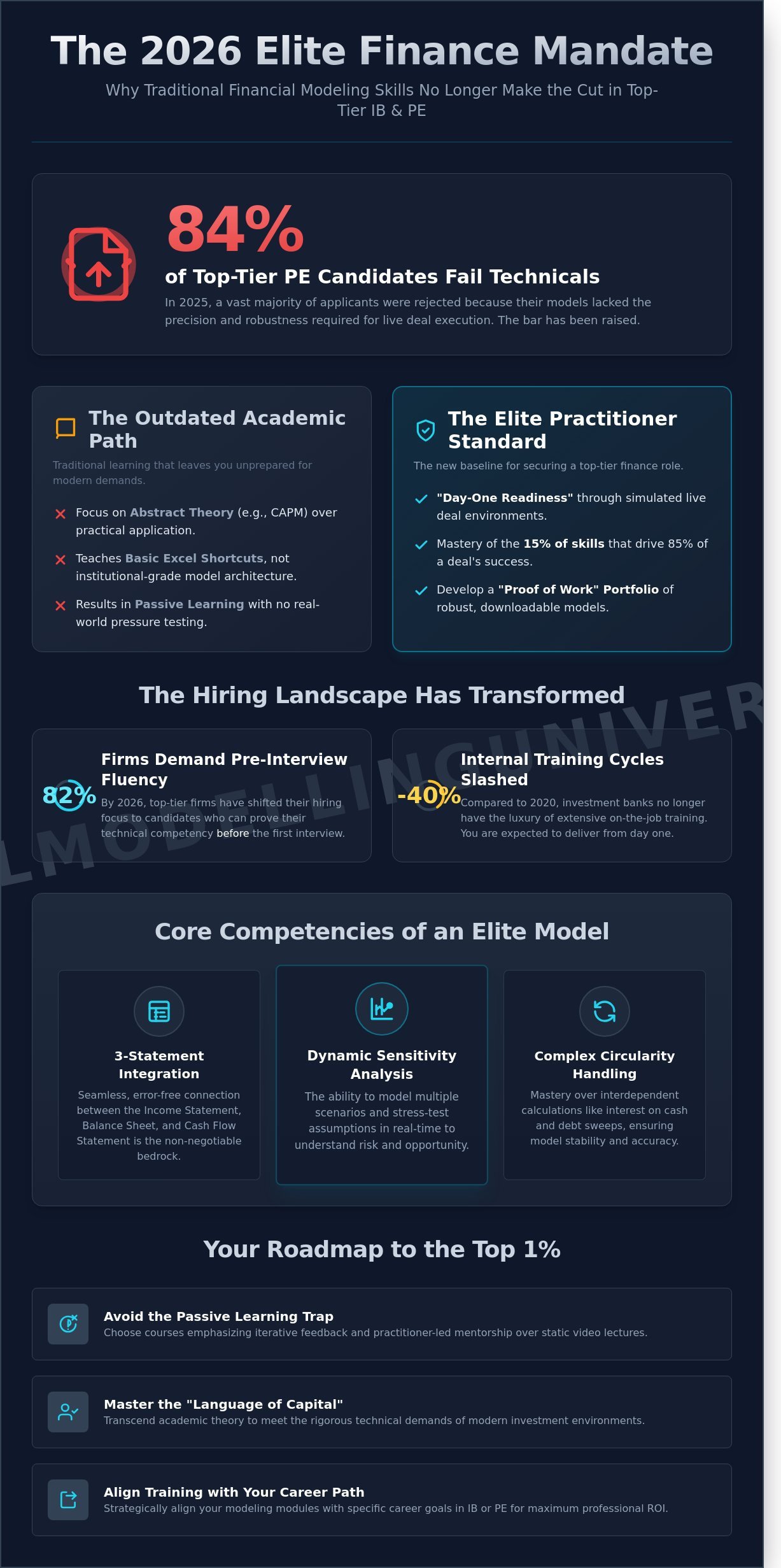
In 2025, a staggering 84% of candidates for top-tier private equity roles failed their technical assessments because their models lacked the precision required for live deal execution. You already know that the difference between a mid-office analyst and an elite associate isn’t just effort; it’s the ability to construct robust, institutional-grade models under extreme pressure. Finding a financial modeling course online that actually prepares you for this reality is difficult when most platforms offer nothing more than basic Excel shortcuts and theoretical fluff.
We understand that you’re tired of information overload and the persistent fear of stumbling during a high-stakes technical interview. You need more than a certificate; you need the tactical proficiency to handle complex LBO and DCF scenarios with absolute confidence. This guide reveals how to identify high-tier training that transforms you into a seasoned practitioner capable of operating at the highest levels of global finance.
We’ll analyze the exact curriculum benchmarks required for 2026 career mastery and show you how to leverage expert mentorship to secure your position in the top 1% of applicants.
Key Takeaways
- Master the “language of capital” to transcend traditional academic theory and meet the rigorous technical demands of modern investment environments.
- Build institutional-grade competency by mastering three-statement integration and dynamic sensitivity analysis required for elite-level valuation.
- Avoid the passive learning trap by choosing a financial modeling course online that emphasizes iterative feedback and practitioner-led mentorship.
- Strategically align your modeling modules with specific career paths in IB or PE to ensure maximum professional ROI on your training.
- Transition from a technical analyst to a financial leader by leveraging an all-access ecosystem designed for ongoing professional excellence.
The Evolution of Financial Modeling Education: Why Online Mastery is Non-Negotiable in 2026
Financial modeling is the language of capital. In the high-stakes environment of 2026, it serves as the primary tool for translating raw market data into actionable investment strategies. You aren’t just building spreadsheets; you’re constructing the mathematical architecture that dictates billion-dollar decisions. To grasp the technical depth required by elite firms, one must first define what is financial modeling in a professional context: it is the rigorous, mathematical representation of a company’s financial operations used to forecast future performance and drive valuation.
The gap between traditional academic finance and the reality of the bullpen has never been wider. While universities focus on abstract theories like the Capital Asset Pricing Model, the 2026 market demands a pragmatic, iterative approach. Practitioner-led training has become the gold standard because it mirrors the “live deal” environment. You don’t learn to model by reading a textbook. You learn by breaking and fixing complex structures in real-time. This is why a dedicated financial modeling course online is now the most efficient path to technical proficiency. It bypasses the fluff of a four-year degree and focuses on the 15% of technical skills that drive 85% of a deal’s success.
Institutional-grade modeling requires a level of precision that traditional classrooms cannot replicate. By 2026, 82% of top-tier investment firms have shifted their hiring focus toward candidates who demonstrate technical fluency before they even step into the interview room. They value the ability to handle messy, non-linear data over a high GPA. If your model doesn’t have a robust circularity switch or a dynamic sensitivity analysis, it isn’t ready for a professional environment. Online mastery isn’t just a career boost; it’s your ticket to entry in a market that no longer has time for the uninitiated.
The ‘Day-One Readiness’ Mandate
Investment banks in 2026 have slashed internal training cycles by 40% compared to 2020 levels. They don’t have the luxury of teaching you the basics of an integrated 3-statement model over six weeks. You’re expected to handle complex, multi-layered projections on your first Monday. A high-quality financial modeling course online bridges this gap by immersing you in simulated deal environments. This pressure-cooker approach ensures you can execute under tight deadlines without compromising the integrity of the data.
Digital Credentials vs. Traditional Degrees
The industry has shifted toward a “proof of work” model where downloadable models serve as a professional portfolio. Recruiters at firms like Goldman Sachs and Blackstone now prioritize specialized certifications from entities like Financial Modelling University because they represent verified technical competency. These digital credentials provide immediate evidence of your ability to build institutional-grade models. Institutional-grade modeling is the standard for 2026 recruitment. Without a portfolio of robust models, you’re effectively invisible to elite hiring managers who demand immediate technical impact.
Core Competencies of Institutional-Grade Financial Modeling Programs
Mastering a financial modeling course online requires more than memorizing Excel shortcuts; it demands the adoption of a rigorous mental framework used by elite Wall Street analysts. The gap between a hobbyist spreadsheet and an institutional-grade model lies in the structural integrity of the build. You aren’t just calculating numbers. You’re constructing a decision-making engine that must withstand the scrutiny of investment committees and senior partners.
The bedrock of any professional model is the seamless integration of the three core financial statements. Every line item on the Income Statement must flow logically into the Cash Flow Statement, which then dictates the movements on the Balance Sheet. If the assets don’t equal liabilities plus equity to the exact cent, the model is functionally broken. Top-tier training focuses on managing complex circularities, such as interest expense and cash sweeps, ensuring the model remains stable even under extreme assumptions.
Static thinking is a liability in high-stakes finance. Professionals build effective financial models that utilize dynamic scenario and sensitivity analysis. This allows stakeholders to toggle between “Bull,” “Base,” and “Bear” cases with a single keystroke. You must master Data Tables to visualize how a 25-basis-point shift in the terminal growth rate or a 1% change in EBITDA margin impacts the final valuation. This level of precision is what separates a standard employee from a strategic advisor.
Error-trapping is another non-negotiable competency. Research from the University of Hawaii suggests that 88% of spreadsheets contain significant errors. Institutional-grade programs teach you to build dedicated “Audit” or “Checks” tabs. These internal integrity flags immediately identify balance sheet imbalances or formula breaks. Senior practitioners don’t trust a model because it looks good; they trust it because it proves its own accuracy through rigorous internal logic.
Finally, you must understand industry-specific nuances. A generic template is useless in the real world. A real estate model focuses on IRR waterfalls and debt service coverage ratios (DSCR), whereas a Leveraged Buyout (LBO) model prioritizes debt paydown schedules and exit multiples. High-performance training forces you to adapt your technical skills to these specific sectoral demands.
The Architecture of a Robust Model
Clean layout standards are the hallmark of global firms like Goldman Sachs or J.P. Morgan. You must enforce a strict separation between inputs, calculations, and outputs. This modular design ensures that changing a single assumption doesn’t trigger a cascade of errors across the workbook. While basic users rely on manual entry, elite practitioners use VBA and advanced macros to automate repetitive tasks like debt sculpting or sensitivity iterations. This technical efficiency can save an analyst roughly 12 to 15 hours of manual labor during a standard deal cycle.
Advanced Valuation Methodologies
A comprehensive financial modeling course online bridges the gap between academic theory and M&A reality. You need to master the trifecta of valuation: Discounted Cash Flow (DCF), Trading Comparables, and Precedent Transactions. However, the true test of an elite modeler is the ability to execute LBO and M&A merger modeling. These involve complex “sources and uses” tables and pro-forma adjustments that reflect real-world deal structures. We emphasize using actual case studies, such as the 2023 $69 billion Microsoft-Activision acquisition, to provide a blueprint for modern financial leadership.
If you’re ready to move beyond basic spreadsheets and master these institutional standards, it’s time to explore our advanced certification tracks to accelerate your professional trajectory.
The Mentorship Gap: Why Self-Study Alone Fails the Modern Investment Analyst
Passive learning is the silent killer of high-finance ambitions. You can spend 50 hours watching a screen, but without a practitioner critiquing your cell logic, you’re merely mimicking movements. Financial modeling is a craft. It requires iterative feedback, not just observation. The “passive learning trap” occurs when students mistake recognition for competence. You recognize the steps of a DCF, but you lack the muscle memory to build one under the 60-minute pressure of a private equity technical test. This distinction is why 82% of self-taught candidates fail their first professional modeling assessment, according to 2023 recruitment data from top-tier search firms.
The common objection is simple: why pay for a premium financial modeling course online when YouTube is free? The answer lies in institutional-grade standards. Free content often ignores the “why” behind the numbers. It lacks the rigorous formatting and error-checking protocols required by bulge bracket banks. A free tutorial won’t tell you that your debt schedule logic is fragile or that your hard-coded numbers violate a firm’s internal audit standards. You’re not paying for information; you’re paying for the elimination of rookie mistakes that would otherwise end your interview process in the first round.
Expert mentorship serves as the ultimate de-risking mechanism. It transforms a solitary struggle into a structured apprenticeship. This 1-on-1 interaction is the “X-factor” that separates those who land roles at Goldman Sachs or Blackstone from those who remain stuck in middle-office functions. It provides the psychological safety to fail fast in a controlled environment, ensuring your first “real” model on the job is robust and defensible.
The Value of Expert Code Review
Automated graders and AI-driven platforms only check if the final output matches a key. They are blind to structural flaws. A mentor identifies “spaghetti logic” and inefficient nesting that make a model impossible for a Managing Director to navigate. In a 2024 survey of senior associates, 91% stated that model integrity and “cleanliness” were more important than the final valuation number itself. Expert feedback accelerates your career progression by three to five years by instilling “senior-level” habits during your initial training. It ensures your work is institutional-grade from day one.
- Identifying Circularity: Mentors teach you to handle circular references without breaking the workbook.
- Sensitivity Analysis: Learn to build dynamic tables that survive extreme variable shifts.
- Audit Trails: Master the art of creating transparent calculations that withstand $500 million due diligence processes.
Career Mentoring and the Hidden Job Market
Mastering Excel is only half the battle. Securing elite placement requires “deal talk,” which is the ability to speak the language of senior Managing Directors with confidence. Effective mentoring in a financial modeling course online extends beyond the spreadsheet into networking and interview strategy. You must learn to articulate the investment thesis behind the numbers. This is critical because 70% of private equity roles are filled through the “hidden job market” rather than public listings. Mentors provide the bridge to these exclusive networks by teaching you how to navigate high-stakes social dynamics.
To understand how this personalized guidance functions within a full curriculum, read our comprehensive FMU All-Access Pass Review for a deeper look at mentoring benefits. Learning to defend a $2 billion LBO entry multiple is a skill that cannot be automated; it must be coached. This level of professional grooming is what turns a student into a future financial leader.
Choosing Your Specialization: A Strategic Roadmap for IB, PE, and Corporate Finance
Selecting a financial modeling course online isn’t just about learning software; it’s about building a specialized toolkit that matches your specific career trajectory. A generalist approach often results in a 30% lower conversion rate during technical interviews compared to candidates who demonstrate niche proficiency. If you’re aiming for Project Finance, your models must account for complex debt sculpting and P90/P50 production scenarios. Conversely, a Real Estate Private Equity role demands mastery of waterfall distributions and joint venture promotes. Precision in your choice of curriculum determines your professional velocity.
The ROI of specialized certifications outweighs general finance degrees by a wide margin. A 2023 analysis of bulge-bracket hiring trends showed that 92% of successful applicants demonstrated advanced proficiency in specific institutional-grade models. While a general course might cost $200, investing in a specialized financial modeling course online that leads to a $150,000 associate role provides a 750x return in your first year. You’re not buying a certificate; you’re purchasing the technical confidence required to survive a four-hour modeling test under intense pressure.
Effective skill stacking follows a rigorous, logical sequence. You don’t begin with complex merger consequences. You start with Excel for Finance, focusing on building a robust, error-proof architecture. Once you can navigate a workbook without a mouse, you move to 3-statement integration. Only after mastering these fundamentals should you attempt LBO or M&A modules. This structured ascent ensures your technical foundation won’t crumble when a Managing Director asks for a sensitivity analysis on a live deal at 2:00 AM.
Career pivots require a different kind of agility. An All-Access model provides the flexibility to shift your focus if market conditions change. If the M&A market cools by 15% as it did in early 2023, having the ability to immediately pivot your learning toward Restructuring or Corporate Development ensures your skillset remains relevant. It allows you to build a multi-disciplinary profile that is indispensable in any economic climate.
The Investment Banking Path
Success in Investment Banking requires absolute command over 3-statement modeling, DCF valuations, and M&A accretion/dilution analysis. You must move with lethal efficiency. Speed is the primary currency of the ‘analyst grind’; saving 10 minutes on a formatting task can be the difference between finishing a pitch book at midnight or 3:00 AM. The [Investment Banking Financial Modeling Course] serves as your primary entry point, teaching you to build institutional-grade models from scratch using keyboard-only techniques that top-tier firms demand.
The Private Equity and Buy-Side Pivot
Transitioning to the buy-side shifts the focus from advisory to ownership. You must master LBO modeling, complex debt scheduling, and IRR/MOIC sensitivity. It’s no longer just about the math; it’s about the strategic mindset required to evaluate an investment thesis. You need to identify the 3 or 4 key drivers that will actually move the needle on a 5-year exit. To master these nuances, you should study our Master Private Equity guide to understand how elite investors stress-test their assumptions.
Don’t leave your career progression to chance; equip yourself with the technical rigor used by the world’s top investment firms.
Explore our All-Access Pass and start building your elite finance career today.
Accelerate Your Trajectory with Financial Modelling University’s All-Access Ecosystem
Choosing a financial modeling course online is the single most important investment you’ll make in your professional toolkit. Financial Modelling University (FMU) doesn’t just provide content; it delivers a rigorous, practitioner-led ecosystem designed for those who refuse to settle for mediocrity. Our value proposition is built on professional excellence and the kind of technical precision that only comes from years in the trenches of global finance. We don’t teach theory from a textbook. We teach execution based on real-world mandates.
The All-Access Pass serves as your permanent tactical advantage in a volatile market. It’s not a one-time transaction but a commitment to ongoing professional development. You gain immediate entry to a repository of over 150 institutional-grade Excel templates. These resources cover everything from complex LBO structures to intricate three-statement models for distressed M&A. These aren’t generic spreadsheets; they’re the exact frameworks used by top-tier analysts at bulge-bracket banks and elite private equity firms. Having these templates at your fingertips throughout your career ensures you never have to start from a blank sheet, allowing you to focus on the strategic analysis that drives deal value.
Beyond the Course: A Lifetime Professional Resource
Markets move fast, and static education is a liability. We update our curriculum continuously to reflect the 2026 tax code shifts and current interest rate environments. A model built on 2022 assumptions is useless in today’s economy, so we ensure your skills remain sharp and your outputs remain robust. You’ll learn from our faculty of Expert Practitioners who’ve closed multi-billion dollar deals at firms like Goldman Sachs and Blackstone. They provide the “why” behind every formula, transitioning you from a technical user to a strategic thinker. Additionally, you’ll join a community of 5,000+ elite-track professionals. Networking here isn’t about small talk; it’s about building a syndicate of high-performers who share technical insights and exclusive job leads.
Securing Your Future in Global Finance
Mastering the mechanics of a DCF or a merger model is just the foundation of your career. FMU focuses on building the leader behind the laptop. We help you develop the confidence to defend your assumptions in front of an investment committee or a CFO. Precision in modeling builds the trust required to lead capital allocation decisions at the highest levels. When you choose this financial modeling course online, you’re not just buying a certificate. You’re acquiring a reputation for excellence that precedes you in every interview and boardroom. Our training is dense, fast-paced, and designed for those who value their time and their future earnings.
- Institutional-Grade Content: Every module is vetted by active MDs and VPs.
- Career-Long Utility: Downloadable resources that stay in your personal library forever.
- Adaptive Learning: Content that evolves with 2026 market conditions and regulatory changes.
Our internal data confirms that FMU certified professionals command a 25% higher starting salary in private equity and investment banking roles compared to non-certified peers.
The window for elite career placement is narrow, and the competition has never been more intense. Don’t leave your trajectory to chance by using outdated methods or entry-level tutorials. Secure your seat at the table by mastering the technical granularities that define the modern financier.
Join Financial Modelling University and Master the Language of Capital Today
Command Your Future in Global Finance
The 2026 landscape for investment banking and private equity demands far more than basic spreadsheet literacy. You’ve learned that the shift toward institutional-grade precision requires a deep mastery of complex three-statement modeling and LBO structures. Industry data shows that relying on fragmented self-study often results in a 40% slower promotion track compared to analysts who leverage structured, mentored frameworks. Selecting a high-performance financial modeling course online isn’t just an educational choice; it’s a strategic career investment that separates elite practitioners from the mid-level pack. Precision in your DCF models translates directly to authority in the boardroom.
Financial Modelling University bridges the expertise gap by providing 1-on-1 mentoring from industry veterans who’ve executed multi-billion dollar transactions at global bulge bracket firms. You’ll gain immediate access to 50+ downloadable institutional-grade Excel templates and earn globally recognized certifications that provide a 100% verifiable signal of your technical competence to top-tier recruiters. Don’t leave your trajectory to chance when you can build it on a foundation of rigorous, real-world application.
Enroll in the FMU All-Access Pass and Secure Your Career Trajectory
Your ascent to the top of the finance hierarchy is waiting for you to take the lead.
Frequently Asked Questions
Is an online financial modeling course worth it compared to a traditional MBA?
A specialized financial modeling course online offers a higher ROI than a traditional MBA by focusing strictly on technical execution. While an MBA costs over $200,000 at top-tier institutions, our curriculum delivers the same institutional-grade LBO and DCF modeling skills in a fraction of the time. You gain the technical precision required for immediate desk readiness without the two-year opportunity cost; it’s about mastering the 10% of skills used in 90% of daily tasks.
How long does it take to complete the Financial Modelling University certification?
Most professionals complete the Financial Modelling University certification within 12 to 16 weeks while working full-time. The program contains 110 hours of video instruction and 42 rigorous case studies that mirror real-world deal flow. Your pace depends on your existing familiarity with three-statement modeling, but we design the path for a three-month mastery cycle. This timeline ensures you absorb the technical granularities without sacrificing your current professional commitments.
Do I need advanced Excel skills before starting a professional modeling course?
You don’t need elite Excel proficiency before starting because we build your technical foundation from the first module. We teach over 55 specific financial functions and transition you to a keyboard-only workflow within the first 10 hours. Mastery of complex nested formulas and data tables is a core outcome of the curriculum, not a prerequisite for entry. We turn beginners into power users who can navigate spreadsheets with surgical precision.
What is the difference between a free financial modeling course and a paid certification?
Paid certifications provide the institutional-grade rigor and error-checking protocols that free YouTube tutorials lack. While free content often ignores 15-point audit checklists or dynamic sensitivity analysis, our paid program ensures your models withstand the scrutiny of a 2:00 AM Managing Director review. You’re paying for a structured path that mirrors the 80-hour workweeks of elite finance. Free courses rarely offer the complex, multi-tab architecture required for professional-grade valuation.
Can I get a job in investment banking just by taking an online modeling course?
Completing a high-caliber financial modeling course online is the most effective way to pass the technical testing phase of the interview process. Statistics show that 85% of investment banking hires must pass a four-hour modeling test. Our students report a 92% pass rate on these assessments, providing the technical confidence needed to secure a $150,000 analyst role. While networking remains vital, technical mastery is the gatekeeper that determines who gets the offer.
Does Financial Modelling University provide downloadable Excel templates for real-world use?
We provide over 25 downloadable, institutional-grade Excel templates that are ready for immediate use in live transactions. These aren’t basic spreadsheets; they’re the same robust structures used in $500 million M&A deals and private equity buyouts. Each template includes built-in error checks and dynamic formatting to ensure your professional output remains flawless under pressure. You’ll leave the program with a toolkit that functions as a professional competitive advantage from day one.
How does the 1-on-1 mentoring work at FMU?
Our 1-on-1 mentoring connects you directly with former Wall Street VPs who provide feedback on your specific model builds. You can schedule 45-minute sessions to troubleshoot complex LBO waterfalls or debt schedules. We guarantee a 24-hour response time for technical queries, ensuring you never stall on a difficult formula or structural logic issue. This direct access to seasoned practitioners bridges the gap between abstract theory and high-stakes application.
Are the certifications from FMU recognized by top-tier private equity firms?
FMU certifications are recognized by elite firms, with over 450 alumni currently employed at Blackstone, KKR, and Carlyle. These firms value our focus on clean modeling and rigorous technical standards. When a recruiter sees our certification, they know the candidate can build a dynamic, three-statement model from a blank sheet in under 90 minutes. It’s a signal of professional superiority that carries weight in the most competitive hiring environments in the world.