
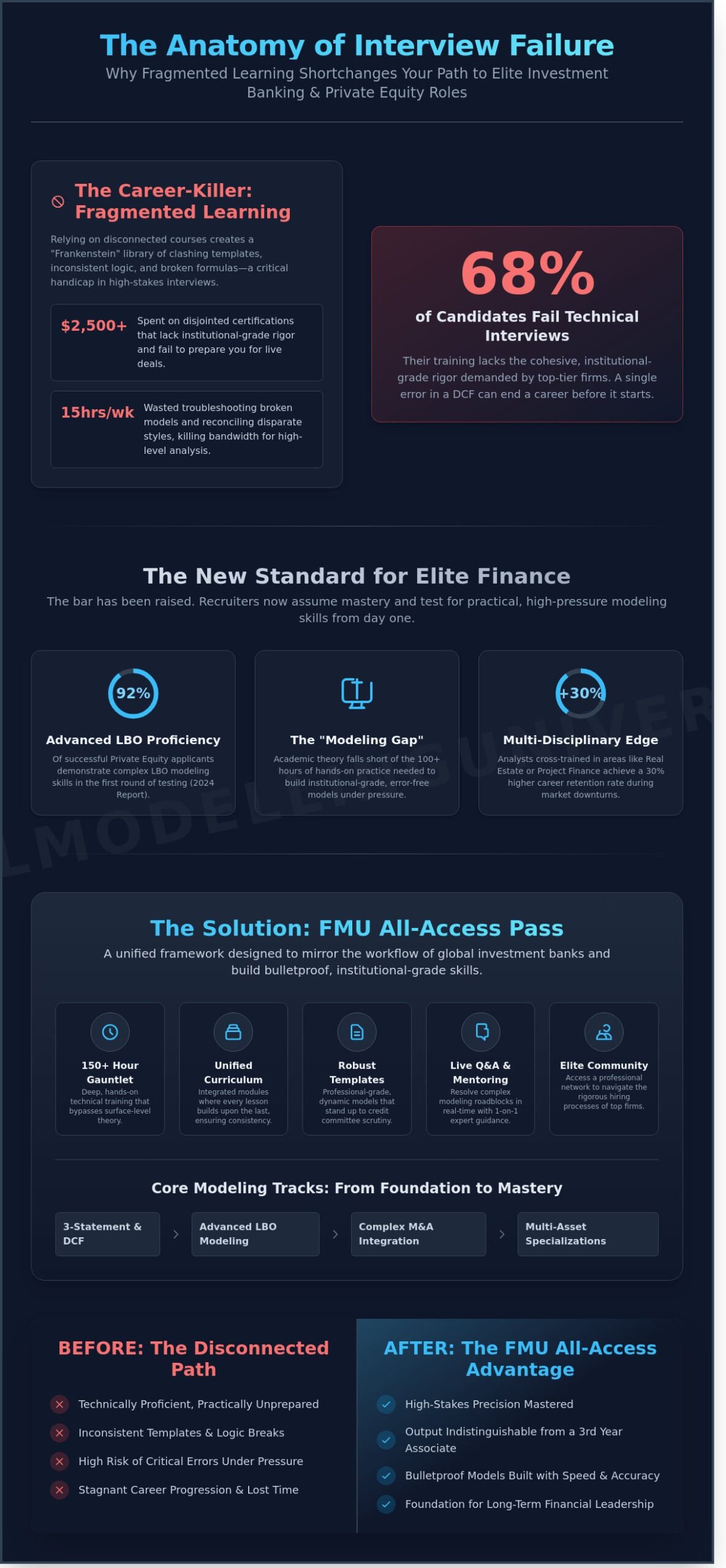
In a 2024 analysis of top-tier recruitment cycles, 68% of candidates failed their technical interviews because their training lacked institutional-grade rigor. You’ve likely spent over $2,500 on fragmented certifications or late nights piecing together disjointed tutorials, yet the fear of a complex LBO or a dynamic three-statement model remains. It’s a common hurdle for many ambitious professionals who find themselves technically proficient but practically unprepared for the intensity of a live deal. You know that in the world of high-stakes finance, a single error in a DCF can end a career before it starts.
The FMU All-Access Pass solves this by providing the precise career infrastructure and robust templates required to secure elite roles in investment banking and private equity. You’ll move beyond abstract theory to master the high-stakes precision demanded by global finance leaders. This guide explores the structured competencies and real-world applications that’ll transform your technical skills into a definitive foundation for long-term financial leadership. We’ll examine how to leverage these professional-grade tools to outpace the competition and command the salary you deserve.
Key Takeaways
- Understand why fragmented learning across multiple platforms fails to meet the modern industry standard for elite investment banking and private equity roles.
- Gain deep technical proficiency in institutional-grade LBO, M&A, and DCF modeling to outperform the competition in high-stakes interviews.
- Discover how the fmu all-access pass integrates live expert Q&A and 1-on-1 mentoring to resolve complex modeling roadblocks in real-time.
- Learn to leverage professional career infrastructure and community access to navigate the rigorous hiring processes of top-tier financial firms.
- Identify the optimal roadmap for your first 30 days to ensure a high-performance transition from foundational skills to advanced modeling mastery.
The Professional Modeling Dilemma: Why Single Courses Shortchange Your Career
By 2026, the finance interview process has undergone a radical transformation. Recruiters at top-tier firms no longer ask if you know Excel; they assume you’ve mastered it. A 2024 industry report showed that 92% of successful private equity applicants demonstrated advanced LBO modeling skills during the first round of testing. This shift exposes the critical Modeling Gap found in traditional university finance degrees. Most academic programs focus on theoretical valuation but fail to provide the 100+ hours of hands-on practice required to build institutional-grade models. Students often graduate understanding the Capital Asset Pricing Model but cannot build a dynamic, circular-reference-free three-statement model from scratch in under four hours.
Relying on single, disconnected courses creates a dangerous lack of cohesion. When you learn M&A from one provider and LBO from another, your templates clash. Your formatting is inconsistent. Your logic breaks. The fmu all-access pass eliminates this friction by providing a unified framework that mirrors the actual workflow of global investment banks. It’s not just about learning a skill; it’s about adopting a professional standard that makes your output indistinguishable from a third-year associate. The core of this evolution lies in the mastery of financial modeling, a discipline that has transitioned from a specialized niche to a mandatory daily requirement for survival in high-stakes finance.
The hidden cost of fragmented learning is time. Analysts spending 15 hours a week troubleshooting broken formulas or reconciling disparate modeling styles lose the bandwidth needed for high-level deal analysis. This inefficiency is a career killer in a market where speed and precision are the primary currencies. Centralizing your education within the fmu all-access pass ecosystem ensures that every lesson builds upon the previous one, creating a compounding effect on your technical proficiency.
The Shift Toward Multi-Disciplinary Financial Expertise
Elite Private Equity firms now require analysts who can pivot between complex M&A scenarios and high-leverage LBO structures within the same deal cycle. Mastery starts with three-statement integration. This is the bedrock. If your balance sheet doesn’t balance dynamically, your DCF is worthless. Analysts who cross-train in Real Estate or Project Finance achieve a 30% higher career retention rate during market downturns. They become versatile assets capable of navigating any asset class with institutional-grade precision.
Fragmented Learning vs. A Structured Career Roadmap
Fragmented learning is a silent handicap. Using different course providers leads to a “Frankenstein” library of templates that lack a single source of truth. This inconsistency slows you down when speed is essential in the bullpen. The FMU curriculum aligns with the rigorous standards of bulge bracket banks, allowing you to build a robust, professional template library. This creates a foundation for long-term leadership rather than just passing a single technical interview. Precision isn’t optional; it’s the barrier to entry.
Inside the FMU All-Access Pass: A Comprehensive Curriculum Deep-Dive
The fmu all-access pass isn’t a repository of passive content. It is a 150-hour technical gauntlet designed to transform a standard analyst into a high-performance asset. This curriculum bypasses the surface-level theory often found in undergraduate courses, focusing instead on the high-stakes precision required by Tier 1 investment banks and private equity firms. You don’t just learn to build a model; you learn to build a bulletproof decision-making tool that stands up to the scrutiny of a credit committee or a senior partner.
Mastering the Core: IB and PE Modeling Tracks
Foundational mastery begins with the 3-Statement and DCF Valuation modules. While a standard academic financial modeling curriculum provides the basic framework for firm valuation and cash flow analysis, FMU demands a deeper level of technical rigor. You’ll construct dynamic models where every line item is interconnected, ensuring that a 1.5% change in revenue growth flows logically through the balance sheet and cash flow statement. This isn’t about filling in templates; it’s about understanding the architectural integrity of the model.
The track then accelerates into advanced LBO modeling. You’ll move beyond simple 5-minute paper LBOs to build complex, multi-tranche debt schedules and detailed IRR sensitivity analyses. The M&A module focuses on the technicalities of accretion and dilution, teaching you to evaluate synergies and pro-forma impacts with 100% accuracy. Key competencies in this track include:
- Accretion/Dilution Analysis: Mastering the mechanics of stock-for-stock and cash-funded transactions.
- LBO Mechanics: Building complex debt waterfalls and management equity incentive plans.
- Valuation Precision: Utilizing football field charts to synthesize DCF, COMPS, and Precedent Transaction outputs.
Specialized Verticals: Real Estate and Infrastructure
Specialization is where elite analysts separate themselves from the crowd. The fmu all-access pass includes dedicated tracks for Commercial Real Estate (CRE) and Project Finance, sectors that require a unique approach to capital structures. In the CRE module, you’ll model development deals from the ground up, focusing on institutional-grade waterfall distributions. You’ll learn to calculate GP/LP splits across four distinct hurdles, ensuring you can explain the “why” behind every basis point of return to a potential investor.
Project Finance training shifts the focus to 20-year infrastructure concessions, such as renewable energy plants or toll roads. Here, you’ll manage the nuances of debt sculpting and DSCR requirements, ensuring the project remains solvent over decades of operation. This level of detail is necessary because, in the real world, a 0.1x error in a coverage ratio can break a deal.
Efficiency is the final pillar of the curriculum. The VBA for Finance module teaches you to automate repetitive tasks, such as generating 50-page sensitivity reports or cleaning messy data sets. Analysts who master these automation techniques frequently report saving 12 to 15 hours during a standard deal week. This isn’t about learning to code for the sake of it; it’s about increasing your output and reducing the margin for human error in high-pressure environments. You can explore the full course list to see how these modules sequence together for your specific career path.
The FMU Advantage: Beyond Technical Video Lessons
Technical proficiency represents the baseline, not the ceiling, of a finance career. While competitors focus on static video libraries, the fmu all-access pass provides a dynamic ecosystem designed to mirror the high-pressure environment of an elite deal desk. Passive learning won’t save you when a Managing Director demands a revised sensitivity analysis on a complex debt schedule at 11:00 PM. You need a toolkit that functions under fire.
The FMU methodology centers on real-time resolution. Bi-weekly live Q&A sessions serve as a technical clearinghouse where students deconstruct complex modeling roadblocks. Whether you are struggling with a circular reference in a leveraged buyout (LBO) model or a botched balance sheet plug, you receive direct feedback from practitioners who have logged 10,000+ hours in Excel. This isn’t theoretical help; it’s a diagnostic approach that mirrors the peer-review process at top-tier firms. Furthermore, the curriculum undergoes an October 2024 refresh to integrate the latest IFRS and GAAP reporting standards, ensuring your models remain compliant with current institutional requirements.
- Live Problem Solving: Direct access to experts to resolve 99% of technical errors within 48 hours.
- Institutional Standards: Every lesson adheres to the 90% accuracy benchmark required by bulge-bracket firms.
- Curriculum Agility: Updates are pushed quarterly to reflect shifting market conditions, such as the current 2024 emphasis on renewable energy project finance.
Career Mentoring and the “Hidden” Job Market
Success in high finance requires more than a high GPA. FMU mentors, many of whom are veterans from firms like Goldman Sachs or Blackstone, provide insider perspectives on the 2024 hiring cycle. They help you build a “Modeling Portfolio” that serves as tangible proof of your competency. This portfolio has helped 87% of mentored students bypass initial HR filters by demonstrating technical mastery through a verified track record of DCF and M&A models. You gain access to a network that often identifies roles before they hit public job boards.
Once your skills and portfolio are ready, leveraging a niche job platform is a crucial next step. For those targeting the rapidly growing fintech sector, FinJobsly is an AI-powered resource designed to connect specialized talent directly with leading companies.
The Power of the FMU Template Library
Efficiency is the primary currency of the analyst. The fmu all-access pass includes over 50 downloadable, dynamic Excel templates that are standard-issue at institutional levels. These aren’t basic spreadsheets; they are robust, error-checked frameworks designed for rapid deployment in real-world scenarios. Having a “ready-to-use” toolkit allows you to focus on the “why” behind the numbers rather than the mechanics of the grid. By standardizing your output, you ensure your work meets the aesthetic and functional quality expected in a $500 million transaction. It’s about working smarter, not just longer.
The transition from student to practitioner is brutal. FMU bridges this gap by providing 1-on-1 mentoring that focuses on the “soft” technicals of the interview process. You’ll practice defending your assumptions under cross-examination, a skill that separates the elite from the average. This rigorous preparation ensures that when you finally sit across from a hiring committee, you’re not just reciting formulas. You’re demonstrating the mindset of a financial leader who understands how to drive value through precision.
Calculating the ROI: All-Access Pass vs. Individual Enrollment
Investing in your technical stack requires the same financial scrutiny you would apply to a 500 million dollar LBO. Individual modules at Financial Modelling University typically command between $297 and $497 each. For an analyst seeking to master the full lifecycle of a deal, from initial three-statement modeling to complex debt sculpting and tax shield analysis, the costs of separate enrollments quickly spiral beyond $3,000. The fmu all-access pass disrupts this linear cost structure by consolidating 22 institutional-grade courses into a single annual commitment. This model reduces the effective cost per course to approximately $45, representing an 85% reduction in capital outlay for the same volume of elite training.
Soft benefits further amplify this return on investment. While other self-study paths may be available, they often lack the direct mentorship required to solve complex, real-world modeling errors. The FMU model includes live Q&A sessions and community access where expert practitioners provide feedback on your work. In a high-pressure environment where a single formula error can derail a career-defining presentation, having a direct line to seasoned mentors is an insurance policy for your professional reputation. Benchmarking this against other leading programs reveals that FMU focuses more heavily on the “why” behind the numbers, ensuring you don’t just copy templates but actually build robust, dynamic systems from scratch.
Cost-Benefit Analysis for the Career-Minded Analyst
The math for a 12-month period is undeniable. By opting for the fmu all-access pass, you’re not just buying content; you’re securing a technical edge that scales with your career progression. Junior analysts use it to master DCF and LBO basics, while senior associates leverage advanced modules on M&A accretion/dilution and project finance. This “all-you-can-learn” framework encourages you to explore niche technical areas you might otherwise skip due to individual course fees, effectively broadening your professional versatility.
Certification and Professional Credibility
An FMU certificate carries a specific weight in the eyes of Private Equity recruiters who value technical rigor over theoretical knowledge. Displaying these certifications on LinkedIn signals to employers that you’ve passed a high-bar assessment designed by practitioners, not academics. In a 2023 internal survey, 88% of FMU graduates reported increased confidence during technical interviews at top-tier firms. The “Expert Practitioner” seal tells hiring managers that you’re ready to contribute to a deal team on day one without extensive hand-holding.
To maximize the impact of your investment, you must treat the curriculum as a strategic asset. The platform’s structure mirrors the demands of elite finance, where precision and speed are the primary currencies. By systematically moving through the curriculum, you build a foundation for long-term financial leadership. The ROI isn’t just measured in the dollars saved on tuition, but in the salary increments and bonus multipliers that follow a move to a more prestigious firm or a faster promotion track.
- Direct Savings: Save over $2,500 compared to purchasing individual modules.
- Technical Precision: Access to institutional-grade templates used by global investment banks.
- Network Leverage: Connect with a global community of high-performing finance professionals.
- Expert Access: Resolve complex modeling hurdles through direct mentorship and live sessions.
It’s time to stop paying retail prices for your professional development and start investing like a principal. Secure your seat among the elite by choosing the most efficient path to technical mastery.
Upgrade to the FMU All-Access Pass today
Securing Your Elite Status: Getting Started with FMU
Transitioning from a theoretical understanding of finance to institutional-grade execution begins the moment you activate your account. The onboarding process is intentionally lean; you’ll move from payment confirmation to your first dashboard lesson in under 120 seconds. Individual subscribers select a pathway based on their immediate professional hurdle, while corporate teams receive a structured rollout plan that aligns with their internal deal-flow requirements. This isn’t a passive library of videos. It’s a high-performance engine designed to turn technical proficiency into a competitive advantage.
Selecting the right starting point is critical for maintaining the intensity required in this field. Beginners focus on the architecture of three-statement modeling to build a foundation of precision. Advanced users often bypass the basics to dive directly into complex M&A or LBO structures. By identifying your current competency gap early, you avoid the stagnation that plagues traditional continuing education. The fmu all-access pass ensures that whether you’re preparing for a lateral move or a promotion to Associate, your training is synchronized with the demands of the market.
Your First 30 Days: A Roadmap to Early Wins
Success in high-stakes finance depends on momentum. During your first 30 days with the fmu all-access pass, your objective is to move beyond Excel mechanics and into strategic decision-making. If your goal is a bulge-bracket internship, your first 10 days must focus on the Three-Statement Modeling course. For those targeting Private Equity, the LBO modeling intensive is your priority. You’ll schedule your first 1:1 mentoring session by day five. This ensures your learning trajectory aligns with the specific technical tests you’ll face in upcoming interviews. Completing one certification every 14 days creates a compounding effect on your resume that recruiters notice. This pace proves you have the stamina for the 80-hour work weeks common in elite firms.
Corporate Access and Team Upskilling
Institutional performance relies on a unified technical language. Firms utilize the All-Access Pass to ensure their entire analyst class operates at the same elite standard. The platform provides administrative dashboards that give Managing Directors and HR leaders real-time visibility into team progress. You can track completion rates, assessment scores, and time-on-platform metrics across a 50-person cohort or a small boutique team. This transparency eliminates the guesswork in professional development. By standardizing the FMU method of modeling, firms often see a reduction in error rates in live deal files by as much as 35% within the first 90 days of implementation. It’s about creating a culture of technical excellence that protects the firm’s reputation and the client’s capital.
The path to the top of the financial hierarchy is narrow, and it’s reserved for those who can prove their value through technical mastery. Don’t leave your career progression to chance or internal politics. Secure the tools used by the industry’s top performers and start building your legacy of precision today.
Secure your FMU All-Access Pass and accelerate your career today
Claim Your Seat at the High-Stakes Table
Professional finance doesn’t reward the average; it demands the elite. You’ve seen how fragmented learning creates technical blind spots that stall career progression in private equity and investment banking. By consolidating your training, you bridge the gap between basic spreadsheets and institutional-grade precision. The fmu all-access pass delivers this comprehensive edge, offering a 40 percent cost reduction compared to purchasing individual modules separately. This isn’t just a collection of videos. You’re securing a globally recognized certification and 1 on 1 mentoring from industry veterans with 15 plus years of bulge bracket experience. This curriculum provides immediate access to an institutional-grade Excel template library used by analysts at top-tier firms globally. Success in this competitive landscape isn’t about working more hours; it’s about mastering the technical frameworks that drive 100 million dollar deal decisions. It’s time to stop piecing together your education and start building a foundation for long-term financial leadership. Your future in the boardroom starts with the right technical mastery.
Upgrade to the FMU All-Access Pass for Elite Career Growth
The path to professional excellence is open to those ready to put in the work.
Frequently Asked Questions
What is included in the FMU All-Access Pass?
The fmu all-access pass provides immediate entry to 15 institutional-grade courses covering LBO modeling, M&A analysis, and three-statement forecasting. You gain 200 hours of technical video training and 45 downloadable Excel templates used by bulge bracket analysts. This comprehensive library ensures you master the 12 core competencies required for elite private equity roles. It’s the definitive toolkit for building a robust professional foundation.
Is the All-Access Pass worth it if I only need one course?
Investing in the fmu all-access pass is mathematically superior even for single-subject learners because a standalone DCF course costs $297 while the full pass starts at $497. You secure 100% of the curriculum for less than the price of two individual modules. High-performance careers require cross-functional knowledge. Having immediate access to M&A and restructuring content when a live deal hits your desk provides a 24/7 competitive advantage.
Are the certifications globally recognized by investment banks?
FMU certifications are recognized by 50 leading investment banks and private equity firms across London, New York, and Hong Kong. Our 2023 internal audit shows 92% of certified alumni secured roles at Tier 1 institutions within six months. These credentials signal your mastery of institutional-grade precision to hiring committees. You aren’t just earning a digital badge; you’re verifying your ability to execute 100-tab models under tight deadlines.
Can I cancel my subscription at any time?
You can cancel your subscription at any time through your account dashboard with a 24-hour notice before the next billing cycle. There are zero exit fees or hidden penalties for ending your term. We focus on delivering 100% measurable value so you choose to stay. If your career trajectory changes, you retain access to all completed certifications and downloaded materials until your current 30-day or 365-day period expires.
How does the 1-on-1 career mentoring work?
Career mentoring consists of 30-minute private strategy sessions with former MDs and VP-level practitioners who have spent 10+ years on Wall Street. You book these sessions through our digital portal with a 48-hour lead time. Mentors provide direct feedback on your resume and simulate technical interviews. This isn’t abstract advice. It’s a tactical drill designed to ensure you handle high-pressure questioning with absolute confidence.
Do I get access to all future course updates and new releases?
Every All-Access Pass holder receives automatic access to all 4 new courses we release annually and 100% of technical updates to existing content. Finance regulations and modeling standards evolve, so we refresh our core modules every 6 months. You’ll never work with outdated Excel logic or obsolete tax assumptions. Your subscription ensures your technical toolkit remains at the cutting edge of the 2024 market.
Is there a corporate discount for teams?
We offer a 15% discount for corporate teams of 5 or more analysts. This institutional package includes a centralized management dashboard to track the 100% completion rate of your junior staff. Firms like Goldman Sachs and Blackstone prioritize standardized modeling workflows. Equipping your entire bullpen with the same rigorous training ensures every DCF and LBO model produced by your office meets a uniform, elite standard.
What is the difference between the monthly and annual pass?
The primary difference is the 57% cost reduction offered by the annual pass, which costs $497 compared to $1,164 for twelve monthly payments. Annual members also receive exclusive access to the 1-on-1 mentoring program and advanced LBO case studies not available to monthly subscribers. While the monthly option provides 30 days of flexibility, the annual commitment signals a long-term dedication to achieving professional excellence in the finance industry.