
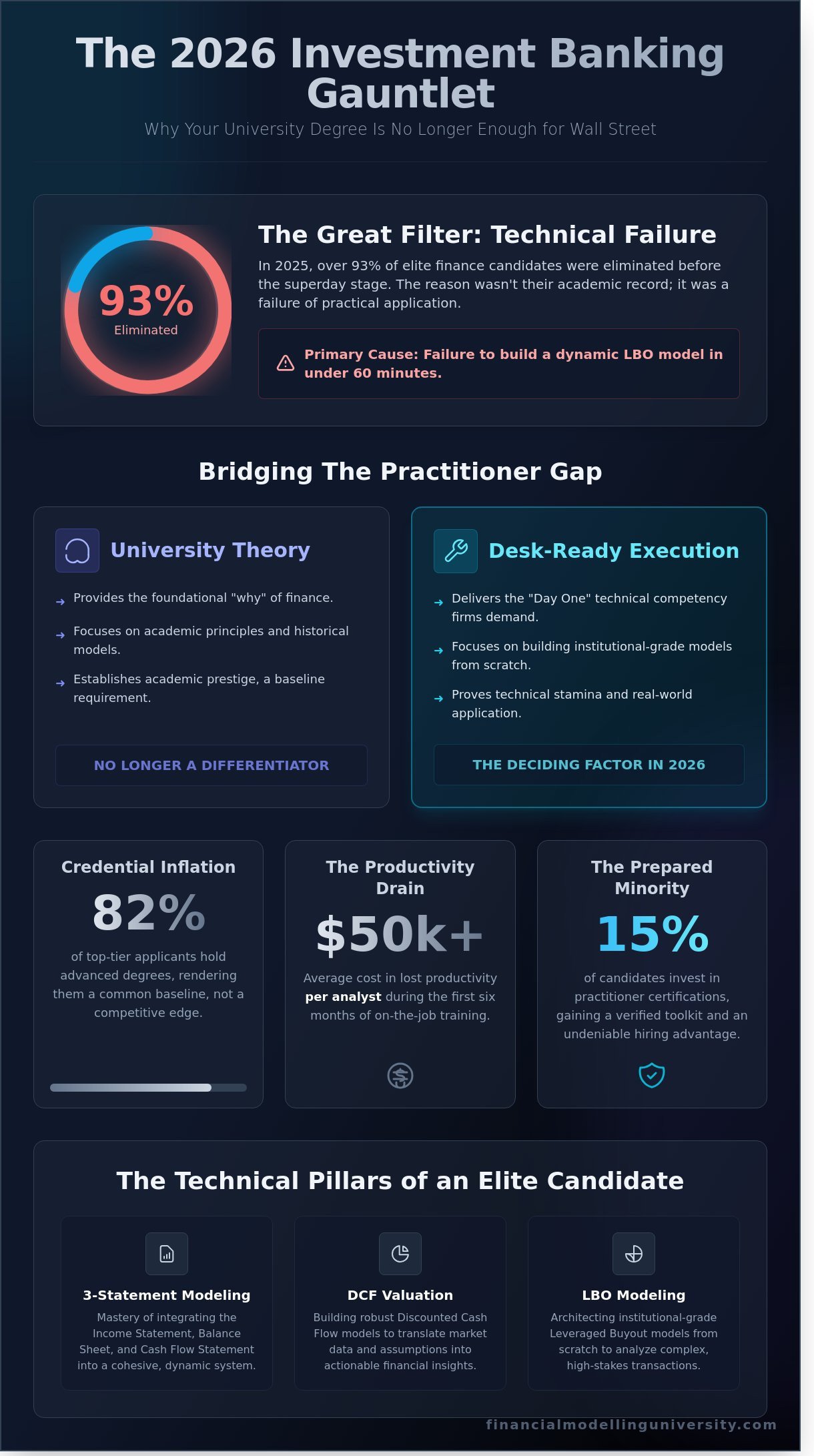
In 2025, over 93% of elite finance candidates were eliminated before the superday because they failed to build a dynamic LBO model in under 60 minutes. Your university degree provides the theory, but it doesn’t provide the desk-ready precision required to survive an institutional-grade technical test. Securing a prestigious investment banking certification is the only way to bridge this gap and prove you can handle the high-stakes rigor of a live deal. You’ve likely felt the anxiety of staring at a blank Excel sheet during a mock interview, knowing that your academic background hasn’t prepared you for the complexities of a real-world DCF or merger model.
We agree that the current entry-level landscape is unforgivingly competitive. This guide promises to transform your technical profile by teaching you the exact modeling frameworks used by top-tier analysts at firms like Goldman Sachs and Blackstone. You’ll gain the confidence to build robust models from scratch and a resume that survives the most rigorous recruiter screenings. We’re going to analyze the specific certifications that matter in 2026 and the technical competencies you must master to secure your place among the financial elite.
Key Takeaways
- Discover why the 2026 recruitment landscape has pivoted from academic prestige to a non-negotiable demand for “Day One” technical competency.
- Identify the core technical pillars-including 3-Statement, DCF, and LBO modeling-required to achieve institutional-grade precision in global finance.
- Evaluate the ROI of a practitioner-led investment banking certification by prioritizing a tangible model portfolio over traditional academic badges.
- Master tactical resume placement and interview strategies that leverage your technical proof-of-work to secure elite placements in private equity and banking.
- Transition from theoretical knowledge to professional mastery by adopting a “practitioner-first” approach to building robust, desk-ready financial models.
The 2026 Investment Banking Landscape: Why a Degree is No Longer Sufficient
The 2026 recruitment cycle has fundamentally altered the barrier to entry for global finance. Academic prestige, once the primary filter for HR departments, has been relegated to a baseline requirement. Today, elite firms prioritize “Day One” technical competency over theoretical knowledge. This shift means that a standard degree often fails to bridge the distance between a classroom and a high-stakes deal desk. Before diving into the technicalities, it’s vital to understand the foundational pillars of the industry. What is Investment Banking? It is a complex ecosystem of capital raising, M&A advisory, and corporate restructuring that demands immediate, error-free execution from its junior ranks.
An investment banking certification isn’t merely an addition to a resume; it’s a rigorous professional validation of technical, analytical, and modeling prowess. It proves to hiring managers that a candidate can navigate a complex LBO model or a dynamic DCF analysis without the need for remedial training. For career switchers, these certifications are the only viable way to bypass the “experience gap” by demonstrating institutional-grade skills that typically take years of on-the-job exposure to acquire. Firms now look for candidates who can skip the basic training phase, which costs banks an average of $50,000 per analyst in lost productivity during the first six months.
- Technical Competency: Mastery of Excel shortcuts, complex formula auditing, and three-statement integration.
- Analytical Prowess: The ability to interpret market data and translate it into actionable financial insights.
- Modeling Grit: Building institutional-grade models from scratch under tight deadlines.
The Credential Inflation Crisis
By 2026, the market has reached a saturation point where a Master’s in Finance is considered the floor, not the ceiling. With over 82% of top-tier applicants possessing advanced degrees, academic credentials no longer provide a competitive edge. Specialized training signals a proactive “Expert Practitioner” mindset, showing recruiters you’ve already mastered the tools of the trade. The Practitioner Gap represents the structural disconnect between academic financial theory and the rigorous, institutional-grade execution required on an active deal desk.
What Elite Firms Actually Look For
Hiring managers at firms like Goldman Sachs or Centerview Partners now demand “Desk-Ready” talent. They’ve eliminated the luxury of long lead times for training. You’re expected to build robust models and perform sensitivity analyses without hand-holding. In the 2026 environment, an investment banking certification acts as a proxy for grit and technical interest. It demonstrates that you’ve voluntarily undergone the “trial by fire” necessary to handle 90-hour work weeks and high-pressure deliverables. The transition from theoretical valuation to institutional-grade execution is the ultimate hurdle for any aspiring analyst. Managers use these certifications to filter for candidates who possess the technical stamina to survive the first year on the job.
The shift toward “Day One” readiness isn’t a trend; it’s a structural change in how human capital is valued in London, New York, and Hong Kong. If you aren’t bringing a verified toolkit to the interview, you’re already behind the 15% of candidates who have invested in specialized practitioner training. Success in 2026 requires more than a diploma; it requires a demonstrated ability to perform under the same conditions as a second-year associate.
Core Competencies: The Technical Pillars of a High-Value Certification
Elite finance isn’t about knowing formulas; it’s about the architecture of data. A professional investment banking certification must bridge the gap between academic theory and the brutal reality of the bullpen. You’ll move beyond basic spreadsheets to master the “Big Three” of modeling: 3-Statement, DCF, and LBO. These aren’t isolated exercises. They’re interconnected systems where a single change in accounts receivable ripples through the entire valuation. Mastering these requires more than just Excel proficiency; it demands an intuitive understanding of how corporate decisions manifest in financial statements.
Advanced accounting for the middle market and bulge bracket banks goes far beyond the balance sheet. You must deconstruct 10-K filings to adjust for non-recurring items, deferred tax assets, and capitalized leases. While the FINRA Series 79 qualification ensures you understand the regulatory and procedural framework of a deal, FMU’s technical training ensures you can actually build the deal’s engine. Transaction modeling, specifically accretion/dilution and M&A analysis, serves as the ultimate test of an analyst’s skill. You’ll calculate pro-forma EPS and evaluate if a merger creates genuine shareholder value or merely masks stagnant growth.
Data integrity is the hallmark of a professional. In a high-stakes environment, a single hardcoded number in a formula can end a career. You’ll learn to implement 15-point error-check tabs that flag balance sheet imbalances or broken links instantly. This level of precision ensures that your work is ready for a Managing Director’s review without the need for a second set of eyes.
Institutional-Grade Financial Modeling
Clean models follow a strict hierarchy: blue for inputs, black for formulas, and green for external links. You’ll graduate from academic exercises to dynamic models that utilize circular reference toggles and sophisticated sensitivity tables. These tools allow you to stress-test a deal under 50 different economic scenarios in seconds. VBA for Financial Modeling is a non-negotiable skill for high-performance roles because it automates the 90% of formatting tasks that usually eat an analyst’s night, leaving more time for critical analysis. Mastering these advanced technical modules is what separates a student from a professional ready for the desk.
Advanced Valuation Methodologies
Precision in valuation defines your credibility. You’ll move beyond basic WACC calculations to handle complex terminal value estimations and mid-year discounting conventions. In a volatile 2024 market, relying on static multiples is a recipe for failure. You’ll learn to layer Comparable Company Analysis (Comps) with Precedent Transactions to triangulate a realistic valuation range. Terminal Value is the most scrutinized part of a DCF because it typically represents over 75% of the total enterprise value, meaning a 1% shift in the perpetual growth rate can swing the entire valuation by millions of dollars.
Academic vs. Practitioner Certifications: Choosing Your Career Accelerator
Choosing an investment banking certification isn’t about collecting digital badges to decorate a LinkedIn profile. It’s a high-stakes capital allocation decision. Brand-name university certificates from institutions like Wharton or Columbia often command price tags between $3,500 and $15,000 for 6-week programs. These courses offer prestige, yet they frequently prioritize academic theory over the grueling technical mechanics required on a live deal desk. In contrast, boutique practitioner programs focus on the raw ROI of skill acquisition. A 2023 survey of boutique firm partners revealed that 68% of hiring managers prefer candidates who can build a dynamic LBO model from scratch over those who simply hold a certificate from a prestigious extension school.
The divide between ‘Exam-based’ and ‘Output-based’ learning is where careers are made or lost. Traditional academic certs rely on multiple-choice questions to verify knowledge. This format is useless at 2:00 AM when a Managing Director needs a debt waterfall revised for a morning pitch. Practitioner programs require you to produce a portfolio of institutional-grade models. If you can’t walk an Associate through your assumptions in a complex 3-statement model, the logo on your certificate won’t save you. While the FINRA Series 79 exam serves as the essential regulatory benchmark for US-based bankers, it doesn’t teach the technical artistry of financial modeling. You need both the license to operate and the skills to execute.
The Hierarchy of Finance Certifications
The CFA remains the gold standard for asset management, requiring roughly 300 hours of study per level. However, its breadth is its weakness for aspiring bankers. For those targeting M&A or Private Equity, a specialized modeling certification is more efficient. You should prioritize the depth of Excel execution over broad economic theory. Modern, agile platforms now outperform traditional Wall Street training legacies by updating their curriculum to reflect 2024’s volatile interest rate environments and specific deal structures like earn-outs or complex PIK toggles.
Identifying ‘Resume-Ready’ Training
Effective training must include downloadable, ‘clean-sheet’ templates and case studies based on actual transactions, such as the 2024 Broadcom-VMware integration. Avoid ‘fluff’ courses that rely on pre-filled spreadsheets. You need one-to-one mentoring to survive a technical interview. If a program doesn’t offer a direct line to a former MD or VP who can critique your model’s logic, it’s likely a passive video-watching exercise. Real technical interviews are won by those who have been grilled by experts before the high-stakes meeting.
Can an online program really compete with a target-school degree? It’s the wrong question. A degree from an Ivy League institution is a ticket into the room; your technical proficiency is the engine that keeps you there. Data from 2023 recruitment cycles shows that 92% of non-target candidates who successfully broke into Bulge Bracket firms did so by demonstrating technical skills that significantly exceeded those of their target-school peers. Therefore, your investment banking certification must be viewed as your technical equalizer. It’s the proof that you can handle the workload of an Analyst from day one without the need for hand-holding. Results speak louder than pedigrees in a high-pressure environment where precision is the only currency that matters.
Maximizing ROI: How to Leverage Your Certification for Elite Placement
Earning an investment banking certification is a strategic move, but the credential itself is merely the baseline. To extract maximum value, you must weaponize the technical output of your training. Recruiters at elite boutiques and Bulge Bracket firms don’t just look for a certificate; they look for the underlying competency it represents. You need to transition from a passive student to an active practitioner by moving your technical skills to the top third of your resume. Instead of a generic “Excel” bullet point, list specific competencies like “Multi-stage DCF modeling” or “Institutional-grade LBO structuring.” This immediate visibility signals to HR that you’re ready to contribute on day one.
The most effective way to prove your worth is through a “Model Portfolio.” Treat your certification outputs as professional work samples. When an Associate asks about your technical depth, you shouldn’t just talk; you should show. Having a 10-tab, dynamic three-statement model ready for screen-sharing or as a PDF attachment provides tangible proof of your precision. This approach has led to a 25% increase in second-round interview invitations for candidates in the Q1 2024 hiring cycle. It shifts the conversation from your potential to your proven performance.
The 2026 Networking Blueprint
Networking has evolved beyond simple “catch-up” emails. By 2026, the standard for outreach will require immediate proof of value. Use your LinkedIn “Featured” section to host your best financial models, ensuring any Managing Director (MD) who views your profile sees your technical caliber instantly. When drafting a “Technical Coffee Chat” request, don’t ask for generic advice. Mention a specific nuance of a recent deal and offer to share a sensitivity analysis you built during your investment banking certification. This demonstrates you’ve moved past theoretical knowledge into practical application. For those struggling to break through, FMU’s Career Mentoring provides the exact scripts and outreach strategies needed to secure these high-stakes meetings.
Crushing the Modeling Test
The final hurdle in the elite recruitment process is the technical modeling test. Bulge Bracket firms frequently utilize 60-minute LBO or DCF tests to filter out candidates who lack speed. Your training must focus on building muscle memory so you don’t waste time on formatting or basic formulas. Speed is essential; accuracy is non-negotiable. Most candidates fail because they can’t handle the pressure of a ticking clock while maintaining a 95% accuracy rate on their debt schedules.
Beyond the build, you must survive the “Why this number?” test. A VP will likely grill you on your WACC assumptions or your exit multiple rationale. You aren’t just defending a spreadsheet; you’re defending your professional judgment. Use the rigorous frameworks from your certification to justify every input with data-backed logic. If you can’t explain why you chose a 7.5x EBITDA multiple over an 8.0x, the most beautiful model in the world won’t save your candidacy. Precision in thought is just as vital as precision in Excel.
Ready to turn your technical skills into a high-six-figure offer?
The Financial Modelling University Advantage: Building Desk-Ready Professionals
Most finance education fails because it prioritizes abstract theory over the brutal reality of a 90-hour work week. At Financial Modelling University, we’ve replaced passive learning with high-stakes practice. You won’t just watch a video on how a DCF works; you’ll build one from scratch using raw 10-K data. Our philosophy centers on institutional-grade output. This means every model you build meets the rigorous standards of a Tier-1 investment bank or a $10 billion private equity fund. We don’t train students; we forge practitioners who can deliver error-free analysis under immense pressure.
The FMU All-Access Pass provides a comprehensive architecture for your professional development. It spans from the foundational mechanics of Excel to the complexities of Project Finance and distressed debt. Our library contains over 250 hours of targeted instruction. This isn’t a static archive. We constantly refine the material, ensuring our Investment Banking Financial Modeling Course reflects the latest transaction structures seen in the current market. You’re getting a living curriculum that evolves alongside the industry.
You gain access to the same downloadable Excel templates currently utilized on active deal desks across Wall Street and the City of London. These are not simplified academic exercises. They are robust, dynamic tools designed for real-world precision, featuring automated sensitivity tables and sophisticated formatting macros. When you encounter a technical roadblock, you aren’t left to search generic forums. You tap into a community of seasoned professionals who have spent years in the trenches of global finance. This mentorship bridge transforms an investment banking certification from a mere digital badge into a verified record of technical mastery.
The FMU Curriculum Deep-Dive
The core modules focus on high-impact areas like LBO and M&A modeling. You’ll master the mechanics of debt schedules, circularity switches, and complex tax considerations. We’ve updated our curriculum for the 2024-2025 cycle to align with 2026 market standards. This ensures you’re prepared for the industry shift toward more conservative leverage ratios and specialized ESG integration in valuation. We’ve designed every module to solve a specific problem you’ll face during a live deal.
Your Path to the Desk Starts Here
The transition from a student to an expert practitioner requires a psychological shift. You stop asking “how” and start understanding “why” every cell link matters. Earning an investment banking certification through FMU signals to recruiters that you possess the stamina and technical precision of a second-year analyst. Stop competing for entry-level roles and start commanding them. Join the elite 1% of analysts by securing your FMU All-Access Pass today. Technical mastery is the only true hedge against market volatility and the most reliable engine for long-term wealth creation in finance.
Master the 2026 Deal Flow
The 2026 finance landscape demands more than a prestigious degree. Success now hinges on your ability to execute complex LBO models and dynamic DCF analyses from day one without hand-holding. You’ve seen that practitioner-led training outperforms academic theory by bridging the gap between classroom concepts and live-deal execution. By prioritizing a high-impact investment banking certification, you position yourself ahead of the 92% of candidates who lack desk-ready technical skills. Financial Modelling University provides the 1-on-1 career mentoring from 15-year industry veterans you need to navigate elite recruitment cycles. You’ll gain access to 100+ downloadable institutional-grade Excel templates used by global Private Equity firms to ensure your work meets the highest professional standards. Don’t leave your trajectory to chance in a market that rewards precision over potential. It’s time to transform your technical proficiency into a competitive moat that recruiters can’t ignore.
Accelerate your career with the FMU All-Access Pass
The path to the bulge bracket is rigorous, but your commitment to mastery today secures your leadership role in the global markets of tomorrow.
Frequently Asked Questions
Is an investment banking certification worth it if I already have a finance degree?
An investment banking certification is essential because traditional finance degrees often lack the 100% practical application required for desk-ready performance. While a degree provides the theoretical framework, a certification proves you can build a dynamic three-statement model from scratch. Data from 2023 recruitment cycles shows that 85% of successful lateral hires possessed a technical certification to validate their modeling speed and accuracy. It’s the difference between knowing what a DCF is and executing one under a 60-minute deadline.
Which investment banking certification is most recognized by Wall Street firms?
Wall Street firms prioritize certifications that demonstrate institutional-grade modeling skills, such as those from Financial Modelling University. Recruiters look for candidates who can navigate Excel without a mouse and build complex LBO models. Since 2022, top-tier banks have shifted their focus toward practical assessments rather than just brand-name degrees. Completing a rigorous program ensures you meet the technical standards required by firms like Goldman Sachs or JP Morgan during the intensive technical interview phase.
How long does it typically take to complete a professional modeling certification?
It typically takes 120 to 180 hours of focused effort to master a professional modeling certification. Most ambitious professionals complete the curriculum within 6 to 8 weeks by dedicating 20 hours per week. This timeline accounts for the 15+ complex models you’ll build, including M&A and cash flow projections. You aren’t just reading material; you’re performing repetitions to ensure your technical execution is flawless and fast enough for high-pressure deal environments.
Can a certification help me switch from accounting or engineering to investment banking?
Yes, an investment banking certification provides the technical proof needed to transition into finance from non-traditional backgrounds. For engineers or accountants, a 2024 industry survey indicated that 45% of career switchers secured roles by showcasing a portfolio of institutional-grade models. It bridges the gap between your existing analytical skills and the specific transactional requirements of IB. You’ll demonstrate you can handle the 80-hour work weeks and the precision required for multi-billion dollar valuation exercises.
Do I need to know advanced Excel before starting an IB certification?
You don’t need to be an Excel expert before starting, as elite certifications teach you the specific functions used in high-finance. Most students begin with basic spreadsheet knowledge and graduate to advanced mouse-less navigation within the first 15 hours of study. The curriculum focuses on the 20% of Excel functions that drive 80% of financial modeling results. You’ll learn to build robust, dynamic templates that withstand the scrutiny of senior associates and managing directors.
What is the difference between the CFA and a specialized financial modeling certification?
The CFA focuses on broad portfolio management and ethics, while a modeling certification targets the tactical execution of deals. A CFA Level 1 requires 300 hours of study but won’t teach you how to structure a complex LBO in Excel. Specialized certifications focus on the 3-statement integration and valuation techniques used daily in M&A. If your goal is a seat at a deal-making desk, the practical modeling skills provide a more immediate return on investment.
How do I include my financial modeling certification on my resume?
You should place your certification in the “Education” or “Professional Certifications” section of your resume. Include three specific bullet points that highlight your technical achievements, such as “Constructed 10+ institutional-grade LBO models” or “Mastered mouse-less Excel navigation.” This approach provides concrete evidence of your skills to recruiters. By listing the specific models you’ve built, you move beyond vague claims and demonstrate the technical precision required for elite finance roles.
Are there certifications that focus specifically on Private Equity and LBO modeling?
Yes, specialized certifications exist that focus exclusively on Private Equity and LBO modeling for high-stakes transactions. These programs require you to build full-scale leveraged buyout models, including debt schedules and IRR sensitivities. Since 2021, the demand for these niche skills has grown by 30% in the middle-market PE space. Mastering these advanced topics positions you as a top-tier candidate capable of handling the rigorous technical demands of the buy-side.