

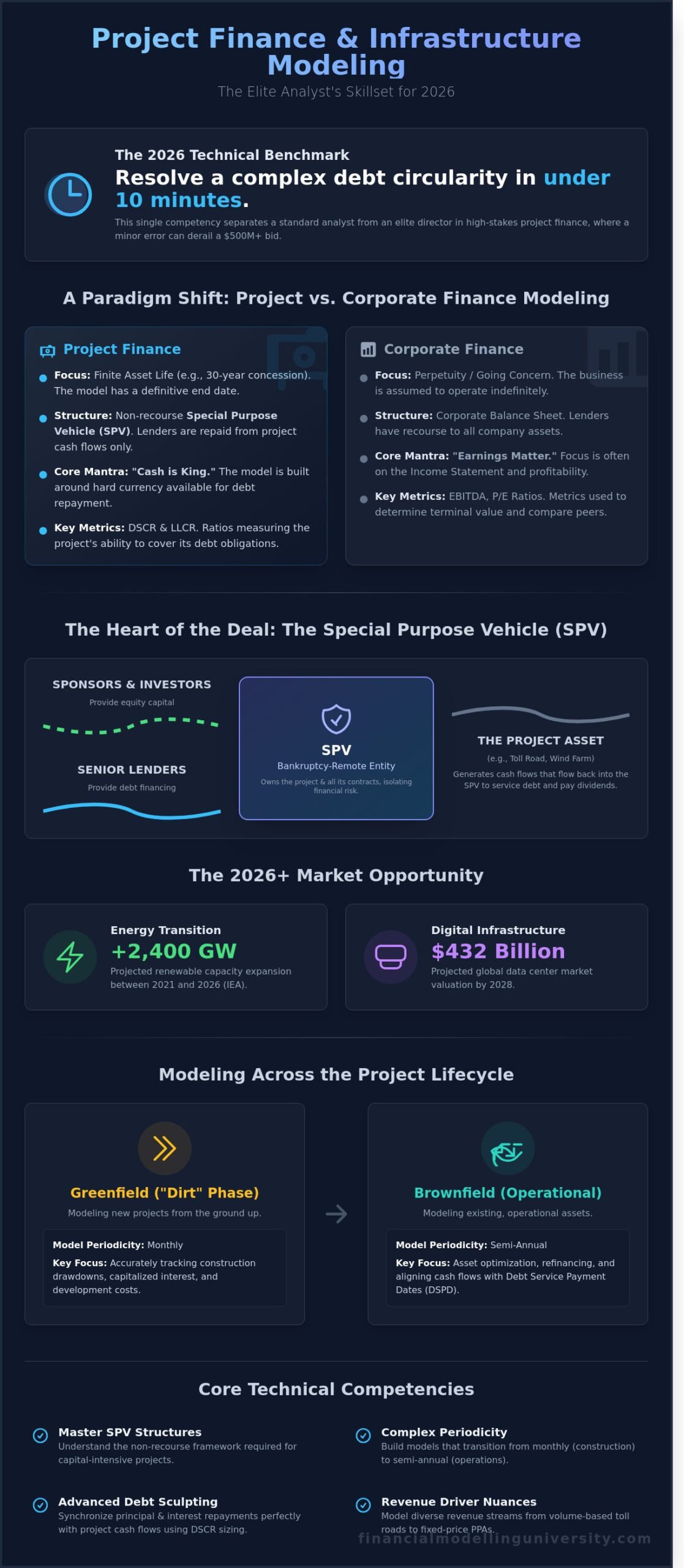
In 2026, the technical gap between a standard analyst and an elite director is defined by a single competency: the ability to resolve a complex debt circularity in under 10 minutes without breaking the model’s integrity. You understand that project finance & infrastructure modeling is a high-stakes discipline where a minor error in SPV accounting logic can derail a $500 million concession bid. It’s a field where 30-year projections require more than just Excel proficiency; they demand a rigorous, institutional-grade architecture that stands up to the scrutiny of global lenders.
You’ve likely felt the frustration of manual debt sculpting or the uncertainty that comes with modeling multi-decade infrastructure assets. This guide changes that. You’ll learn to build deal-ready models from the ground up, mastering the advanced DSCR sizing and debt structuring techniques used by top-tier private equity firms. We’ll examine the specific mechanics of the SPV framework and provide a clear path toward earning a recognized certification that accelerates your career mobility in the elite finance market.
Key Takeaways
- Distinguish between standard corporate finance and the specialized non-recourse SPV structures required for high-stakes, capital-intensive projects.
- Build the technical foundation for project finance & infrastructure modeling by mastering complex periodicity and revenue drivers like Availability Payments.
- Master advanced debt sculpting and sizing strategies to ensure principal and interest repayments are perfectly synchronized with project cash flows.
- Learn to navigate the unique modeling challenges of the project lifecycle, from greenfield “dirt” construction to brownfield asset optimization.
- Align your technical proficiency with the demands of the 2026 energy transition to secure your status as an elite practitioner in the global market.
What is Project Finance & Infrastructure Modeling?
Mastering project finance & infrastructure modeling is the definitive threshold between standard accounting and high-stakes financial engineering. At its core, this discipline involves the granular projection of cash flows for massive, capital-intensive assets such as toll roads, offshore wind farms, and fiber-optic networks. Unlike traditional corporate analysis, this process relies on a non-recourse or limited-recourse structure. To understand the foundational mechanics, one must look at What is Project Finance & Infrastructure Modeling? as a method where lenders rely primarily on the project’s specific revenue stream for repayment rather than the general credit of the sponsors.
Infrastructure stands as a unique asset class because of its defensive characteristics. These projects typically operate under long-term contracts, often spanning 20 to 40 years, which provide highly predictable, inflation-linked cash flows. The 2026 market environment is currently being reshaped by two massive tailwinds. First, the International Energy Agency projects that renewable capacity will expand by over 2,400 gigawatts between 2021 and 2026. Second, the global data center market is accelerating toward a projected valuation of $432 billion by 2028. For a modeler, this means the complexity of the inputs is rising; you aren’t just forecasting prices, you’re modeling intricate regulatory subsidies and power purchase agreements.
The Role of the Special Purpose Vehicle (SPV)
The Special Purpose Vehicle, or SPV, functions as the legal and financial heartbeat of every deal. It’s a bankruptcy-remote entity created solely to own the project. This structure ensures risk isolation; if the project fails, the lenders can’t seize the sponsor’s other assets. In your model, the SPV is the “box” where all cash flows reside. It manages the complex web of contracts between the engineering firm, the operators, the off-takers, and the senior lenders. Precise modeling requires tracking how every dollar flows through this entity, ensuring that tax obligations and operating expenses are met before a single cent reaches the debt providers or equity investors.
Project Finance vs. Corporate Finance Modeling
The shift from corporate to project finance requires a total recalibration of your analytical framework. In corporate finance, you’re often focused on the Income Statement and P/E ratios to determine a terminal value based on perpetuity. Project finance ignores these metrics. Here, the asset has a finite life, usually dictated by a concession agreement or a land lease. When the contract ends, the value often reverts to zero or a nominal salvage amount. Your model must reflect this “ticking clock” by focusing on the debt repayment profile over a specific tenor.
In this environment, “cash is king” isn’t a cliché; it’s a technical requirement. The primary metric is Cash Flow Available for Debt Service (CFADS). Unlike EBITDA, which can be manipulated by non-cash items, CFADS represents the hard currency available to satisfy lenders. You’ll spend your time calculating the Debt Service Coverage Ratio (DSCR) and the Loan Life Coverage Ratio (LLCR) to ensure the project can withstand a 15% or 20% downside sensitivity in revenue without defaulting. This level of precision is what protects capital and secures your reputation as an elite practitioner in the field.
Core Mechanics: Building the Infrastructure Financial Model
The architecture of an elite model relies on the interaction between debt sizing and the underlying asset’s cash flow profile, a process central to project finance & infrastructure modeling. You’ll structure the construction phase in monthly blocks to track drawdowns and capitalized interest with total accuracy. Once operations commence, the periodicity often shifts to semi-annual periods to align with the Debt Service Payment Dates (DSPD) found in institutional credit agreements. Understanding the Core Mechanics: Building the Infrastructure Financial Model requires a grasp of how these timelines interface with complex 20-year revenue contracts and statutory tax depreciation schedules.
Revenue Drivers in Infrastructure
Revenue modeling is not a “one size fits all” exercise. For toll roads, you’re modeling volume risk where a 5% drop in traffic can breach a 1.20x Debt Service Coverage Ratio (DSCR) covenant. Conversely, renewable energy projects often utilize Power Purchase Agreements (PPAs) that fix the price for 15 years, shifting the focus to resource availability and curtailment risk. You must account for inflation indexing; most institutional-grade models apply a 2.0% or 2.5% CPI adjustment to availability payments to protect real returns against rising O&M costs.
By 2026, government subsidies like the Inflation Reduction Act’s 30% Investment Tax Credit (ITC) will be the primary driver for project IRR in the North American market. These incentives aren’t just “extra” cash; they’re structural components that determine the maximum leverage a project can support. Mastering these nuances is what separates a junior analyst from a lead associate. Building a professional-grade infrastructure model is the only way to demonstrate this competency to senior stakeholders in a high-stakes environment.
Operating and Maintenance (O&M) Costs
Operating expenditures in infrastructure are characterized by their long-term predictability and their sudden, lumpy capital requirements. Fixed O&M costs, such as site security and base insurance premiums, are straightforward. However, the real technical challenge lies in modeling the Major Maintenance Reserve Account (MMRA). You’ll need to project lifecycle Capex for events like turbine overhauls or road resurfacing that occur every 7 to 10 years. These aren’t just expenses; they’re cash flow diversions that sit senior to equity distributions and are often mandated by lenders to ensure asset integrity.
Managing the transition from the EPC (Engineering, Procurement, Construction) phase to operations is equally critical. The model must handle the “handover” where construction debt is termed out or refinanced into long-term tranches. Precision here prevents the common mistake of double-counting cash flows during the first quarter of operations. This requires a robust set of flags and switches to ensure the model remains dynamic as the project moves through its lifecycle.
By 2026, the integration of ESG metrics will move from a qualitative “nice-to-have” to a quantitative necessity in project finance & infrastructure modeling. You’ll need to model carbon intensity penalties and green bond margin ratchets, where a 10 basis point reduction in interest rates is tied to specific sustainability KPIs. This level of technical rigor is the foundation for any successful career in project finance. Your ability to quantify these risks is your professional moat.
Advanced Debt Sculpting and Sizing Strategies
In project finance & infrastructure modeling, debt isn’t just a static line item; it’s a precision-engineered instrument. Unlike corporate lending where debt is often a fixed multiple of EBITDA, infrastructure deals rely on debt sculpting. This process aligns principal and interest payments with the Cash Flow Available for Debt Service (CFADS). If a 500MW solar farm generates lower revenue during winter months, the repayment schedule must contract accordingly to maintain a target DSCR. This flexibility ensures the project doesn’t default during predictable seasonal dips.
Lenders typically demand a Debt Service Reserve Account (DSRA) to mitigate liquidity shocks. This reserve usually covers 6 months of principal and interest. Funding for the DSRA often occurs via the first drawdown or through a cash trap mechanism during the initial 12 months of operations. For structural benchmarks and market standards, the Guide to Infrastructure Financing provides a comprehensive framework for these non-recourse arrangements. In these deals, the project’s assets are the sole collateral. This means covenant testing, such as a 1.15x or 1.20x minimum DSCR, is the only shield for the lender against project volatility.
Solving Circularities in Excel
Circular references are the enemy of a robust model. Interest during construction (IDC) and fee calculations create loops because the debt amount funds the interest, which then increases the total debt required. While algebraic solutions work for simple structures, institutional-grade project finance & infrastructure modeling utilizes “Copy-Paste” macros. These macros break the loop by pasting values until the model converges. This ensures audit-readiness and prevents the Excel “Circular Reference” warning from compromising the model’s integrity during a high-stakes negotiation.
Key Credit Metrics: DSCR, LLCR, and PLCR
The Debt Service Coverage Ratio (DSCR) is the primary metric for debt sustainability in PF. While the DSCR looks at a specific period, the Loan Life Coverage Ratio (LLCR) provides a macro view. It measures the Net Present Value (NPV) of CFADS over the remaining loan term divided by the outstanding debt balance. A 1.40x LLCR suggests a comfortable margin for the lender over the life of the facility. If the LLCR drops below 1.10x, the project enters a high-risk zone for technical default.
The Project Life Coverage Ratio (PLCR) extends this analysis to the entire concession period, including the “tail” period after the debt is repaid. A PLCR significantly higher than the LLCR indicates a valuable residual period, providing a 15% to 25% cushion that can support refinancing or restructuring if the project hits turbulence. Professional modelers use these ratios to stress-test the deal’s resilience against a 10% increase in O&M costs or a 5% drop in availability payments.
Greenfield vs. Brownfield: Adapting Models to Project Lifecycle
Greenfield assets demand a ground-up build. You’re modeling a 24 to 36-month construction window before a single dollar of revenue arrives. Mastery of project finance & infrastructure modeling requires knowing when to pivot from a CAPEX-heavy construction schedule to a stabilized operational yield model. The risk profile shifts the moment the first commercial operation date (COD) is reached. While Greenfield projects target 15% to 20% internal rates of return (IRR) to compensate for construction uncertainty, Brownfield assets prioritize yield and cash flow durability. Modeling these stages isn’t just about changing inputs; it’s about shifting the entire valuation logic from a Discounted Cash Flow (DCF) focus to a yield-based pricing approach.
In the renewables sector, the 2023 Inflation Reduction Act (IRA) changed how we model the “flip” in tax equity structures. You must account for the transition where the tax equity investor receives 99% of tax benefits until a pre-defined IRR, often 7% to 10%, is met. After this point, the equity allocation flips, usually to a 5% share for the tax partner. Precision is mandatory. A 1% error in the flip date calculation can destroy the sponsor’s equity return. Use a monthly periodicity during the first five years of operations to capture these nuances accurately.
Modeling the Construction Phase (Greenfield)
The construction phase is a battle of liquidity management. Your Sources and Uses table must remain in balance at every calculation step. If a $500 million project faces a 10% cost overrun, the model must automatically trigger a proportional draw on the equity bridge loan or the contingency reserve. Key components include:
- Interest During Construction (IDC): This is non-cash interest that capitalizes into the project cost. It’s a circular reference that requires a robust macro or a dedicated calculation block to solve without crashing the model.
- Commitment Fees: Model these as a percentage of the undrawn debt balance, typically 0.5% to 1.0%, to ensure the financing cost is fully loaded.
- Contingency Planning: Hard-code a 5% to 10% contingency buffer into the CAPEX schedule. This acts as the first line of defense against inflationary pressure in 2024 material costs.
Brownfield Acquisition and Refinancing
Brownfield deals are about optimization and the exit. Infrastructure funds often realize value by acquiring an asset at a 12% discount rate and selling it at an 8% exit yield once the operational history is proven. This “yield compression” is the primary driver of value in project finance & infrastructure modeling for mature assets. You aren’t modeling “dirt” anymore; you’re modeling a 20-year annuity.
Refinancing is the most powerful lever for improving the IRR in a Brownfield scenario. Since the Q1 2024 stabilization of interest rates, many sponsors are modeling a refinancing event in Year 5. By replacing expensive construction debt with lower-cost institutional bonds, you can execute a dividend recapitalization. This allows the sponsor to pull 30% to 50% of their initial equity out of the project early. It’s a high-stakes move that requires a deep understanding of debt sculpted to a 1.20x Debt Service Coverage Ratio (DSCR).
Accelerating Your Career with FMU’s Project Finance Certification
By 2026, the global energy transition will require an estimated $4.5 trillion in annual infrastructure investment according to the International Energy Agency. This capital influx creates a massive talent gap for professionals who possess elite technical skills. You don’t just need to know Excel; you must master project finance & infrastructure modeling at an institutional level to survive in this high-stakes environment. Financial Modelling University (FMU) delivers a curriculum that mirrors the exact workflows found in Tier-1 investment banks and global infrastructure funds. We provide the technical rigor required to move from a back-office support role to a lead deal-structuring position.
Our training focuses on the “why” behind every formula. You’ll learn from seasoned practitioners who’ve closed multi-billion dollar deals, not from career academics. We provide downloadable, audit-ready Excel templates that follow the strictest international modeling standards. These assets aren’t just educational tools. They’re professional-grade foundations you can deploy immediately in your next transaction. By mastering these frameworks, you ensure your models are transparent, scalable, and capable of withstanding the most aggressive third-party audits.
Beyond the Spreadsheet: Strategic Deal Structuring
Mastery of project finance & infrastructure modeling allows you to move beyond data entry and into the role of a strategic advisor. You’ll learn to use models to negotiate better terms with lenders and sponsors by quantifying risk in real-time. We emphasize sophisticated scenario analysis, such as stress-testing P50 versus P90 energy production outcomes in renewable projects. A robust model serves as a dynamic negotiation lever that quantifies the financial impact of every term sheet clause during live deal discussions. This capability turns a technical analyst into a vital asset during the closing phase of a 25-year concession agreement.
The FMU Advantage: Institutional-Grade Training
The FMU All-Access Pass provides the continuous learning path necessary as the 2026 market evolves toward more complex hybrid-asset structures. You’ll earn a globally recognized certification that validates your expertise to recruiters at elite private equity firms and sovereign wealth funds. Our program goes beyond the technical by offering direct access to career mentoring and specific interview preparation for high-pressure finance roles. We don’t just teach you how to build a model; we teach you how to lead the deal team. High-performance careers are built on technical superiority and the confidence to defend your numbers under fire.
Success in the infrastructure sector requires more than basic spreadsheet skills. It demands a level of precision that only institutional-grade training can provide. You can start building that foundation today.
Master Project Finance Modeling with the FMU All-Access Pass
Secure Your Competitive Edge in Global Infrastructure
The 2026 financial landscape demands more than basic spreadsheet skills. Mastering the intricacies of debt sculpting and the distinct risk profiles of greenfield versus brownfield assets is now the minimum entry requirement for tier-one investment banks. Precision in project finance & infrastructure modeling separates elite analysts from those stuck in middle-office roles. To secure your position in this high-stakes field, you’ve got to bridge the gap between theoretical knowledge and institutional-grade execution. Financial Modelling University provides the exact framework used by global practitioners to evaluate $500 million plus infrastructure deals. You’ll gain access to 50+ downloadable institutional-grade Excel templates and receive 1-on-1 career mentoring from experts with 15 years of transaction experience. Our globally recognized certification isn’t just a badge; it’s a testament to your technical rigor and professional readiness. Don’t leave your career trajectory to chance when you can command it through mastery.
Enroll in the Project Finance & Infrastructure Modeling Course
Your path to the top of the finance hierarchy starts with the first cell you link today.
Frequently Asked Questions
What is the difference between project finance and corporate finance modeling?
Project finance modeling focuses on a single, non-recourse Special Purpose Vehicle (SPV) while corporate finance modeling evaluates the entire balance sheet of an operating entity. In project finance, you’re building a 25 year cash flow forecast based on specific contracts like Power Purchase Agreements (PPAs). Corporate models typically rely on 5 year historical trends to project future growth. This structural difference means project finance requires a granular focus on debt serviceability rather than enterprise value.
Do I need advanced VBA skills for project finance modeling?
You need functional VBA skills to handle the circular references inherent in debt sizing and tax calculations. While you don’t need to be a software developer, writing a copy-paste macro is a mandatory skill for 95% of institutional-grade infrastructure models. These macros ensure your model remains stable when calculating interest during construction. Mastering this specific automation is what separates entry-level analysts from elite practitioners who value precision and efficiency.
What are the most important ratios in an infrastructure model?
The Debt Service Coverage Ratio (DSCR) and Loan Life Coverage Ratio (LLCR) are the primary metrics for any project finance & infrastructure modeling exercise. Lenders typically require a minimum DSCR of 1.20x for renewable energy deals or 1.35x for higher-risk thermal projects. These ratios determine the project’s ability to meet its senior debt obligations. You must also track the Project Life Coverage Ratio (PLCR) to assess the tail value available after the debt matures.
How do you handle circular references in debt sizing?
You handle circular references by writing a VBA macro that breaks the loop between interest expense and total debt sizing. Professional modelers avoid Excel’s native iterative calculation toggle because it leads to model instability; 100% of top-tier banks require hard-coded macro solutions. This macro copies the calculated debt value and pastes it as a hardcoded input until the difference between the two reaches a zero-sum delta. It’s a rigorous process that ensures your model remains robust under stress testing.
What is debt sculpting and why is it used in project finance?
Debt sculpting is the process of sizing principal repayments to match the specific timing of a project’s available cash flow. It’s used to maintain a constant DSCR, such as 1.25x, throughout the entire loan tenor. This technique is vital in infrastructure because cash flows are often seasonal or structured around specific off-take agreements. By sculpting the debt, you maximize the leverage while ensuring the project remains bankable for 15 or 20 years.
What is the difference between P50 and P90 in renewable energy modeling?
P50 represents the level of annual energy production exceeded 50% of the time, while P90 is the conservative estimate exceeded 90% of the time. Lenders almost exclusively use the P90 case for debt sizing to ensure a 90% statistical probability that the project can cover its costs. In a typical wind farm model, the P90 yield might be 15% lower than the P50 estimate. This haircut is a fundamental risk mitigation tool in project finance & infrastructure modeling.
How long does it take to learn project finance modeling?
Mastering project finance modeling requires 100 to 150 hours of deliberate, hands-on practice with complex transaction structures. You can’t learn this through passive observation. You must build at least three full-scale models from a blank sheet to understand the logic. This timeline assumes you already possess a strong foundation in Excel and accounting. Achieving elite status in this field is a marathon that demands rigorous attention to detail over several months of study.
Is a project finance certification worth it for investment banking?
A project finance certification is a powerful signal of technical competence that 85% of hiring managers in private equity and investment banking value. It serves as a bridge between theoretical knowledge and the high-stakes reality of a deal desk. By holding a recognized credential, you demonstrate that you can handle the 30-year projections and complex tax waterfalls required in the industry. It’s an investment in your professional shelf-life and long-term career security.