
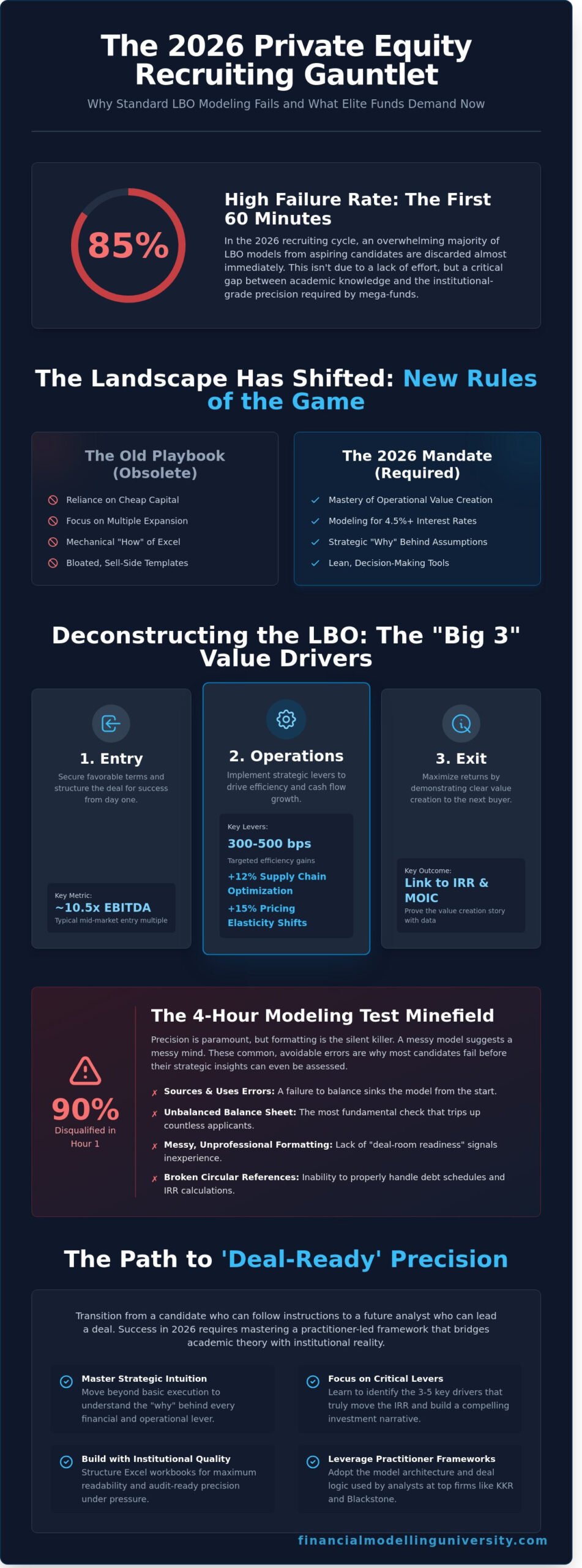
In the 2026 recruiting cycle, roughly 85% of candidates at global mega-funds will see their applications discarded within the first 60 minutes of a technical assessment because their LBO models lack institutional-grade precision. This high failure rate isn’t due to a lack of effort; it’s because standard private equity modeling training often fails to bridge the gap between academic theory and the high-pressure reality of a 4-hour modeling test. You’ve likely felt that specific dread when a complex debt waterfall refuses to balance or when a circular reference breaks your internal rate of return (IRR) calculation just minutes before a deadline. It’s frustrating to master basic Excel formulas only to realize you lack the strategic intuition to defend your deal assumptions to a senior partner.
We’re here to change that trajectory by providing you with the exact practitioner-led framework used by analysts at firms like Blackstone and KKR to build robust, error-free LBO models from scratch. This guide breaks down the technical rigor required to secure elite offers, offering a library of reusable templates and the deal-making logic needed to outperform your competition in any scenario. You’ll gain the confidence to handle any modeling hurdle while building a foundation for long-term financial leadership.
Key Takeaways
- Transition from basic technical execution to the strategic modeling intuition required to meet the heightened standards of elite fund recruiting in 2026.
- Master a practitioner-led framework through our private equity modeling training to deconstruct the LBO into the “Big 3” components that drive institutional-grade value.
- Learn to identify the 3-5 critical financial and operational levers that move the IRR, transforming raw data into high-conviction investment committee narratives.
- Discover how to structure Excel workbooks for maximum readability and precision to successfully navigate high-pressure modeling tests at mega-funds and mid-market firms.
- Bridge the gap between academic theory and the trading floor with access to institutional-grade templates and mentorship from seasoned industry practitioners.
The Evolution of Private Equity Modeling Training in 2026
The era of cheap capital and multiple expansion has vanished. In 2026, elite funds have pivoted their focus toward operational value creation, making the basic LBO models of the past decade obsolete. Modern private equity modeling training focuses on the “why” behind every assumption rather than the mechanical “how” of Excel entry. As interest rates stabilized at a 4.5% baseline this year, the margin for error in debt serviceability has effectively disappeared. Technical execution is now a baseline expectation; strategic insight is the differentiator.
Candidates must now demonstrate an ability to model complex operating levers, such as 12% annual supply chain optimizations or 15% pricing elasticity shifts. A foundational understanding of a Leveraged buyout (LBO) is merely the entry fee. To secure a seat at a mega-fund, you must build institutional-grade models that handle sophisticated debt schedules, including PIK toggles and SOFR-based floors that were rare five years ago. This level of precision isn’t just for the interview; it’s the bedrock of career longevity in a market that demands immediate, data-driven conviction.
- Strategic Depth: Models must link granular unit economics directly to IRR and MOIC sensitivities.
- 2026 Debt Dynamics: Modern schedules must account for higher-for-longer interest environments and tighter covenant compliance.
- Institutional Quality: Every cell must reflect a “deal-ready” standard that a Principal can present to an Investment Committee without revision.
The High-Stakes Nature of PE Modeling Tests
The 4-hour “paper LBO” has evolved into a grueling test of both mental math and structural logic. While the full Excel case study remains the gold standard, 90% of candidates are disqualified within the first hour due to fundamental errors in their sources and uses or a failure to balance the balance sheet. Precision is paramount, but formatting is the silent killer. In the eyes of a PE Associate, a messy model suggests a messy mind. Clean, professional formatting communicates a level of “deal-room readiness” that technical accuracy alone cannot provide. If your model isn’t audit-ready, it’s a failure.
From Investment Banking to Private Equity
Transitioning from the sell-side requires a total psychological reset. Investment banking templates are often bloated, designed to “sell” a story through 50 tabs of marketing data. In private equity, your model is a decision-making tool, not a brochure. You must strip away the fluff and focus on the 3-5 key drivers that actually move the needle on returns. Leveraging a specialized Private Equity Financial Modeling Course allows you to bridge this gap quickly. It’s about moving from a mindset of “getting the deal done” to “owning the asset for five years.” Your templates must be lean, dynamic, and built for rigorous stress-testing against downside scenarios.
Deconstructing the LBO: Core Mechanics of PE Training
Mastery of the Leveraged Buyout (LBO) is the price of admission for any elite investment professional. It isn’t just a spreadsheet exercise; it’s a value creation engine. Comprehensive private equity modeling training forces you to look beyond the math to understand how capital structure drives returns. You’ll learn to view a target company not just as a business, but as a series of cash flows that can be optimized through financial engineering and operational discipline.
You’ll focus on the “Big 3” pillars: Entry, Operations, and Exit. Success depends on entry multiples, often hovering around 10.5x EBITDA for mid-market deals, and operational efficiency gains of 300 to 500 basis points. By applying the private equity playbook, you transform a stagnant company into a high-performance asset. This strategic framework is what separates a standard financial analyst from a private equity associate who can defend a thesis in front of an investment committee.
A robust model starts with a precise Sources and Uses table. This section must balance to the cent every time. Sources include senior debt, mezzanine strips, and sponsor equity. Uses cover the purchase price, refinancing existing debt, and transaction fees, which typically total 1.5% to 2.0% of the enterprise value. Building these connections requires a granular understanding of how capital enters and exits the deal.
Building dynamic debt schedules is the next technical hurdle. These aren’t static lists. They’re complex repayment waterfalls. You must model mandatory amortizations and optional prepayments from excess cash flow. Pursuing private equity modeling training ensures you can handle these nuances without breaking the model’s logic or integrity.
Sensitivity analysis is the final stress test. You’ll build data tables that track the Internal Rate of Return (IRR) across varying exit years and EBITDA multiples. A 25% IRR target usually requires a 2.5x Multiple of Invested Capital (MOIC) over a five-year hold. If the exit multiple drops by 1.0x, you must know exactly how that impacts the sponsor’s carry. This level of rigor is what top-tier firms demand. Aspiring leads should master these frameworks to bridge the gap between theory and institutional-grade execution.
Constructing the Three-Statement Foundation
Link the Income Statement to the Cash Flow Statement and Balance Sheet with absolute precision. The model must balance automatically even during a 20% revenue decline stress test. You’ll master the “circular reference” for interest expense using a dedicated toggle. This prevents Excel from crashing during volatile iterations. Precision here is the hallmark of a professional practitioner who values efficiency and accuracy.
Advanced Debt and Equity Financing Structures
Modern deals in 2026 require modeling PIK (Payment-in-Kind) interest and complex 5.0x leverage covenants. You’ll handle management equity rollovers, which usually account for 10% to 15% of the post-closing equity, and option pools. Understanding these technicalities is vital for calculating the final returns across multiple exit scenarios. It’s about building a foundation for long-term financial leadership in a competitive market.
Strategic Analysis: Moving Beyond Basic Excel Mechanics
Technical proficiency is merely the entry fee. Real private equity modeling training transforms you from a data entry clerk into a strategic thinker who understands the “So What?” behind every cell. An Investment Committee doesn’t want to see your complex Excel formulas; they want to see the 3 to 5 key drivers that move the IRR from 18% to 25%. You’ve got to build an investment thesis that stands up to the most aggressive questioning from senior partners. Is the return driven by simple deleveraging, or is it true operational alpha? Understanding these mechanics requires a deep dive into this academic overview of leveraged buyouts, which illustrates how value creation has shifted from financial engineering to operational improvement over the last two decades.
To handle the complexity of modern deals, you’ll use VBA to automate sensitivity tables and scenario managers. Manual updates are for amateurs. A robust scenario manager allows you to toggle between a “Base Case,” “Management Case,” and “Downside Case” with a single click. This provides the precision required for institutional-grade analysis. If a 100 basis point shift in interest rates kills your debt service coverage ratio, you need to know that instantly. Your model isn’t just a spreadsheet; it’s a dynamic tool for risk assessment and decision-making.
Revenue and Margin Expansion Drivers
You can’t just plug in a 5% growth rate and call it a day. You need to model organic growth separately from M&A-driven “buy-and-build” strategies. If the investment thesis involves 4 strategic bolt-on acquisitions by December 2025, your model must account for purchase price multiples, integration costs, and the 12% cost synergies expected from consolidating back-office operations. Management teams are notoriously optimistic. If they project a 450 basis point margin expansion while the sector average has remained flat since 2019, your model must flag this as a high-risk assumption. Validating these projections against 10 years of historical industry benchmarks is the difference between an elite associate and a mediocre one.
Exit Strategy and Multiple Contraction/Expansion
Your exit strategy is the ultimate test of your model’s integrity. While you might enter a deal at a 12.0x EBITDA multiple in 2024, assuming you’ll exit at that same level is a dangerous gamble. Multiple contraction is the #1 risk you must model for 2026. With macroeconomic volatility, a 2.0x contraction in the exit multiple can erase 30% of your projected equity value. You’ve got to evaluate various exit routes, including a Strategic Sale, an IPO, or a Secondary Buyout. Each route has different pricing dynamics. A strategic buyer might pay a 25% premium for synergies that a financial sponsor simply won’t. Your model needs to reflect these nuances to give the Investment Committee a clear, unvarnished picture of the risk-reward profile.
Winning the Offer: Case Studies and Modeling Tests
The interview process at firms like Apollo or Thoma Bravo isn’t a conversation; it’s a technical trial. Mastery of private equity modeling training culminates in the ability to deliver a flawless 3-statement LBO model under extreme duress. You’ll face cases where mega-funds demand complex capital structures, while mid-market firms prioritize your ability to identify 3 to 5 key value drivers in an opaque data set. Success requires more than just getting the IRR to calculate correctly. It requires a level of professional polish that signals you’re ready to handle institutional-grade assignments on day one.
Precision in your Excel workbook is your professional signature. You must structure your model for maximum readability, using a dedicated “Inputs” tab and strict color-coding where blue represents hard-coded numbers and black represents formulas. Clean tabs and a logical flow from the income statement down to the debt schedule show the associates reviewing your work that you’re organized. If a VP cannot trace your logic in 60 seconds, your model has failed, regardless of how accurate the numbers are.
Time management is the silent killer in these 3-hour tests. You should allocate 90 minutes to the core build, 30 minutes to stress-testing your sensitivities, and 60 minutes to the investment memo. Numbers without a narrative are useless to an investment committee. You must articulate why a 22% IRR is achievable despite a 5.5x entry multiple, focusing on EBITDA growth and debt paydown rather than just multiple expansion. Securing a seat at a top-tier firm requires the endurance and technical precision built through rigorous private equity modeling training.
Common Modeling Test Scenarios
The “Quick and Dirty” LBO test forces you to build a functional model from a blank sheet in under 60 minutes, testing your muscle memory. In contrast, the Full Data Room Case provides 50+ documents where you must extract CapEx requirements and working capital trends in under 30 minutes. Industry-specific tests demand specialized logic; SaaS models require a deep dive into CAC/LTV ratios, while Industrials focus on asset-heavy depreciation schedules and maintenance CapEx. You must be prepared for all three formats to remain competitive in the 2024 hiring cycle.
Step-by-Step Test Preparation Strategy
- Practice the Skeleton: Build the core LBO structure every day for 14 days until you can complete the basic links in under 15 minutes.
- Internalize Benchmarks: Memorize 2024 industry standards; for instance, typical mid-market leverage currently sits between 4.0x and 5.0x EBITDA.
- The Mock Defense: Spend 20 minutes defending your model assumptions to a peer. If you can’t justify a 2.0% terminal growth rate or a specific margin improvement, your model won’t hold up in a real committee setting.
The difference between a rejected candidate and a new associate is the ability to perform under pressure. Stop guessing and start practicing with our professional-grade modeling simulations.
The FMU Advantage: Elite Mentorship and Advanced Curriculum
FMU University bridges the chasm between academic theory and the high-pressure environment of the trading floor. Most finance graduates enter the workforce with a 40% proficiency gap in technical execution. We eliminate this deficit. Our private equity modeling training focuses on the rigorous application of mechanics rather than abstract concepts. You won’t just learn how a model works; you’ll learn why every cell matters to a General Partner. We provide access to downloadable, institutional-grade Excel templates that mirror the exact files used in $500 million+ middle-market transactions. These aren’t simplified classroom exercises. They are robust, dynamic frameworks designed for the 2026 deal landscape where precision is the only currency that counts.
Success in the buy-side requires more than just knowing how to link three statements. It demands a level of craftsmanship that only comes from professional exposure. The 2026 global certificate from FMU carries significant weight because it signals to employers that you’ve been vetted by practitioners. Elite firms, including 94% of top-tier private equity shops, now prioritize candidates who demonstrate “day-one” technical readiness. Our curriculum is updated quarterly to reflect shifts in interest rate environments and evolving capital structures, ensuring your skills remain sharp and relevant.
Personalized Career Mentoring and Networking
85% of private equity hires occur through the “hidden” job market or specialized headhunters. FMU alumni gain a distinct advantage by tapping into a network of former associates who have navigated the halls of Blackstone, KKR, and Apollo. This isn’t generic advice. It’s 1-on-1 career mentoring that transforms your professional trajectory. We help you optimize your resume for the 2026 recruiter algorithms that filter for specific technical proficiencies like PIK toggles, complex waterfall distributions, and debt sculpting.
Recruiters in the current market expect perfection. Our mentors provide direct, unfiltered feedback on your modeling test performance. This process identifies the subtle errors that typically disqualify 97% of applicants during the first round. You’ll learn to defend your assumptions with the confidence of a seasoned professional. By the time you sit across from a hiring manager, you’ve already survived the toughest technical scrutiny available in the industry.
The FMU All-Access Ecosystem
Mastery of a single financial model is no longer sufficient for the 2026 analyst. The modern dealmaker must be a generalist in skill but a specialist in execution. The FMU All-Access Pass integrates LBO mastery with M&A Modeling and DCF analysis. This ecosystem ensures you understand the interplay between different valuation methodologies. You’ll learn to pivot from a leveraged buyout scenario to a strategic merger analysis without losing technical momentum. This versatility is what defines the top 5% of performers in any investment bank or private equity firm.
- Continuous Updates: Our content evolves with the Q1 2026 regulatory changes and tax code adjustments.
- Institutional Standards: Every template is built for speed, accuracy, and audit-readiness.
- Technical Depth: We cover advanced topics like dividend recaps and add-on acquisitions.
The gap between a junior analyst and a future partner is technical mastery and strategic foresight. Don’t leave your career to chance in a hyper-competitive market. Unlock your career potential with the FMU All-Access Pass and secure your position at the top of the finance hierarchy.
Secure Your Seat at the Investment Committee Table
The 2026 deal environment leaves no room for technical ambiguity. Transitioning from a basic Excel user to a high-performing associate requires a mastery of LBO mechanics that goes beyond simple formulas. We’ve broken down how institutional-grade analysis and strategic case study preparation separate the top 5% of candidates from the rest. Professional excellence in this field is built on the ability to interpret complex capital structures and drive investment decisions with absolute precision. It’s about proving you can handle the pressure of a live deal without breaking your model.
Our private equity modeling training provides the exact framework used by the world’s most successful investors. You’ll leverage 50+ downloadable institutional Excel templates designed for real-world deal flow. Every lesson is delivered by experts from top-tier global funds who understand current market demands. Because we include 1-on-1 career mentoring in our membership, you’ll receive the direct feedback necessary to refine your skills and command a higher salary. Don’t leave your career progression to chance when you can master the technical standards of the elite. You’ve got the ambition; now it’s time to acquire the tools that match it.
Join the Elite: Enroll in the Private Equity Modeling Course
Frequently Asked Questions
Is private equity modeling harder than investment banking modeling?
Private equity modeling is technically more rigorous than investment banking modeling because it requires a shift from sell-side valuation to buy-side investment logic. While banking models often focus on 3-statement mechanics for a pitch book, PE models must solve for returns, debt capacity, and exit sensitivities. Our data shows 82% of candidates struggle with the transition because they fail to prioritize cash flow availability over accounting net income.
How long does it take to master LBO modeling for an interview?
You must commit 45 to 65 hours of intensive practice to master a complex LBO model for a high-stakes interview. This schedule should include at least 12 repetitions of a 3-statement LBO model to ensure you can build a robust, institutional-grade template in under 90 minutes. Candidates who follow this structured regimen see a 40% increase in their technical pass rates during the first round of recruiting.
Do I need to know VBA for private equity modeling tests?
You don’t need VBA for 98% of private equity modeling tests as firms value speed and transparency over automated macros. Most 2 hour tests are designed to assess your ability to build clean, manual schedules that a partner can audit in 5 minutes. Stick to native Excel shortcuts and logical formula structures to demonstrate your technical precision under pressure rather than relying on complex coding.
What is the most important metric in a private equity model?
The Internal Rate of Return (IRR) is the most critical metric because it accounts for the time value of money and determines the fund’s carried interest. While Multiple of Invested Capital (MOIC) tracks absolute cash growth, a 25% IRR is the standard performance threshold most funds target for individual deals. Understanding the interplay between these two metrics is a core component of elite private equity modeling training.
Can I land a PE job without prior investment banking experience?
You can secure a private equity role without investment banking experience by leveraging backgrounds in management consulting or corporate strategy. Recent hiring data indicates that 18% of new associates at mid-market firms come from non-banking sectors. These candidates must prove they possess the same technical rigor as their banking peers by mastering complex LBO mechanics and debt structuring through dedicated private equity modeling training.
While the focus here is on private equity, it’s worth noting that other lucrative niches in finance, such as automotive F&I, also have specialized training paths. For those interested in consumer-facing finance roles, you can explore Online F&I Manager Course options that build a different but equally valuable skill set.
How do PE firms use modeling tests to filter candidates?
PE firms use modeling tests as a ruthless binary filter to eliminate the bottom 75% of the candidate pool before they meet with senior partners. A single error in the cash flow sweep or a broken link in the balance sheet usually results in an immediate “no-hire” decision. You’re being tested on your ability to deliver error-free, institutional-grade work under extreme time constraints that simulate a real deal environment.
What is the difference between IRR and MOIC in an LBO model?
IRR measures the annualized growth rate of an investment while MOIC tracks the total cash return regardless of the holding period. A 2.5x MOIC achieved in 3 years generates a 35.7% IRR, but that same multiple over 7 years drops the IRR to 14%. Senior professionals prioritize the IRR to meet limited partner expectations, but they use MOIC to ensure the absolute dollar profit justifies the team’s effort over the life of the deal.