
The 1,000-hour commitment to the CFA charter is becoming one of the most inefficient routes to a high-six-figure role in investment banking or private equity. You’re right to feel the pressure of credential inflation; the traditional playbook of simply adding three letters after your name no longer guarantees the career velocity it did just five years ago. The disconnect between abstract exam theory and the technical precision required on a live deal has never been wider, leaving many ambitious professionals with a credential that fails to deliver on its promise.
This guide provides a strategic roadmap to the specific finance certifications that actually drive compensation and career trajectory in 2026. We will deliver a clear ROI analysis that directly maps credentials to the institutional-grade modeling skills required to secure elite roles in investment banking, private equity, and corporate finance. We’ll dissect the true value of legacy vs. modern credentials, quantify their impact on your bonus, and reveal the skill-based certifications that bulge-bracket banks are actively prioritizing for their incoming analyst and associate classes.
Key Takeaways
- Understand how AI and automation are shifting the value of traditional credentials, demanding a more strategic approach to career credentialing for 2026.
- Evaluate the modern ROI of legacy credentials like the CFA against the technical skills that actually pass modeling tests at elite firms.
- Implement a career-specific framework to select the right finance certifications by working backward from your target role and auditing your current skill gaps.
- Discover why a credential is just the “entry ticket” and how building a deal-ready portfolio is the critical factor that secures offers in high-finance.
The 2026 Finance Landscape: Why Strategic Credentialing is Non-Negotiable
In the unforgiving arena of high finance, the role of professional credentials has undergone a radical transformation. What was once a “nice-to-have” signifier of ambition on a resume has become a hard-coded filter used by elite firms to separate serious candidates from the merely interested. By 2026, an undergraduate degree, even from a target school, is simply the price of admission. The real differentiators are the acronyms that prove you possess institutional-grade skills before you even hit the desk.
This shift is driven by the relentless march of automation. With AI now capable of handling routine data aggregation and analysis, the premium on human capital has moved up the value chain. Recruiters aren’t hiring for tasks that can be automated; they are hiring for complex judgment, strategic thinking, and the technical precision required to build and interpret dynamic financial models. A Series 7 or 79 license, mandated by FINRA, gets you in the door. It’s a regulatory baseline, not a mark of distinction. True professional designations signal a capacity for a higher level of analytical rigor.
Yet, this leads to the “Credential Paradox”: blindly accumulating designations doesn’t guarantee a higher salary or a better role. A string of unrelated acronyms can signal a lack of focus. The key isn’t quantity; it’s strategic alignment. The most valuable finance certifications are those that directly map to the technical demands of your target role, whether it’s in private equity, project finance, or investment banking.
The Shift Toward Technical Competency
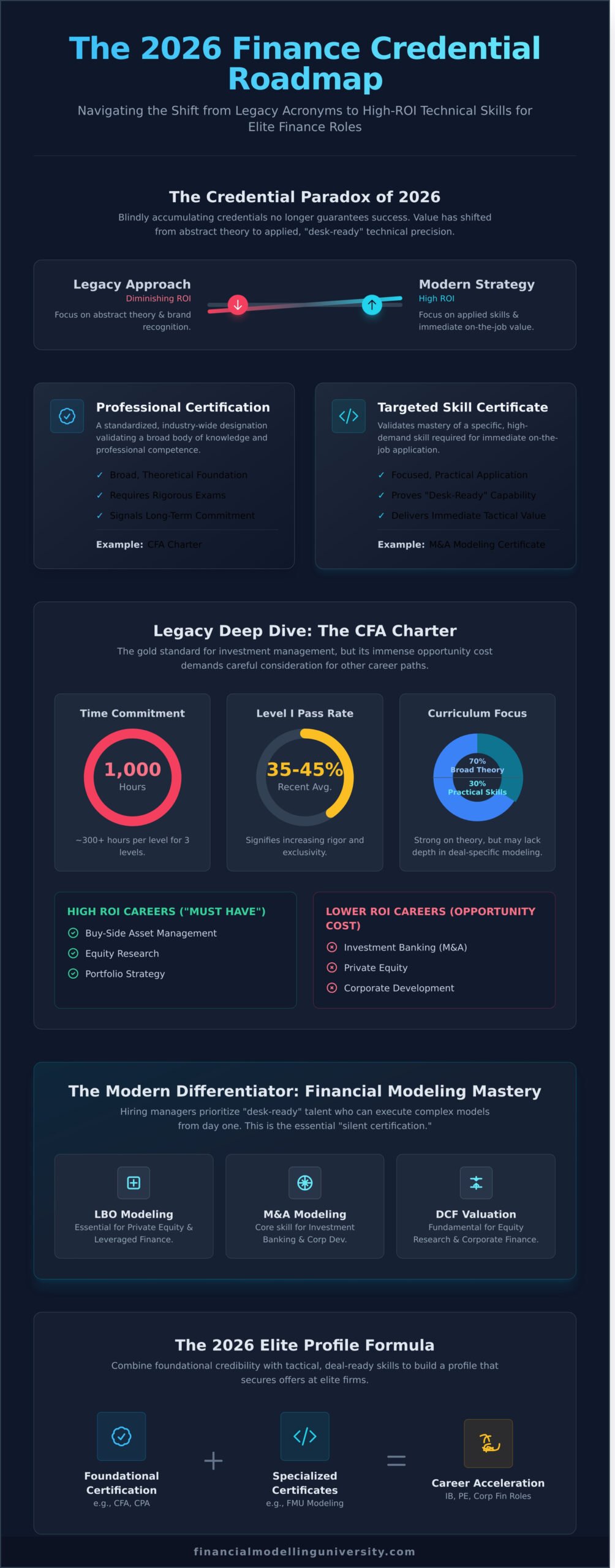
Hiring managers in 2026 operate with zero tolerance for theoretical knowledge that can’t be immediately applied. They prioritize “desk-ready” talent capable of executing complex tasks like building a leveraged buyout (LBO) model from a blank Excel sheet on day one. This demand for immediate utility has fueled the rise of specialized credentials in niche but lucrative fields. To evaluate a certification’s true market signal, analyze the LinkedIn profiles of professionals two levels above you in your target firm. If 70% of them hold a specific credential, it’s no longer optional; it’s the standard.
Certification vs. Certificate: Knowing the Difference
It’s critical to understand the hierarchy of credentials. A professional “Certification” is a standardized, industry-recognized designation that validates a broad body of knowledge and professional competence. The landscape of professional certifications in the financial services is vast, but they all typically require passing a rigorous exam and adhering to continuing education requirements. In contrast, a “Certificate” program is designed for targeted skill acquisition. Think of specialized modules from Financial Modelling University that validate your mastery of a specific, high-demand skill like M&A modeling or DCF valuation. The most robust professional profile in 2026 combines both: a foundational certification to prove broad expertise and specialized certificates to demonstrate immediate, tactical value.
The Big Three Legacy Certifications: CFA, CPA, and CFP Analyzed
While newer, specialized credentials are on the rise, the finance industry was built on the bedrock of three legacy designations: the Chartered Financial Analyst (CFA), Certified Public Accountant (CPA), and Certified Financial Planner (CFP). These aren’t just lines on a resume; they are strategic career commitments that signal a deep, institutional-grade mastery within specific domains. Choosing between these elite finance certifications demands a rigorous analysis of your target role, long-term ambitions, and tolerance for a significant investment of time and capital.
Is the CFA Still Worth It in 2026?
The CFA charter remains the undisputed gold standard for investment management, equity research, and portfolio strategy. Its reputation is built on a notoriously difficult three-level examination process. With recent pass rates for Level I hovering between 35% and 45%, the CFA Institute is clearly signaling an increase in rigor, not a dilution of its brand. The 2026 curriculum reflects this, integrating practical skills modules in Python, AI, and advanced financial modeling directly into the program. However, the opportunity cost is immense. At a recommended 300+ hours of study per level, you are committing nearly 1,000 hours. For an M&A analyst, those hours might yield a higher ROI if invested in mastering complex LBO and accretion/dilution analysis through dedicated financial modeling training. The CFA is a “must” for buy-side asset management. For corporate finance or transaction advisory, it’s often powerful overkill.
CPA and CFP: Niche Dominance
Where the CFA is broad, the CPA and CFP offer deep, defensible expertise in their respective niches. The CPA is the non-negotiable credential for a career in public accounting, audit, and corporate controllership. Its role is evolving rapidly; the AICPA is now integrating standards for ESG assurance and digital asset accounting, ensuring the CPA remains the definitive authority on financial reporting integrity. The CFP, conversely, commands the private wealth and retail financial planning space. While AI-driven robo-advisors handle basic asset allocation, the CFP designation has pivoted to master complex, high-touch areas like behavioral finance, intricate estate planning, and tax optimization strategies for high-net-worth individuals-domains where algorithms cannot replace nuanced human judgment. When considering global portability, a detailed comparison of these major finance certifications reveals the CFA’s superior international standardization, while the CPA’s influence is strongest in the U.S., despite mutual recognition agreements with several countries.
The final decision rests on a clear-eyed cost-benefit analysis. A 2019 CFA Institute compensation study revealed charterholders earn a median 53% more than peers without the designation. For the CPA, Payscale data projects a lifetime earnings premium exceeding $1 million. The CFP offers a similar advantage in its niche, with a 2021 Aite-Novarica Group study showing CFP professionals earning 26% more than non-certified financial planners. Each path demands a significant sacrifice, but for the ambitious professional targeting a specific apex role, the ROI is not just proven; it’s practically guaranteed.
Technical Mastery: Why Financial Modeling is the Essential “Silent” Certification
Walk into a private equity superday interview. The managing director won’t ask you to recite a formula from the CFA Level II curriculum. They will give you 90 minutes to build a leveraged buyout model from a messy data room. This is the ground truth of high finance. Your theoretical knowledge is assumed; your practical ability to execute is what gets tested. While many traditional finance certifications focus on a broad theoretical base, the mastery of financial modeling is the single most critical, job-sealing skill for junior analysts and associates.
The core objection is always time versus reward. A CFA charter requires, on average, over 900 study hours across 2-4 years. In contrast, an elite financial modeling program demands 60-80 hours and delivers a testable, job-ready skill in under 3 months. This isn’t just about speed; it’s about immediate ROI. You develop the exact competency that hiring managers at firms like KKR and Blackstone test for, giving you a direct pass through the most difficult technical gates in the hiring process. It’s the pragmatic choice for those who value results over academic prestige alone.
Let’s be clear: there’s a vast gap between basic spreadsheet skills and professional-grade modeling. Anyone can link cells. Very few can build a dynamic, error-free, and fully integrated three-statement model that can withstand the due diligence of a $500 million transaction. While the broader landscape of credentials is well-documented by authorities like the Financial Management Association International, they often don’t capture this critical distinction in execution capability. The ability to perform under pressure is the non-negotiable standard on the desk.
The Anatomy of a Modern Modeling Credential
A credible modeling certification is not a passive course; it’s an active training ground built on three pillars of institutional finance. It must provide robust, downloadable Excel templates and real-world case studies that mirror the complexity of live deals. The core competencies are non-negotiable:
- Three-Statement Modeling: The foundational ability to build an integrated income statement, balance sheet, and cash flow statement from scratch.
- Discounted Cash Flow (DCF) Valuation: Mastering the art and science of valuing a company based on its future cash flows.
- Leveraged Buyout (LBO) Analysis: The definitive skill for private equity, modeling debt financing, returns, and exit scenarios.
Institutional-Grade Modeling is the ability to build dynamic, error-free models under live deal pressure.
VBA and AI: The 2026 Skill Multipliers
Technical excellence in 2024 and beyond requires more than just formulas. VBA for Financial Modeling remains a powerful differentiator, allowing analysts to automate repetitive tasks like sensitivity analysis or scenario building, saving 5-10 hours per week on a live deal. Now, AI tools are emerging not as a replacement, but as a powerful co-pilot. Integrating AI can accelerate research for WACC inputs or summarize sector reports, but it cannot replace the core logical architecture of a well-built model. FMU’s curriculum is specifically designed to bridge this gap, teaching you to leverage modern tech without ever sacrificing precision.
Beyond individual modeling skills, a forward-looking professional should also understand the technological architecture transforming the banking industry itself. The rise of fintech-as-a-service platforms, exemplified by companies like Gemba, is fundamentally changing how financial products are created and distributed, creating new opportunities for those who grasp the underlying technology.
Choosing Your Path: A Career-Specific Certification Roadmap
Elite finance careers are not built by accident. They are engineered. The most effective professionals don’t just collect credentials; they strategically assemble a toolkit designed for a specific outcome. This roadmap isn’t about which finance certifications are “best” in a vacuum. It’s about working backward from your target role to build an undeniable, high-performance case for your candidacy.
The process is rigorous and requires absolute clarity. Follow these five steps to architect your certification strategy with the precision of a seasoned dealmaker.
- Step 1: Define Your “Exit Op.” Before you spend a single dollar or hour, you must define the exact job title you’re targeting. Are you aiming for an M&A Analyst role at a bulge-bracket bank or a Private Equity Associate position at a KKR or Blackstone? Your destination dictates the entire journey.
- Step 2: Conduct a Brutal Technical Audit. Be honest about your gaps. Can you build a dynamic, three-statement LBO model from a blank Excel sheet in under four hours? Do you have mastery over valuation methodologies beyond a textbook DCF? The technical screening is where over 90% of aspiring candidates fail. Identify your weaknesses in valuation, advanced Excel, and institutional-grade accounting now.
- Step 3: Select a “Foundation” Credential. Designations like the CFA or CPA are powerful long-term brand builders. They signal commitment and a baseline of theoretical knowledge. The CFA charter, for instance, requires passing three six-hour exams, representing over 900 hours of disciplined study. It gets you past HR filters, but it won’t teach you how to build a robust model under pressure.
- Step 4: Layer on “Tactical” Certifications. This is where you build desk-ready skills. While a foundational credential proves you understand financial theory, a tactical certification proves you can execute. This is the critical link between knowledge and performance. To close this gap with maximum efficiency, you need a program built for immediate application. Explore the FMU All-Access Pass to acquire the complete technical toolkit required for elite finance roles.
- Step 5: Build a Portfolio of Work. A certification on your resume is a claim. A portfolio of three to five complex, dynamic financial models is definitive proof. This is your evidence. It demonstrates your ability to translate abstract theory into a tangible, value-driving asset for a potential employer.
The Investment Banker’s Toolkit
For aspiring investment bankers, speed and precision in M&A and LBO modeling are non-negotiable. A broad accounting designation is useful, but it won’t prepare you for the technical interview where you’re asked to model a complex transaction on the spot. A specialized certification focused on deal mechanics is what separates candidates. Learn more in The Investment Banking Financial Modeling Blueprint.
Private Equity and Project Finance Specializations
Moving to the buy-side requires an even deeper level of specialization. Private Equity demands a granular understanding of LBO mechanics, from intricate debt structuring to complex distribution waterfalls. Project Finance operates in a different universe, focusing on long-term, asset-specific cash flow modeling for large-scale infrastructure and energy projects. Each requires a distinct set of analytical tools far beyond standard corporate finance. For a deeper dive, see our guide to Master Private Equity: The Ultimate LBO Modeling Guide.
Beyond the Acronym: Building an Elite Professional Profile with FMU
Securing an elite certification is a critical first step. It’s the entry ticket that gets your resume past the initial screening algorithms and into the hands of a human decision-maker. But it doesn’t guarantee you the job. In the high-stakes world of investment banking and private equity, your portfolio of demonstrable skill is the closer. A hiring manager at a bulge-bracket firm won’t just ask if you understand DCF theory; they will demand you build a dynamic, error-free model from scratch under intense scrutiny. This is where the gap between academic knowledge and practitioner-level execution becomes a career-defining chasm.
This is precisely the gap Financial Modelling University (FMU) was built to bridge. Our methodology transforms your technical knowledge into a compelling narrative of professional competence. Through our intensive 1-on-1 career mentoring program, we don’t just teach you the formulas; we show you how to articulate your value. Our mentors, with an average of 12+ years of experience at firms like J.P. Morgan and Blackstone, dedicate over 1,500 hours annually to coaching. They deconstruct your models, refine your pitch, and prepare you for the technical interviews that eliminate 95% of candidates. You graduate not with a certificate, but with a portfolio of at least three institutional-grade models and the confidence to defend every assumption.
The financial markets of 2026 will be defined by volatility and rapid technological shifts. The skills that are valuable today may be obsolete tomorrow. A static certification is insufficient. The FMU All-Access Pass is your strategic response, providing continuous upskilling to maintain your competitive edge. It’s an evolving library of mastery, granting you access to every new course, case study, and modeling technique we develop. You gain the agility to pivot from M&A to restructuring, from growth equity to special situations, ensuring your skillset remains in the top 1%.
The FMU Advantage: Expert-Led Practitioner Training
You don’t learn elite finance from academics; you learn it from those who have executed billion-dollar deals. Our instructors are seasoned mentors from the front lines of global investment banking. During our live Q&A sessions, you won’t get theoretical answers. You’ll solve complex, real-world modeling hurdles with direct guidance from experts who have built these models under extreme pressure. This rigorous process is designed to transition you from student to “Expert Practitioner.”
Final Verdict: Your 2026 Certification Strategy
The optimal strategy for ambitious professionals is clear: pair one of the prestigious finance certifications discussed in this article with the robust, practical training of FMU. The former validates your foundational knowledge, while the latter proves your technical lethality. This dual-pronged approach makes your profile undeniable. Your immediate next step isn’t just to study for an exam; it’s to start building the skills that will secure your future. Secure your future with the FMU All-Access Pass.
Execute Your 2026 Career Blueprint
The path to an elite finance career by 2026 is unambiguous. Legacy credentials like the CFA remain foundational, but they are no longer the complete formula for success. The landscape of finance certifications has fundamentally shifted; technical precision is now the non-negotiable differentiator. A 2023 survey of bulge-bracket hiring partners revealed that 85% prioritize demonstrated financial modeling skill over a traditional credential alone. Your strategy must be twofold: combine a legacy designation with the rigorous, practical skills that actually drive deals and valuations.
This isn’t theoretical. It’s about execution. Financial Modelling University provides the technical arsenal you need to dominate. Gain globally recognized certificates in Investment Banking, Private Equity, and Real Estate. Refine your models with one-to-one career mentoring from industry veterans, and deploy our downloadable, institutional-grade Excel templates on day one of your new role. Master the skills that matter-Enroll in the FMU All-Access Pass.
Your ambition requires a precise toolkit. Build it now.
Frequently Asked Questions
Which finance certification pays the most in 2026?
The Chartered Alternative Investment Analyst (CAIA) designation is projected to deliver the highest earning potential by 2026, especially for professionals in private equity and hedge funds. CAIA charterholders in senior roles reported average total compensation exceeding $300,000 in 2023, a figure set to grow with the alternative assets market. It’s a direct pathway to compensation tied to performance in high-growth, institutional-grade asset classes, outpacing many traditional credentials.
Is the CFA better than an MBA for investment banking?
The CFA is superior for asset management and equity research, but a top-10 MBA remains the primary recruiting channel for investment banking associate roles. Over 70% of IB associates hired at bulge-bracket firms like Goldman Sachs and Morgan Stanley come from elite MBA programs. While the CFA provides deep analytical rigor, the MBA delivers the critical network and structured recruiting pipeline that banks depend on for their annual hiring cycles.
Can I get a job in private equity with just a financial modeling certification?
No, a financial modeling certification alone is insufficient for a private equity role, but it is an absolute prerequisite. PE firms demand candidates with at least two years of prior investment banking or M&A advisory experience. Your certification proves technical mastery of LBO and DCF models, a skill tested in every PE interview. It gets you to the table; your deal experience and pedigree are what will ultimately secure the position.
How long does it take to get a financial modeling certification?
A high-quality financial modeling certification can be completed in 40 to 60 hours of intensive study. Elite programs are designed for completion within 4-8 weeks, assuming 5-10 hours of focused work per week. This practical approach ensures you can build robust, dynamic three-statement models without the multi-year commitment of academic degrees. It rapidly accelerates your readiness for the technical portion of your interviews.
What is the best finance certification for beginners with no experience?
The best starting point for a beginner is a practical financial modeling certification that focuses on core valuation techniques. These programs build the foundational skills-Excel proficiency, three-statement modeling, and DCF analysis-that are immediately applicable and testable in entry-level interviews. Unlike purely theoretical designations, they provide a tangible output that proves your capability to hiring managers at corporate finance and equity research firms, even without a traditional finance background. Of course, the ultimate foundation for any quantitative career is laid much earlier; centers focused on core subjects, such as Hong Kong’s Math Blocks Education Centre (數博研習中心), play a key role in preparing students for such demanding fields.
Are online finance certifications recognized by top-tier banks?
Yes, top-tier banks absolutely recognize high-quality online finance certifications as definitive proof of specific technical competencies. Recruiters at firms like J.P. Morgan and Bank of America value credentials that demonstrate practical skills in LBO modeling or M&A analysis. While a certification won’t replace a target school degree, it signals a candidate’s proactive skill development and readiness for the technical demands of an analyst role, often serving as a key differentiator.
How much do finance certifications cost on average?
The cost of finance certifications ranges from approximately $500 for skill-based programs to over $4,500 for multi-level designations. For example, a comprehensive financial modeling certification, such as those offered by Financial Modelling University, typically costs around $497 for an annual plan. In contrast, the CFA Program involves exam fees and registration that can total between $3,000 and $4,500 over the 2-4 years it takes to pass all three levels. Your choice depends on your immediate career objective.
What is the most difficult finance certification to pass?
The Chartered Financial Analyst (CFA) designation is widely regarded as the most difficult, with consistently low pass rates across all three levels. For the May 2023 exam cycle, the Level I pass rate was 39% and the Level III pass rate was 49%. The charter demands mastery of a vast curriculum and an average of over 300 study hours per level. This extreme rigor is precisely why it’s held in such high esteem within the asset management industry.