

A 20% return on equity might look impressive at first glance, but that number can be driven by very different realities: stronger profit margins, better asset efficiency, or simply more leverage.
That is why analysts still rely on DuPont Analysis, a framework that has been used for more than a century to break ROE into the components that actually explain performance.
With ROE ranging from 24.04% in U.S. pharmaceuticals to -8.29% in basic chemicals, it is clear that the headline ratio alone rarely tells the full story.
What Is DuPont Analysis?
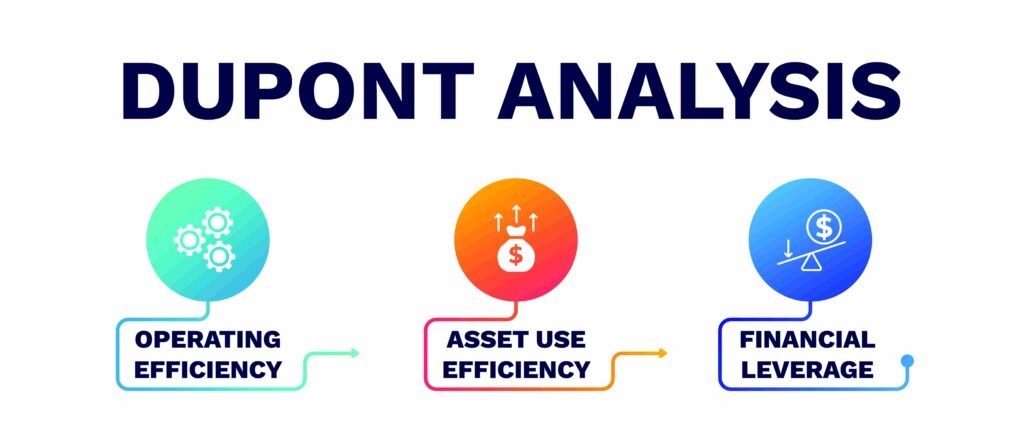
DuPont analysis is a financial framework that breaks down Return on Equity (ROE) into three components: profit margin, asset turnover, and financial leverage. By decomposing ROE into these elements, analysts can identify the specific drivers behind a company’s profitability and overall financial performance.
Rather than evaluating ROE as a single profitability metric, DuPont analysis separates it into components that reflect a company’s operating performance, efficiency in using assets, and capital structure.
The framework was originally developed at DuPont Corporation in the early twentieth century to help managers understand what factors were influencing the company’s profitability.
By breaking ROE into distinct elements, the method allowed decision makers to identify whether changes in performance were driven by operational improvements, better asset utilization, or increased leverage.
The DuPont Analysis Formula
The core idea behind DuPont analysis is the decomposition of Return on Equity into several measurable financial ratios. The DuPont analysis formula shows how profitability, efficiency, and financial leverage combine to determine a company’s ROE.
The basic form of the formula is:
ROE = Net Profit Margin × Asset Turnover × Equity Multiplier
Each component comes from the company’s financial statements and captures a different aspect of performance.
| Component | Formula | What It Measures |
| Net Profit Margin | Net Income / Revenue | Profit generated from each dollar of sales |
| Asset Turnover | Revenue / Total Assets | Efficiency of asset utilization |
| Equity Multiplier | Total Assets / Shareholders’ Equity | Degree of financial leverage |
When multiplied together, these ratios reconstruct Return on Equity. The DuPont analysis formula therefore provides a structured way to analyze the drivers of shareholder returns rather than treating ROE as a single isolated metric.
Interpreting the Components of DuPont Analysis

Each ratio represents a different economic driver of shareholder returns.
Net Profit Margin
Net profit margin measures how much profit a company generates from its revenue after accounting for all expenses, including operating costs, interest, and taxes. A higher margin indicates that the company is able to convert a larger share of its sales into net income.
For analysts, this ratio reflects pricing power, cost control, and overall operational effectiveness. Changes in profit margin may signal improvements in operational efficiency, shifts in product mix, or changes in competitive conditions.
Asset Turnover
Asset turnover measures how effectively a company uses its assets to generate revenue. It shows how much sales the business produces for each dollar invested in assets.
A higher asset turnover ratio indicates that the company is utilizing its resources efficiently. Lower turnover may suggest underutilized assets, inefficient operations, or a capital intensive business model. Analysts often compare this ratio with industry peers to assess relative efficiency.
Real-World Illustration: Walmart

Walmart provides a clear example of how strong asset turnover can support shareholder returns even when profit margins are relatively low. In fiscal 2025, the company reported $681.0 billion in revenue and $19.4 billion in net income, which implies a net profit margin of about 2.9%.
With average total assets of approximately $256.6 billion, Walmart generated asset turnover of about 2.65x. This profile shows how a large retailer can rely on scale, inventory movement, and efficient asset utilization rather than high margins to support performance.
Equity Multiplier
The equity multiplier reflects the extent to which a company uses debt financing relative to equity. It indicates how much of the company’s assets are financed by shareholders versus creditors.
A higher equity multiplier increases ROE because leverage amplifies returns generated from assets. However, it also increases financial risk because the company must service its debt obligations.
Real-World Illustration: Apple
Apple shows a very different DuPont profile. In fiscal 2025, the company reported $416.2 billion in net sales and $112.0 billion in net income, which implies a net profit margin of about 26.9%.
Apple reported $359.2 billion in total assets and $73.7 billion in shareholders’ equity, which points to a high equity multiplier relative to many companies. This combination shows why analysts use DuPont analysis to distinguish strong operating profitability from the amplifying effect of capital structure.
These three components allow analysts to determine whether a company’s ROE is driven by strong profitability, efficient use of assets, or greater financial leverage.
DuPont Analysis Example
A practical DuPont analysis example shows how the framework helps analysts understand the drivers behind a company’s Return on Equity. Consider the following simplified financial data for a company.
| Financial Data | Value |
| Net Income | $100 million |
| Revenue | $1 billion |
| Total Assets | $500 million |
| Shareholders’ Equity | $250 million |
Step 1: Calculate the Components
Using the ratios from the DuPont analysis formula, we calculate each component.
| Component | Calculation | Result |
| Net Profit Margin | 100M / 1B | 10% |
| Asset Turnover | 1B / 500M | 2.0 |
| Equity Multiplier | 500M / 250M | 2.0 |
Step 2: Calculate Return on Equity
ROE is obtained by multiplying the three components:
ROE = 10% × 2.0 × 2.0 = 40%
Interpreting the Result
The result shows that the company generates a 40 percent return on shareholder equity. However, the decomposition explains how this return is created.
The profit margin indicates moderate profitability. The asset turnover ratio shows that the company uses its assets efficiently to generate revenue. The equity multiplier reveals that leverage amplifies the return to shareholders.
The Three-Step and Five-Step DuPont Models

DuPont analysis can be applied using different levels of detail. The most common approach is the three-step model, but analysts sometimes use an expanded five-step model to obtain deeper insights into profitability drivers.
Three-Step DuPont Model
The three-step model is the standard version used in most financial analysis. It decomposes Return on Equity into three key ratios.
| Component | Formula | Purpose |
| Net Profit Margin | Net Income / Revenue | Measures profitability |
| Asset Turnover | Revenue / Total Assets | Measures asset efficiency |
| Equity Multiplier | Total Assets / Shareholders’ Equity | Measures financial leverage |
The three components combine to produce the familiar DuPont analysis formula:
ROE = Net Profit Margin × Asset Turnover × Equity Multiplier
This structure allows analysts to quickly determine whether changes in ROE are driven by operating performance, asset utilization, or capital structure.
Five-Step DuPont Model
The five-step model extends the framework by breaking the profit margin into additional components. This allows analysts to separate operating performance from financing and tax effects.
| Component | Formula |
| Tax Burden | Net Income / Earnings Before Tax |
| Interest Burden | Earnings Before Tax / Operating Income |
| Operating Margin | Operating Income / Revenue |
| Asset Turnover | Revenue / Total Assets |
| Financial Leverage | Total Assets / Shareholders’ Equity |
This expanded structure helps analysts isolate the effects of taxes, interest expenses, and operating profitability. As a result, the five-step model provides a more detailed view of the factors that influence Return on Equity.
Why Analysts Use DuPont Analysis

Financial analysts use DuPont analysis to identify the specific drivers behind changes in Return on Equity. By decomposing ROE into profitability, efficiency, and leverage, analysts can evaluate the economic sources of shareholder returns.
Several practical applications make the framework particularly useful in financial analysis.
For analysts building valuation or performance models, understanding where DuPont analysis fits within broader frameworks like common types of financial models can help place ROE decomposition in the wider context of financial analysis and forecasting.
Identifying the Drivers of ROE
The most important use of DuPont analysis is performance diagnostics. When ROE changes, the framework allows analysts to determine whether the change is caused by profitability, asset utilization, or financial leverage.
For example, an increase in ROE may result from improved margins, more efficient use of assets, or higher leverage. Without decomposition, these effects cannot be separated.
Comparing Companies Within an Industry
DuPont analysis is often used to compare companies that operate in the same industry. Two firms may report similar ROE levels, but the underlying drivers can differ significantly.
| Company | Profit Margin | Asset Turnover | Equity Multiplier | ROE |
| Company A | High | Moderate | Low | Similar ROE |
| Company B | Moderate | High | Higher | Similar ROE |
The comparison reveals whether performance is driven by operational efficiency, pricing power, or financial leverage.
Evaluation of Management Decisions
Changes in the components of DuPont analysis often reflect management decisions. Improvements in profit margin may result from cost control or pricing strategy. Changes in asset turnover may reflect operational improvements or investment decisions.
Assessing Financial Risk
DuPont analysis also helps analysts identify situations where high ROE is primarily driven by leverage. When the equity multiplier is the main contributor to returns, the company may be relying heavily on debt financing, which increases financial risk.
Limits of DuPont Analysis

Although DuPont analysis is a useful framework for understanding the drivers of Return on Equity, it also has several limitations. Analysts typically interpret the results together with other financial metrics rather than relying on it as a standalone tool.
Reliance on Accounting Data
DuPont analysis is based on financial statement figures such as net income, revenue, and book value of equity.
These numbers depend on accounting standards and company policies. Differences in revenue recognition, depreciation methods, or asset valuation can affect the ratios and reduce comparability.
Sensitivity to Financial Leverage
The framework shows how leverage influences ROE through the equity multiplier. While leverage can increase returns to shareholders, it also increases financial risk.
A company may report a high ROE simply because it uses significant debt rather than because it operates more efficiently.
Limited Insight Into Cash Flow
DuPont analysis focuses on profitability ratios derived from accounting earnings. It does not directly evaluate the timing or quality of cash flows.
For this reason, analysts often complement it with cash flow analysis and liquidity metrics.
Industry Differences
Comparisons using DuPont analysis are most meaningful within the same industry. Different sectors operate with very different asset structures and capital intensity.
For example, asset turnover in retail businesses is typically much higher than in manufacturing or utilities.
FAQ
Conclusion
DuPont analysis provides a structured way to understand the drivers of Return on Equity. By decomposing ROE into profitability, asset efficiency, and financial leverage, the framework helps analysts identify the economic sources of shareholder returns.
For this reason, DuPont analysis is widely used in financial statement analysis, equity research, and corporate finance.
Analysts who want to apply these concepts in practice often develop their skills through structured training programs such as the financial modeling courses available here.
When combined with other financial metrics, it offers a practical way to evaluate a company’s performance and the sustainability of its returns.







One Response