
To learn more, explore all available Courses.
Does your model break the moment you toggle a scenario or adjust a complex debt schedule? Most analysts lose hundreds of hours annually to manual spreadsheet maintenance, often feeling technically inferior to peers who leverage automation. It’s a common pain point in high-finance roles where the risk of human error in complex workbooks can derail a multi-million dollar transaction. Mastering vba for financial modeling isn’t just a technical upgrade; it’s a career multiplier that separates data entry clerks from strategic architects.
We’ll show you how to harness the technical precision of VBA to automate complex financial workflows and elevate your modeling to institutional standards. You’ll learn to build audit-ready models that command respect in investment banking and private equity recruitment. This guide covers high-impact use cases for LBO and DCF models, compares VBA to Python in a 2026 context, and establishes the rigorous coding standards top-tier banks demand. Secure your competitive edge by transforming your approach to spreadsheet engineering.
To learn more, explore all available Courses.
Visual Basic for Applications (VBA) is the native programming language embedded within Microsoft Excel. While basic users view it as a way to record simple steps, elite practitioners treat vba for financial modeling as a precision tool to build dynamic, automated systems. At the highest levels of investment banking, manual modeling creates an “Efficiency Gap.” If you’re manually updating fifty sensitivity tables or hard-coding circular references, you aren’t just slow; you’re a liability. Understanding financial modeling fundamentals is the baseline, but VBA is what allows you to scale that knowledge into institutional-grade outputs. It’s the difference between a static, brittle workbook and a living decision-support system that can handle the rigors of a $500 million transaction.
Don’t confuse professional VBA with the basic “Record Macro” button. Recorded macros generate bloated, inefficient code that breaks the moment a row is added or a worksheet is renamed. They lack the logic required for complex “If-Then” scenarios or dynamic loops used in sophisticated valuation. Professional vba for financial modeling involves writing clean, modular scripts from scratch. This transition from a spreadsheet user to a financial software architect is vital for your career progression. You’ll learn to build “circularity breakers” and automated scenario managers that function flawlessly under pressure. Written code allows for robust error handling and user prompts that recorded macros simply cannot provide.
Top-tier banks and private equity firms demand absolute model integrity. When a deal team handles a complex LBO, they can’t afford a manual error in a debt schedule or a botched sensitivity analysis. Senior associates and VPs prioritize analysts who can automate these risks away. They want “audit-ready” code that follows a logical structure and is easy for a third party to review. Desk-ready technical proficiency is the currency of the modern analyst. Financial Modelling University has trained over 25,000 finance professionals to meet these exact standards. Mastering these automation skills transforms you from a data entry clerk into a strategic asset. You’ll become the person who can handle the most complex workflows in M&A or project finance with speed and precision.
In leveraged finance, manual debt sculpting is a persistent bottleneck. Using vba for financial modeling allows you to build robust “copy-paste” loops that resolve circular interest calculations without the instability of native Excel iterations. Beyond circularity, professional analysts deploy User Defined Functions (UDFs) to streamline proprietary tax logic or complex hurdle rates that standard formulas can’t handle efficiently. These custom functions reduce workbook bloat and improve calculation speed; this ensures your model remains responsive during high-pressure deal negotiations. By centralizing logic in UDFs, you also make the model easier to audit, as the math is contained in a single, reviewable script rather than spread across thousands of cells.
Probabilistic valuation requires running thousands of trials to determine a range of possible outcomes. VBA is the ideal engine for these simulations because it executes logic locally, maintaining data security within the workbook. By referencing the official VBA documentation, you can script efficient random number generators that feed directly into your DCF assumptions. This creates a real-time risk assessment dashboard that visualizes return probabilities for executive review. Unlike external tools, a VBA-driven simulation stays within the file, making it easy to share with senior partners who need to see the “what-if” impact on IRR or NPV instantly.
Professional M&A models require instant toggles between Management, Bank, and Upside cases. Rather than duplicating tabs, use vba for financial modeling to build a centralized scenario manager that updates every sheet in the workbook simultaneously. This approach keeps your file size manageable and reduces the risk of formula breaks across multiple worksheets. For the final output, automate your reporting packages by scripting data exports directly into pitch-ready templates. This saves hours of manual formatting during the final stages of a transaction, allowing you to focus on the strategic implications of the deal rather than cell alignment. To master these advanced automation techniques, explore the VBA for Financial Modeling Course.
To learn more, explore all available Courses.
To learn more, explore all available Courses.
The 2026 technical landscape is defined by a division of labor rather than a replacement of tools. Python handles the heavy lifting of data cleaning and machine learning, but vba for financial modeling remains the essential layer for workbook-specific logic. Excel is the primary interface for investment committees and senior partners. They expect a self-contained tool that functions without external dependencies or cloud connectivity. VBA provides this local, zero-latency environment. It ensures your proprietary deal data complies with supervisory guidance on model risk management, which emphasizes the need for independent validation and internal controls within banking systems.
Speed of development is the primary advantage for desk analysts. While Python might execute a complex script faster, the time required to set up an environment and map data often exceeds the time it takes to write a VBA routine directly in the model. The “Hybrid Analyst” doesn’t choose one over the other. They master both to maximize their career leverage. You’ll use Python for the heavy research phase and VBA for the final, pitch-ready execution. This dual proficiency ensures you’re never limited by your tech stack during a high-stakes transaction.
VBA is your primary tool for model-specific automation, custom user forms, and legacy system integration. It’s the only professional choice for shareable models in client-facing roles. When you send a workbook to a client, you can’t assume they have a specific Python distribution or library installed. VBA runs natively, ensuring your automation works on every machine in the bank. To build the foundational skills required before you automate, explore all available Courses at FMU. This technical base is vital for anyone aiming for the level of elite industry practitioners.
Transition to Python when your analysis involves massive datasets that exceed Excel’s million-row limit. It’s the right choice for machine learning, time-series forecasting, and API-heavy research. Modern analysts use Python to process raw market data and then push the finalized outputs into a VBA-powered Excel model for valuation. This coexistence allows you to maintain professional rigor while utilizing the strengths of each language. FMU’s curriculum helps you navigate this technical intersection with the confidence of an industry expert, ensuring your models are both powerful and audit-ready.
To learn more, explore all available Courses.
To learn more, explore all available Courses.
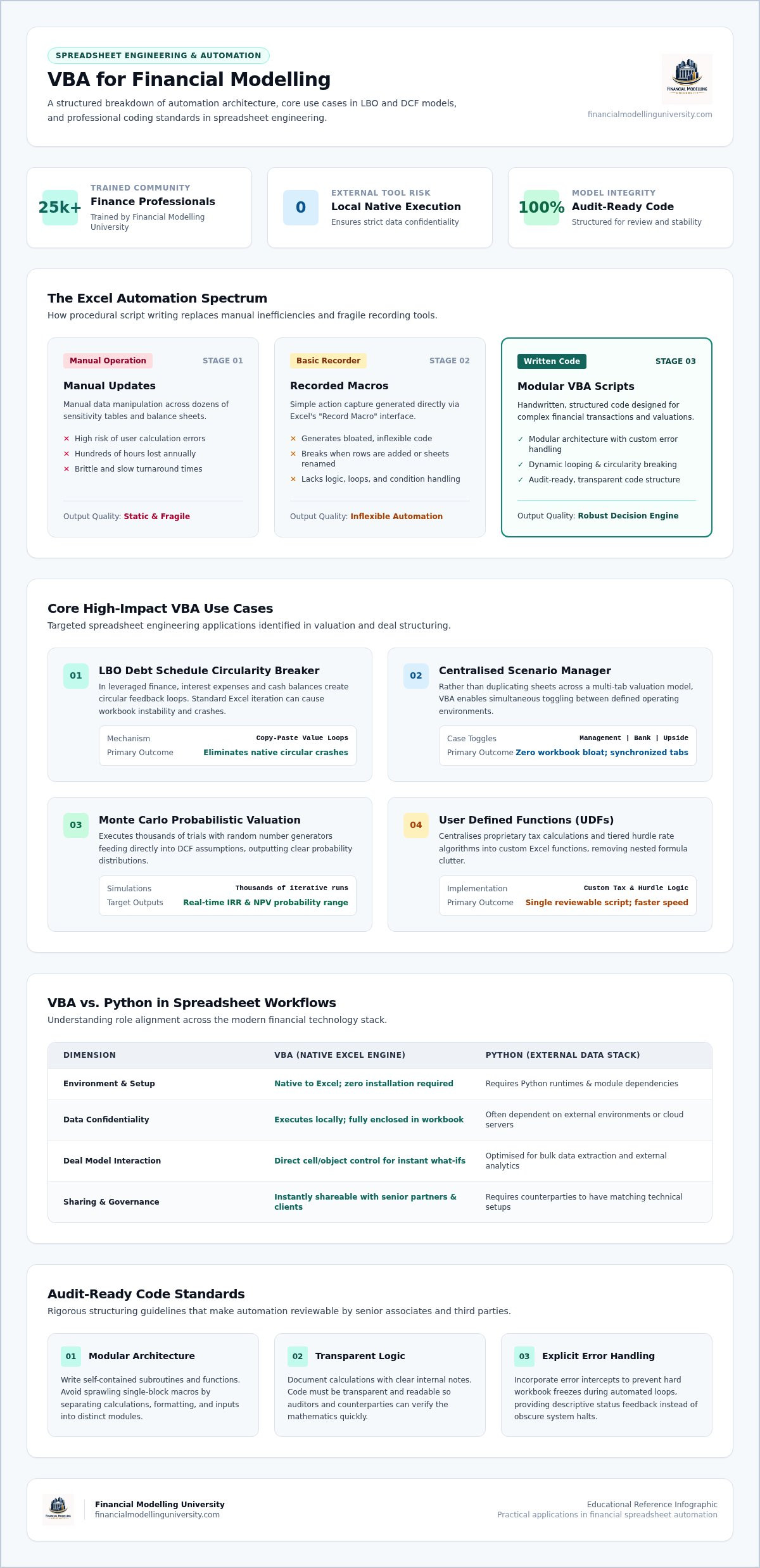
In high-stakes finance, your code is a liability if it isn’t transparent. The “No-Black-Box” rule is the institutional standard for vba for financial modeling. Senior bankers and auditors must be able to trace every logical step without deciphering cryptic scripts. If a VP can’t understand what your macro does within sixty seconds of reading the comments, your model fails the audit test. Standardizing naming conventions for variables and subroutines ensures that your work is transferable across a deal team. This level of discipline prevents the catastrophic logic errors that plague 88% to 91% of un-standardized corporate spreadsheets, according to historical auditing studies. Professionalism in code is about building trust through clarity.
Institutional-grade automation rests on five foundational practices that ensure stability and speed. First, always use Option Explicit at the top of every module. This forces you to declare every variable, preventing silent typos from destroying your model’s integrity. Second, embrace modular programming by breaking complex tasks into small, manageable sub-routines. A single 500-line script is impossible to debug; ten 50-line modules are audit-ready. Third, prioritize documentation. Write code for the reader, not the compiler, by explaining the “why” behind every complex calculation. Fourth, implement performance optimization by turning off screen updates and automatic calculations during execution. This eliminates screen flickering and lag, making your model feel like a professional software application. Finally, ensure 64-bit compatibility by using the PtrSafe keyword for Windows API calls, a requirement for modern banking IT environments.
A runtime error during a client presentation is a career-limiting event. Use “On Error GoTo” patterns to intercept unexpected data inputs before they cause a crash. Instead of a generic system error, build custom user alerts that explain exactly what went wrong and how to fix it. This proactive approach demonstrates technical maturity and keeps the focus on the deal rather than the technical failure. Rigorous testing and debugging protocols aren’t optional; they’re the foundation of institutional-grade workbooks. You must stress-test your macros against empty cells, incorrect data types, and broken links. To master these elite coding standards, enroll in the VBA for Financial Modeling Course today.
To learn more, explore all available Courses.
To learn more, explore all available Courses.
Success in high finance requires more than just basic spreadsheet skills; it demands the ability to build resilient, automated systems. The VBA for Financial Modeling Course at FMU is designed to move you beyond the role of a standard spreadsheet user. You’ll become a Strategic Architect, capable of constructing models that withstand the scrutiny of elite investment committees. This isn’t a generic programming class. It’s a specialized curriculum focused on desk-ready applications used in investment banking and private equity. You’ll gain access to proprietary Excel templates that have been battle-tested by industry practitioners on multi-billion dollar deals.
Generic coding tutorials often fail because they don’t understand the nuances of a DCF or an LBO. FMU training is built by elite mentors who have worked at bulge-bracket banks. We focus exclusively on high-finance applications. You’ll learn the syntax required to break circular debt loops and automate complex sensitivity matrices. Our instructors provide one-to-one career support, helping you translate these technical skills into a portfolio that commands attention. In the 2026 job market, an FMU certification serves as a quantitative hallmark of your expertise, signaling to recruiters that you possess the technical precision required for institutional-grade work.
Professional mastery is a journey that requires the right blueprint. By joining FMU, you enter a network of 25,000+ ambitious finance professionals who have already utilized our methods to secure a competitive edge. Our specialized modules take you from the basics of VBA syntax to advanced Private Equity Financial Modeling automation. You’ll learn to build audit-ready code that senior associates can trust. This training is the definitive step toward performing at the level of elite industry practitioners. Don’t let technical inferiority hold your career back. Take control of your professional trajectory by mastering the automation tools that define modern finance.
To learn more, explore all available Courses.
To learn more, explore all available Courses.
Excel remains the undisputed frontend of global finance. Mastering vba for financial modeling ensures your work meets the rigid transparency and performance standards of bulge-bracket banks. You’ve learned how to break circularity in LBO models and build audit-ready documentation that survives the toughest reviews. This technical precision isn’t just about speed; it’s about professional credibility and career longevity. It’s the definitive difference between manual spreadsheet labor and high-level strategic execution.
FMU provides the blueprint for this transformation. Our elite mentor-led curriculum is trusted by 25,000+ finance professionals worldwide. By earning an institutional-grade certification, you signal your readiness for the high-stakes environment of investment banking and private equity. Don’t settle for being a basic spreadsheet user when you can operate as a strategic architect. The path to professional mastery is structured, logical, and highly disciplined.
Master Financial Modeling Like the Pros and secure your competitive edge today. You have the talent; now acquire the technical precision to match your ambition. Your future in high finance starts with the right technical foundation.
To learn more, explore all available Courses.
To learn more, explore all available Courses.
Yes, VBA remains the essential tool for local Excel automation and confidential deal execution. While Python is useful for data science, investment banking workflows rely on VBA for zero-latency workbook manipulation and shareable models. Most bulge-bracket banks prioritize VBA for internal tools to maintain data security and ensure every team member can run the code without complex software environments.
Mastering vba for financial modeling typically takes four to eight weeks of focused study. This timeframe allows you to move from basic syntax to building complex “copy-paste” loops and automated scenario managers. Analysts who dedicate a few hours each week to desk-ready applications see immediate results in their workflow efficiency and model stability during live deal negotiations.
No, you don’t need a computer science background to learn VBA effectively. The language is designed to be intuitive for Excel users, leveraging the existing spreadsheet object model you already understand. FMU courses guide you through the transition from recording basic macros to writing modular, audit-ready code. A solid foundation in advanced Excel functions is the only prerequisite for success.
VBA is the preferred engine for running Monte Carlo simulations within a local workbook. It allows you to execute thousands of probabilistic iterations without the latency of cloud-based tools. By scripting random number generators directly into your assumptions, you can visualize a range of valuation outcomes. This local execution ensures your proprietary deal data never leaves the secure banking environment.
VBA is the actual programming language, while a macro is a specific set of instructions written in that language. Most users start with “Recorded Macros,” which are often inefficient and brittle. Professional vba for financial modeling involves writing clean, structured code from scratch. This approach allows for robust error handling and dynamic logic that recorded steps simply cannot replicate in a complex LBO model.
VBA improves DCF accuracy by eliminating the human error associated with manual sensitivity updates and assumption toggles. It allows you to build automated checks that flag inconsistencies in cash flow projections or terminal value calculations. By standardizing these processes, you ensure the model remains audit-ready and compliant with institutional risk management standards, protecting the integrity of your valuation.
VBA and Python serve different roles, but VBA is superior for workbook-specific automation and client-facing models. Analysts use VBA to break circular references and manage scenario switches locally. Python is better suited for massive data scraping or machine learning tasks. For a junior analyst, mastering VBA first provides immediate “desk-ready” value that senior associates can utilize on every deal.
Mastering automation skills is a significant career catalyst that signals technical maturity to recruiters. Top-tier banks and private equity firms prioritize candidates who can build institutional-grade models with speed and precision. An FMU certification proves you can handle the rigors of a high-stakes deal team. It transforms your profile from a standard applicant into a Strategic Architect capable of advanced financial engineering.
To learn more, explore all available Courses.