


To learn more, explore all available Courses.
A DCF valuation is not a math problem; it’s a strategic narrative built on institutional-grade precision. While many analysts treat the discounted cash flow method as a simple exercise in Excel arithmetic, elite practitioners know that true value lies in the defensibility of your assumptions. You’ve likely felt the frustration of conflicting data on discount rates or the difficulty of forecasting beyond the explicit period. These technical hurdles are exactly what separate standard analysts from the professionals at top-tier investment banks who are trusted by the industry.
We recognize that achieving technical mastery is the ultimate catalyst for your career advancement. This guide will unlock the mechanics of the DCF valuation and teach you to build models that meet the most rigorous industry standards. We’ll cover everything from calculating the weighted average cost of capital to defending your terminal value assumptions with confidence. You’ll gain the specific skills needed to perform at the level of elite industry practitioners and prepare for high-stakes banking roles. To learn more, explore all available Courses.
Professional investors don’t rely on market sentiment; they build models. A dcf valuation represents the bedrock of fundamental analysis. It’s the most rigorous way to determine what a company is actually worth. The core philosophy is simple yet profound. A business’s value is the sum of its future cash flows, adjusted for the risk and timing of those receipts. This discounted cash flow analysis approach focuses on the company’s ability to generate cash rather than where the stock happens to trade today.
While relative valuation relies on market multiples like EV/EBITDA, it only tells you what others are currently paying. It doesn’t tell you what the asset is worth in a vacuum. DCF provides that intrinsic perspective. However, precision is mandatory. In financial modeling, “garbage in, garbage out” is a literal rule. If your growth assumptions are lazy or your margins are unrealistic, your output is worthless. Mastery requires a disciplined approach to every input.
In investment banking, time is money. A dollar received today is more valuable than a dollar received five years from now because you can reinvest it immediately. We use the discount rate as a hurdle rate to account for this opportunity cost and the specific risks of the business. Mastering these complex calculations requires speed and accuracy. Modern excel for finance techniques allow analysts to automate these discount factors, ensuring the model remains dynamic and error-free even as assumptions shift.
Use DCF as your primary method when you have high visibility into future cash flows or when market comps are distorted by volatility. It serves as a vital sanity check against market-based pricing. If a company trades at 20x earnings but your model suggests 12x, you’ve identified a potential overvaluation. Elite analysts prioritize this method for long-term horizons because it forces you to understand the operational drivers of the business. It’s the difference between following the crowd and leading the trade with conviction.
The accuracy of your dcf valuation depends entirely on the quality of your cash flow projections. You must distinguish between Unlevered Free Cash Flow (UFCF) and Levered Free Cash Flow (LFCF) before touching a cell in Excel. Institutional analysts typically focus on UFCF to determine Enterprise Value, as it provides a view of the business that is independent of its capital structure. Unlevered Free Cash Flow is the cash available to all capital providers before debt obligations. By stripping away interest expenses and debt repayments, you isolate the core earning power of the company’s assets.
To calculate UFCF with professional precision, follow this institutional adjustment path:
Build a detailed 5-to-10-year explicit forecast period based on fundamental drivers rather than simple percentage increases. Analyze historical trends to identify whether growth is driven by volume, price, or market expansion. You should integrate advanced cash flow analysis to verify that your margin assumptions align with the company’s competitive positioning. If you’re projecting margin expansion, you must defend the specific operational efficiencies that will make it happen.
Predicting NWC requirements is a common failure point for junior analysts. Your model must reflect that revenue growth usually requires more inventory and carries higher accounts receivable. Align your Capex with D&A as the company approaches its “steady state” in the final years of the forecast. Overlooking the challenges of terminal value in DCF modeling often starts here; if your reinvestment rate is too low, your terminal growth rate becomes mathematically impossible. Mastering these nuances is what separates a student from a professional ready for an Investment Banking Financial Modeling Course.
WACC is the most critical variable in your dcf valuation. It functions as the discount rate that converts future cash flows into present value. For an institutional investor, WACC represents the opportunity cost of capital; it’s the minimum return required to justify the risk of the investment. A model is only as strong as its discount rate. If your WACC is off by even 50 basis points, the resulting enterprise value can shift by millions. You must master the three foundational components: the cost of equity, the after-tax cost of debt, and the market-based capital structure.
Institutional precision requires a deep dive into the Capital Asset Pricing Model (CAPM) to derive the cost of equity. You aren’t just plugging in numbers; you’re defending a risk profile. Precise discount rates depend on the technical methodology of calculating the Weighted Average Cost of Capital, which balances the expected returns of shareholders against the contractual obligations of lenders. We always adjust the cost of debt for taxes because interest payments are tax-deductible, creating a valuable tax shield that lowers the effective cost for the firm.
Build a robust peer group to determine a representative Beta for the business. You must unlever the raw Betas of comparable companies to remove the effects of their specific capital structures, then re-lever the industry average Beta using your target company’s debt-to-equity ratio. For 2026 models, identify the current 10-year Treasury yield as your risk-free rate and apply a defensible Equity Risk Premium based on historical institutional data. Remember that the cost of equity is always higher than the cost of debt. Equity holders sit at the bottom of the capital stack and demand a premium for that additional risk.
Ignore book values when weighting your capital structure. Elite analysts use market values for both equity (market capitalization) and debt. If the company’s current capital structure is temporary or suboptimal, you should use a “target” capital structure that reflects how the business will be financed in its steady state. Calculate the pre-tax cost of debt by looking at the yield-to-maturity on existing bonds or the interest rates on recent credit facilities. This rigorous weighting ensures your discount rate reflects the real-world costs of funding the company’s operations over the long term.
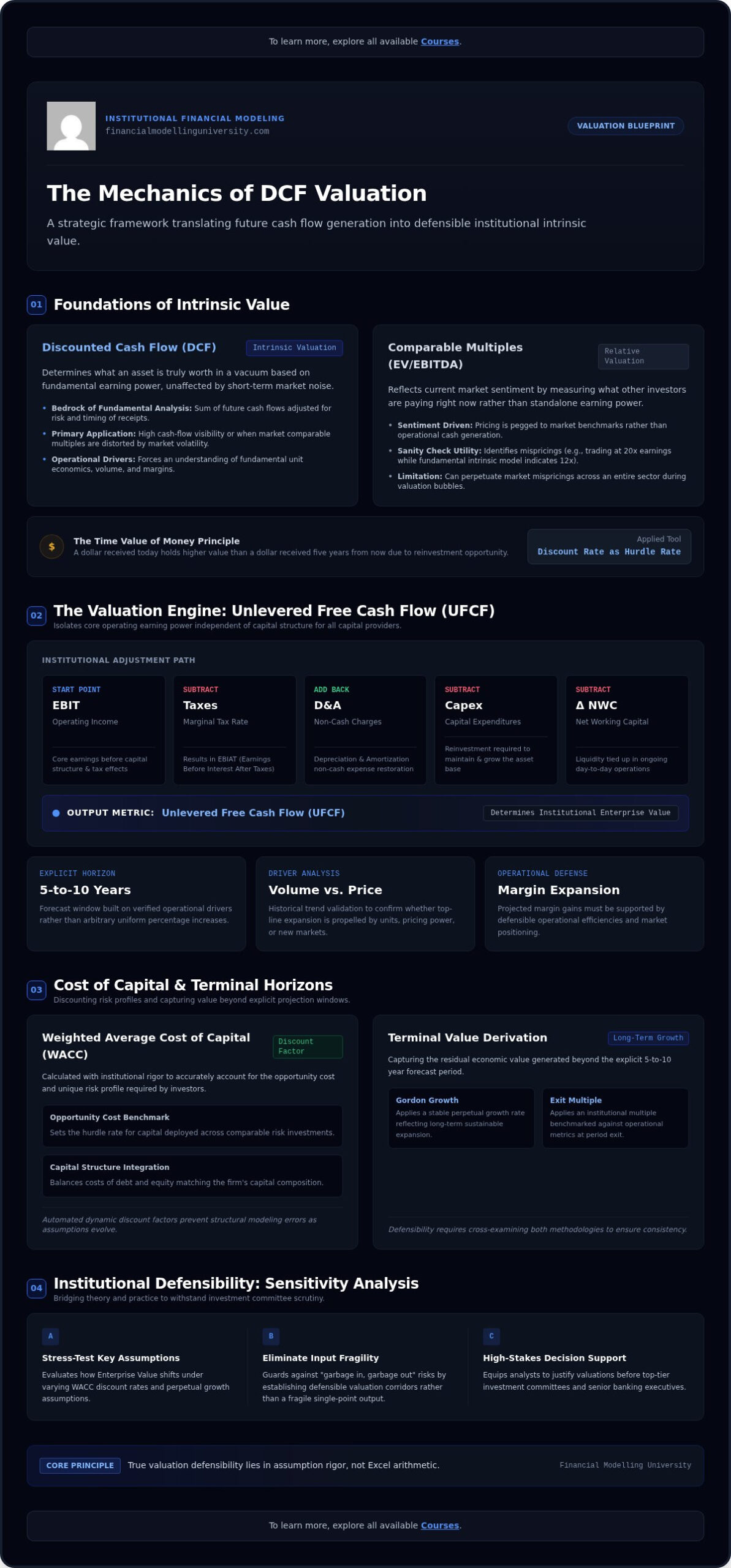
The terminal value represents the single most significant component of any dcf valuation. In institutional models, it often accounts for 60% to 80% of the total enterprise value. Because so much value is back-weighted, your assumptions for the period beyond the explicit forecast must be flawless. Elite analysts use a technical terminal value estimation process to ensure these figures don’t become arbitrary “plug” numbers that distort the final output. You’re effectively modeling the business in its “steady state” where growth and reinvestment have stabilized.
You must employ two primary methodologies: the Gordon Growth Method and the Exit Multiple Method. Professional rigor requires you to calculate both and cross-check the results. If the implied exit multiple from your perpetuity growth calculation significantly exceeds current market comps, your long-term growth rate is likely too aggressive. This triangulation is what separates a defensible model from a theoretical exercise. It’s a standard practice in top-tier banks to use one method as the primary driver and the other as a sanity check.
This approach assumes the business will grow at a constant rate (g) forever. Selecting this rate requires extreme caution. A fundamental rule in finance is that your perpetual growth rate cannot exceed the long-term growth rate of the economy where the company operates. If it did, the company would eventually become the entire GDP. Most institutional models use a growth rate between 2% and 3%, often tied to long-term inflation targets or GDP projections. You must ensure the formula correctly discounts this perpetual stream back to the present day.
The exit multiple method is favored in investment banking because it reflects how the market actually prices businesses. You apply a relevant multiple, such as EV/EBITDA or EV/Revenue, to the financial metrics of your final forecast year. You must normalize the final year EBITDA to remove one-time items or cyclical peaks. Professional models also apply a mid-year convention adjustment to account for the fact that cash flows are received throughout the year. Master these nuances by enrolling in our Investment Banking Financial Modeling Course.
Sensitivity analysis is your final defense in a robust dcf valuation. By building data tables that test how changes in WACC and terminal growth affect the valuation, you can present a range of values to an investment committee. These tables typically feature WACC on the y-axis and the terminal growth rate on the x-axis. This demonstrates that you’ve considered the inherent volatility of the markets and aren’t wedded to a single, static number. It shows the “valuation football field” that institutional investors expect to see.
Technical proficiency in dcf valuation is the price of admission for high-stakes finance roles. It isn’t just about building a standalone model; it’s about integrating that model into a broader strategic framework. Mastery of these mechanics serves as the essential foundation for an M&A modeling course, where you’ll evaluate targets and quantify synergies. Without a rock-solid DCF, your accretion/dilution analysis lacks a credible baseline for the target’s standalone value. You must understand how intrinsic value shifts when ownership changes or operational efficiencies are realized.
In the high-pressure environment of an investment committee, your spreadsheet is only as good as your ability to defend it. Senior bankers and VPs will challenge your terminal growth rates and WACC inputs with aggressive questioning. You must bridge the gap between technical execution and strategic storytelling. This same rigor applies as you transition toward private equity financial modeling, where the focus shifts from intrinsic value to internal rates of return and debt repayment capacity. Perform at this level, and you position yourself as a high-status professional ready for career transformation.
Junior analysts spend the majority of their time refining the inputs and ensuring “no-nonsense” formatting. Your Excel workbooks must be clean, logical, and audit-ready. Precision isn’t optional; it’s the hallmark of a professional. Beyond the numbers, you’re responsible for building the narrative. You must link every revenue growth assumption back to specific market trends or business strategies. If you can’t explain why a margin is expanding based on real-world operational changes, the number shouldn’t be in your model. This level of discipline is what FMU teaches to ensure you’re industry-ready.
Elite practitioners never rely on a single number. You’ll use sensitivity tables (Data Tables) to show how valuation ranges shift under different scenarios. These tables are the centerpiece of any investment committee deck, providing a visual representation of risk. You’ll also create “Football Field” charts to compare your dcf valuation against comparable company multiples, precedent transactions, and 52-week high/low stock prices. This triangulation provides the “sanity check” needed to validate your findings before a deal moves forward. Institutional practitioners value this multifaceted approach because it acknowledges market volatility while maintaining academic rigor. Success in elite banking requires this level of disciplined, multi-layered analysis that goes far beyond simple data entry.
Achieving mastery in dcf valuation isn’t just a technical requirement; it’s a career-defining milestone. You’ve learned how to isolate intrinsic value through precise UFCF forecasting and rigorous WACC derivation. By applying terminal value cross-checks and sensitivity analysis, you move beyond basic arithmetic to build models that withstand the most intense scrutiny from investment committees. This level of discipline is exactly what elite firms demand from their analysts.
Financial Modelling University provides the institutional-grade curriculum and downloadable Excel templates you need to perform at this level. We’re trusted by 25,000+ finance professionals who use our globally recognized certificates to accelerate their advancement. It’s time to Master Financial Modeling Like the Pros and secure your place at the top of the industry. Your path to professional mastery is structured and within reach.
Unlevered dcf valuation calculates the Enterprise Value by discounting Unlevered Free Cash Flows at the Weighted Average Cost of Capital. This method is independent of capital structure, making it the industry standard for investment banking. Levered DCF discounts cash flows available only to equity holders at the Cost of Equity to derive Equity Value directly. Most professionals prefer the unlevered approach because it allows for a cleaner comparison across peer groups with different debt levels.
Choosing the correct discount rate requires calculating the Weighted Average Cost of Capital (WACC) for unlevered models. You must derive the Cost of Equity using the Capital Asset Pricing Model (CAPM) and determine the after-tax Cost of Debt. This rate acts as a hurdle that reflects the specific operational and financial risks of the business. For institutional accuracy, ensure your risk-free rate and equity risk premium are based on current 2026 market data.
Terminal Value is high because it captures the present value of all future cash flows beyond the explicit forecast period. In a standard five or ten-year model, this single figure accounts for the business’s value into perpetuity. Since a healthy company is expected to operate indefinitely, the cumulative value of those decades of cash flow naturally outweighs the initial forecast years. It typically represents 60% to 80% of the total enterprise value.
You can use dcf valuation for startups, but the model requires a much longer explicit forecast period. You must project the financials until the company reaches a “steady state” with positive, predictable cash flows. This often involves modeling a transition from high-growth, high-burn phases to operational maturity. Analysts must defend these long-term assumptions by focusing on unit economics, customer acquisition costs, and the eventual path to sustainable profitability in a competitive landscape.
The mid-year convention assumes that cash flows are received steadily throughout the year rather than in a single lump sum on December 31st. By discounting cash flows from the midpoint of each period, you decrease the discount period by 0.5 years for every entry. This adjustment results in a higher valuation because cash received earlier is more valuable. Institutional models use this convention to more accurately reflect the actual timing of corporate cash receipts.
Common mistakes include using unrealistic terminal growth rates that exceed GDP and failing to align Capex with Depreciation in the terminal year. Analysts also frequently use book values for debt and equity instead of market values when calculating WACC. These errors violate the “no-nonsense” precision required in elite banking. Another frequent pitfall is ignoring the change in Net Working Capital, which can significantly distort the actual cash available to the business’s capital providers.
When a company has a high debt-to-equity ratio, you must use a target capital structure that reflects the long-term financing strategy rather than a temporary spike. High leverage increases the financial risk to equity holders, which you must capture by levering the Beta. This raises the Cost of Equity. Always use the market value of equity and the market value of debt to ensure your WACC weights reflect current institutional reality rather than outdated accounting figures.
A DCF is generally considered more accurate for determining intrinsic value because it focuses on a company’s specific fundamental drivers. Multiples valuation is a relative method that reflects current market sentiment, which can be volatile or irrational. While multiples provide a useful “sanity check,” elite practitioners prioritize the DCF for its academic rigor and ability to isolate value in a vacuum. Most professional reports use both methods to triangulate a defensible valuation range.