


What if the key to unlocking your financial modeling potential lies in mastering terminal value estimation? Many professionals in investment banking and private equity find themselves grappling with the complexities of accurately calculating terminal value, often leading to uncertainty and fear of miscalculations. You’re not alone if you’ve felt overwhelmed by the myriad of methods available or if you worry about the implications of an inaccurate estimate on your financial models. In this article, you’ll learn the essential steps to confidently estimate terminal value and significantly improve the accuracy of your financial projections. We’ll break down the various methods, provide actionable insights, and equip you with a comprehensive checklist tailored for 2026. Get ready to elevate your financial modeling expertise and position yourself as a leader in the high-stakes world of finance.
Terminal value represents the estimated value of a business beyond the explicit forecast period in a Discounted Cash Flow (DCF) model. It is a crucial component, often accounting for a significant portion—sometimes over 70%—of the total valuation. This highlights its importance in determining the long-term financial outlook of a company. Understanding terminal value estimation is essential for finance professionals aiming to provide accurate valuations that guide investment decisions.
The impact of terminal value on long-term valuation cannot be overstated. It serves as a projection of future cash flows into perpetuity, reflecting the growth potential of a business. For investors, a well-estimated terminal value can offer insights into the sustainability of a company’s operations and its ability to generate returns over time. A miscalculation can lead to substantial discrepancies in the valuation, ultimately affecting strategic decisions regarding investments, mergers, or acquisitions. For more in-depth insights, consider exploring Cash Flow Analysis for Professionals.
<pWhen estimating terminal value, several assumptions play a pivotal role:
Employing realistic assumptions is critical; over-optimism can lead to inflated valuations, while overly conservative estimates may undervalue a company’s potential. By emphasizing precision in terminal value estimation, finance professionals can enhance overall valuation accuracy and support informed decision-making.
Mastering terminal value estimation is crucial for financial professionals aiming to produce accurate valuation models. This section will guide you through a systematic checklist for estimating terminal value effectively, ensuring you choose the right method and execute the calculations accurately.
The first step in terminal value estimation is selecting the appropriate method based on the business context. The two primary approaches are the perpetuity growth model and the exit multiple approach, each suited for different scenarios.
Selecting the right method is vital. If your business context indicates stable cash flows, lean towards the perpetuity growth model. Conversely, if market dynamics suggest variable earnings, the exit multiple approach may yield a more accurate estimate.
Once you’ve selected a method, follow these key steps to calculate terminal value accurately:
Integrating terminal value into your Discounted Cash Flow (DCF) model is essential for a comprehensive valuation. Use Excel effectively by employing formulas and functions to streamline calculations, ensuring accuracy and efficiency.
By mastering these steps, you position yourself to deliver precise terminal value estimations. This expertise not only enhances your analytical skills but also strengthens your professional profile in competitive finance roles. For further insights, consider visiting relevant anchor text to expand your knowledge and skillset in financial modeling.
Terminal value estimation is a critical component of financial modeling, yet many professionals fall victim to common pitfalls that can skew their results. Understanding these mistakes and how to avoid them is essential for accurate valuations. This section highlights prevalent errors in terminal value estimation, offers strategies to mitigate them, and underscores the necessity of sensitivity analysis in achieving robust financial assessments.
One of the primary mistakes in terminal value estimation is the assumption of unrealistic growth rates. Analysts often project growth rates that are overly optimistic or inconsistent with historical performance. For instance, a company that has historically grown at 5% should not be projected to maintain a 10% growth rate indefinitely. To avoid this error, base your growth rate assumptions on a combination of historical data, industry trends, and macroeconomic indicators.
Another area of concern is the selection of the discount rate. An improper discount rate can significantly distort the present value of future cash flows. For example, using a discount rate that is too low may inflate the terminal value, while an excessively high rate may undervalue it. Always ensure that the discount rate reflects the company’s weighted average cost of capital (WACC) and is consistent with the risk profile of the investment.
To delve deeper into financial modeling techniques, consider exploring Mastering Investment Banking Financial Modeling.
Sensitivity analysis is a powerful tool that enhances the accuracy of terminal value estimations by examining how changes in key assumptions impact the final valuation. By testing different scenarios, such as varying growth rates or discount rates, you can better understand the potential range of outcomes and the inherent risks involved.
To perform sensitivity analysis on terminal value, follow these steps:
For example, you might test a base growth rate of 5%, a low scenario of 3%, and a high scenario of 7%. Similarly, you can adjust the discount rate from 8% to 10% and 12%. This structured approach reveals how sensitive your terminal value estimation is to changes in these assumptions, allowing for more informed decision-making.
By avoiding common pitfalls and embracing sensitivity analysis, you position yourself for greater accuracy in terminal value estimation, ultimately leading to enhanced valuation and investment decisions.
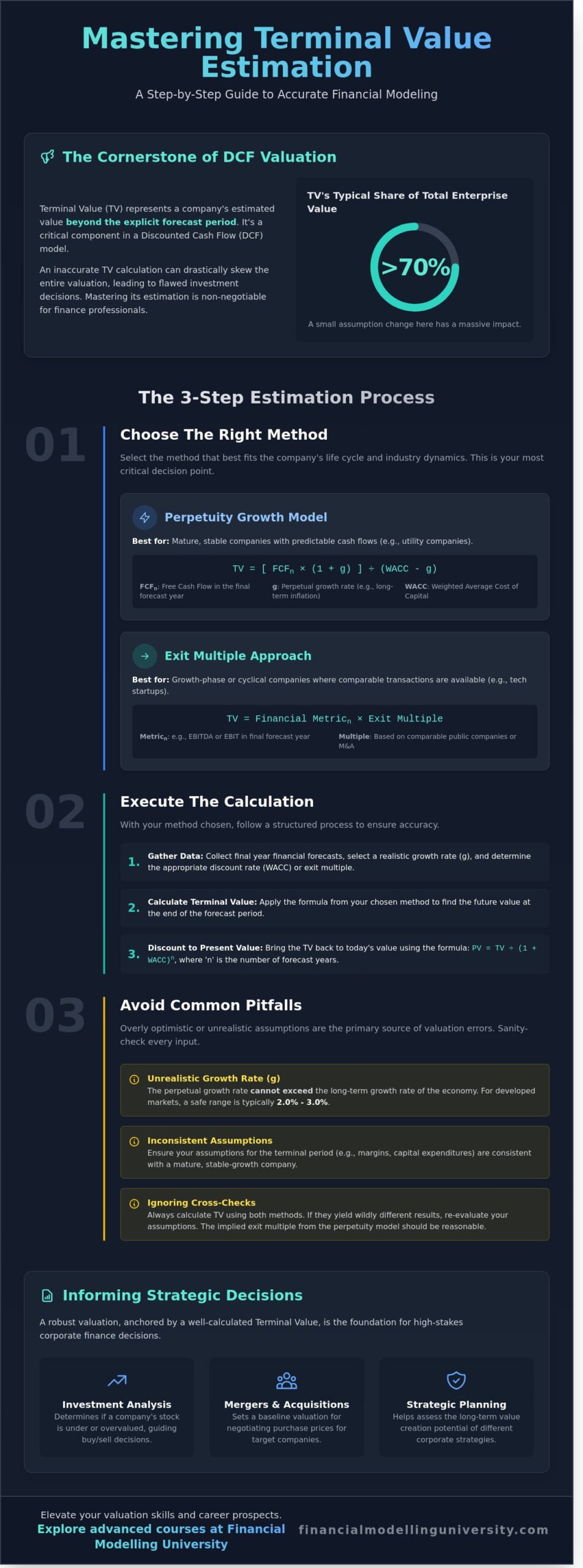
Understanding how to interpret terminal value results is crucial for making informed strategic decisions in corporate finance and investment. Terminal value estimation represents the present value of all future cash flows beyond a specific forecast period, often constituting a significant portion of a company’s total valuation. Consequently, it has far-reaching implications for various financial strategies.
In the context of merger and acquisition strategies, terminal value can significantly influence decision-making. For instance, a prospective buyer evaluating a target company must consider its terminal value to assess whether the acquisition price reflects the company’s long-term growth potential. If the terminal value estimation indicates strong future cash flows, it may justify a higher purchase price.
Consider a real-world example: Company A evaluates Company B for acquisition. Company B’s DCF analysis reveals a terminal value of $500 million, suggesting robust growth prospects. This figure encourages Company A to proceed with the acquisition, believing the investment will yield substantial returns over time.
Corporate finance professionals should also consider the sensitivity of terminal value to changes in growth rates and discount rates. A slight adjustment in these variables can lead to significant fluctuations in terminal value, impacting not just acquisitions but also investment decisions. For example, a 1% increase in the discount rate could reduce the terminal value by 10%, fundamentally altering strategic options.
Effectively communicating terminal value results to stakeholders is essential for ensuring alignment and understanding. Here are some best practices for presenting these results:
When explaining terminal value estimation to non-experts, emphasize its practical significance. For instance, relate the terminal value to potential future cash flow distributions or the implications for shareholder value. This approach can foster deeper engagement and understanding among stakeholders who may not possess a financial background.
For those looking to enhance their financial modeling skills further, consider exploring Private Equity Financial Modeling, which provides robust insights into practical applications of financial metrics.
Mastering the interpretation of terminal value results not only bolsters analytical capabilities but also enhances strategic discussions within your organization. To elevate your financial acumen, explore advanced training opportunities that align with your career goals.
As you refine your skills in terminal value estimation and other vital areas of financial modeling, consider leveraging the resources available through Financial Modelling University (FMU). The institution offers advanced courses, personalized mentoring, and globally recognized certification programs designed to elevate your proficiency and career trajectory.
FMU features a suite of specialized courses focused on valuation and financial modeling. These advanced programs delve deeper into complex topics, such as discounted cash flow (DCF) analysis, merger and acquisition (M&A) modeling, and leveraged buyout (LBO) valuation. By engaging in these courses, you not only enhance your technical expertise but also position yourself for significant career advancement. Graduates of these courses have reported a 30% increase in job placement rates and promotions within a year of completion.
For more information on these offerings, visit Financial Modeling Course Online.
FMU provides one-on-one mentoring sessions that cater to your unique learning needs. This personalized guidance is invaluable, particularly when tackling complex topics like terminal value estimation. Through direct interaction with seasoned professionals, you gain insights that are often not available in traditional classroom settings. The mentoring process is structured to foster your growth, equipping you with the tools and confidence to tackle real-world financial challenges.
Additionally, FMU’s certification programs are recognized globally, enhancing your credentials in the competitive landscape of finance. Many alumni have successfully transitioned into elite positions across investment banking, private equity, and corporate finance, attributing their success to the robust training and certification received at FMU. Success stories abound, with past students reporting promotions and job offers shortly after completing their programs.
Explore FMU’s comprehensive course catalog to discover how you can take your financial modeling skills to the next level. The journey to becoming an expert practitioner in terminal value estimation and beyond starts here, where ambition meets rigorous training and unparalleled support.
Ready to take your skills to the next level? Discover advanced financial modeling courses at FMU, where you’ll gain globally recognized certifications, one-on-one mentoring, and access to expert-led courses. Equip yourself with the tools needed for elite career mastery in investment banking, private equity, and corporate finance. Your journey to professional excellence starts now. Embrace the challenge and excel!
Terminal value represents the estimated value of a business at the end of a forecasting period, capturing its cash flows beyond that horizon. It is crucial in financial modeling because it accounts for a significant portion of a company’s total value, often exceeding 60% in discounted cash flow (DCF) analyses.
To calculate terminal value using the perpetuity growth model, apply the formula: Terminal Value = Final Year Cash Flow × (1 + Growth Rate) / (Discount Rate – Growth Rate). For instance, if a company has a final year cash flow of $1 million, a growth rate of 3%, and a discount rate of 10%, the terminal value would be approximately $14.3 million.
The exit multiple method offers a straightforward approach by applying an industry-specific multiple to the company’s projected earnings, such as EBITDA. This method is advantageous because it reflects current market conditions and allows for quicker calculations, making it useful for investors seeking rapid insights into a company’s future potential.
Terminal value is vital in DCF models as it often constitutes a large portion of the total valuation, sometimes upwards of 75%. By estimating future cash flows beyond the forecast period, terminal value ensures a more accurate representation of a company’s worth and aids in informed investment decisions.
Sensitivity analysis enhances terminal value estimations by testing how changes in key assumptions—such as growth rates and discount rates—impact valuation outcomes. By evaluating multiple scenarios, financial analysts can identify ranges of potential terminal values, leading to more robust and informed investment strategies.
Common mistakes in terminal value calculations include using unrealistic growth rates or failing to account for market conditions. Additionally, neglecting to perform sensitivity analysis can lead to over-reliance on a single estimate, which may misrepresent the company’s potential value in varying economic contexts.
Terminal value directly influences strategic financial decisions by providing insights into long-term growth potential. Companies with a higher terminal value may attract more investment and better financing options. Conversely, an undervalued terminal value may lead to missed opportunities in mergers, acquisitions, or divestitures.