


A spreadsheet is not a financial model; it’s a liability waiting to compromise a multi-million dollar transaction. You likely recognize that the gap between “knowing Excel” and executing institutional-grade analysis is widening as we approach 2026. Most ambitious professionals feel the weight of information overload when searching for a clear answer to what is financial modelling in the context of elite finance. You don’t just want to “use” software. You want to build robust, dynamic tools that survive the scrutiny of a private equity partner or an investment committee. Mastering these technical granularities is the definitive gateway to elite professional status and long-term job security.
This guide provides a pragmatic roadmap by stripping away the amateur habits that stall careers in investment banking and private equity. We’ll move past basic formulas to explore the strategic purpose of three-statement modeling and DCF analysis in high-stakes environments. You’ll master the fundamental definitions and the career-defining power of elite analysis that drives real-world deal flow. We are moving from abstract theory to the precision of the Expert Practitioner. By the end of this article, you will understand the core components of professional models and the specific path to becoming desk-ready for the next fiscal year.
In the high-stakes corridors of investment banking and private equity, a model isn’t just a collection of cells. It’s a living, breathing mathematical representation of a company’s financial performance and future expectations. While a novice might ask what is financial modelling to understand the basics of quantitative finance, the elite practitioner views it as the ultimate decision-making engine. Spreadsheets serve as the canvas, but the logic is the paint. A professional model translates complex business narratives into a structured numerical output, allowing stakeholders to visualize the impact of every strategic lever.
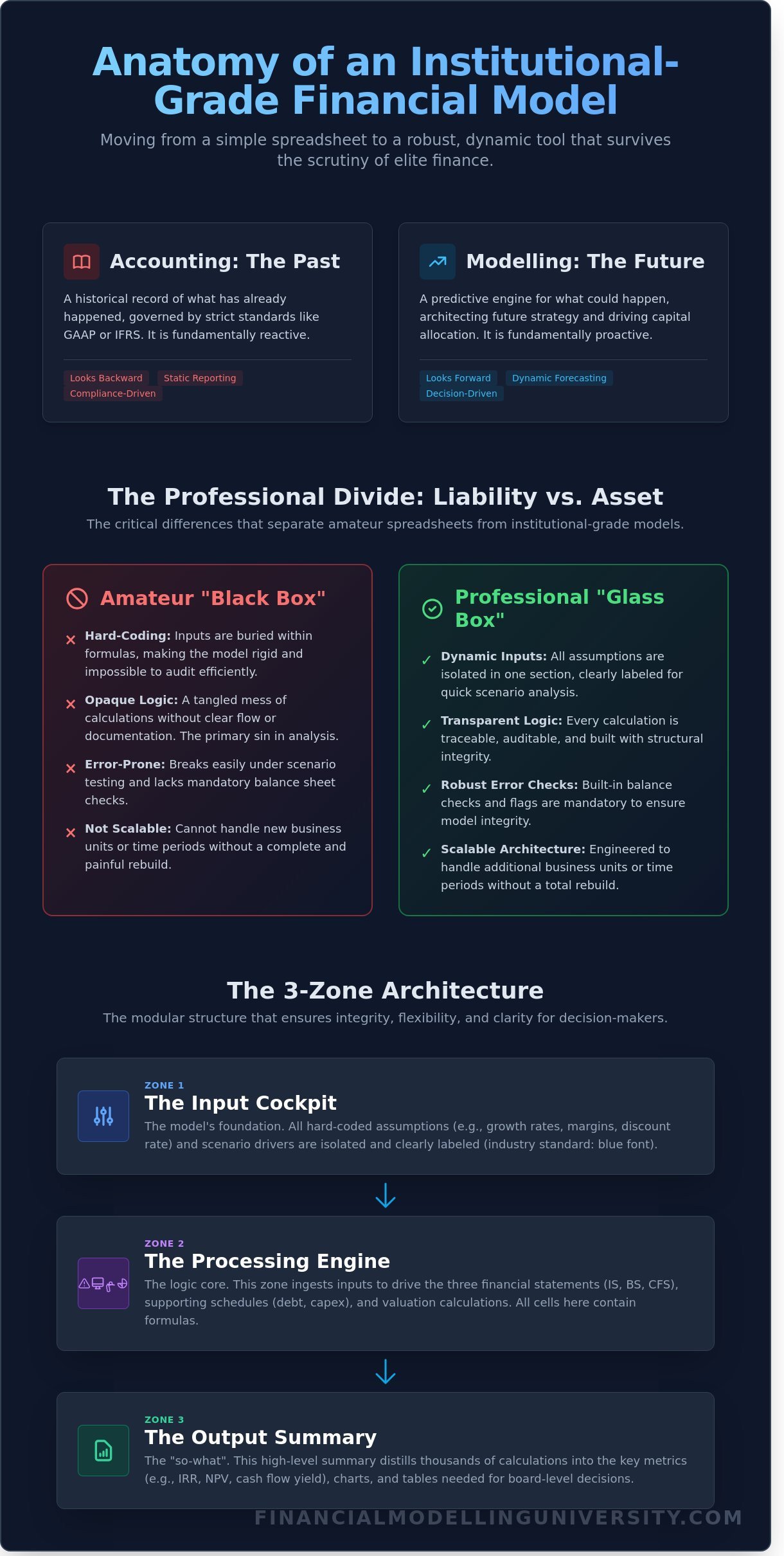
There’s a fundamental divide between accounting and modelling. Accounting looks backward. It’s the record of what happened, governed by GAAP or IFRS standards. Modelling, however, is forward-looking. It moves from historical data reporting to predictive strategic forecasting. You aren’t just tallying past revenue; you’re architecting the future. In 2024, the distinction became even sharper as firms shifted from static 5-year plans to dynamic, rolling forecasts that react to real-time market volatility. Mastery of this skill is the definitive gateway to elite professional status and job security in a competitive market.
Models drive capital allocation. C-suite executives at Fortune 500 companies rely on these tools to justify multi-billion dollar investments. A robust model provides a risk-free environment to test “What-If” scenarios, such as a 15% spike in raw material costs or a sudden business pivot into a new territory. During high-stakes M&A negotiations, the model becomes the definitive source of truth. It determines the valuation that either closes the deal or kills it. Without a model, you’re just guessing. With one, you’re calculating risk with surgical precision.
The hallmark of professional work is transparency and flexibility. Amateur models are often “black boxes” filled with hard-coding, which is the primary sin in institutional-grade analysis. Hard-coding prevents scalability and hides errors. Top-tier banks demand Excel financial modeling standards where every input is isolated and every calculation is traceable. This rigor ensures that when a Managing Director asks for a sensitivity analysis at 2:00 AM, the model doesn’t break. Precision isn’t optional. It’s the barrier to entry for elite finance roles. Understanding what is financial modelling at this level requires a commitment to technical excellence and structural integrity.
Institutional-grade models aren’t merely spreadsheets; they’re engineered decision-engines. When elite analysts define what is financial modelling, they describe a modular architecture that separates logic from data. This structural integrity ensures that a change in a single variable, such as a 50-basis point shift in the 2026 discount rate, ripples through the entire system without compromising the workbook’s integrity. A robust model consists of three distinct zones: the input cockpit, the processing engine, and the output summary.
The input section serves as the model’s foundation. You must isolate every hard-coded variable here, typically using the industry-standard blue font to distinguish them from black-font formulas. This isolation allows an associate to run 25 plus scenario iterations in minutes rather than hours. The processing engine then ingests these inputs to drive the three-statement link. Finally, the output section distills thousands of calculations into a single page of “so-what” metrics like Internal Rate of Return (IRR), Net Present Value (NPV), and cash flow yield. For those aiming for the elite tier of finance, mastering these structural fundamentals is the non-negotiable first step toward professional excellence.
Effective dashboards bridge the gap between technical analysts and executive decision-makers by visualizing Real-World Applications of Financial Models through dynamic charts and sensitivity tables. A summary dashboard should highlight the 3 to 5 variables that move the needle most, providing the C-suite with immediate clarity on risk and reward.
The core of what is financial modelling lies in the dynamic loop between the Income Statement, Balance Sheet, and Cash Flow Statement. A model isn’t considered balanced until the ending cash balance on the Cash Flow Statement ties perfectly to the cash line on the Balance Sheet. Circularity arises when the interest expense on the income statement depends on the average debt balance, while that same debt balance is simultaneously influenced by the net income generated on the income statement. This interaction creates a self-correcting loop that reflects the true financial health of an enterprise.
Precision in 2026 requires moving beyond historical averages to identify Key Value Drivers like Customer Acquisition Cost (CAC) or specific commodity price hedges. You must distinguish between hard data, such as a signed lease agreement, and calculated assumptions like a 4.2% terminal growth rate. Sourcing credible benchmarks is critical; for instance, enterprise SaaS models in 2026 often target a 3.5 to 1 LTV-to-CAC ratio to remain competitive. Professional models use these drivers to stress-test the business against volatile market conditions, ensuring the analysis remains robust under pressure.
The modelling ecosystem isn’t a static collection of templates. It’s a dynamic framework designed to solve specific strategic puzzles. Understanding what is financial modelling in a professional context means recognizing that a model’s architecture must mirror the complexity of the underlying asset. A seed-stage startup needs a lean, 12-month cash flow forecast to survive. Conversely, a global enterprise undergoing a carve-out requires a multi-entity consolidation with complex tax layering and intercompany eliminations.
Models evolve alongside the business lifecycle. You start with operational budgets and graduate to complex transaction structures as capital requirements increase. Professional-grade models incorporate rigorous sensitivity analysis to mitigate investment risk. By stressing variables like WACC or EBITDA margins by 150 basis points, analysts quantify the margin of safety. This isn’t just data entry. It’s risk engineering. Matching model complexity to the business stage prevents over-modelling early ventures or under-modelling mature acquisitions.
The Discounted Cash Flow (DCF) model remains the gold standard for intrinsic valuation. It forces a granular look at long-term free cash flow and terminal value, providing a “ground truth” independent of market sentiment. Complementing this is Comparable Company Analysis. This provides a market-based reality check using trading multiples from peer groups. To build these from scratch with institutional precision, consult our guide on investment banking financial modeling.
When the stakes involve billions in capital, specialized structures are required. Merger analysis focuses on accretion, dilution, and the exact timing of synergy realization. You can explore these mechanics in our deep dive on m&a modeling. For private equity, the Leveraged Buyout (LBO) model is the primary tool for testing debt capacity and IRR targets. Mastery of private equity financial modeling is what separates elite associates from the rest of the field. Finally, project finance models handle long-term infrastructure assets. These focus on complex debt sculpting and cash flow waterfalls over 25 year horizons. Knowing what is financial modelling at this level requires an understanding of how specific debt covenants impact equity returns.
Accuracy is merely the baseline for entry. In the high-stakes world of institutional-grade analysis, readability is what determines your career trajectory. If a Managing Director cannot audit your logic within 120 seconds, your model is a liability. By 2026, AI tools like Microsoft Copilot have automated roughly 85% of the data cleaning process; however, they cannot architect the strategic logic required for a complex LBO or M&A transaction. Understanding what is financial modelling in this new era means mastering the “why” behind the numbers rather than just the mechanics of Excel.
Common pitfalls remain the primary cause of deal-delaying errors. Over-complexity often masks a lack of fundamental understanding. Hidden circularities and zero documentation turn a workbook into a “black box” that no institutional investor will trust. You must perform a rigorous Stress Test before your seniors see the file. This involves toggling extreme bear-case scenarios to ensure the balance sheet still balances and the debt covenants don’t trigger errors under pressure. If your model breaks during a simple sensitivity check, it isn’t desk-ready.
Precision is a habit, not an accident. Adhering to global standards ensures your work can be passed between teams without friction. Consistent color-coding is the first rule: use blue for hard-coded inputs and black for formulas. This isn’t a suggestion; it’s a requirement for auditability. Build modular “Schedules” for Debt, PP&E, and Working Capital to keep the main Three-Statement engine clean. Finally, maintain a detailed Change Log. In collaborative environments, knowing who adjusted a growth assumption at 3:00 AM is vital for version control and risk management.
A formal investment banking certification serves as a technical seal of approval for recruiters. While internal bank training provides a foundation, it often lacks the depth of elite external programs that simulate real-world deal pressure. In the 2026 hiring landscape, finance certifications have become mandatory filters for elite roles. They prove you possess the technical proficiency to contribute on Day 1 without constant supervision. Mastery of what is financial modelling requires a commitment to these professional standards to ensure your output is always institutional-grade.
Don’t leave your career to chance. Secure your future with elite training at Financial Modelling University.
Mastering the spreadsheet is the most effective way to decouple your income from your hours worked. In high-finance hubs like New York or London, the ability to build a dynamic, error-free model is the primary differentiator between back-office support and front-office dealmaking. By 2026, entry-level analysts who lack institutional-grade skills face a 40% higher risk of displacement by automated tools. Conversely, those who can architect complex scenarios see salary premiums of 25% or more compared to their peers. It’s not just a technical skill; it’s a career insurance policy.
The daily life of an elite modeller is a high-stakes transition from granular data to strategic narrative. Your morning might begin at 8:00 AM scrubbing raw trial balance data for a $500 million acquisition target. By midday, you’re sensitizing debt covenants to ensure the deal doesn’t breach under a 2% interest rate hike. By 4:00 PM, you’re standing in front of the Investment Committee, using your model to defend a valuation. You aren’t just an “Excel person.” You’re the person who provides the certainty required to move capital.
The 2026 market belongs to the Hybrid Analyst. This professional understands that what is financial modelling at its core is the art of quantifying the future through a blend of technical precision and business intuition. You don’t just build formulas; you build arguments. If you can’t explain why a revenue driver is set at 5% instead of 7%, your technical skill is useless. The goal is to move from theoretical knowledge to institutional-grade execution where every cell serves a strategic purpose.
Your path to the top starts with an unbreakable foundation. You can’t build a skyscraper on a swamp, so begin by mastering excel for finance. Once your mechanics are fast and fluid, move to building your first three-statement model from a blank sheet. Avoid templates; they’re a crutch that prevents true understanding. To truly understand what is financial modelling in a professional context, you must see how the Income Statement, Balance Sheet, and Cash Flow statement breathe together. Finally, accelerate your trajectory by enrolling in a financial modeling course online. This moves you beyond academic theory and into the brutal, practical reality of institutional finance.
Mastering the mechanics of a three-statement model is the difference between a stagnant back-office role and a high-impact seat in private equity. You’ve seen that understanding what is financial modelling goes beyond basic Excel functions; it’s the rigorous application of logic to forecast a company’s future value with institutional precision. Professional standards require moving past the “Garbage In, Garbage Out” trap to build dynamic frameworks that survive the scrutiny of a $500 million credit committee. Data from 2024 indicates that 85% of top-tier investment banks now prioritize technical modeling proficiency over academic prestige alone. This shift makes high-level technical skill your ultimate leverage in a volatile market.
To bridge the gap between theory and the trading floor, you need a structured path to excellence. Secure Your Future with the Investment Banking Financial Modeling Blueprint and gain access to globally recognized certifications, 1-on-1 career mentoring from 15-year industry veterans, and the exact institutional-grade Excel templates used at global bulge bracket firms. You have the ambition to reach the elite levels of finance. Now, equip yourself with the tools to stay there.
Financial modelling is fundamentally different from accounting because it focuses on future projections rather than historical reporting. While accounting ensures that a firm’s 2025 financial statements comply with GAAP or IFRS standards, understanding what is financial modelling involves using those historical figures to forecast performance under various strategic scenarios. It requires a mastery of the three-statement model to ensure the balance sheet always balances dynamically.
You can access basic tutorials on platforms like YouTube, but self-teaching rarely meets the 100% accuracy standard required by Tier-1 investment banks. Free resources often lack the rigorous error-checking protocols and complex capital structure mechanics found in institutional-grade training. To compete for private equity roles in 2026, you need structured feedback that replicates a high-pressure deal environment and forces you to eliminate technical errors.
Microsoft Excel continues to be the dominant tool for 95% of practitioners in 2026 due to its unmatched flexibility and the widespread adoption of Power Query. While specialized platforms exist, elite analysts use Excel combined with VBA or Python integrations to handle massive datasets. Mastery of keyboard shortcuts and efficient formula construction remains the baseline requirement for any professional analyst working at a global bulge bracket firm.
Achieving institutional-grade proficiency typically requires 150 to 200 hours of deliberate practice over a 4 to 6 month period. This timeline assumes you’re building at least 10 full three-statement models from scratch across different industries. True mastery isn’t about speed; it’s about developing the mental framework to link complex operational drivers to cash flow outcomes without relying on manual adjustments or clunky workarounds.
You don’t need advanced calculus or a PhD in mathematics to excel in this field. Professional modelling relies on 8th-grade arithmetic combined with rigorous logical sequencing and a deep understanding of financial theory. The challenge lies in your ability to translate a 50-page credit agreement or a complex tax code into a series of interconnected formulas. Precision and attention to detail are far more valuable than theoretical mathematical prowess.
The Leveraged Buyout (LBO) model is widely considered the most complex due to its intricate debt waterfalls and circular references. A robust LBO model must accurately track multiple tranches of debt, PIK interest, and IRR sensitivities across a 5 to 7 year investment horizon. Understanding what is financial modelling at this level requires an intimate knowledge of how capital structure shifts impact equity returns for private equity sponsors.
AI won’t replace modellers by 2030, but it will certainly replace modellers who don’t use AI. According to a 2024 Gartner report, 80% of routine finance tasks will be automated, yet the demand for human judgment in strategic capital allocation remains absolute. High-level analysts use AI to clean data and generate initial shells, allowing them to focus on the nuanced assumptions that drive multi-billion dollar investment decisions.