


An institutional-grade comparable company analysis is not a math exercise; it’s a strategic defense of relevance through rigorous normalization. While many junior analysts simply pull tickers and average out multiples, elite practitioners know that a defensible valuation requires a deeper understanding of capital structures and sector-specific nuances. You’ve likely faced the frustration of trying to find “identical” peers or deciding which multiples to use when GAAP data feels inconsistent. With the SEC’s May 2026 proposal to raise the Large Accelerated Filer threshold to $2 billion, the landscape of public disclosure is shifting. This means your ability to adjust financial data for non-recurring items and verify the quality of reporting is now more critical than ever.
At FMU, we believe that mastery is built on precision and industry-proven frameworks. This guide provides the exact blueprint you need to master financial modeling like the pros. You’ll learn how to navigate the 2026 tax environment, including the 15% Corporate Alternative Minimum Tax, to ensure your Enterprise Value calculations are airtight. We’ll move through a step-by-step process to help you identify truly comparable peers, normalize for recent FASB updates like ASU 2026-01, and finally construct a professional football field chart. By the end of this article, you’ll have the confidence to present a valuation range that commands respect in any Investment Committee room.
The market doesn’t care about your beautifully crafted 10-year DCF if it contradicts where capital is actually flowing. Comparable company analysis (CCA) serves as the primary reality check in high-stakes finance. It’s a market-based valuation method that determines a firm’s value by looking at the trading multiples of peer companies with similar financial and operating characteristics. While a DCF tells you what a company “should” be worth based on its future cash flows, trading comps tell you what the market is actually willing to pay right now. This is the distinction between theory and execution.
Theoretical models often fail to capture the visceral mood of the market. Intrinsic valuation looks inward, focusing on the specific risk profile and cash-generating potential of a single entity. However, market sentiment frequently overrides these fundamentals. Elite practitioners use a comparable company analysis to “sanity check” their DCF outputs. If your DCF implies a 15x EBITDA multiple but the entire sector is trading at 8x, your assumptions likely need a rigorous overhaul. In fast-moving sectors where long-term cash flows are unpredictable, relative valuation often becomes the only defensible path forward.
The speed of information in 2026 has transformed how we spread comps. With the SEC’s May 2026 proposal to scale back reporting requirements for 81% of public companies, the quality of your peer data is no longer a given. Analysts must now integrate real-time data feeds to adjust for sudden shifts in industry health. Current interest rate environments also play a decisive role. As the federal corporate tax rate remains at 21%, the cost of capital continues to fluctuate, directly impacting the multiples the market is willing to support. Trading comps provide the “live” snapshot required to navigate these complexities with the precision of an industry expert.
Selecting the right peer group is the most critical step in a comparable company analysis. Most junior analysts make the mistake of looking for companies that sell the same product. Professional practitioners know that business model similarity and capital structure are far more important. A company selling high-end medical devices via a recurring subscription model cannot be compared to a manufacturer selling similar devices via one-time capital sales. Their risk profiles, cash flow predictability, and market multiples will differ fundamentally.
Start with broad industry classification codes like SIC or GICS, but don’t stop there. Apply hard quantitative filters for revenue, EBITDA, and market capitalization. With the SEC’s May 2026 proposal raising the Large Accelerated Filer threshold to $2 billion, size now dictates reporting transparency and liquidity more than ever. Geography also introduces specific risks. A domestic peer operates under a flat 21% federal corporate tax rate, while an international competitor may face different regulatory burdens or currency fluctuations that distort their multiples. Filter strictly to maintain a clean data set.
Multiples are essentially a shorthand for a company’s growth and risk profile. You cannot compare a mature incumbent with 2% annual growth to a high-growth disruptor scaling at 30%. Their P/E and EV/EBITDA multiples will naturally diverge. Elite-level precision requires filtering by ROIC and operating margins. If your target company maintains a 25% margin while the peers average 10%, your peer group is flawed. To refine your technical intuition and learn how to handle these complex adjustments, explore the Investment Banking Financial Modeling Course for a deeper dive into professional-grade peer selection.
Spreading comps is where the technical analyst separates themselves from the data entry clerk. Raw financial data is often “noisy” and inconsistent across different firms. To perform a professional comparable company analysis, you must first normalize the financials to ensure you’re comparing apples to apples. This process begins with gathering the latest 10-K, 10-Q, and consensus analyst estimates. Because fiscal year-ends rarely align across a peer group, you must calculate Last Twelve Months (LTM) figures to create a synchronized snapshot of performance. Use the standard formula: Current Quarter + Prior Fiscal Year – Prior Year’s Corresponding Quarter. This ensures your multiples reflect the most recent operating reality.
The May 2026 SEC proposal to raise the Large Accelerated Filer threshold to $2 billion has significant implications for this workflow. With approximately 81% of public companies potentially moving to scaled disclosure requirements, many will be exempt from auditor attestation on internal controls. This shifts the burden of data verification onto the analyst. You can’t simply trust the face of the income statement. You must dig into the footnotes to identify non-recurring items and standardize accounting treatments, such as the capitalization of R&D or the treatment of operating leases, to maintain institutional-grade precision.
Elite modeling requires “cleaning” EBITDA to reflect core recurring operations. Scour the management discussion and analysis (MD&A) for hidden one-time charges like restructuring costs, litigation settlements, or M&A integration expenses. If a peer recently completed a major transaction, you must use pro-forma adjustments to account for the full-year impact of that acquisition. Don’t forget to adjust for stock-based compensation if it’s a significant outlier in the sector. These adjustments prevent temporary accounting noise from distorting your valuation multiples.
Choosing the right multiple depends on the capital structure and the sector. Enterprise Value (EV) multiples, such as EV/EBITDA or EV/Revenue, are “capital structure neutral.” They allow you to compare firms regardless of their debt levels. This is why EV/EBITDA is the gold standard for most industrial and service sectors. In contrast, Equity Value multiples like the P/E ratio are used when the bottom line is the primary focus, particularly in sectors like banking where P/B (Price-to-Book) is more relevant. Always match the numerator to the denominator; if the metric is available to both debt and equity holders (like EBITDA), use Enterprise Value. If it’s only for shareholders (like Net Income), use Equity Value.
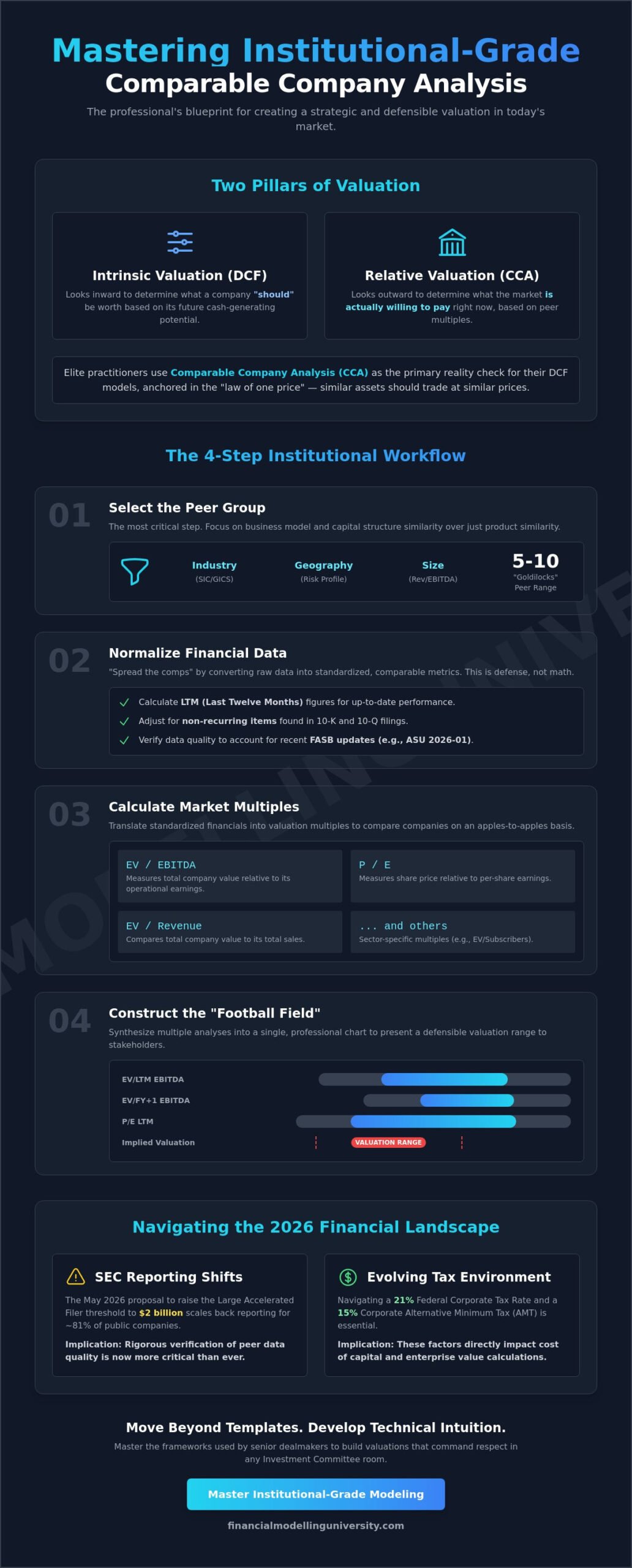
The football field chart is the visual culmination of your comparable company analysis. It transforms a technical spreadsheet into a strategic narrative that senior dealmakers can digest in seconds. While junior analysts often present a single “average” price, elite practitioners provide a valuation range. This range is typically anchored by the 25th and 75th percentiles of your peer group. By utilizing the interquartile range, you effectively strip away the noise of extreme laggards and overvalued outliers. This creates a defensible “middle ground” that accounts for market volatility and slight operational variances.
Interpreting this data requires more than just looking at the output. You must synthesize a narrative. If your target company maintains a superior growth profile or higher operating margins than the peer median, you must argue for a valuation at the top end of the range. Conversely, if the target faces specific regulatory risks or has a less diversified revenue stream, a discount is warranted. Your job is to explain exactly where the target sits on that field and why. This synthesis turns raw math into institutional-grade advice.
The median is the industry standard for a reason: it prevents a single massive outlier from skewing the entire peer group. However, sophisticated analysts often look at the harmonic mean when dealing with ratio-based data like P/E multiples. The harmonic mean provides a more accurate average of “value” because it effectively averages the yields rather than the prices. For market-cap-heavy sectors where two or three firms dominate the industry, consider a weighted average to reflect the true market reality. Precision in these calculations builds the credibility required for high-stakes presentations.
Expect the Investment Committee to challenge your selection. You must be prepared to defend why a specific peer was included or excluded. Use regression analysis to justify your multiples. By plotting EV/EBITDA against EBITDA growth rates, you can visually demonstrate if a company is a true peer or a statistical anomaly. If a peer falls far off the regression line, it’s usually an outlier that should be discarded. To master these advanced defense tactics and learn to structure your pitch books with surgical precision, enroll in the Investment Banking Financial Modeling Course. Developing this technical intuition is how you transition from an analyst to a strategic architect. Master Financial Modeling Like the Pros and gain the confidence to lead any valuation discussion.
Templates are a commodity. Technical intuition is a competitive advantage. While many online tutorials provide a pre-built Excel sheet, they fail to teach the decision-making process required at the highest levels of finance. A professional comparable company analysis is only as good as the analyst’s ability to defend the underlying assumptions. At FMU, we don’t just teach you how to spread a comp; we train you to think like a VP. This means understanding how a shift in the 2026 tax environment or a new FASB update impacts the trading multiples you present to an Investment Committee.
Mastering trading comps is the foundation for more complex valuation work. Once you’ve perfected relative valuation, you must learn to integrate these findings with Precedent Transactions and LBO analysis. This holistic approach is the core of our Financial Modeling Course Online. We bridge the gap between academic theory and the high-pressure environment of live deal execution. You’ll learn to move fluidly between different valuation methodologies to build a defensible range of value.
Elite practitioners learn by doing. Our curriculum uses actual deal data to simulate the challenges you’ll face in a top-tier firm. You’ll move from basic valuation to high-stakes Private Equity Financial Modeling, learning how to structure complex buyouts with precision. FMU provides access to the same institutional-grade Excel templates used by the pros. Beyond the screen, our 1-on-1 mentoring ensures your technical skills are sharp enough to withstand the most rigorous scrutiny from senior partners. This hands-on approach is why we are trusted by over 25,000 finance professionals worldwide.
Your goal isn’t just to learn; it’s to transform your career. FMU certifications are recognized hallmarks of technical excellence. Whether you’re targeting buy-side or sell-side roles, you need a portfolio of models that command respect during the interview process. We provide the blueprint for building that authority. A deep understanding of comparable company analysis combined with our proven frameworks will position you as a high-value asset to any deal team. Don’t settle for mediocre training. Enroll in the FMU All-Access Pass today and start your journey toward becoming an industry expert. Master financial modeling like the pros and secure your place among the elite.
Mastering a comparable company analysis requires more than just pulling multiples from a terminal. It demands a rigorous hierarchy for peer selection and the technical discipline to normalize financial data against shifting SEC regulations and FASB standards. You’ve learned how to move beyond basic averages to construct a defensible football field chart that commands respect in any Investment Committee. This transition from junior analyst to strategic architect is the hallmark of those who lead high-stakes deal teams. Precision is the currency of the elite.
Don’t let your career plateau at entry-level technicals. To perform at the level of elite industry practitioners, you need a blueprint proven by the world’s top-tier firms. Trusted by 25,000+ finance professionals, FMU provides the elite industry-insider mentorship and institutional-grade Excel templates necessary for total mastery. Take the next step toward professional prestige and career transformation today. Your path to the top of the industry is structured, logical, and begins with the right training.
Master Financial Modeling Like the Pros with FMU University
Trading comps reflect the current market value of minority interests in public companies. Precedent transactions represent the historical price paid for the entire entity in an M&A deal. Because precedent transactions involve a change of control, they typically include a “control premium” that makes those multiples higher than those found in a standard trading analysis.
Negative EBITDA renders EBITDA-based multiples mathematically useless. In these cases, you must pivot to EV/Revenue multiples or use forward-looking NTM (Next Twelve Months) estimates where the company is projected to be profitable. Never include negative multiples in your peer averages; it destroys the integrity of your comparable company analysis and leads to indefensible results.
High-growth tech firms are best valued using EV/Revenue or EV/Gross Profit multiples. Since these companies often prioritize market share over immediate net income, revenue-based metrics capture their scale and potential. For firms with a clear path to profitability, professional analysts also use “out-year” multiples, discounting future EBITDA back to the present day.
Enterprise Value is capital structure neutral. It represents the value of the business to all capital providers, including both debt and equity holders. Equity Value is heavily influenced by a firm’s specific leverage. Using EV allows you to compare the operational performance of different companies regardless of how they choose to finance their balance sheets.
Update your comps daily during an active transaction. Market prices shift constantly, and a single day of volatility can significantly move the implied value of your target. You must also integrate new data immediately whenever a peer releases a 10-Q, 10-K, or an updated guidance statement that alters consensus analyst estimates.
Yes, you can value a private firm by applying the multiples of its public peers. However, you must apply a “DLOM” or Discount for Lack of Marketability. Private shares aren’t liquid, so investors typically demand a 20% to 30% discount compared to the multiples seen in the public markets.
A football field chart is a summary graphic that displays the valuation ranges from various methodologies side by side. It shows the results of your comparable company analysis, precedent transactions, DCF, and LBO models. This visual allows senior dealmakers to identify the “valuation crossover” where different methods converge on a single defensible price.
Use calendarization to synchronize the financial data across your peer group. This involves calculating the LTM (Last Twelve Months) figures for every company. By adjusting all peers to the same calendar end-date, you ensure that your multiples aren’t distorted by different seasonal cycles or macroeconomic shifts that occurred at different times.