

61% of finance leaders now find it harder to hire skilled professionals than just a year ago, while only 6% believe their current staff can handle high-priority projects. This gap isn’t just a recruitment issue; it’s a training crisis. You’ve likely seen the fallout in your own office: inconsistent modeling standards, a reliance on legacy Excel habits, and the loss of top talent who feel their skills are stagnating. Effective professional development for finance teams is the only way to bridge this divide and transform your department into a high-performance engine.
We agree that the status quo of “learning on the job” is no longer sufficient for modern valuation and deal execution. This guide will show you how to implement institutional-grade modeling frameworks that eliminate errors and drastically reduce turnaround times. You’ll learn to move beyond basic functions and master the technical precision required by elite industry practitioners. We’ll explore the specific training paths that foster technical mastery, ensure team-wide consistency, and turn your finance function into a primary competitive advantage.
In 2026, the definition of professional development has undergone a radical transformation. It’s no longer a passive HR requirement or a collection of vague soft-skill workshops. Instead, it has become a high-stakes lever for achieving a competitive edge. Elite firms recognize that generalist knowledge is a commodity; specialized technical mastery is the only way to safeguard margins and accelerate deal velocity. The market demands more than just basic proficiency. It requires the ability to navigate complex structures with speed and absolute precision.
This shift explains why 25,000+ finance professionals now prioritize institutional-grade certifications over traditional academic degrees. A master’s degree provides theory, but FMU provides the blueprint for real-world execution. We set the global standard for advanced financial analysis by focusing on the precise mechanics used in the world’s most sophisticated tax and legal jurisdictions. Effective professional development for finance teams must now deliver immediate, measurable ROI through superior modeling accuracy and faster turnaround times on complex valuations.
The era of “one-size-fits-all” training platforms is over. Firms are abandoning broad curriculums in favor of deep, sector-specific expertise. Whether it’s Real Estate, Infrastructure, or Private Equity, the logic required for a complex LBO is fundamentally different from a Project Finance model. Specialized training reduces the “technical debt” that often accumulates in junior analyst pools. By providing your team with the specific tools for their desk, you eliminate the friction of inconsistent standards. You ensure every model is built for senior-level review from the first version. Mastery is the only way to stay relevant in a landscape that rewards specialization over general knowledge.
Contrary to popular belief, the rise of AI has made deep technical understanding more critical, not less. While automation can generate a basic spreadsheet, it cannot verify structural integrity or complex valuation logic. Senior leaders must now train their teams to audit AI-generated outputs with surgical precision. This requires a level of expertise found in Mastering Investment Banking Financial Modeling. You don’t just need people who can use tools; you need strategic architects who can spot a logic error before it destroys a deal. Modern professional development for finance teams balances this technological speed with the human rigor required for institutional-grade results. Don’t let your team become dependent on black-box tools. Build their capacity to lead.
Technical mastery is the baseline for elite performance. It isn’t just about knowing how to open a spreadsheet or link a balance sheet. It’s about the ability to build models that survive the surgical scrutiny of a Private Equity investment committee or a sophisticated M&A target. In the context of professional development for finance teams, this means moving past basic three-statement templates. You need to master circular references in debt schedules, complex tax layering, and multi-stage terminal values. Proficiency directly dictates deal execution speed. A team that fumbles with Excel shortcuts or breaks a model when a single assumption changes is a liability. Precision is the only currency that matters in high-stakes finance.
While executives must strengthen strategic financial skills to lead, the analysts and associates must possess the technical depth to support those strategies. Without technical mastery, strategic vision is just guesswork. Elite teams prioritize specialized modeling as their core development pillars. They don’t settle for generalist knowledge. They build specialists who can navigate the nuances of specific deal structures without hesitation. This level of expertise ensures that models are not only error-free but also transferable across the entire organization. When every team member follows the same institutional-grade logic, the risk of “key person dependency” vanishes.
Modern finance requires a focus on three critical areas. First, Advanced DCF Valuation. In the volatile markets of 2026, terminal value and WACC calculations require more than just a static input. Teams must model multiple scenarios with surgical precision. Second, LBO Modeling. You must build models that stand up to rigorous scrutiny by accounting for complex debt tranches and exit multiples. Finally, M&A Modeling. This involves integrating complex synergies and performing detailed accretion/dilution analysis. Mastering these pillars ensures your team can handle any deal structure that comes across their desk with total confidence.
Excel remains the primary language of investment banking. However, the professional standard has shifted. Elite teams have moved beyond mouse-heavy modeling to keyboard-only efficiency. This isn’t just about speed; it’s about the flow of logic. When you remove the friction of the interface, you can focus entirely on the structural integrity of the model. Implementing best practices for model auditing and error-checking is non-negotiable. To ensure your analysts are performing at this level, explore the Excel for Finance guide for team-wide standardization. For those ready to scale these skills across a global department, our specialized Investment Banking Financial Modeling Course provides the ultimate blueprint for technical excellence.
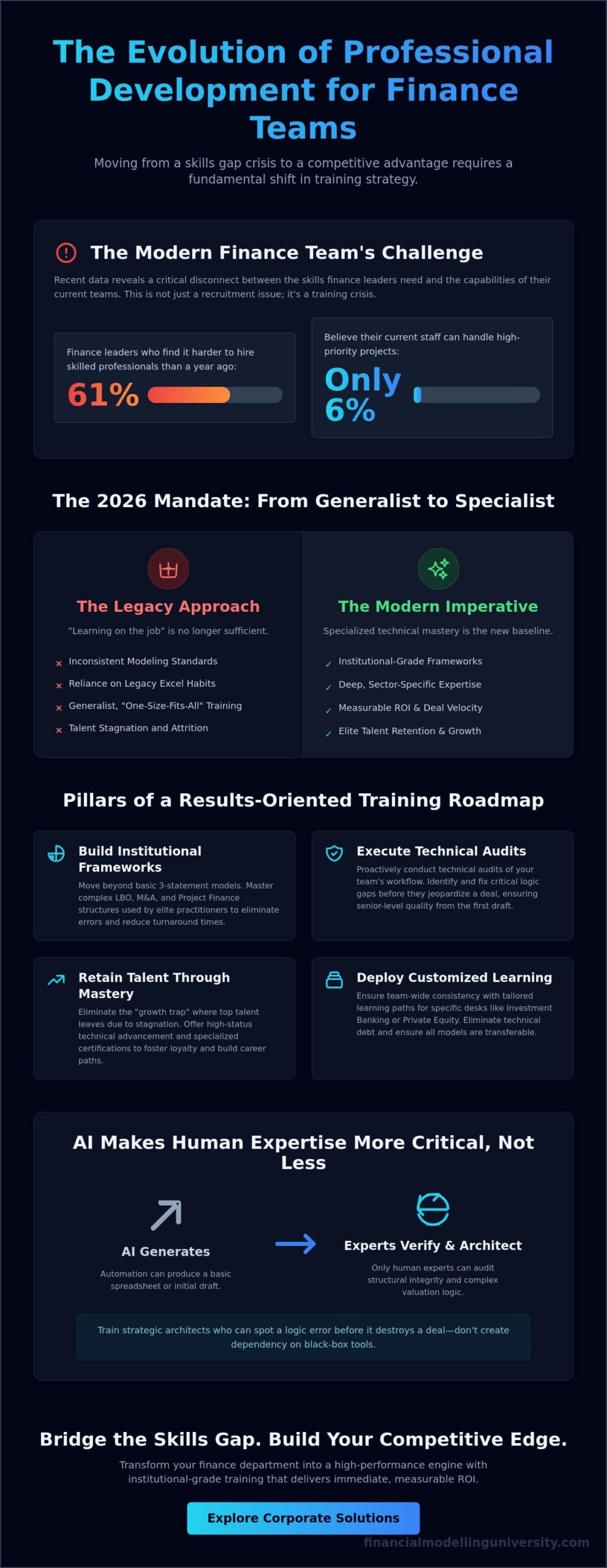
Building an elite finance unit requires a structured, data-driven approach. Don’t guess which skills your team needs; measure them. Start by conducting a rigorous technical audit to identify specific gaps in modeling logic and keyboard speed. This audit serves as the baseline for professional development for finance teams, ensuring that every training hour spent translates directly into improved deal execution. Once you’ve identified the weaknesses, you can build a roadmap that moves beyond generalities and focuses on the high-status technical skills that drive firm value.
A results-oriented roadmap must follow five critical steps to ensure institutional-grade outcomes:
Generic training is a waste of resources. Your roadmap must account for the specific technical requirements of your desk. For teams focused on property portfolios, Real Estate Financial Modeling provides the necessary frameworks for institutional-grade valuation. Conversely, infrastructure teams require a deep dive into project finance and debt sculpting. Customize these paths based on seniority. Junior analysts should focus on speed and structural integrity, while senior associates must master complex tax layering and exit waterfalls. Always ensure training materials include downloadable, deal-ready Excel templates to accelerate the transition from learning to execution.
Static video lessons cannot solve the unique problems encountered during a billion-dollar LBO. Complex financial problem-solving requires a dialogue with experts who have already navigated these hurdles. This is why “office hours” with industry veterans are a cornerstone of effective professional development for finance teams. Mentorship transforms a standard curriculum into a career-defining experience. It teaches your team to think like strategic architects, identifying risks and opportunities that a software tool or a basic template might miss. Focus on programs that offer this level of direct, elite mentorship to ensure your team performs at the level of the world’s top practitioners.
Top-tier analysts are driven by more than just compensation. They’re driven by the pursuit of technical mastery. When a firm fails to provide a clear path for technical advancement, these high-performers fall into the “Growth Trap.” They realize their skills are stagnating and quickly leave for competitors who offer institutional-grade training. Investing in professional development for finance teams isn’t just an expense; it’s your most effective retention tool. By providing a clear roadmap to Financial Modeling Course Online certifications, you signal that you value their career trajectory as much as your own deal flow.
Mastery has a profound psychological impact on your junior staff. When an analyst can build a complex debt schedule or a multi-stage waterfall without constant senior hand-holding, their confidence surges. This confidence leads to greater autonomy and a willingness to take on more deal responsibility. It transforms your team from a group of spreadsheet operators into a unit of strategic architects. In a market where 33% of new hires quit within their first year, offering the promise of mastery is a powerful recruitment magnet that attracts the industry’s most ambitious talent.
Stop viewing training as a “soft” benefit. The ROI of technical upskilling is quantifiable. Measure the reduction in model errors and the decrease in time-to-completion for complex valuations. Research from February 2026 indicates that 57% of finance leaders report a desperate need to upskill their teams. Consider the math: the cost of a “bad hire” or replacing a top performer often exceeds 1.5x their annual salary. Compare that to the cost of upskilling an existing high-performer who already understands your firm’s culture and clients. Technical proficiency is the most direct route to protecting your bottom line.
A firm’s reputation depends on the integrity of its analysis. If three analysts build an LBO model using three different logic frameworks, your firm is exposed to catastrophic risk. Standardizing the “Institutional Way” creates a unified language for financial analysis. It ensures that any team member can pick up a colleague’s model and understand the logic flow immediately. This level of interoperability is the hallmark of an elite unit. It protects your reputation and ensures that your deal execution remains seamless, regardless of which analyst is at the keyboard. Secure your team’s future and eliminate the growth trap by enrolling in the FMU All-Access Pass today.
Scaling an elite finance function requires more than just individual effort. It demands a centralized, institutional approach to professional development for finance teams. FMU’s Corporate Group Training moves beyond simple seat licenses. We provide a comprehensive ecosystem designed for administrative oversight and technical precision. This allows leadership to deploy specific curriculum paths, whether your focus is an Investment Banking Financial Modeling Course or a Private Equity Financial Modeling Course. You ensure every analyst operates on the same high-status logic, eliminating the risk of fragmented standards.
The FMU All-Access Pass for teams provides a library of 2026-ready modules. This isn’t a static archive; it’s a dynamic resource that evolves with the market. Your team gains immediate access to specialized paths like the Project Finance & Infrastructure Modeling Course and the Real Estate Financial Modeling Course. By providing these tools, you eliminate technical silos and ensure that specialized knowledge is shared across the entire organization. If your team needs to automate complex repetitive tasks, the VBA for Financial Modeling Course offers the necessary technical depth. Start your upskilling plan by identifying your team’s most pressing deal-flow requirements and mapping them to our specialized curriculum.
Dashboards are useless if the content doesn’t inspire engagement. FMU provides granular administrative oversight to ensure your L&D budgets deliver measurable results. Track employee progress in real-time. Set milestones for technical assessments and certification completion. Use this data to identify high-potential employees who demonstrate the discipline required for promotion. This isn’t just about compliance. It’s about building a data-backed talent pipeline. When you can see exactly who has mastered the LBO Modeling Course or the DCF Valuation Course, you can assign the right people to the right deals with total confidence.
FMU is the trusted partner for elite investment professionals globally. We understand that an analyst’s time is their most valuable asset. Our promise is “no-nonsense,” action-oriented learning that strips away academic fluff to mirror the precision required in the field. We provide the blueprint for career transformation that has already served 25,000+ finance professionals. When you choose FMU, you aren’t just buying a course. You’re entering a university experience that sets the global standard for technical mastery. This commitment to excellence ensures that every member of your team can perform at the level of the world’s most prestigious firms. Inquire about Corporate Group Training for your team today and begin the transformation of your finance function into an elite unit.
Join the 25,000+ finance professionals who’ve already mastered financial modeling like the pros. Our corporate solutions provide one-to-one career mentoring and access to institutional-grade Excel templates that withstand the highest levels of private equity scrutiny. Empower your team with FMU Corporate Group Training and ensure your staff earns the certifications that define global industry excellence. The path to technical mastery is clear. Start building your elite unit today and watch your team’s confidence and performance reach new heights.
Professional development for finance teams eliminates the “Growth Trap” by providing a clear path to technical mastery. High-performing analysts prioritize skill advancement over almost any other workplace perk. Providing institutional-grade training signals that you’re invested in their career trajectory. This approach reduces turnover costs, which often reach 1.5x an employee’s salary, by keeping your top talent engaged and challenged within your organization.
Online training is often superior because it allows analysts to reference complex modules during live deal execution. This format supports a self-paced, disciplined approach that mirrors the rigorous environment of high-stakes finance. FMU’s university experience combines high-definition technical walkthroughs with one-to-one career mentoring. This hybrid approach ensures that theory is immediately applied to real-world modeling logic without the logistical friction or downtime of classroom-based sessions.
Measure ROI through quantitative metrics like reduced model error rates and faster turnaround times on valuations. Effective professional development for finance teams should lead to a measurable decrease in senior-level review time. Track qualitative shifts such as increased employee satisfaction and higher internal promotion rates. When your analysts can build an institutional-grade LBO model in half the time, the financial benefit to the firm’s deal capacity is direct.
General certifications provide a theoretical baseline, while specialized modeling courses provide the blueprint for deal execution. A CPA or CFA validates financial literacy, but an FMU course teaches you how to structure a complex M&A model or a project finance debt schedule. Specialized training focuses on the mechanical “how” of the job. It equips your team with the surgical technical skills required to build models that survive institutional scrutiny.
Analysts should dedicate two to four hours of focused technical training per week. Elite practitioners treat development as a non-negotiable part of their workflow, not an afterthought. This structured approach prevents burnout while ensuring consistent skill progression. By dedicating small blocks of time to mastering advanced Excel techniques or new valuation frameworks, your team maintains a competitive edge without disrupting the firm’s immediate deal flow requirements.
Specialized modeling training provides the practical application that makes theoretical concepts in the CFA or CPA exams easier to grasp. Understanding the mechanics of a DCF valuation or an accretion analysis in Excel reinforces the underlying financial principles tested in these certifications. While specialized courses focus on execution, they build a powerful foundation of technical fluency that significantly improves exam performance and professional confidence across the board.
Standardization ensures that every model follows a unified logic, making them transferable and easy to audit across the firm. Without institutional-grade standards, a firm faces catastrophic risk if a key analyst leaves or if a logic error is buried in a non-standard template. A unified modeling language allows senior leaders to spot structural issues quickly. This consistency protects the firm’s reputation and ensures that investment decisions are based on verified data.