


A discounted cash flow model can look precise while still being fundamentally wrong. The output arrives as a single confident number, but behind it sits a chain of assumptions that can quietly distort reality.
A small shift in revenue growth, a one-point change in discount rate, or a slightly optimistic terminal value can move a discounted cash flow valuation by 20 to 50 percent without touching a single formula.
In most cases, models do not fail because of the formula, but because of the assumptions embedded within it. Analysts spend hours refining calculations while leaving the most sensitive drivers loosely justified.
The result is a discounted cash flow analysis that is technically correct but economically fragile. Investors and investment committees challenge your assumptions. This article focuses on the six that matter most and how to defend them under real scrutiny.
At its core, discounted cash flow (DCF) is a valuation method that estimates what a business is worth today based on the cash it will generate in the future.
DCF answers a simple question: how much should you pay today for a stream of uncertain future cash flows?
The logic is straightforward. Future cash flows are projected, then discounted back to present value using a rate that reflects risk and the time value of money.
The standard discounted cash flow formula is:
Where:
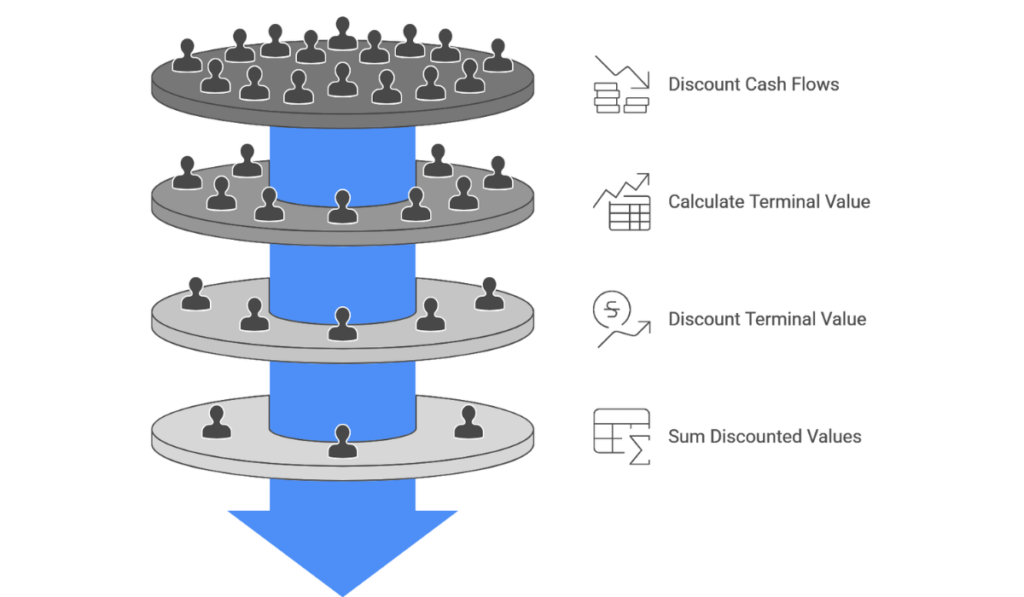
This framework is what makes discounted cash flow valuation so widely used across corporate finance, M&A, and investment analysis. It forces analysts to think explicitly about how a business generates cash, how it reinvests, and how risk impacts value.
The insight in a DCF does not come from the formula, but from how assumptions translate business economics into cash flows.
Across every credible discounted cash flow analysis, the same pattern holds:
In most models, a handful of assumptions drive the majority of the valuation:
| Assumption | Typical impact on valuation |
| Revenue growth | Compounds across all future cash flows |
| Operating margins | Drives profitability and cash conversion |
| Discount rate | Compresses or expands value directly |
| Terminal value | Often 60–80% of total valuation |
Even minor adjustments can materially change results. A 1% increase in discount rate or a slight uplift in terminal growth can reduce or increase valuation by double-digit percentages.
This is why experienced practitioners treat DCF not as a precise answer, but as a structured way to test assumptions. The goal is to understand what must be true for that number to hold.

Revenue is the single most important assumption in any discounted cash flow analysis. It is the engine of the model. Every downstream line item, margins, capital expenditures, and working capital, ultimately scale off it. If revenue is wrong, everything else is mechanically wrong.
Most weak models fail here because growth is treated as a percentage rather than a set of drivers. A growth rate without a source behind it is just a number on a spreadsheet.
A credible discounted cash flow valuation breaks revenue into components that can be explained and challenged.
What actually drives growth:
How to defend it:
If you cannot explain where growth comes from, the rest of the discounted cash flow model will not hold up under scrutiny.
If revenue is the engine, margins determine how much of that revenue actually converts into cash. In any discounted cash flow valuation, small changes in operating margins can materially shift free cash flow over time.
The common mistake is assuming steady margin expansion without explaining the source. The margin improvement must be earned through the business model.
What drives margins:
How to defend it:
Unexplained margin expansion is one of the fastest ways to inflate a discounted cash flow analysis. If margin expansion cannot be clearly linked to operational drivers, it should be treated cautiously.

Capital expenditures determine how much cash the business must reinvest to sustain and grow operations. In a discounted cash flow valuation, ignoring or underestimating capex is one of the easiest ways to overstate value.
The key distinction is between maintenance and growth capex. Both matter, and both must be aligned with the operating assumptions in the model.
What drives capex:
How to defend it:
An increase in the growth forecast without corresponding capital expenditures or operational investment would not be justifiable. As a result, the projected growth and the discounted cash flow analysis would become economically inconsistent.

Working capital determines how efficiently a business converts revenue into cash. In a discounted cash flow analysis, it is often simplified, but even small changes can materially impact near-term cash flow.
Growth typically requires investment in receivables and inventory. Ignoring this creates an overly optimistic view of cash generation.
What drives working capital:
How to defend it:
A business can show strong growth and margins but still generate weak cash flow. If working capital is not modeled correctly, the discounted cash flow valuation will overstate liquidity and value.

The discount rate is where risk enters the model. In any discounted cash flow valuation, it determines how aggressively future cash flows are translated into present value. Small changes here can move valuation materially.
As J.P. Morgan Asset Management observes in its 2026 Market Outlook, reduced discount rates in valuation models increase the present value of future cash flows – a dynamic that directly shapes how equity markets price risk and growth.
While often presented as a calculation, the discount rate is ultimately a set of judgments about risk, capital structure, and market conditions.
(The discount rate must be consistent with the cash flow definition (WACC for FCFF, cost of equity for FCFE). Any mismatch will lead to valuation errors.)
What drives the discount rate:
How to defend it:
A 1% change in the discount rate can materially impact a discounted cash flow valuation. Treating the discount rate as a fixed input rather than a matter of judgment can lead to a misrepresentation of risk.
For example, when building a model in a developing country, incorporating a higher cost of equity to reflect political risk will capture that uncertainty. Applying an additional layer of conservatism to the cash flow forecast on the basis of political risk would effectively double-count the risk, resulting in a distorted valuation.

Terminal value is often the largest component of a discounted cash flow valuation, frequently accounting for more than half of the total value. That makes it the most sensitive and most misused assumption in the model.
The math behind terminal value is straightforward. What breaks models is the long-term assumptions buried inside them.
What drives terminal value:
How to defend it:
Terminal value assumes the business has reached a steady state. Any inconsistency between forecast-period dynamics and terminal assumptions can materially distort valuation.
The terminal value can create the illusion of precision while driving most of the outcome. If it is not grounded in realistic assumptions, the entire discounted cash flow analysis becomes unreliable.
A strong discounted cash flow valuation is not judged by the model itself, but by how well the assumptions hold together under pressure.
At this stage, the focus shifts from individual inputs to consistency across the model.
What must hold across the entire model:
What investors and ICs will actually challenge:
The purpose of a discounted cash flow analysis is coherence. If the assumptions reinforce each other, the valuation becomes defensible. If they do not, no level of detail will save it.

A discounted cash flow valuation is only as strong as the assumptions behind it. The model itself is straightforward. The challenge is making sure each input reflects how the business actually operates and how risk is priced.
The six assumptions covered here drive nearly every discounted cash flow analysis outcome. Small changes in any one of them can materially shift value. That is why precision in the output is less important than discipline in the inputs.
The goal is to build a valuation that can be explained, challenged, and defended. When the assumptions are grounded and internally consistent, the model becomes a useful decision tool. When they are not, the model produces a precise number with no economic meaning.