


The difference between a rejection letter and a high-status associate offer isn’t how fast you can build a circular reference. It’s whether you think like an investor or a calculator. In a 2026 market where deal volume has dropped 67 percent but deal values are rising, firms are only hunting for high-conviction opportunities. This private equity case study walkthrough moves you beyond basic mechanics. It’s designed to stop the analysis paralysis that kills candidates during timed tests. You’ll learn to stop fearing the data and start identifying the deal-breaker risks that partners actually care about.
It’s common to feel overwhelmed when staring at a raw data set with only three hours to produce a full investment memo. Most candidates struggle to connect their model outputs to a qualitative thesis. This guide promises to bridge that gap by providing a repeatable, institutional-grade framework used by the pros. We’ll show you how to incorporate current market realities, such as LBO leverage capped at 4 to 6x EBITDA and senior debt pricing around 9 to 11 percent, into a model that stands up to scrutiny. You’ll gain expert-level Excel techniques for speed and the professional confidence to defend a Buy or No-Buy decision. This is how you master financial modeling like the industry insiders and secure your seat at a top-tier fund.
A private equity case study isn’t just a test of your Excel skills. It’s a full-scale simulation of the investment process designed to see if you can think like a principal. To understand the high stakes involved, you must first grasp What is Private Equity? at an institutional level. It’s the business of deploying capital into companies to generate outsized returns through operational improvements and financial engineering. Consequently, funds use these exercises to evaluate three specific pillars: your technical LBO modeling, your strategic investment thesis, and your ability to present to an investment committee.
In 2026, the bar is higher. Deal volume has dropped 67 percent from last year, making firms intensely selective about every hire. They don’t want “model monkeys” who just turn the crank on a template. They need associates who offer data-driven insights that go beyond standard three-statement modeling. This private equity case study walkthrough helps you shift your mindset from a banking analyst to that of a principal investor who understands risk and reward.
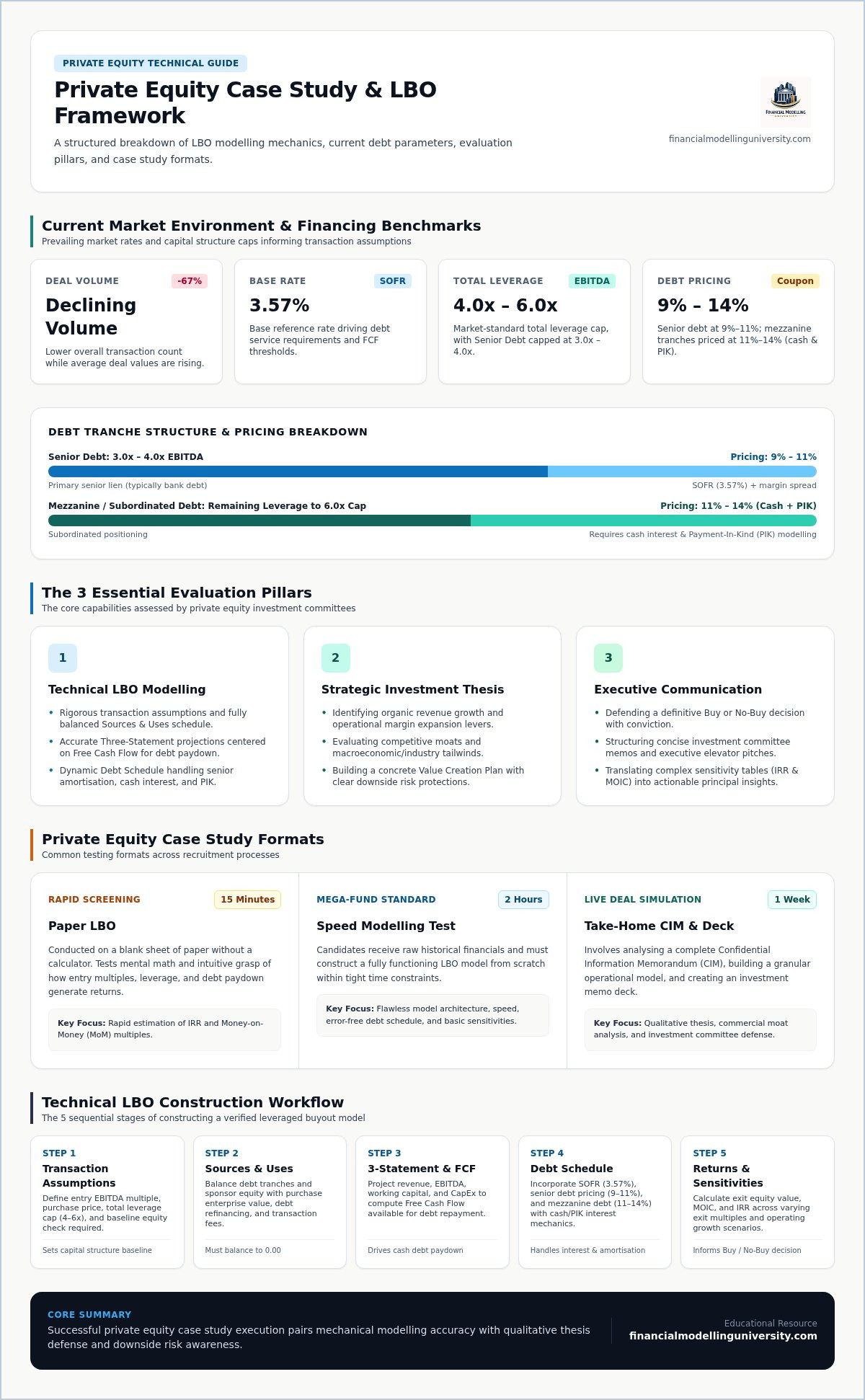
The format varies by fund culture and the stage of the interview. The Paper LBO is the ultimate filter for technical intuition. You’ll have 15 minutes to estimate IRR and money-on-money (MoM) multiples on a blank sheet of paper. It’s about showing you understand how entry multiples and debt paydown interact without the help of a calculator. If you can’t do the mental math, you won’t survive the first round.
The 2-Hour Speed Test is the standard for mega-funds. You’ll get a set of financials and a few hours to build a functional LBO from scratch. Precision is non-negotiable under this level of time pressure. Finally, the 1-Week Take-Home involves a full Confidential Information Memorandum (CIM). You’ll build a complex model and a multi-page investment deck, simulating the actual work of an associate during a live deal process.
Technical accuracy is your baseline. If your Sources and Uses table doesn’t balance or your Debt Schedule has errors, your candidacy ends immediately. However, the model is only the entry ticket. Partners are hunting for investment judgment. Can you identify the two or three variables, such as organic revenue growth or margin expansion, that actually drive the deal’s IRR?
They also demand commercial awareness. You must prove you understand the company’s competitive moat and the broader industry tailwinds. With SOFR at 3.57 percent in 2026, you need to explain how the business will handle debt service while still funding capital expenditures. It’s about demonstrating that you’ve considered the downside case just as much as the base case. This private equity case study walkthrough will ensure you focus on the drivers that move the needle for the Investment Committee.
Executing a flawless private equity case study walkthrough starts with technical precision. Building an institutional-grade leveraged buyout (LBO) model requires more than just filling in a template. It demands a logical flow that mirrors a real deal. First, set your transaction assumptions. In 2026, you’ll likely cap total leverage at 4 to 6x EBITDA, with senior debt typically accounting for 3 to 4x. This baseline dictates your equity contribution. Next, construct the Sources and Uses table. It’s the non-negotiable foundation of your model. If this doesn’t balance, your entire analysis is dead on arrival.
Project the three statements with a singular focus on Free Cash Flow (FCF) available for debt service. This cash is what pays down debt and drives equity value. Layer in a sophisticated Debt Schedule to reflect current market realities. With SOFR at 3.57 percent, your senior debt pricing will hit approximately 9 to 11 percent. Account for mezzanine debt at 11 to 14 percent, ensuring you model both cash and Payment-In-Kind (PIK) interest correctly. Finally, calculate your exit returns. Focus on MOIC and IRR across various sensitivity scenarios to prove the deal’s resilience. This private equity case study walkthrough ensures you don’t just build a model, but a tool for professional decision-making.
Speed is your greatest asset in a timed test. Implement circuit breakers to handle circular reference errors in your interest calculations without crashing Excel. Master two-way data tables to visualize how exit multiples and revenue growth impact IRR simultaneously. Follow the FMU standard for formatting: blue for hardcoded inputs, black for formulas, and green for links to other sheets. This discipline prevents errors and builds immediate trust with the Investment Committee.
In 2026, a high-level revenue growth assumption isn’t enough to secure an offer. Funds expect a bottom-up build. You must model LTV, CAC, and churn rates to justify your projections. This granular approach to private equity financial modeling allows you to identify expansion revenue opportunities that drive margin expansion. If you can’t explain the unit economics, you can’t defend the exit multiple. For those looking to refine these technical nuances, the Private Equity Financial Modeling Course provides the professional edge needed for elite performance.
A flawless model is merely the entry price for a private equity seat. To win the offer, you must bridge the gap between a “good company” and a “good investment.” Many candidates fail because they fall in love with a business’s product without analyzing the entry price versus the intrinsic value. According to the current private equity landscape analysis by Bain & Company, value creation in 2026 relies almost entirely on operational EBITDA growth rather than multiple expansion. Your private equity case study walkthrough must clearly articulate a “Value Creation Plan” that explains exactly how the fund will drive that growth over a five-year hold period.
Synthesizing qualitative risks into your model is where elite candidates separate themselves. If the CIM reveals a concentrated customer base or a looming regulatory shift, don’t just mention it in the presentation. Bake it into a “Downside Case.” For instance, you might model a 200-basis-point margin contraction to see if the business can still service its debt with SOFR at 3.57 percent. In a 2026 environment with a flat 21 percent US corporate tax rate, your cash flow projections must be airtight. Your core investment thesis should be a single, punchy sentence: “We should acquire Target Co because its dominant 40 percent market share in a fragmented industry allows for a buy-and-build strategy that offsets current high borrowing costs.”
Use Porter’s Five Forces to evaluate the sustainability of the target’s margins. Focus on the “Bargaining Power of Suppliers” and “Threat of Substitutes” to determine if the company has a true competitive moat. Move beyond a generic SWOT analysis. Instead, execute a SWOT 2.0 that focuses on opportunities specifically aligned with your fund’s expertise, such as AI-driven cost optimization or geographic expansion. When evaluating management through the CIM, look for a track record of hitting past projections. If they’ve consistently missed targets, your model’s revenue growth should reflect a more conservative reality.
Your model is finished. Now the real work begins. Partners don’t buy spreadsheets; they buy conviction backed by rigorous logic. The final stage of any private equity case study walkthrough is the investment committee defense. This is where you transform hours of technical work into a professional narrative. You must structure your investment memo with surgical precision. Start with a punchy Executive Summary, followed by deep dives into the Industry, Business, Financials, and Risks. Each section must build a cumulative case for the transaction while acknowledging the hurdles that could derail the returns.
Master the 30-second elevator pitch. If a partner asks for your recommendation in the hallway, you must be able to summarize your Buy or No-Buy decision with absolute conviction. Link your recommendation to the primary driver you identified in your model. For example, you might highlight how a 5.0x leverage ratio is realistic in the 2026 credit market, given that senior debt is currently priced at SOFR plus 450 to 650 basis points. With SOFR at 3.57 percent, you need to prove the business generates enough cash flow to cover an all-in rate of approximately 10 percent. This level of technical specificity signals that you are ready to step onto a live deal team.
Clarity is a hallmark of the elite associate. Your presentation deck should feature a “Football Field” chart to show valuation ranges across DCF, LBO, and trading comps. Include a “Bridge” chart that decomposes your IRR into its core components: deleveraging, organic growth, and multiple expansion. This visualization proves you understand exactly how the fund will make money. Finally, use a “Waterfall” chart to illustrate the capital structure seniority. It should clearly show where the 50 to 65 percent debt sits in relation to the equity cushion. These visuals prevent the committee from getting lost in the weeds of your Excel tabs.
Expect to be challenged. Partners will often ask trap questions like, “Which assumption are you least confident in?” Avoid the urge to be defensive. Instead, demonstrate intellectual honesty by identifying a high-variance variable, such as the exit multiple, and explaining how your downside case protects the fund’s principal. When you walk through your model on a screen, move with purpose. Don’t let the audience see you hunting for cells. If a partner challenges your exit multiple, pivot to the unit economics or the HSR filing threshold of $126.4 million to explain the strategic exit environment. To reach this level of professional mastery, enroll in the Private Equity Financial Modeling Course and learn to defend your thesis like an industry expert.
The top 1 percent of private equity candidates don’t wait for their firms to provide training. They proactively seek out the tools that separate associates from partners. In a 2026 environment where deal volume has tightened and firms are focusing on high-conviction opportunities, your ability to execute a flawless private equity case study walkthrough is your most valuable currency. Self-study is no longer optional. It is the secret weapon for those aiming for mega-funds. The LBO modeling course at FMU is specifically designed to bridge the gap between the rigid templates of investment banking and the flexible, high-stakes requirements of private equity investing.
Mastering the technical mechanics is only the first step. To secure a seat at a top-tier fund, you must transition from a modeler to a strategic architect. This means understanding how every cell in your spreadsheet impacts the final investment thesis. By leveraging the investment banking financial modeling course, you’ll gain the foundational rigor needed to build complex structures. However, for those looking to dominate multiple sectors, the FMU All-Access Pass provides the specialized knowledge required for Real Estate or Project Finance modeling. This comprehensive approach ensures you aren’t just prepared for one interview, but for an entire career at the elite level.
FMU provides more than just tutorials. You gain access to institutional-grade Excel templates used by professionals at the world’s leading private equity firms. These aren’t simplified academic exercises; they are the actual frameworks used to evaluate billion-dollar transactions. Alongside these tools, FMU offers one-to-one career mentoring to help you refine your presentation style. This personalized feedback is critical for mastering the “defense” portion of the private equity case study walkthrough. When you complete our curriculum, you earn a globally recognized certification that signals to recruiters you are deal-ready from day one.
Your journey to the investment committee starts with disciplined practice. Download our free case study checklist to audit your next model and ensure no “deal-breaker” risks are overlooked. Join the community of 25,000+ finance professionals who have used our financial modeling course online to accelerate their career trajectories. The path to professional mastery is structured, logical, and available to those committed to their advancement. Don’t leave your career to chance. Master Private Equity Modeling with FMU Today and claim your seat at the table.
Success in the elite world of finance requires more than raw talent; it demands a repeatable, professional process. This private equity case study walkthrough has provided the blueprint for moving from a standard Excel analyst to a strategic investor. You now understand that a balanced Sources and Uses table is just the entry ticket. The real victory lies in your ability to identify value creation drivers and defend your IRR assumptions against rigorous partner questioning.
Don’t leave your career transformation to chance. Financial Modelling University is trusted by 25,000+ finance professionals who have used our curriculum to bridge the gap between banking and investing. Our courses provide the institutional-grade LBO templates and expert-led career mentoring you need to perform at the level of industry insiders. Master the mechanics, refine your narrative, and walk into your next interview with absolute conviction. Master Private Equity Modeling Like the Pros with FMU and claim the prestige your ambition deserves.
Spend 60 percent of your time on the model and 40 percent on the investment thesis and deck. A flawless model is useless if you can’t articulate why the deal makes sense. In a timed private equity case study walkthrough, prioritize a functional LBO first. Once the debt schedule and IRR are set, focus on your value creation narrative. Precision in the model builds the foundation, but the presentation wins the offer.
Target a net IRR of 20 percent to 25 percent and a Money-on-Money (MoM) multiple of 2.0x to 2.5x over a five year hold. In the 2026 market, senior debt pricing sits at 9 to 11 percent, making these hurdles difficult to reach without significant EBITDA growth. If your returns fall below these benchmarks, you must provide a compelling strategic reason why the risk profile warrants a lower return.
No, focus on the cash flow statement and a simplified income statement to drive the debt schedule. You don’t need a perfectly balanced balance sheet in a 2-hour speed test. Prioritize the Sources and Uses, the debt paydown, and the returns summary. Accuracy in the debt schedule is more important than a complete three-statement integration because it dictates the final IRR.
Make reasonable assumptions and document them clearly in your presentation. If the CIM lacks specific CapEx data, use industry benchmarks or a percentage of revenue based on comparable companies. Professional candidates don’t stop when data is missing; they create a logical base case and explain their reasoning to the Investment Committee. Transparency about your assumptions builds trust with the partners.
The most frequent errors include a non-balancing Sources and Uses table and incorrect interest expense calculations. Many candidates also forget to account for the 21 percent US corporate tax rate when projecting free cash flow. Ensure your circular reference circuit breaker is active to prevent model crashes. These technical lapses signal a lack of deal-readiness and can end your candidacy immediately.
Yes, recommending a ‘No-Buy’ is acceptable if you can prove the deal destroys value or carries unmanageable risk. Partners value intellectual honesty over blind optimism. If the IRR doesn’t hit 20 percent even in your upside case, defend your decision with data-driven conviction. Show that you’re focused on capital preservation and not just making a deal happen at any price.
Formatting is critical because it signals professional discipline and attention to detail. Use the FMU standard: blue for hardcoded inputs, black for formulas, and green for links to other sheets. A messy model suggests a messy thinker and makes it difficult for partners to audit your logic. Clear formatting allows the committee to focus on your investment judgment rather than your Excel errors.
Use AI tools for data extraction or market research, but don’t rely on them for core financial modeling. Most elite funds prohibit AI during timed tests to evaluate your individual technical proficiency. While AI can quickly verify the 2026 HSR filing threshold of 126.4 million dollars, you must personally audit every formula. This ensures you can defend the private equity case study walkthrough with absolute confidence during the Q&A.