

Most financial modeling courses teach you how to use Excel, but they fail to teach you how to think like an institutional investor. You’ve probably spent hours wrestling with broken circular references or staring at a blank spreadsheet, dreading the moment a senior VP asks you to stress-test a complex LBO model from scratch. At Financial Modelling University (FMU), we understand that the fear of failing a technical interview or appearing inefficient during a live deal is the biggest hurdle to your career trajectory. Precision isn’t just a goal; it’s the industry standard you must meet to survive in elite finance.
We’ve designed this 2026 masterclass to bridge the gap between academic theory and the high-stakes reality of investment banking. You’ll learn to master institutional-grade financial modeling with the confidence of a seasoned analyst, ensuring you’re prepared for any M&A or DCF valuation challenge. We’ll preview the essential FMU curriculum updates, including the latest AI-integrated Excel features and the downloadable templates that have helped over 25,000 finance professionals Master Financial Modeling Like the Pros. It’s time to stop worrying about your spreadsheets and start focusing on your career advancement.
In the high-stakes environment of 2026, a financial modeling course is no longer just an Excel tutorial; it’s a masterclass in strategic architecture. Elite investment professionals don’t just input data. They build robust, flexible frameworks that serve as the primary blueprint for multi-billion dollar institutional decisions. While many believe basic Excel proficiency is sufficient, the industry has shifted toward a demand for advanced technical logic. Top-tier firms like JP Morgan and Goldman Sachs prioritize candidates who possess verified modeling mastery because they cannot afford structural errors in their valuation or risk assessment processes.
Achieving a six-figure salary in finance requires more than just a prestigious degree. It demands a specialized skill set that translates complex, messy data into actionable insights. Understanding What is Financial Modeling? in a professional context means mastering the art of forecasting and risk management with surgical precision. This level of expertise is the minimum entry fee for those aiming to reach the upper echelons of private equity or investment banking.
Global market volatility has reached levels that make rigid, traditional models obsolete. Today’s analysts must build dynamic, AI-assisted forecasting tools that account for rapid shifts in interest rates and regulatory updates, such as the 2026 Basel III modernization proposals. The integration of AI in Excel 2026 has automated data cleaning, but it hasn’t replaced the need for human logic. “Good enough” models that lack deep scenario analysis no longer pass institutional due diligence. You need models that are resilient under pressure and technically sound at every level.
The gap between academic theory and the reality of a fast-paced investment bank is vast. A recognized certification serves as a powerful signal of technical excellence to recruiters, distinguishing you from thousands of applicants who only understand theory. There’s a fundamental difference between a tutorial-based learner and an industry-trained expert. While one follows a script, the other understands the underlying mechanics of LBOs and M&A deals. At FMU, we focus on this transition, turning aspiring analysts into elite practitioners through a curriculum trusted by over 25,000 professionals. Mastery of a financial modeling course isn’t just about learning software; it’s about securing your professional future.
Professional financial modeling rests on a foundation of structural integrity. To succeed in top-tier banking, you must move beyond simply filling in existing boxes. You need to understand the underlying mechanics of the three-statement model. This is where the income statement, balance sheet, and cash flow statement interlock to create a living financial ecosystem. Every comprehensive financial modeling course worth its salt begins here. Building these models from a blank sheet ensures you don’t just follow a pattern but truly architect the logic of the business.
Elite analysts rely on institutional-grade templates to maintain speed, but their real value lies in the ability to audit and adjust every cell. Without this “blank sheet” mindset, a model becomes a liability rather than an asset. It’s the difference between a technician and a strategic advisor who can defend their assumptions in a boardroom.
The “Big Three” models, DCF, LBO, and M&A, form the core of the investment professional’s toolkit. While the academic principles of financial modeling provide the theoretical framework, the practical application in a DCF Valuation Course focuses on the nuances of terminal value and WACC sensitivity. M&A modeling adds layers of complexity through purchase accounting and synergy realization. You must be able to calculate accretion and dilution with absolute precision. Errors in these calculations can derail a deal and your reputation. A professional financial modeling course must integrate these deal-specific complexities to prepare you for high-stakes transactions.
The 2026 landscape has evolved significantly. While Excel for Finance remains the primary language of the industry, it’s now augmented by AI-powered features. Tools like Microsoft 365’s Copilot assist in cleaning messy data and explaining complex formulas, but they don’t replace the need for human oversight. Professional analysts use VBA for Financial Modeling to automate repetitive tasks, such as running thousands of sensitivity analyses or managing complex LBO debt waterfalls. This tech stack allows you to move faster without sacrificing accuracy. If you’re ready to move beyond the basics, consider exploring the FMU All-Access Pass for a complete library of institutional-grade training and downloadable templates.
Selecting a financial modeling course is a strategic decision that dictates your technical ceiling. You aren’t just buying a login; you’re investing in a professional reputation. To evaluate any program, you must look past the marketing and scrutinize three specific pillars: technical depth, industry recognition, and ongoing career support. A course that focuses solely on basic formulas won’t prepare you for the complexities of a high-stakes deal. You need a curriculum that mirrors the intensity of a Wall Street bullpen.
Continuous learning is now the industry standard. This is why elite professionals often favor all-access subscriptions over isolated modules. As Excel features evolve and global financial standards shift, having lifetime access ensures your skills don’t become obsolete. Specialized modules, such as Real Estate Financial Modeling, allow you to pivot between sectors with the confidence of a specialist. If your training doesn’t evolve with the market, it’s a liability, not an asset.
Online learning offers the flexibility busy analysts need, but it often lacks the critical feedback loop required for advanced concepts. Mastering complex LBO structures requires an expert to audit your logic and point out structural flaws that a self-graded quiz might miss. You should seek a balance. Use self-study modules to solidify the foundation, but ensure your financial modeling course includes access to one-to-one mentoring. This mentorship is what refines your institutional-grade modeling habits. Speed of completion is a vanity metric; depth of understanding is what wins technical interviews.
A certificate from a recognized University experience carries weight because it signals a commitment to academic and practical rigor. High-status descriptors like “Master Financial Modeler” on your LinkedIn profile have a significant psychological impact on recruiters, instantly validating your technical baseline. FMU alumni have used our proven methods to secure roles at top-tier firms, leveraging a global network of over 25,000 finance professionals. When technical excellence is the barrier to entry, your certification must serve as an undeniable signal of your elite status. Don’t settle for generic tutorials when you can have a credential trusted by the industry.
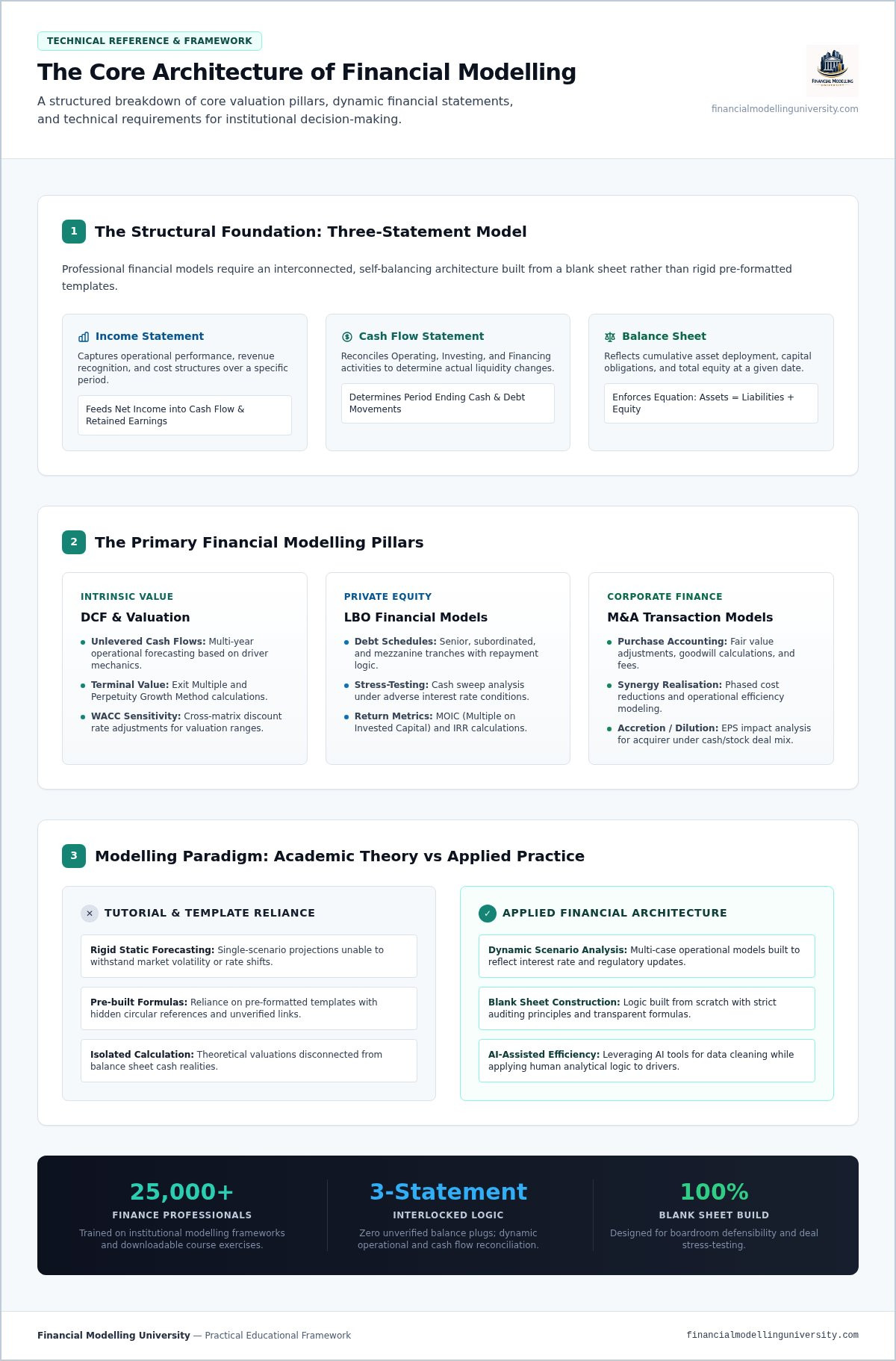
Mastery in the high-stakes world of finance isn’t a single event. It is a disciplined, multi-stage progression. You don’t become an elite analyst by memorizing formulas; you achieve it by executing a structured career roadmap. Your journey through a professional financial modeling course should move through four distinct phases, each designed to elevate your technical authority and market value. This progression ensures you aren’t just a spreadsheet operator but a strategic architect capable of navigating complex deals.
Start by solidifying your foundation. You must connect the Income Statement, Balance Sheet, and Cash Flow Statement into a seamless, self-balancing ecosystem. Once your foundational logic is bulletproof, move to Step 2: mastering intrinsic valuation. This is where you apply advanced theory to real-world scenarios through a comprehensive Investment Banking Financial Modeling Course. This stage transforms you from a student into a practitioner who understands the “why” behind every valuation multiple.
The three-statement model is the heart of every institutional-grade analysis. Amateurs often struggle with circular references that break models under stress. Professional models avoid these traps by implementing rigorous error-checking tabs and clear audit trails. Your model must be transparent enough for a senior VP to audit in minutes. Every financial modeling course at FMU emphasizes this structural integrity. We teach you to build models that remain robust even when market assumptions shift violently. If your statements don’t balance automatically, your logic is flawed, and your credibility is at risk.
Once you’ve mastered the core, specialization is your fastest path to higher compensation. Step 3 involves diving into sector-specific nuances. Private Equity Financial Modeling requires a deep understanding of debt waterfalls and entry/exit multiples. Similarly, modeling for Real Estate demands mastery of IRR, Cash-on-Cash returns, and complex equity waterfall structures. These specialized skills allow you to pivot into elite buy-side roles where precision is rewarded with significant bonuses.
Choosing a financial modeling course is about more than acquiring a certificate; it’s about gaining the precision of a Wall Street insider. Financial Modelling University (FMU) stands as an elite mentor for those committed to professional mastery. We don’t offer generic tutorials. We provide the exact blueprint used by industry leaders to navigate high-stakes deals. Our curriculum is built on academic rigor and practical application, ensuring you perform at the level of the world’s most prestigious firms.
The FMU All-Access Pass is the definitive career insurance policy for the modern analyst. It grants you entry to our entire library of specialized training, from private equity to project finance. You’ll gain access to the same institutional-grade Excel templates trusted by over 25,000 finance professionals globally. These aren’t just spreadsheets; they’re the battle-tested tools you need to accelerate your career trajectory and secure your place in a high-stakes environment. Precision is our standard, and results are our focus.
Generic learning portals often fail because they lack personal accountability. At FMU, we bridge this gap through one-to-one career mentoring. You’ll have direct access to practitioners who have executed multi-billion dollar deals and understand the nuances of the competitive banking landscape. This personalized guidance helps you navigate technical interviews and complex deal structures with absolute confidence. You aren’t just joining a course; you’re entering a community of 25,000+ ambitious professionals who are dedicated to “Mastering Financial Modeling Like the Pros.”
The path to expertise is structured and disciplined. You can enroll in individual modules like our LBO Modeling Course or secure your future with the FMU All-Access Pass. Starting your first institutional-grade model today has an immediate impact on your technical authority. Stop wrestling with inefficient spreadsheets and start building the strategic architecture that defines elite careers. Secure your professional future and transform your career with FMU University. The blueprint for success is ready. It’s time to execute.
The global finance landscape in 2026 demands more than just basic spreadsheet literacy. It requires the ability to architect complex logic that drives multi-billion dollar decisions. You now understand why mastering the “Big Three” models from a blank sheet is essential for your professional credibility. A high-caliber financial modeling course isn’t just an educational expense; it’s a strategic investment in your future trajectory as an industry expert. Precision remains the only currency that matters in the bullpen.
Master Financial Modeling Like the Pros with the FMU All-Access Pass
The blueprint for your professional transformation is ready. Take the lead and secure your place among the industry’s elite practitioners today.
The best financial modeling course for investment banking in 2026 is one that prioritizes technical depth and institutional-grade standards over basic software tutorials. FMU’s Investment Banking Financial Modeling Course is designed to teach you the strategic architecture required to build models from a blank sheet. It mirrors the high-stakes environment of elite firms, ensuring you master the specific logic and structural integrity demanded by top-tier global banks.
Online certifications are highly valuable for your CV when they come from recognized institutions like FMU. Recruiters at elite firms use these credentials to verify your technical baseline and commitment to professional development. A globally recognized certificate signals that you possess the precision and discipline required for high-pressure roles; it transforms your profile from a general applicant into a verified technical expert ready for the bullpen.
Completion time depends on your prior experience and the depth of the specific program. Most professionals spend between 40 and 100 hours to master a comprehensive financial modeling course. FMU allows for self-paced learning, enabling you to balance intensive training with your current workload. Speed is less important than achieving the depth of understanding required to defend your model in a high-stakes technical interview.
You don’t need to be an Excel expert before starting. Our curriculum includes specialized modules like Excel for Finance to ensure you build a solid technical foundation. We teach you the specific shortcuts, functions, and logic used by industry pros. This approach ensures that your spreadsheet skills evolve alongside your financial knowledge, allowing you to focus on strategic architecture rather than just software mechanics.
A DCF valuation course focuses on determining a company’s intrinsic value based on projected future cash flows; it is the gold standard for long-term investment analysis. In contrast, an LBO modeling course focuses on the mechanics of a leveraged buyout, including debt waterfalls, acquisition financing, and internal rate of return (IRR). Both are essential pillars of the elite analyst’s toolkit, serving different strategic purposes in deal execution.
Financial Modelling University provides specialized training solutions tailored for finance teams and corporate partners. We’ve trained over 25,000 professionals, helping institutions standardize their modeling practices and technical output. Our curriculum ensures that entire teams speak the same technical language and produce institutional-grade models. If you’re looking to upskill your department, our All-Access Pass offers a scalable way to maintain a competitive edge.
While no certificate guarantees employment, an FMU certificate significantly boosts your credibility during the rigorous technical interviews at firms like JP Morgan. Our alumni have successfully secured roles at top-tier banks by demonstrating the precision and logic taught in our masterclasses. The training provides the level of expertise that recruiters look for when screening candidates for high-prestige investment banking and private equity roles.
Yes, the downloadable Excel templates provided in our courses are institutional-grade and used by real-world analysts. These templates aren’t just academic exercises; they’re the same blueprints used to execute multi-billion dollar transactions. They include professional formatting, error-checking tabs, and robust audit trails. Mastering these templates allows you to work with the same efficiency and clarity as seasoned professionals at elite global institutions.