


Could you build a fully functional ground-up development pro-forma from a blank sheet in under 60 minutes while a Managing Director watches? For many analysts, the fear of failing a technical test or botching a complex waterfall structure is the only thing standing between them and a VP-level promotion. It’s a high-stakes environment where “good enough” modeling leads to rejected deals and stalled careers. Most professionals struggle with the sheer complexity of institutional-grade underwriting, especially as we adapt to the specific market standards of 2026.
We understand that mastering real estate financial modeling requires more than just basic Excel skills; it demands a disciplined, narrative-driven approach that elite private equity firms trust. This guide is your catalyst for transformation, designed to move you from tutorial-level basics to professional mastery. You’ll learn to structure complex joint venture promotes and value high-stakes deals with the precision of an industry insider. Our goal is to provide the academic rigor and practical application necessary to command respect in any boardroom.
We’ll break down the advanced frameworks used by top-tier practitioners to execute complex transactions. From mastering ground-up development logic to securing an industry-recognized certification, this is the blueprint for performing at the highest level of the field.
In its simplest form, real estate financial modeling is the process of creating a dynamic numerical representation of a real estate transaction. However, the industry has moved far beyond static spreadsheets. Today, institutional-grade modeling acts as a sophisticated decision-making tool. It bridges the gap between raw data and actionable investment strategy, providing the clarity needed for high-stakes execution. At Financial Modelling University (FMU), we emphasize this transition from basic calculation to professional-level underwriting.
The 2026 market demands a higher level of rigor. Increased volatility in interest rates and shifting cap rates means your underwriting must be bulletproof. You can’t rely on a single-point estimate anymore. Robust sensitivity analysis is now mandatory. It allows you to stress-test your assumptions against various economic scenarios, including varying exit cap rates and vacancy fluctuations. This ensures the deal remains viable even if the market shifts unexpectedly. High-level practitioners use these models to identify the “breaking point” of a deal before committing capital.
Within the investment committee (IC) approval process, the model is your primary advocate. It translates your thesis into a language of risk and reward that senior partners understand. If your model lacks clarity or fails to account for nuanced deal structures, the deal dies before it starts. A professional model provides the quantitative backing necessary to move a project from a concept to a closed transaction.
The fundamental goal is forecasting cash flows to determine if an investment meets your firm’s hurdle rates. You’re looking for precision in calculating key metrics like Internal Rate of Return (IRR), Equity Multiple, and Cash-on-Cash return. Beyond these numbers, your model must be “auditable” by Limited Partners (LPs). Institutional capital requires transparency. If an LP can’t follow your logic, they won’t fund your deal. Professional models use clean, standardized layouts that separate inputs, calculations, and outputs to ensure full transparency during the due diligence phase.
Mastering real estate financial modeling is essential for various industry participants who each approach the data with different priorities:
In 2026, the baseline for real estate financial modeling has shifted toward the integration of big data and AI-driven market analytics. Elite firms no longer rely on broad assumptions; they use granular data to project property performance with surgical accuracy. This level of detail, often enhanced by spatial analysis skills gained in a formation ArcGIS Pro initiation et avancé, is what separates institutional-grade underwriting from amateur attempts.
The structure begins with the “above-the-line” items: Gross Potential Rent (GPR), other income, and operating expenses (OpEx). However, high-stakes practitioners focus heavily on “below-the-line” items that often dictate the deal’s success. Capital Expenditures (CapEx), Tenant Improvements (TIs), and Leasing Commissions (LCs) must be modeled with precision, especially in value-add scenarios. Ignoring these costs leads to inflated IRR projections that won’t survive a rigorous due diligence process. Mastering these nuances is a core component of a professional Real Estate Financial Modeling Course, where the focus is on building models that withstand LP scrutiny.
Debt modeling also requires a sophisticated touch. You must distinguish between sizing loans based on Loan-to-Value (LTV) for stabilized acquisitions versus Loan-to-Cost (LTC) for development projects. In the current interest rate environment, Debt Service Coverage Ratios (DSCR) are often the primary constraint. Additionally, 2026 models must incorporate ESG-linked financing and energy-efficiency tax credits. These are no longer optional “green” initiatives; they are vital components of the capital stack that directly reduce the effective cost of capital and enhance the bottom line.
Dynamic rent roll integration is mandatory for multifamily and office properties. You need to model “Lost to Lease,” which is the difference between market rents and actual contract rents, to capture the potential upside as leases expire. In shifting markets, concessions like “one month free” should be modeled as a reduction in effective rent rather than a simple expense to maintain an accurate view of cash flow. Net Operating Income (NOI) is the bedrock of property valuation, serving as the fundamental metric for determining an asset’s institutional worth.
Determining an appropriate exit cap rate in 2026 requires looking beyond historical averages and analyzing the current interest rate cycle. If rates remain “higher for longer,” your terminal cap rates must reflect that risk premium to avoid overpaying at entry. Sensitivity tables are the hallmark of an expert modeler. Build two-way data tables that cross-reference exit cap rates against exit dates or rent growth. This allows you to visualize “Best Case” versus “Worst Case” scenarios, providing the Investment Committee with a clear map of the deal’s risk profile and breaking points.
Deciding between acquisition and development is more than a choice of asset type; it’s a choice of fundamental risk profile. Acquisition modeling focuses on existing, cash-flowing assets where the primary goal is verifying the stability of the current income stream. Development modeling, however, tackles the “ground-up” challenge. It requires managing construction interest and absorption rates before a single dollar of rent is collected. Each path demands a specific logic within your real estate financial modeling framework to ensure the output matches institutional expectations.
Renovation and value-add strategies sit in the middle of this spectrum. Here, you’re modeling the bridge between current in-place rents and pro-forma market rents. This involves precise timing of unit renovations and the subsequent “rent pop” expected upon completion. If your model doesn’t account for the downtime during renovation, your cash-on-cash returns will be artificially inflated. Professional modelers use monthly toggles to reflect these operational nuances with precision.
Risk-adjusted returns dictate that development requires a significantly higher IRR hurdle than stabilized acquisitions. You’re taking on entitlement, construction, and lease-up risk that simply doesn’t exist with a core asset. An expert modeler must reflect this by adjusting the discount rate to account for increased uncertainty. If a development project doesn’t offer a substantial premium over a core-plus acquisition, the deal rarely clears the investment committee.
Core investments prioritize capital preservation and steady distributions. Your model should emphasize Debt Service Coverage Ratios (DSCR) and long-term yield over aggressive exit multiples. It’s essential to include detailed lines for management fees, routine maintenance, and replacement reserves to ensure the net cash flow is realistic for institutional LPs. For a deeper dive into these standards, consult our Institutional-Grade Guide for 2026.
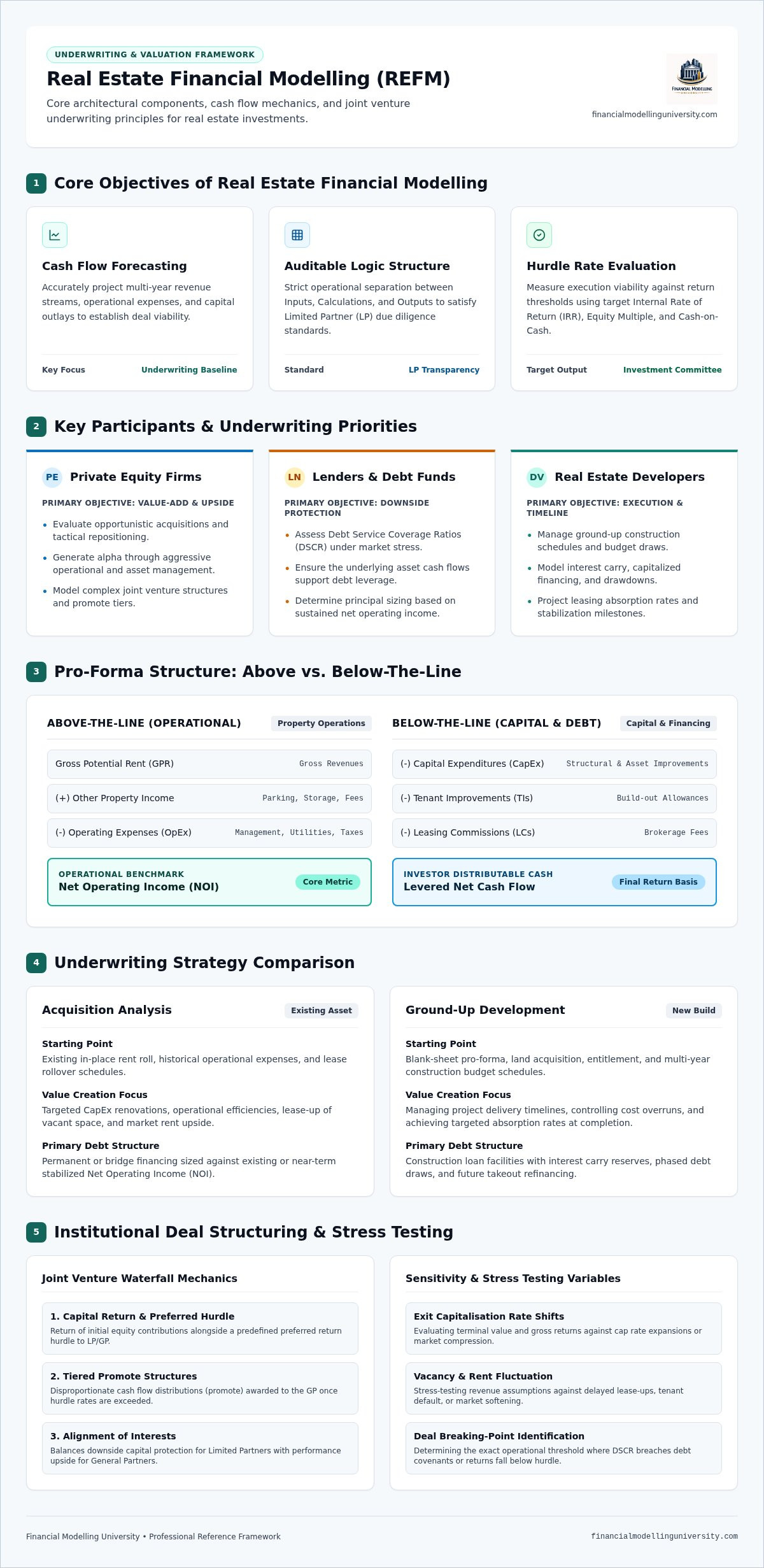
The joint venture (JV) structure is the engine of institutional real estate. It defines the relationship between the General Partner (GP), who provides the local expertise and deal flow, and the Limited Partner (LP), who provides the majority of the capital. In real estate financial modeling, the waterfall is the mathematical expression of this partnership. It dictates how cash flow is split once certain performance hurdles are met. This isn’t just about formulas; it’s about aligning incentives to ensure both parties are motivated to maximize the asset’s value.
In the 2026 market, deal terms have become increasingly sophisticated. LPs are demanding more protection through clawback provisions, which require the GP to return previously paid promotes if the overall project performance dips below a specific threshold at exit. Conversely, GPs are negotiating for “catch-up” clauses that allow them to receive a larger share of profits after the LP has achieved their preferred return. Understanding these nuances is critical for any analyst aiming for a leadership role. You can master these advanced structures and more by enrolling in our Real Estate Financial Modeling Course.
A professional waterfall model follows a logical, step-by-step progression. First, you must model the Return of Capital and the Preferred Return. This ensures the LP receives their initial investment plus a baseline yield, typically 7% to 9%, before the GP participates in any upside. Second, the model triggers the “Catch-up” and “Promote” distribution. In a common 20% over 8% structure, the GP receives 20% of the profits once the 8% IRR hurdle is cleared. Finally, you calculate the resulting Equity Multiple for each partner. This metric provides a clear snapshot of the total cash-on-cash return, allowing partners to evaluate the deal’s ultimate success relative to the capital risked.
Even experienced analysts stumble when building complex distribution tabs. Circular reference errors are the most frequent culprit, often caused by trying to calculate fees based on cash flows that are themselves affected by those fees. You must use clean, iterative logic or specific Excel toggles to avoid breaking the model. Another common mistake is misinterpreting “Pari Passu” distributions. This term means partners receive cash flows in proportion to their initial capital contributions, but many modelers forget to adjust this once a promote tier is hit. The ‘Promote’ is the GP’s primary wealth-creation engine, representing the disproportionate share of profits earned for delivering outsized returns to the capital partner.
Mastery in real estate financial modeling isn’t achieved by watching a few surface-level videos; it’s forged through the application of institutional-grade rigor. At Financial Modelling University, we don’t just teach you how to use Excel. We mentor you to think like a Private Equity Principal. While generic tutorials often focus on basic formulas, the FMU curriculum is designed to transform your technical proficiency into a strategic leadership asset. Our approach ensures you can build, audit, and defend complex models under the intense pressure of a live deal environment.
Choosing Financial Modelling University means stepping away from the software-centric crutches that leave many analysts helpless when a model breaks. Industry professionals choose our university experience because it mirrors the high-stakes environment of elite firms. By the time you finish, you’ll have the confidence to present your underwriting to an investment committee, knowing every cell in your spreadsheet is backed by industry-standard logic. This isn’t just about learning a skill; it’s about securing the career ROI that leads to Associate or VP-level roles and the prestige that comes with them.
The Real Estate Financial Modeling Course provides much more than just educational content. You gain access to downloadable, institutional-grade Excel templates that are fully updated for 2026 market standards. These aren’t simplified versions; they are the exact frameworks used to value and structure complex transactions. Alongside these tools, you’ll receive video mentorship and career guidance from industry insiders who have successfully navigated the world of Real Estate Private Equity (REPE). For those looking to broaden their expertise into other high-stakes asset classes, we also offer a comprehensive Private Equity Financial Modeling Course.
Your journey doesn’t end with the final module. Upon completion, you’ll earn an industry-recognized certification that serves as a powerful signal of prestige on your LinkedIn profile and resume. This credential proves to recruiters and partners that you’ve mastered the advanced frameworks required by the world’s most disciplined investment firms. You’ll also join a global network of 25,000+ high-performing finance professionals who are already using these methods to lead their fields. Take the next step in your career transformation and choose the specialized learning path that aligns with your highest professional ambitions.
Mastering real estate financial modeling is no longer just a technical requirement; it’s the foundation of institutional trust and career longevity. By transitioning from basic spreadsheets to advanced, dynamic frameworks, you position yourself as a strategic leader capable of navigating the complexities of the 2026 market. You now have the blueprint for structuring sophisticated JV waterfalls and executing high-stakes deals with surgical precision. This level of expertise is what separates elite practitioners from the rest of the field.
Ready to transform your professional trajectory? Join over 25,000 finance professionals who’ve already accelerated their careers through our rigorous, results-oriented curriculum. You’ll gain immediate access to downloadable, institutional-grade Excel templates and earn a globally recognized certification that commands respect in any boardroom. It’s your opportunity to learn from high-stakes industry insiders and adopt the proven methods used at the highest levels of private equity.
Master Real Estate Financial Modeling Like the Pros with FMU and take command of your future in finance. Your path to elite mastery starts today.
REFM is fundamentally asset-centric, focusing on the granular cash flows of a physical property rather than the broad operations of a corporation. You’ll model specific lease timings, tenant improvements, and property-level debt. Standard corporate finance deals with entity-level income statements and capital structures. In REFM, the physical asset is the business. This requires a deep understanding of market-specific variables like absorption rates and cap rate compression during the underwriting process.
Mastery of dynamic arrays and XLOOKUP is essential for managing complex rent rolls. You must be proficient in building two-way data tables for sensitivity analysis to stress-test exit assumptions. Beyond basic formulas, 2026 standards require the ability to use Power Query for data cleaning and advanced conditional formatting for auditable models. Speed is paramount; you should navigate your model entirely via keyboard shortcuts to maintain the efficiency expected by institutional-grade deal teams.
An industry-recognized certification is a vital asset for career advancement. It serves as a quantitative hallmark of your technical proficiency and commitment to professional mastery. For those pursuing real estate financial modeling roles at top-tier firms, a certification provides the prestige and social proof needed to stand out. It signals to recruiters that you’ve been trained in institutional-grade frameworks, making you a plug-and-play asset for high-stakes investment teams.
Build your waterfall using a tiered structure based on Internal Rate of Return (IRR) hurdles. Start by calculating the return of capital and the preferred return for the Limited Partner. Use the MIN and MAX functions to ensure cash flows are distributed correctly within each tier. Each level should clearly show the GP promote and the LP share. This logical progression ensures your model remains transparent and auditable during the due diligence phase.
The most frequent errors involve aggressive exit cap rate assumptions and the omission of below-the-line costs. Analysts often forget to model the downtime associated with unit renovations or the leasing commissions required for new tenants. These oversights lead to unrealistic IRR projections that won’t survive a rigorous investment committee review. Always include a robust sensitivity analysis to identify the breaking point of your deal under various adverse economic scenarios.
AI serves as a powerful assistant for data extraction and cleaning, but it cannot replace the expert modeler. Use AI to summarize complex lease documents or to automate repetitive data entry tasks. However, the underlying investment logic and the narrative behind the numbers must be your own. Elite practitioners use AI to enhance their speed, but they rely on their own technical training to ensure the model’s integrity and accuracy.
In the 2026 market, target IRRs for value-add deals typically range from 14% to 18%. This range reflects the increased risk premium required due to higher interest rates and economic volatility. While core assets might target lower yields, value-add strategies demand a premium for the operational execution involved. Your model must demonstrate how you’ll achieve this alpha through specific renovations, lease-ups, or expense management strategies that outperform the broader market.
An MBA is not a prerequisite for success in Real Estate Private Equity if you have the right technical skills. Many firms prioritize candidates who demonstrate institutional-grade proficiency over those with a general graduate degree. Mastery in real estate financial modeling is often the deciding factor during the technical testing phase of an interview. Focusing on specialized, practical training allows you to perform at the level of elite industry practitioners.