


In 2026, a first-year analyst at an elite boutique like Qatalyst Partners can command up to $300,000 in total compensation, yet the vast majority of juniors burn out before they ever see a VP title. You already know that the 80 to 100 hour work week is the entry price for Wall Street. It’s easy to feel paralyzed by information overload while wondering which technical skills actually move the needle for your promotion. To survive this environment, you need more than just stamina; you need a precise execution strategy for your investment banking career path.
This guide serves as your definitive roadmap, transitioning you from a technical architect into a strategic dealmaker. We’ll bypass the fluff to provide a clear 10 year trajectory, detailing 2026 salary expectations at every tier and the specific modeling mastery required to reach the top. You’ll learn how to leverage institutional-grade Excel skills as an unfair advantage, moving from the Analyst bullpen to the Managing Director’s office with the confidence of an industry insider.
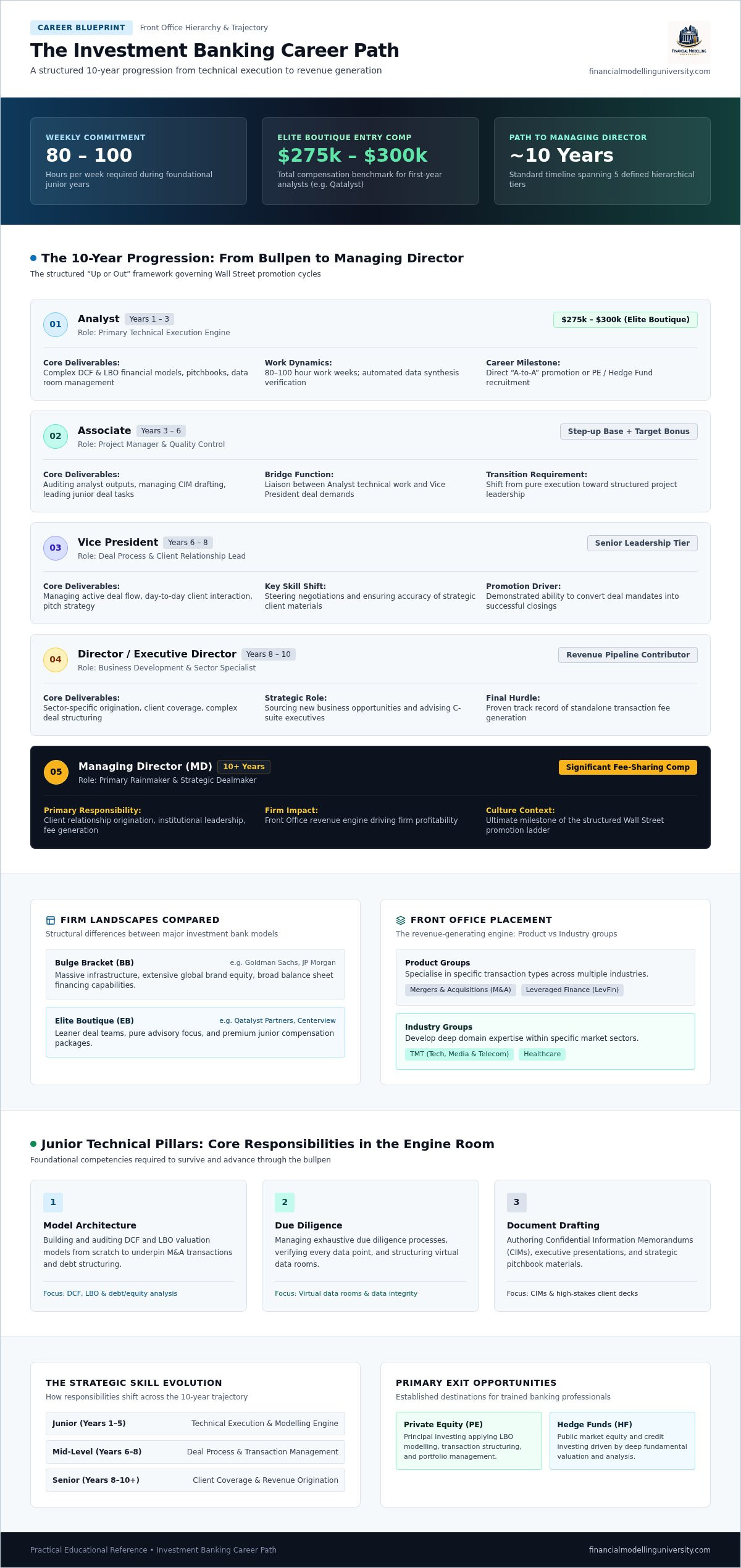
The investment banking career path remains the most structured and competitive ladder in global finance. By 2026, the traditional hierarchy of Analyst, Associate, Vice President, Director, and Managing Director has survived radical technological shifts. The “Up or Out” culture continues to dominate; firms expect you to either evolve into a revenue generator or exit the platform. However, the nature of these roles has changed. AI tools now handle the grunt work of basic data entry, meaning junior bankers are expected to act as data synthesizers from day one. If you can’t interpret the output of a complex LBO model or identify flaws in a DCF valuation, you’re obsolete before your first bonus cycle.
Your experience depends heavily on the type of firm you join. Bulge Bracket (BB) banks like Goldman Sachs or JP Morgan offer massive infrastructure and global brand equity. In contrast, Elite Boutiques (EB) like Qatalyst Partners or Centerview provide leaner deal teams and often higher compensation. In 2026, a first-year analyst at Qatalyst can earn between $275,000 and $300,000 in total compensation, a figure that reflects the high technical bar required at the elite level.
While back and middle office roles support the firm’s operations, the career path we discuss is strictly Front Office. This is the revenue-generating engine. You’ll typically be placed in either a Product Group, such as M&A or Leveraged Finance, or an Industry Group, like TMT or Healthcare. Understanding What is Investment Banking? requires recognizing that you aren’t just an Excel technician; you’re a strategic architect. In the 2026 landscape, the most successful bankers are those who blend sector-specific insights with elite technical execution. Mastery of institutional-grade financial modeling is the only way to prove your value in these high-stakes environments.
Reaching the level of Managing Director is a marathon that typically requires a 10 year commitment. Analysts spend 2 to 3 years in the trenches before moving to Associate roles. While an MBA was once the standard bridge to the Associate level, modern firms increasingly favor direct “A-to-A” promotions for high performers. If you demonstrate superior technical mastery early, you can accelerate this timeline. Promotion cycles generally last 3 years per level. Those who master advanced modeling techniques often find themselves on a fast track to Vice President, where the focus shifts from pure execution to managing the deal process and client relationships.
The Analyst and Associate levels form the technical core of the investment banking career path. While senior bankers focus on relationship management, junior ranks handle the complex architecture of every transaction. Analysts serve as the primary technicians, translating raw company data into institutional-grade valuations. Associates function as managers-in-training; they bridge the gap between execution and project management. They ensure the Analyst’s output is flawless while providing Vice Presidents with the strategic materials needed for high-stakes client meetings.
In 2026, simply knowing how to link cells is no longer sufficient for survival. Automation has raised the baseline expectation for technical output. You must be able to verify the logic behind automated data synthesis and identify subtle flaws in complex structures. This is why mastering investment banking financial modeling has become the #1 survival skill for those entering the bullpen. A typical day involves managing virtual data rooms, refining pitchbooks, and ensuring that every valuation reflects the most current market debt and equity conditions.
Junior bankers spend the majority of their 80 to 100 hour work weeks in the “engine room.” Their primary focus remains on the following technical pillars:
Accuracy is your primary currency in a high-pressure environment. Speed is valuable, but one cell error in a multi-billion dollar valuation can derail a career instantly. To differentiate yourself, you must move beyond manual entry. Mastering Excel for finance allows you to build dynamic, error-proof templates that automate repetitive tasks. This efficiency creates the “unfair advantage” needed to take on more strategic responsibilities.
The most successful analysts adopt a proactive mindset. Instead of waiting for instructions, they anticipate the needs of senior leadership. If you can identify a potential bottleneck in the due diligence process or suggest a more robust sensitivity analysis before being asked, you demonstrate the leadership potential required for promotion. Professionals who want to accelerate this transition often refine their skills through the FMU Investment Banking Financial Modeling Course to ensure their technical execution meets the elite industry standard.
The climb up the investment banking career path shifts dramatically once you cross the threshold into senior leadership. Technical execution remains your foundation, but the metric of success changes from the quality of your spreadsheets to the depth of your client relationships. In 2026, the industry demands that senior bankers act as both technical gatekeepers and strategic visionaries. Success at this level requires a transition from being the “doer” to being the “advisor,” where your value is measured by the revenue you generate and the deals you close.
As you ascend, your compensation structure undergoes a fundamental change. While junior bankers rely on high base salaries, senior leaders see their total pay heavily weighted toward performance-based bonuses and fee-sharing. For instance, a Bulge Bracket Vice President can earn up to $675,000, while a Managing Director’s compensation often exceeds $1,000,000, tied directly to the fees they originate. You’re no longer paid for your time; you’re paid for your results.
The Vice President (VP) acts as the “Deal Principal,” the person responsible for the day-to-day execution of a mandate. You’ve moved away from building the models yourself, but you’re now responsible for reviewing them for strategic deal logic. If an Associate’s LBO model doesn’t account for specific 2026 regulatory capital changes, it’s your job to catch it. You’ll spend your days leading client calls, managing the Analyst/Associate workflow, and developing the sector-specific expertise that provides high-value advice to your clients. It’s a high-pressure balancing act that tests your ability to mentor juniors while satisfying the demands of Directors and MDs.
Reaching the level of Managing Director (MD) is the ultimate goal for those on the investment banking career path. At this pinnacle, you operate with an “Eat What You Kill” mentality. Your primary responsibility is origination: finding new deals and bringing them into the firm. You serve as a strategic advisor to CEOs and Boards of Directors, helping them navigate complex M&A landscapes and digital asset integrations. Success at the MD level requires balancing intense institutional politics with external relationship management. You must protect your firm’s interests while maintaining the trust of the world’s most powerful corporate leaders. It’s a role that demands absolute professional mastery and an unwavering focus on the bottom line.
Technical proficiency is the foundation of your professional credibility. In the high-stakes environment of the investment banking career path, your ability to execute complex analyses determines your trajectory. Amateurs build models that fulfill a basic checklist; elite pros build institutional-grade architectures that survive the scrutiny of a Managing Director or a Private Equity principal. This technical unfair advantage allows you to spend less time troubleshooting and more time providing the strategic deal logic that wins mandates.
Dynamic three-statement modeling is your baseline. You must move beyond static sheets to create integrated financials where every change flows logically across the income statement, balance sheet, and cash flow. Advanced valuation requires going beyond the simple DCF to include sum-of-the-parts and precedent transaction analysis with 2026 market premiums. Deal structuring is the final frontier. You must understand exactly how the interplay of debt, equity, and tax impacts the IRR. This level of insight transforms you from a model builder into a deal architect who can advise on capital structure with confidence.
The signaling value of an online financial modeling course is immense, especially for those from non-target backgrounds. In 2026, recruiters look for verified proof of skill before they even invite you to an interview. FMU certificates serve as a quantitative hallmark of your professional identity, showing you’ve trained under industry experts with real-world deal experience. Continuous education is mandatory to stay ahead of market trends like digital asset tokenization or risk-focused bank supervision. Prove your commitment to excellence by securing the FMU All-Access Pass to master every facet of the deal and accelerate your promotion timeline.
The investment banking career path is a high-octane launchpad. While the climb to Managing Director is lucrative, many professionals use their tenure as a bridge to elite buy-side roles or strategic corporate leadership. By 2026, the versatility of a banking background remains its greatest asset. You aren’t just learning to build decks; you’re learning the mechanics of global capital. This experience makes you a prime candidate for roles that require both technical precision and strategic foresight.
Private Equity remains the dominant choice for junior bankers looking to shift from advisory to ownership. Hedge Funds offer a different challenge, requiring you to move from deal execution to rigorous investment thesis development. If you prefer a more stable environment without sacrificing deal-making intensity, Corporate Development roles at Fortune 500 firms allow you to work “in-house” on acquisitions. Others take their technical rigor into the startup world, using banking skills to build the next fintech unicorn or lead a venture-backed firm through an IPO.
Success in these exits requires a fundamental shift in perspective. You must master private equity financial modeling, which focuses on IRR and cash flow optimization rather than just valuation for a fee. The “Investor Mindset” demands that you evaluate risks as an owner who is putting capital at stake. Recruiting for these roles is notoriously aggressive. In 2026, “on-cycle” recruiting for Private Equity often begins early in an analyst’s second year. You must have your modeling skills perfected before the first headhunter calls, as there is no room for technical hesitation during the “on-cycle” madness.
Career longevity in high finance depends on more than just technical skill. You must actively manage your personal brand to avoid burnout. To effectively navigate these professional pressures and align your trajectory with broader personal growth, discover Rainmakers Coaching International for specialized executive development. Positioning yourself as a thought leader in a specific sector increases your marketability beyond the bullpen. Build a personal brand by staying ahead of 2026 trends, such as digital asset integration and risk-focused bank supervision. Leverage a global network to stay informed about market shifts. The FMU community provides a platform for professionals to share real-world deal experience and maintain their edge. Focus on results, protect your time, and view your technical mastery as a lifelong asset that provides a permanent competitive advantage.
The 2026 roadmap for Wall Street is clear. While the hierarchy remains rigid, your speed of ascent is entirely within your control. Success on the investment banking career path requires a seamless transition from a technical technician to a strategic advisor. Whether you’re aiming for a $300,000 first-year compensation package at an elite boutique or a seat at the Private Equity table, your professional credibility starts with the integrity of your modeling output. You don’t just need to work hard; you need to execute with a precision that senior leadership can’t ignore.
Don’t leave your promotion to chance. Master Financial Modeling Like the Pros with FMU University and join 25,000+ finance professionals who have already transformed their careers. Our platform provides instruction from industry-leading experts and includes the same institutional-grade Excel templates used by elite bulge bracket firms. The industry is evolving, but the demand for technical excellence is permanent. Secure your unfair advantage and start your journey toward professional mastery today.
First-year analysts in 2026 earn a median base salary of $110,000, with all-in compensation ranging from $165,000 to $195,000. At Bulge Bracket firms, total pay typically lands between $160,000 and $210,000. Elite Boutiques offer even higher ceilings; top performers at firms like Qatalyst Partners see packages up to $300,000. These figures reflect the high demand for technical talent capable of navigating a complex M&A and IPO recovery.
You should expect to work between 80 and 100 hours per week during active deal cycles. While some firms have implemented protected weekends or Saturday sabbaticals, the reality of a live M&A mandate often overrides these policies. Junior bankers spend the majority of this time in the engine room, building models and refining pitchbooks. Efficiency is your only defense. Mastering advanced Excel allows you to reclaim valuable hours without sacrificing quality.
Analysts are the primary technical architects, while Associates act as project managers who bridge the gap between execution and senior leadership. An Analyst spends their day deep in Excel, building DCF and LBO models from scratch. The Associate reviews this work for strategic logic and manages the deal workflow. While the Analyst focuses on the technical execution of the numbers, the Associate begins focusing on the deal’s overall strategic fit.
Private Equity remains the most common exit path, with recruiting often starting early in an Analyst’s second year. Other popular choices include Hedge Funds, where the focus shifts to investment thesis development, and Corporate Development at Fortune 500 companies. Some juniors also transition into Venture Capital or Fintech entrepreneurship. Regardless of the path, your success depends on the institutional-grade modeling skills you developed during your time in the bullpen.
AI has shifted the junior role from manual data entry to high-level data synthesis and verification. Automation now handles repetitive tasks like basic spreading of financials, meaning Analysts are expected to produce more sophisticated analysis in less time. This evolution has led to smaller analyst classes with higher expectations for technical output. To survive, you must be able to audit AI-generated outputs and identify flaws in complex valuation logic.
To navigate this shift towards data synthesis and automation, you can learn more about Square Skills and their accredited IT training and career development programmes.
Investment banking remains the premier choice for ambitious professionals seeking high compensation and rapid skill acquisition. The investment banking career path has seen a strong recovery in M&A and IPO activity throughout 2026, leading to increased hiring at major banks. While the hours are grueling, the technical training and global network you build are unparalleled. It serves as a permanent competitive advantage that opens doors to almost any elite role.
You must demonstrate absolute mastery of three-statement modeling, DCF valuation, and LBO mechanics. Bulge Bracket banks expect you to build dynamic, error-free models that account for complex capital structures and 2026 regulatory changes. Proficiency in Excel for finance is a non-negotiable baseline. Beyond pure math, you need the ability to articulate the strategic impact of debt and equity on a firm’s IRR, proving you are a deal architect.