

A generic certificate on your LinkedIn profile doesn’t secure a seat at the deal table. In the high-stakes environment of 2026, institutional-grade technical proficiency is the only currency that matters to elite recruiters. You’ve likely experienced the frustration of information overload, scrolling through dozens of competing platforms while fearing you might waste time and capital on a low-prestige designation. Choosing the right financial modeling certification is about more than just adding a line to your resume. It’s about proving you can handle the pressure of a live transaction without your Excel model breaking under scrutiny.
We understand that your goal isn’t just to learn; it’s to lead. You want to master complex DCF and LBO models that command respect from senior partners and accelerate your career progression to Associate or VP levels. This guide deconstructs the complex landscape of modern designations to find the training that actually translates to deal-ready skills. Financial Modelling University will analyze the elite paths trusted by the industry, compare the most rigorous curriculum standards, and show you how to master financial modeling like the pros. By the end of this guide, you’ll have a clear blueprint to verify your technical mastery and claim your place among the top 1% of finance professionals.
A financial modeling certification is more than a digital badge; it’s a validated credential of technical and strategic proficiency. It proves you can build, audit, and interpret the complex structures that drive billion-dollar decisions. In 2026, the bar has moved. Institutional-grade modeling is now a baseline requirement for entry-level roles in private equity and investment banking. Recruiters no longer treat these skills as a bonus. They use them as a primary filter to identify candidates who can perform from day one. To grasp the foundation of this field, it helps to review the basics of What is Financial Modeling? and how it applies to valuation. Elite certifications allow you to bypass traditional gatekeepers by showcasing a verified skill set that’s immediately applicable to live deals.
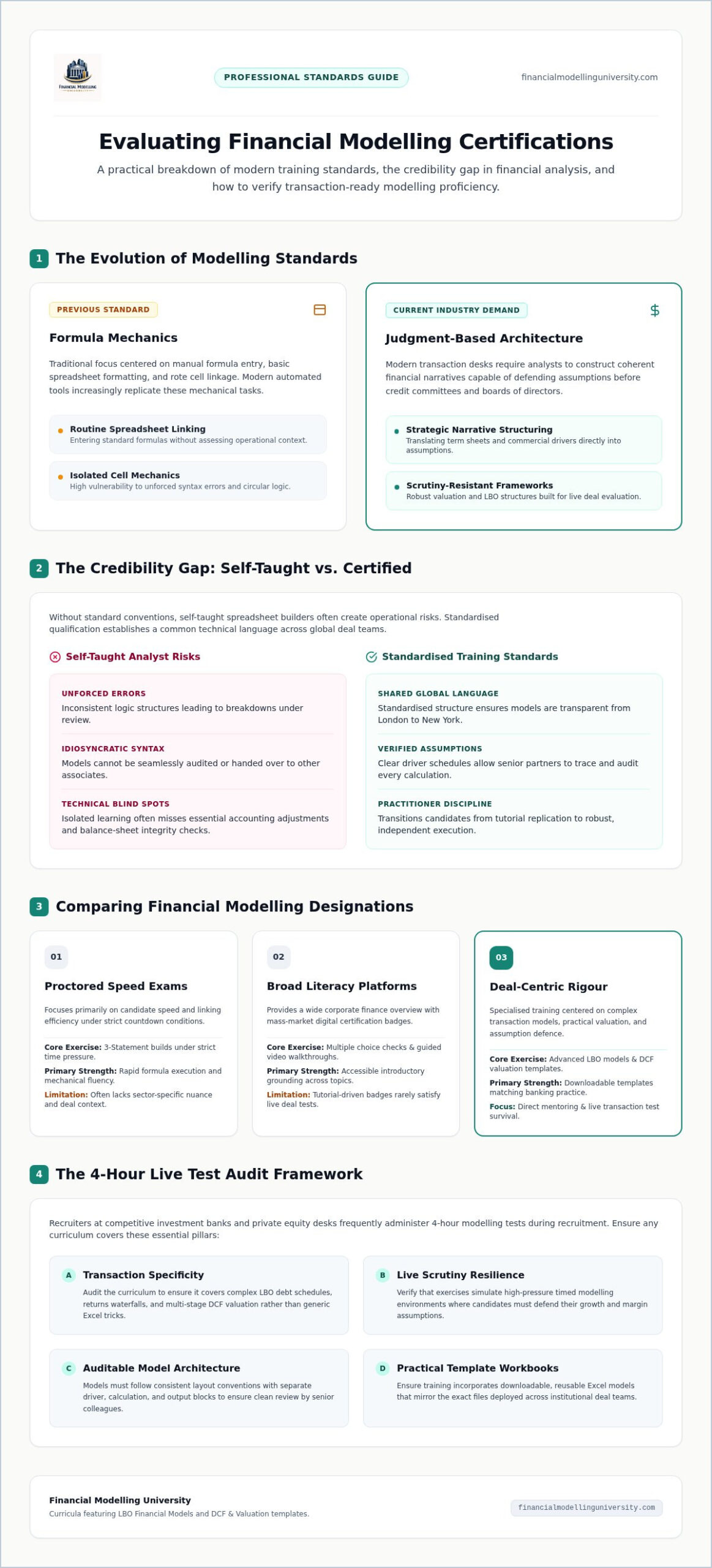
Basic Excel skills are rapidly becoming obsolete. AI tools now handle routine data entry and simple formula replication with high accuracy. Consequently, the industry now demands “judgment-based” modeling. You’re expected to do more than just link cells. You must structure complex financial narratives that can withstand the scrutiny of a credit committee or a board of directors. The transition from “knowing Excel” to “architecting a deal” is the new standard. Professionals must now focus on the strategic implications of their LBO and DCF valuations rather than just the mechanics of the spreadsheet. If you can’t translate a term sheet into a functioning model, you’re a liability to your team.
Self-taught models are often riddled with “unforced errors.” Without a foundation in standardized best practices, your work can become a liability during a high-stakes transaction. A formal financial modeling certification provides a shared language for global deal teams. This ensures that every team member, from London to New York, can follow your logic and verify your assumptions. The psychological impact of a “University” grade certification on recruiter perception is significant. It transforms you from a “tutorial learner” into a disciplined practitioner. FMU University ensures you’re not just learning in a vacuum. You’re gaining the prestige associated with performing at the level of elite industry veterans. This formal training eliminates the risk of technical blind spots that often plague the self-taught analyst.
Selecting a financial modeling certification in 2026 requires a strategic audit of your career trajectory. The market is currently split between three distinct archetypes: proctored speed-tests, broad literacy platforms, and the specialized, deal-centric rigor of FMU University. As the Financial Analyst Career Outlook remains highly competitive, the distinction between a tutorial badge and a deal-ready credential determines your access to high-tier firm interviews. You must decide if you want a general overview or the technical depth required to lead a transaction.
Proctored exams focus on your ability to build a three-statement model under strict time constraints. While this builds foundational speed, it often lacks the sector-specific nuance required in Private Equity or Project Finance. Practical, deal-based certifications prioritize institutional-grade mastery instead. They simulate the pressure of a live environment, requiring you to defend your assumptions to a senior partner. This approach ensures you aren’t just linking cells, but architecting a financial narrative that survives the scrutiny of a credit committee.
FMU University positions itself as the premier mentor for those targeting the most competitive desks. The curriculum prioritizes high-stakes deal types, specifically LBO modeling and M&A valuation. Unlike mass-market platforms, FMU University provides downloadable, institutional-grade Excel for finance templates that mirror the tools used at top-tier investment banks. The defining feature of this path is 1-on-1 career mentoring. This direct access to industry experts bridges the gap between theoretical knowledge and the practical judgment needed to navigate billion-dollar transactions.
Many providers rely on “All-Access” subscription models that favor quantity over depth. These are effective for entry-level literacy but often fail to provide the sophistication needed for Associate or VP levels. High-touch programs differentiate themselves by offering live Q&A sessions with actual industry practitioners who have closed real deals. In a rapidly evolving landscape, “Lifetime Access” is a critical asset. It ensures your technical skills remain current as global market standards shift. For those committed to professional mastery, the FMU All-Access Pass serves as a catalyst for continuous career transformation. Master financial modeling like the pros by choosing a financial modeling certification that offers more than just a certificate.
A financial modeling certification that merely confirms you can link a balance sheet is a poor investment of your capital. In the high-stakes environment of 2026, your credential must prepare you for the ultimate gatekeeper: the 4-hour modeling test. Elite firms don’t hire for effort; they hire for accuracy under pressure. If your model crumbles when a partner asks for a sudden sensitivity check, your certification has failed its primary purpose. We prioritize the “no-nonsense” precision required by top-tier desks over academic theory. True mastery means mastering investment banking financial modeling through a strategic, deal-ready lens.
Building a model like a pro requires a foundation built on three non-negotiable pillars:
Basic accounting literacy is no longer a differentiator for Private Equity or M&A roles. You must move beyond the standard three-statement model to handle complex transaction mechanics like PIK interest, tax-deferred assets, and intricate waterfall structures. Specialized sector-specific knowledge is the next frontier of financial modeling certification. For example, mastering Real Estate Financial Modeling requires understanding asset-specific drivers that generic courses ignore. Integrating VBA and advanced Excel techniques ensures your models are scalable and efficient. This technical rigor allows you to focus on the high-level strategy that secures your seat at the deal table.
Avoid the trap of certification fatigue. A generic financial modeling certification often lacks the sector-specific depth required for elite-tier roles. To secure your seat at the deal table, you must follow a surgical audit process that aligns your training with your professional trajectory. Don’t settle for a broad curriculum that skims the surface of multiple industries without mastering any.
Start by identifying your target sector. Investment banking, private equity, and real estate each demand distinct technical frameworks. Audit the curriculum for deal specificity. Does the program cover complex LBO mechanics or just standard DCF valuation? If you’re targeting private equity, an LBO-heavy curriculum is a non-negotiable requirement. Next, evaluate the “Proof of Work” by inspecting the downloadable Excel templates. They must be institutional-grade, not simplified academic exercises. Finally, check for career support and mentorship. Practical skills are only half the battle; you need the guidance of an industry insider to navigate the recruitment landscape and ensure your skills remain current through long-term community updates.
This path demands absolute technical mastery and the ability to perform under extreme pressure. You’ll face rigorous modeling tests that simulate real-world deal scenarios. Focus on certifications that emphasize LBO modeling, M&A mechanics, and advanced valuation techniques. FMU’s “Elite Career Mastery” philosophy is specifically designed for this high-stakes environment. It prepares you to defend your assumptions before a senior partner, rather than just passing a proctored exam. You’ll gain the confidence to handle the technical scrutiny that defines the transition to Associate and VP levels.
Infrastructure deals involve long-term debt structuring and complex tax modeling that standard corporate finance courses ignore. You need specialized training in project-specific cash flows, debt sculpting, and reserve accounts. Use the FMU All-Access Pass to bridge multiple sectors, from renewable energy to transport infrastructure. Globally recognized certificates in this field signal your ability to manage the financial intricacies of international deals. Gain the competitive edge by choosing the FMU All-Access Pass for continuous professional growth and technical superiority.
Financial Modelling University stands apart from mass-market tutorial factories. We are the University for Professionals who demand more than basic Excel tips. Our curriculum represents the elite standard in technical rigor, designed specifically to transform ambitious analysts into industry-leading practitioners. Obtaining a financial modeling certification from FMU University signals to the market that you possess the technical judgment required for institutional-grade deal-making. Join the 25,000+ finance professionals who have already trusted our proven methods to accelerate their careers. We bridge the gap between classroom theory and the high-stakes reality of the deal table.
Our curriculum is built by practitioners, for practitioners. We don’t deal in abstract theory or simplified academic exercises. Every case study and template mirrors the high-pressure environment of a live transaction. This practical application ensures that your skills are deal-ready from the moment you complete your training. By choosing FMU University, you are investing in a credential that is respected by recruiters and senior partners alike. It is the definitive path for those committed to the highest levels of professional excellence and technical precision.
The FMU All-Access Pass provides unrestricted entry to our entire library of institutional-grade courses. This isn’t a static archive. We continuously update our curriculum to reflect the shifting dynamics of the 2026 market, ensuring your skills never become obsolete. You gain access to the same specialized templates used by top-tier desks globally. The true power of this pass lies in the Elite Mentor network. This isn’t just educational content; it’s a direct line to career breakthroughs through 1-on-1 guidance from experts who have operated at the Associate and VP levels. Most platforms ignore this mentorship, but we consider it the missing link to your success.
Your journey toward elite status begins with technical precision. Enrolling in our DCF valuation course is the first step in building a bulletproof modeling foundation. From there, you will progress to mastering complex LBO structures and M&A narratives, eventually leading your own deal team. The long-term ROI of an FMU certification is found in its ability to evolve alongside your career. We don’t just teach you how to model; we provide the blueprint for professional mastery. Choose your specialized path today or secure the FMU All-Access Pass to unlock your full potential. Master financial modeling like the pros and claim your seat at the table.
To further enhance your leadership capabilities and manage complex deal structures, you may also explore Professional Training and Certification in globally recognized project and portfolio management frameworks.
The landscape of 2026 demands more than just technical literacy; it requires the strategic judgment of a seasoned practitioner. We’ve explored how a high-caliber financial modeling certification serves as your entry ticket to elite desks in investment banking and private equity. Success hinges on moving beyond basic Excel tutorials to master institutional-grade LBO and DCF structures that survive the scrutiny of a live transaction. Remember that the prestige of your credential is only as strong as the deal-ready skills it validates.
You don’t have to navigate this path alone. FMU University provides the blueprint for your transformation, offering direct 1-on-1 career mentoring from industry experts and downloadable institutional-grade Excel templates. Join the 25,000+ finance professionals who have already chosen the path of professional mastery. It’s time to stop learning in a vacuum and start architecting billion-dollar narratives. Master Financial Modeling Like the Pros with the FMU All-Access Pass. Your seat at the deal table is waiting; take the first step toward elite career mastery today.
Yes, it’s a critical tool for verifying technical proficiency before you ever sit for a modeling test. Elite firms use these certifications to filter candidates who can handle institutional-grade LBO and DCF models from day one. While not a replacement for a strong GPA or networking, it provides the “proof of work” that senior partners demand. It demonstrates that you don’t need hand-holding during a high-stakes transaction.
Most professionals complete a rigorous program within three to six months of disciplined study. This timeline depends on your baseline Excel proficiency and the depth of the curriculum. High-level certifications covering specialized sectors like private equity or real estate require significant time to master complex waterfall structures and debt sculpting. Speed is less important than achieving the technical precision required to pass a 4-hour modeling test at a major firm.
A general Excel course teaches software mechanics; a financial modeling certification teaches deal-making judgment. While basic courses focus on VLOOKUPs and formatting, a professional certification requires you to architect complex financial narratives. You must learn to link a three-statement model, perform sensitivity analysis, and build institutional-grade dashboards. It’s the difference between knowing how to use a tool and knowing how to build a billion-dollar investment case.
You don’t need a formal finance degree, but you must possess a strong grasp of accounting fundamentals and logical reasoning. Most elite programs include foundational modules to bridge technical gaps. However, the learning curve is steep. You’ll move quickly from basic financial statements to advanced M&A and LBO mechanics. Commitment to mastering the “no-nonsense” precision of the industry is more important than your previous academic major.
For those looking to expand their professional toolkit with versatile digital expertise, EarnOnlineGuides provides helpful guides on building legitimate online income streams alongside specialized career training.
Yes, institutional-grade certifications are recognized globally as a benchmark for technical readiness. Firms like Goldman Sachs and JP Morgan value candidates who have already mastered the modeling standards used by their own analyst pools. A recognized financial modeling certification signals that you speak the “shared language” of global deal teams. It ensures your work meets the professional standards required in major financial hubs from New York to London.
It doesn’t replace the theoretical foundation of a Master’s degree, but it often carries more weight during technical interviews. Recruiters at elite firms prioritize practical, deal-ready skills over academic theory. A certification proves you can build a functioning LBO model, while a degree might only prove you understand the concept of leverage. For many Associate-level roles, technical mastery is the primary differentiator that secures the job offer.
You’ll be tested on your ability to build dynamic, error-free models without using a mouse. This includes mastering keyboard shortcuts, complex nesting of formulas, and advanced data validation. You must demonstrate proficiency in scenario managers, sensitivity tables, and robust error-checking mechanisms. High-level certifications also evaluate your ability to integrate VBA for model scalability and automate repetitive tasks that are common in investment banking and private equity workflows.
The FMU University career mentoring program provides direct 1-on-1 access to industry experts who have already achieved success at elite firms. These mentors help you navigate the recruitment landscape, refine your “deal-ready” narrative, and prepare for rigorous modeling tests. This specialized guidance bridges the gap between technical proficiency and professional placement. It’s an essential catalyst for career transformation that mass-market tutorial platforms simply cannot provide to their students.