


A model that requires a manual to audit isn’t sophisticated; it’s fundamentally broken. In the high-stakes world of investment banking and private equity, complexity is a liability, while clarity is the ultimate currency. You’ve likely felt the frustration of a model becoming too tangled to manage or the anxiety of a hard-coding error that ruins your credibility during a deal. Mastering excel modeling best practices isn’t just about learning shortcuts. It’s about building “Architectural Integrity” into every cell so your work survives the most rigorous senior associate audits.
We understand that your reputation as a finance professional depends on the precision of your output. That’s why we’ve codified the exact standards used by elite firms into this 2026 guide. You’ll learn how to structure scalable, transparent models that pass technical tests and command respect in any boardroom. We’ll cover everything from institutional formatting and dynamic debt schedules to the error-trapping methods trusted by 25,000+ industry pros. It’s time to stop wasting time on manual checks and start delivering the prestige of institutional-grade work.
Institutional-grade modeling isn’t merely a technical requirement; it’s a professional signature. In the high-pressure environments of bulge bracket investment banks and top-tier private equity firms, your model is the primary medium through which deals are analyzed and multi-billion dollar decisions are made. Adopting excel modeling best practices ensures that your work functions as a reliable, institutional-grade asset rather than a fragile liability. You aren’t just an author; you’re a Strategic Architect. This mindset shift is critical. It requires you to build for the person who will inherit your work, ensuring they can navigate your logic without needing a manual or a direct line to your desk.
When you fail to follow these rigorous standards, the costs are high. A single hard-coding error in a debt schedule can lead to career-ending mistakes or the total loss of deal credibility during a live audit. This is why institutional-grade models are considered the “language” of Wall Street. They provide a standardized, unbreakable framework that allows teams to move at the speed of the market. At Financial Modelling University (FMU), we’ve seen how mastering these standards transforms careers, helping over 25,000 finance professionals move from entry-level tasks to lead execution roles.
To reach the level of an elite industry practitioner, your work must rest on three foundational pillars that define its architectural strength.
Amateurs often try to impress colleagues with technical complexity, but true masters prioritize clarity. Over-engineered spreadsheets filled with twenty-level nested IF statements are a liability, not an asset. They are nearly impossible to audit under the intense time pressure of a deal closing. When a VP reviews your LBO model at midnight, they don’t want to solve a logic puzzle; they want to verify an IRR output. In our Investment Banking Financial Modeling Course, we emphasize that “ego-modeling” is the fastest way to lose trust in a professional setting. Architectural Integrity is the precise balance between granular detail and structural clarity. By stripping away the fluff, you focus on what matters: precision, speed, and reliability. This is how you Master Financial Modeling Like the Pros.
Logic is the skeleton of your financial model. Elite practitioners follow the “Flow of Information” rule: data must move strictly from left to right for time and top to bottom for logic. This structural discipline is a cornerstone of excel modeling best practices. It ensures that any reviewer can trace the origin of a number without getting lost in a maze of circular references. To maintain this clarity, you must strictly separate your model into three distinct zones: Inputs, Calculations, and Outputs. Mixing assumptions with formulas is a rookie mistake that destroys auditability and increases the risk of catastrophic error.
Professional presentation also requires institutional-grade “Cover” and “Index” sheets. These aren’t just for aesthetics; they signal to a client or a VP that the model is a finished product. An index sheet with hyperlinked tabs allows a senior reviewer to navigate a 50-tab LBO model instantly. While some analysts debate the “one-tab” rule for three-statement models, FMU advocates for a more nuanced approach. Consolidate when possible to reduce complexity, but use dedicated sheets for complex modules like project finance or detailed inventory schedules to prevent your calculations from becoming unreadable.
Build your model using self-contained blocks for Revenue, OpEx, and Debt. This modularity allows you to update specific business units without re-engineering the entire workbook. Every sheet must use identical column headers to ensure consistency across the model. Mastering these technical layout standards is a core focus of our Excel for Finance course, where we bridge the gap between basic spreadsheet skills and professional banking standards. Adhering to these excel modeling best practices ensures your work is scalable across different deal teams.
The first commandment of FMU is simple: no hard-codes in formulas. Every driver must be a dedicated input, clearly separated from the logic. When reconciling accounts like PP&E or long-term debt, always use the “BASE” method: Beginning balance, Additions, Subtractions, and Ending balance. This approach creates a transparent audit trail that senior associates can verify in seconds. If you find yourself typing a number directly into a formula, you’ve already compromised your architectural integrity. For those ready to build unbreakable models from scratch, our Investment Banking Financial Modeling Course provides the industry-vetted templates you need to Master Financial Modeling Like the Pros.
Formatting isn’t a cosmetic choice; it’s a diagnostic tool. In the elite tiers of corporate finance, a model’s aesthetic dictates how quickly it can be audited and understood. Adhering to excel modeling best practices means your work must look like it was produced by a top-tier investment bank. This begins with the “Clean Sheet” rule. Gridlines are for amateurs; professionals remove them immediately to create a blank canvas. Consistent font sizes, typically size 10, and uniform row heights ensure the model remains readable across different monitors and printed decks. Perhaps most importantly, never hide rows or columns. Hiding data is a cardinal sin that leads to “ghost” errors during a deal audit. Use the grouping function instead. This keeps the model clean while ensuring every calculation remains accessible to the reviewer.
Color-coding provides an instant visual map of a model’s logic. At FMU, we teach a strict four-color standard that allows any associate to identify cell types without clicking into them. Blue is reserved strictly for hard-coded assumptions and historical data. If a cell is blue, it’s an input that can be safely changed. Black is the color for formulas and references on the same sheet. If you see black, don’t touch the cell logic. Green denotes references to other sheets within the same workbook, while Red signifies references to external workbooks. Professionals avoid external links whenever possible because they are prone to breaking during file transfers. This standardized approach is what separates a “pro” model from a confusing spreadsheet. It’s a core component of our Excel for Finance Course, where we drill these habits until they become second nature.
Inconsistent sign conventions are the leading cause of “double-counting” errors in DCF models and LBO valuations. To prevent this, adopt the “Natural Balance” approach on your assumptions page. Enter all expenses, such as COGS or Interest Expense, as positive numbers. This makes the drivers easier to read and manage for the end user. The conversion to negative values should only happen within the financial statement formulas themselves. On the Cash Flow Statement, follow the absolute rule: cash inflows are positive, and outflows are negative. This clarity is essential when calculating Free Cash Flow for a valuation. Mastering these conventions is critical for passing technical modeling tests at elite firms. If you want to perfect these techniques using real-world templates, our DCF Valuation Course provides the rigorous training required to Master Financial Modeling Like the Pros.
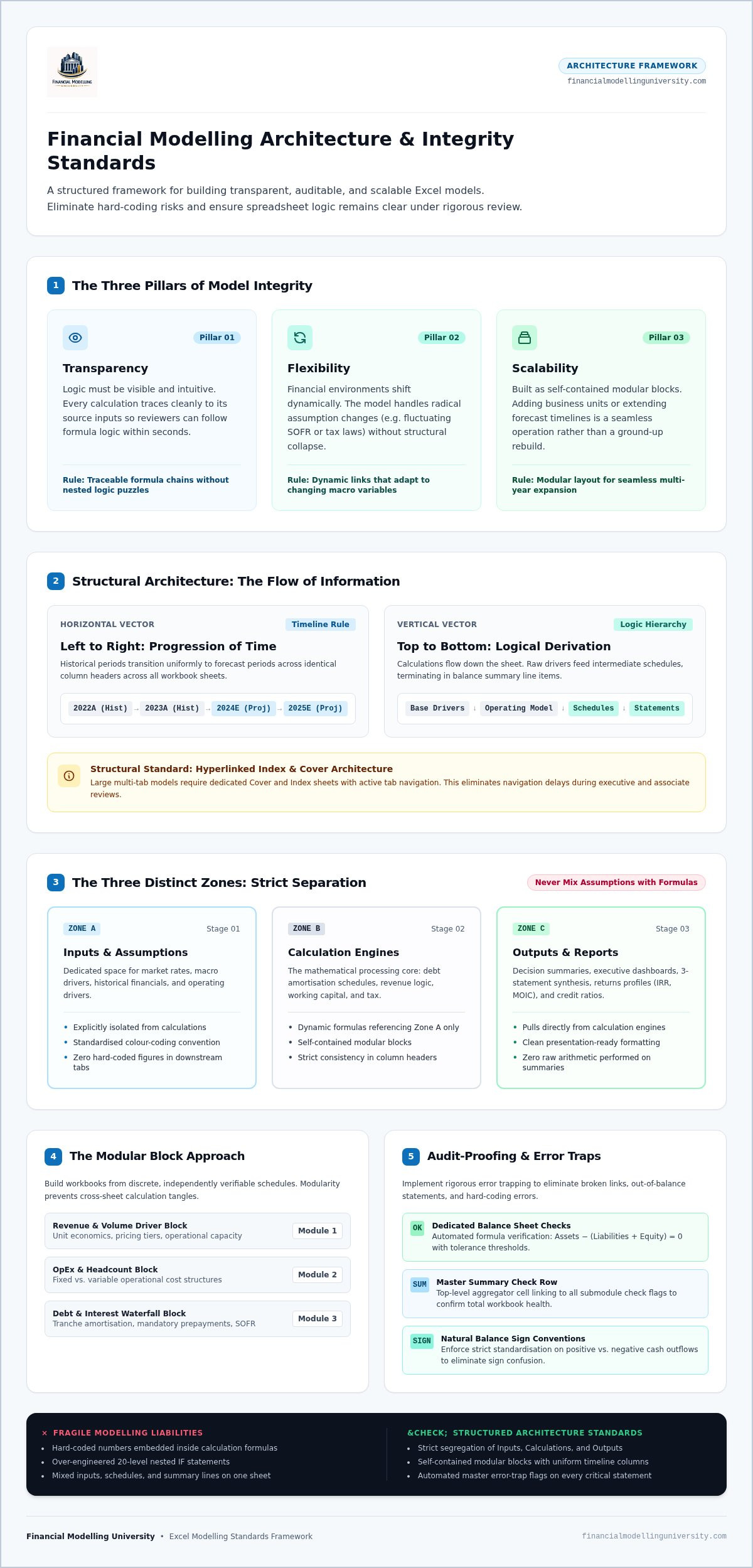
A financial model is only as strong as its weakest link. Even a perfectly formatted workbook is a liability if it contains a hidden logical flaw. In the high-stakes world of investment banking, “unbreakable” architecture is the goal. This requires a proactive approach to error trapping, ensuring that any imbalance is flagged the moment it occurs. Integrating automated checks is a non-negotiable component of excel modeling best practices. By building internal safeguards, you protect your professional reputation and ensure the model remains audit-proof during the intense scrutiny of a deal closing.
Modern auditing also involves leveraging technology to stress-test your work. The “Stress Test” protocol involves pushing your assumptions to their absolute limits. If you set revenue growth to 500% or interest rates to 20%, does the model still hold together? If the balance sheet doesn’t balance or the debt schedule “explodes,” you’ve found a structural weakness that needs immediate remediation. In 2026, elite analysts also use LLMs to peer-review formula logic. To maintain data security, never upload proprietary datasets. Instead, paste the formula structure into the LLM and ask it to “identify logical inconsistencies in this debt waterfall.” This provides a high-level logic audit that complements your manual verification.
Don’t scatter error flags across fifty different worksheets. Centralize every diagnostic check into a single, dedicated “Checks” tab. This dashboard should aggregate the “Balance Sheet Check” (Assets minus Liabilities and Equity) and the “Cash Flow Check” (Ending Cash on the CFS versus the Balance Sheet). Use conditional formatting to make these flags impossible to ignore. A bright red “FALSE” should appear the moment a single cent is out of place. Mastering this centralized architecture is a key theme in our guide on Investment Banking Financial Modeling, where we show you how to build models that senior associates can trust at a glance.
Before you hit “send” on a model, you must perform a final technical sweep. This three-step protocol is designed to catch the errors that lead to embarrassing feedback. Follow these steps every time:
Precision is the hallmark of an industry expert. If you are ready to eliminate errors and produce institutional-grade work, explore our FMU All-Access Pass to Master Financial Modeling Like the Pros.
Technical proficiency is the fastest way to build political capital within a deal team. When you consistently deliver unbreakable work, you move from being a “spreadsheet analyst” to a trusted strategic partner. Adhering to excel modeling best practices signals to your VPs and Managing Directors that you’re ready for the responsibilities of an Associate. They stop checking your formula logic and start focusing on your strategic insights. This transition is where true career acceleration happens, transforming you into an indispensable asset during live deal execution.
Clean modeling isn’t just about avoiding errors; it’s about creating a scalable legacy. In the fast-paced environment of investment banking and private equity, the models you build today will be used for years to come. If they’re built with architectural integrity, they’ll survive multiple rounds of financing and ownership changes. If they’re built poorly, they’ll become a liability that drains your team’s time and resources. Mastery of these standards allows you to move between LBO, M&A, and project finance roles with total confidence in your technical output.
As you progress, you’ll need to adapt these foundational rules to increasingly complex transaction structures. In Private Equity Financial Modeling, the focus shifts toward debt waterfall precision and IRR sensitivity. Similarly, adjusting for sector-specific nuances in Real Estate Financial Modeling requires you to manage joint venture equity splits while maintaining strict transparency. For those managing massive datasets across multiple business units, our VBA for Financial Modeling Course teaches you to automate your audit checks, ensuring your excel modeling best practices remain intact even under extreme deadlines.
Mastery isn’t a one-time event; it’s a commitment to continuous professional development. The FMU All-Access Pass provides you with a comprehensive library of downloadable templates that serve as the institutional “Gold Standard” for your career. These aren’t just academic exercises; they’re the same blueprints used by elite bulge bracket firms to evaluate multi-billion dollar deals. By aligning your workflow with these proven methods, you join a community of 25,000+ finance professionals who perform at the highest level. It’s time to stop second-guessing your architecture and start producing work that commands respect in any boardroom. Take the final step in your career transformation and Master Financial Modeling Like the Pros with FMU University.
Bridge the gap between theoretical knowledge and professional mastery. Join 25,000+ finance professionals who rely on our bulge-bracket standard templates and globally recognized certificates to secure elite job offers. Whether you’re preparing for a technical modeling test or looking to accelerate your path to Associate, the right training is essential. Master Institutional-Grade Modeling with the FMU All-Access Pass and learn to Master Financial Modeling Like the Pros. Your journey toward becoming an industry expert starts with a single, disciplined step. Build with confidence.
Start with the strict separation of inputs, calculations, and outputs. This foundational structure prevents logic errors and ensures your model is auditable by senior team members. Beginners should also master basic excel modeling best practices like removing gridlines and using consistent color-coding for cell types. Never hard-code numbers inside formulas. If you follow these rules, you’ll build a professional reputation for reliability and clarity from your very first project.
Color-coding acts as a visual map that allows reviewers to identify cell functions instantly without clicking into formulas. In elite finance, blue signifies hard-coded inputs, black represents formulas on the same sheet, and green indicates links to other tabs. This standardized aesthetic reduces the time required for a VP or Senior Associate to audit your work. It’s a critical component of institutional-grade modeling that prevents accidental overwriting of dynamic logic.
Consolidate your core 3-statement model on a single sheet whenever the complexity allows for it. Keeping the Income Statement, Balance Sheet, and Cash Flow Statement together minimizes the risk of broken links and simplifies the audit process. However, you should use separate tabs for detailed supporting schedules like depreciation, debt, and working capital. This balanced approach maintains structural clarity while allowing for the granular detail required in complex LBO or M&A models.
Eliminate all hard-coded numbers within your formulas to ensure your model remains dynamic and unbreakable. Use a dedicated inputs section where every driver is clearly labeled and separated from the calculation logic. Additionally, implement error-trapping cells that flag imbalances in your balance sheet or cash flow statement immediately. Building these safeguards allows you to run aggressive sensitivity analyses without risking a structural collapse of the entire excel modeling best practices framework.
The “Natural Balance” approach involves entering all financial drivers as positive numbers on the assumptions page. For instance, you should enter COGS and Interest Expense as positive values to make the inputs easier for a user to manage. The conversion to a negative sign only occurs within the financial statement formulas. This convention reduces the likelihood of sign-flip errors and ensures consistency across complex DCF and LBO valuation models.
You can use AI as a logic-checking tool, but you shouldn’t rely on it to generate core financial formulas without oversight. Paste your formula structure into an LLM to identify logical circularity or potential inefficiencies; however, never upload proprietary or sensitive deal data. Professional modeling requires the “Strategic Architect” mindset that AI currently lacks. Use technology to enhance your auditing speed rather than replacing the fundamental technical mastery required for institutional-grade work.
Start by using the “Trace Precedents” and “Trace Dependents” tools to map the flow of information. Check the “Checks” tab for any existing error flags and verify that the balance sheet reconciles across all projected years. Use the F5 “Go To Special” command to locate any hidden hard-codes within calculation blocks. Understanding the model’s structural architecture is the first step toward verifying its integrity and identifying potential logical flaws in the workbook.
Always group rows and columns instead of hiding them. Hiding data is a dangerous practice that often leads to “ghost” errors because reviewers can easily overlook hidden calculations during an audit. Grouping allows you to collapse detailed sections for a clean presentation while keeping the data accessible with a single click. This transparency is a hallmark of elite industry practitioners who prioritize auditability and long-term model maintenance over simple spreadsheet aesthetics.