


A WACC calculation can materially affect a DCF valuation because WACC is the rate used to discount a company’s projected cash flows. It combines the costs of equity and debt, weighted by each source’s share of total capital, with debt measured at its after-tax cost. Use market values for the weights so they reflect the company’s current financing mix.
The formula is straightforward, but its assumptions require care. Changes in the cost of equity, borrowing rate, tax rate or capital structure can shift WACC and the resulting valuation. A company-wide rate may also be unsuitable for a project with a different risk profile.
This guide explains what WACC means, how to apply its formula and how to estimate each input. It covers how capital weights and the tax adjustment affect the result, what drives the cost of equity and debt, and when a project-specific rate may be appropriate. The goal is a calculation you can build, explain and test in a financial model.
WACC is the average return a business must provide to its capital providers. In a DCF, it discounts unlevered free cash flow to estimate enterprise value.
The Capital Asset Pricing Model (CAPM) estimates the cost of equity: risk-free rate + beta × equity risk premium. It matters because shareholders expect compensation for market risk, which informs the discount rate. Beta measures how a company’s share returns move relative to the market. A beta of 1 indicates movement in line with the market; a beta of 2 implies greater sensitivity.
Market values are the current values of a company’s debt and equity, reflecting each source’s share of financing. They matter because book values may not represent the capital investors currently have at risk. Estimate equity value by multiplying share price by shares outstanding; estimate debt value using traded debt or debt terms. Relevant inputs include market data, company filings and bond information.
Common mistakes include relying automatically on book values, mixing dates and using inconsistent units. Keep debt and equity values on the same valuation date and in the same currency.
Equity generally carries more risk because shareholders receive what remains after creditors’ claims are met. This residual position makes returns more exposed to changes in business performance. Debt investors have contractual interest payments and repayment terms, although default can still put their capital at risk. This difference helps explain why the cost of equity is often higher than the cost of debt.
The risk-free rate represents a baseline return, while the equity risk premium is the additional return investors expect for taking market risk. Both matter because CAPM uses them to estimate the cost of equity. For US companies, the US 10-year bond yield is a common risk-free-rate proxy; the equity risk premium usually ranges from 4% to 6%. Use inputs that match the company’s market and valuation date.
WACC combines the returns required by a company’s capital providers. Its weights show how much each source contributes to total financing. A WACC calculation is useful when the capital mix and required returns match the cash flows being valued.
Each component’s weighted cost equals its share of capital multiplied by its required return. For debt, use the after-tax cost; include preferred equity when the company has it. The formula is: WACC = (E/V × Re) + (D/V × Rd × (1 − T)), plus any weighted preferred-equity component. Here, E, D and V represent equity, debt and total capital.
For long-term cash flows, use the targeted long-term capital structure rather than a temporary financing mix. This aligns the rate with the funding mix expected over the projection period. Match nominal rates with nominal cash flows, and use a consistent currency throughout the valuation model.
For a WACC calculation, consider a hypothetical company with $800,000 of equity and $200,000 of debt, totalling $1,000,000. Assume a 15% cost of equity, a 5% cost of debt and a 20% tax rate. The weights show each source’s share of total capital.
First, calculate the after-tax debt cost: 5% × (1 − 20%) = 4%. Then calculate WACC: (80% × 15%) + (20% × 4%) = 12% + 0.8% = 12.8%. The weighted components reconcile to the total rate. In Excel, check that the weights sum to 100% and that each component uses the intended input cell.
Compare WACC with return on invested capital (ROIC), the return earned on operating capital. When ROIC exceeds WACC, the company creates value. Expected project returns above WACC can also serve as a capital-budgeting hurdle. Use consistent periods for ROIC and WACC.
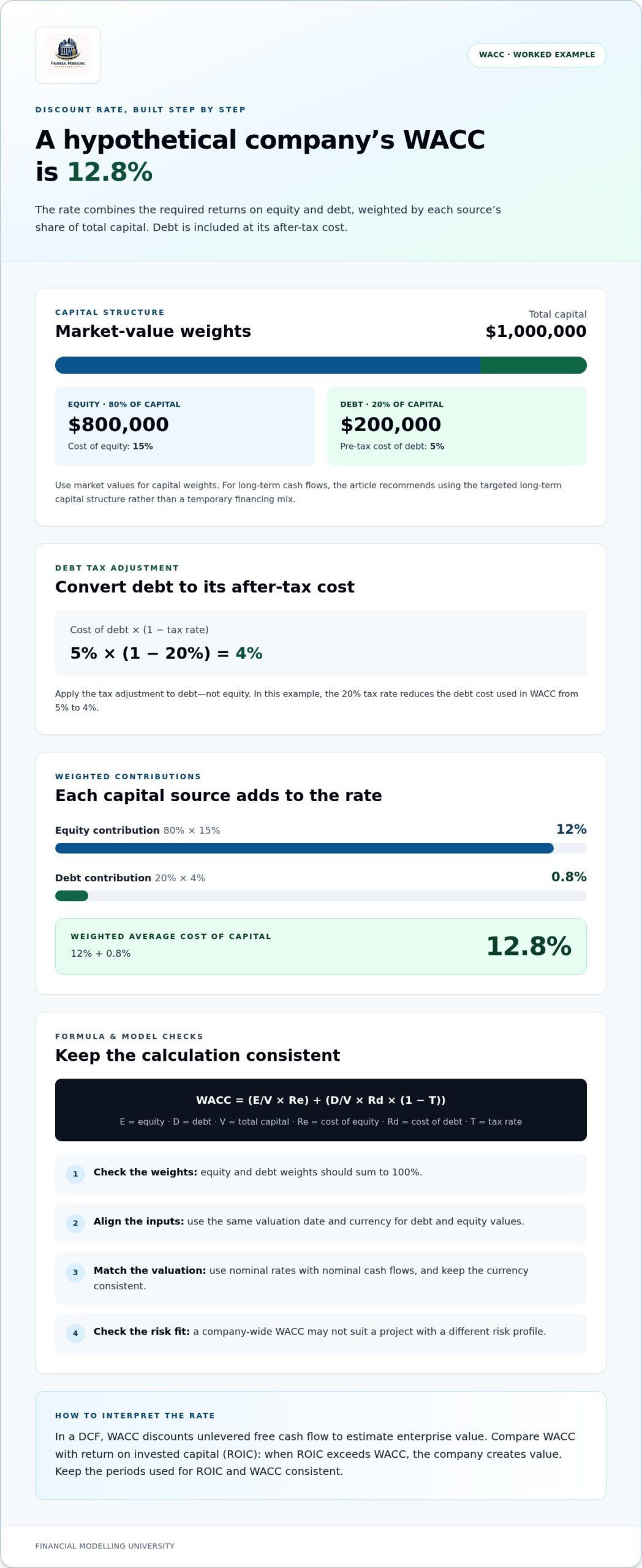
Debt’s stated interest rate isn’t the full cost used in WACC. The after-tax cost reflects the tax benefit associated with deductible interest, often called the interest tax shield. Calculate it as: cost of debt × (1 − corporate tax rate). This adjustment aligns the debt component with after-tax cash flows used in a DCF. In a WACC calculation, apply the adjustment to debt, not to equity.
For example, assume a 10% cost of debt and a 25% tax rate. The after-tax cost is 10% × (1 − 25%), or 7.5%. Multiply that result by debt’s share of total capital to find its weighted contribution. The tax shield reduces this contribution, but it doesn’t change the stated interest rate paid to lenders.
Choose a tax rate that reflects the expected tax benefit over the forecast period. A company with taxable profits may use interest deductions as they arise. If projected taxable income changes, the timing or amount of the benefit may change too. Keep the tax assumption consistent with the forecast instead of automatically using the statutory rate.
Taxes reduce debt’s cost through the interest tax shield. Include preferred stock and other financing sources as separate weighted components, each with its respective required return. Preferred dividends don’t receive the interest tax adjustment.
In Excel, put the pre-tax debt rate, tax rate and after-tax result in separate cells. Check that the formula refers to the intended tax input, then test how the result changes when that assumption changes. A sound WACC calculation applies the tax adjustment once, to debt rather than to the entire rate. Use the expected marginal borrowing cost for the financing being valued, not an unrelated historical rate. Debt’s contribution to WACC is not the same as total cash interest expense.
Industry exposure and company-specific conditions both influence the returns investors require. Reflect the risks of the business or project represented by the forecast cash flows.
Industry risk reflects shared economic and operating exposures; company risk comes from its specific business model, customers and financing. These factors can change investors’ required returns and the appropriate discount rate. For example, a firm reliant on one product may face different revenue uncertainty from a diversified peer in the same sector. Assess operating drivers, not sector labels alone.
Comparable-company beta analysis uses the market risk of similar businesses to estimate a company’s equity risk. It can be useful when the subject company lacks enough trading history for a meaningful estimate. Select peers with comparable operations, then account for differences in their debt and equity mix before applying the estimate. A weak peer set can distort the result, so document why each company is relevant.
Industry WACC comparisons are a reasonableness check, not a replacement for company-specific analysis. Differences may reflect business risk, financing choices, tax assumptions and methods used to estimate inputs. Before relying on a benchmark, check that its sector definition, tax treatment and capital-structure basis suit the company being valued. All else equal, a higher discount rate lowers the present value of forecast cash flows.
A project-specific WACC may be appropriate when a project’s systematic risk differs from the company’s existing operations. A corporate rate can misstate value if the project enters a different business or faces materially different operating exposures. Estimate the project’s risk and financing assumptions, then use a discount rate consistent with its forecast cash flows. This allows clearer comparisons between investment proposals and the company’s existing activities.
Financial Modelling University’s LBO Financial Models online course can help you apply financing assumptions in an Excel model. An LBO model links debt, cash flow and investor returns, illustrating how funding choices affect a company’s capital structure.
Build a model you can explain and update. For your next WACC calculation, record the source and date of each key input, then test how changes affect the valuation. Sensitivity analysis can reveal whether your conclusion depends heavily on one assumption or holds across scenarios. This makes the model more useful in investment discussions and future reviews.
Financial Modelling University offers LBO Financial Models and DCF & Valuation online courses for learners developing practical financial modelling skills. Its Real Estate Models course is upcoming. Choose a path that fits the model you want to build next, then practise applying the methods in Excel.
Explore Financial Modelling University courses and take your next step with confidence.
WACC is the return a company needs to earn on its investments to satisfy its capital providers. In a valuation, it helps translate forecast cash flows into present value. For example, if you’re comparing two projects with similar cash flows but different risks, one company-wide rate may not give a fair comparison. Match the rate to the risk being assessed.
Capital structure is the mix of financing a company uses, including debt, common equity and, where applicable, preferred shares. It matters in financial modelling because financing choices affect both required returns and WACC weights. A business planning to raise debt may use a target financing mix to assess a transaction rather than relying only on its current balance-sheet proportions.
For a company funded by debt and common equity, use WACC = (E/V × Re) + (D/V × Rd × (1 − T)). E and D are the market values of equity and debt; V is their combined value. Re is the cost of equity, Rd is the pre-tax cost of debt, and T is the corporate tax rate. Add a weighted preferred-share component if needed.
CAPM estimates cost of equity as the risk-free rate plus beta multiplied by the equity risk premium. For example, if the risk-free rate is 4%, beta is 1, and the premium is 5%, the estimate is 9%. In an Excel model, keep these three inputs separate so you can test how a changed beta or market premium affects the required shareholder return.
Multiply the pre-tax borrowing rate by one minus the applicable corporate tax rate. For instance, a 6% borrowing rate and a 25% tax rate produce a 4.5% after-tax cost: 6% × (1 − 25%). This value is the debt component used in WACC, not the cash interest payment. Keep the tax assumption consistent with the forecast used in the valuation.
Add market-value debt and equity to find total capital, then divide each value by that total. If equity is valued at E and debt at D, the weights are E ÷ (E + D) and D ÷ (E + D). Check that the weights sum to 100%. Use consistent valuation dates and currencies so one financing source isn’t overstated by mismatched inputs.