


A private equity modeling test typically gives you 60-90 minutes to build or complete an Excel LBO model. You need to connect operating assumptions to debt repayment and sponsor returns, not simply fill a spreadsheet quickly. Paper LBOs may also appear earlier in interviews, testing your investment intuition.
The time limit makes a clear build order, sound assumptions, and accurate MOIC and IRR calculations essential. This guide explains common test formats, how to structure an LBO model, how to interpret returns, and how to practise under timed conditions. Use each practice run to improve your accuracy and explain your decisions clearly.
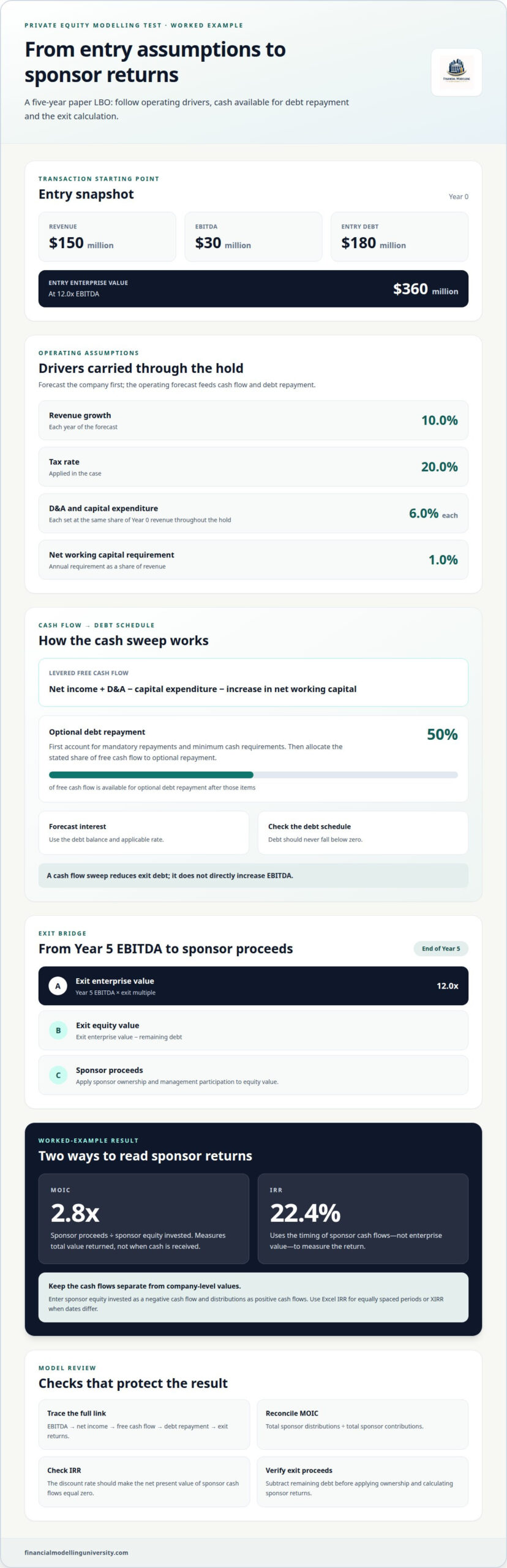
In a five-year paper LBO, exit value and remaining debt drive sponsor proceeds. The case provides Year 0 revenue of $150 million, EBITDA of $30 million, and entry debt of $180 million. At 12.0x LTM EBITDA, entry enterprise value is $360 million. Assume the exit multiple remains 12.0x at the end of Year 5.
Situation: The company must fund interest, investment and mandatory repayments while supporting growth. Action: Forecast revenue growth at 10.0% each year, a 20.0% tax rate, and depreciation and amortisation and capital expenditure each at 6.0% of Year 0 revenue throughout the hold. Set annual net working capital requirements at 1.0% of revenue. Calculate levered free cash flow as net income plus depreciation and amortisation, less capital expenditure and the increase in net working capital.
Link cash flow to the debt schedule. Deduct mandatory repayments and minimum cash requirements before optional repayment. In this case, 50% of free cash flow is available for optional debt repayment after those items. A cash flow sweep reduces exit debt; it does not directly increase EBITDA. Forecast interest from the debt balance and applicable rate, then check that debt never falls below zero.
Result: Calculate exit enterprise value by multiplying Year 5 EBITDA by the exit multiple. Subtract remaining debt to derive equity value, then apply sponsor ownership and management participation. MOIC equals sponsor proceeds divided by sponsor equity invested. IRR uses the timing of sponsor cash flows, not enterprise value. The example produces 2.8x MOIC and 22.4% IRR throughout the holding period.
In a private equity modeling test, specify the entry and exit multiples, operating drivers, taxes, interest, debt terms, mandatory amortisation, minimum cash, and sponsor ownership. The conclusion depends on cash available for debt repayment and proceeds to the sponsor. Practise tracing formulas from EBITDA through net income and free cash flow to exit returns. The model should make clear how each assumption affects those linked calculations.
Situation: An LBO model can show strong enterprise value growth yet still overstate investor performance. Enterprise value belongs to all capital providers, while return calculations must reflect sponsor cash flows. Separate sponsor contributions and distributions from company-level debt and equity balances before calculating either measure.
Action: Calculate MOIC by dividing total sponsor cash proceeds by total sponsor equity contributions. If the sponsor invests once and receives proceeds at exit, divide exit proceeds by the initial equity investment. For multiple contributions or distributions, include every sponsor cash flow. MOIC measures total value returned but ignores when each payment occurs.
IRR captures timing. It is the discount rate that makes the net present value of sponsor cash flows equal zero. Enter the initial equity investment as a negative cash flow and each later distribution as a positive cash flow. In Excel, use IRR for equally spaced periods or XIRR when dates differ. Check that the cash flow schedule includes the initial investment and all interim flows, not just exit proceeds.
Result: A case example frames likely returns as 20% to 30% IRR and 2x to 3x MOIC. A 20% IRR is described as a typical threshold for considering an opportunity. Treat these as screening context, not a substitute for testing the assumptions. Higher exit enterprise value, lower debt at exit, and greater sponsor ownership can increase proceeds. Higher interest expense or additional equity contributions can reduce sponsor returns.
Reconcile the calculations: total sponsor distributions divided by total contributions should match MOIC, while IRR should solve to zero net present value. If the model shows a 2x MOIC but an unexpectedly low IRR, inspect the timing of distributions. If IRR looks unusually high, check sign conventions, ownership allocation and whether debt repayment was subtracted before equity proceeds. Practical financial modelling courses include Excel models and exercises for practising these calculation checks.
An LBO model test asks you to translate transaction assumptions into an Excel model and assess sponsor returns. A paper LBO may come up earlier in interviews to test investment intuition. A spreadsheet exercise tests whether you can connect sources and uses, operating forecasts, working capital, debt repayment, and returns. The prompt sets the required outputs and model scope.
Situation: A basic Excel exercise commonly allows 45-60 minutes, while a broader test may take 60-90 minutes. Timed LBO exercises can also run from 1 to 3 hours, depending on scope. Action: Read the instructions first. Identify the forecast period, debt tranches, sensitivities and deliverables. A standard 90-minute test typically requires a five-year operating forecast. For a 60-minute blank-sheet exercise, prioritise the schedules needed to answer the prompt.
Result: A complete submission links transaction funding to operating performance and debt repayment. Revenue, expenses, and working capital drive cash flow; cash flow funds interest and mandatory repayment. Sponsor equity fills the gap between transaction uses and debt sources. Keep checks visible so you can catch a sources-and-uses imbalance or debt schedule error before time expires.
Build practice progressively. Complete one or two tests at your own pace, then review formula and timing errors. Next, use a 120-minute timer for a full build. Around the fourth attempt, reduce the limit to 90 minutes. Aim to complete 5-10 practice tests, with sessions two to three times a week. Record where time goes: transaction setup, forecast, debt schedule or returns. If an exercise exposes a weak area, practise that section separately, then repeat the full build. This helps sharpen your workflow and preserve time for a final review of income, interest expense, repayment and sponsor returns.
Build the model in transaction order, then link operations to debt repayment and sponsor returns. In the JoeCo example, $100 million of EBITDA at a 10.0x entry multiple implies $1 billion of enterprise value. Use that transaction to organise the model’s core schedules.
Result: A linked model shows how operating performance affects debt paydown and sponsor returns. If the test requests a full three-statement model, connect the income statement, balance sheet and cash flow statement. Otherwise, build only the schedules needed to answer the prompt. Practise this sequence with the LBO financial modelling course and its Excel exercises.
Financial Modelling University’s LBO Financial Models online course offers structured practice with acquisition models. It includes step-by-step video lessons, downloadable Excel models and templates, and practical financial modelling exercises.
Use the course to reinforce the mechanics covered here: linking transaction assumptions, operating forecasts, debt schedules, and sponsor returns. Work through the model in Excel, then use the exercises to apply the same logic to new assumptions. This can help you master your private equity modeling test and spot gaps in your modelling process before a timed interview exercise.
If you want to build further skills in valuation, the DCF & Valuation online course covers a related modelling discipline. Contact Financial Modelling University to discuss which course best fits your learning goals.
Make your next private equity modeling test practice session a focused review, not just another attempt at the spreadsheet. After finishing, trace one assumption through each linked schedule and note where a formula, timing choice, or model check needs attention. Then rebuild that area from a blank worksheet. This turns errors into specific skills to practise.
Keep a brief record of recurring issues, such as inconsistent signs, broken links, or unclear input cells. Use it to choose the focus of your next session, and practise explaining your model logic clearly. A well-structured model is easier to audit, while clear reasoning helps you discuss the decisions behind your assumptions.
Choose further training that matches the skill you want to strengthen. Explore Financial Modelling University courses and continue developing your financial modelling skills, one deliberate improvement at a time.
A private equity modeling test is a timed exercise that assesses how you analyse a leveraged buyout in Excel or on paper. You turn transaction and operating assumptions into a forecast, debt repayment schedule, and investment return analysis. For example, a paper LBO tests whether you can estimate how operating growth and debt paydown affect returns without building a full spreadsheet model.
Tests commonly assess transaction structure, operating forecasts, debt schedules, and investment returns. You may need to interpret revenue and EBITDA assumptions, account for taxes and working capital, calculate interest, and connect cash flow to debt repayment. Excel execution matters too: organise inputs clearly, use consistent formulas, and make the model easy to follow. Some exercises also ask you to explain how changing assumptions affects returns.
A test may use a blank Excel workbook, a partly built model or a paper case. A basic Excel exercise commonly allows 45-60 minutes; a broader test may take 60-90 minutes. A standard 90-minute exercise typically includes a five-year operating forecast. Read the prompt closely: the requested schedules, debt tranches, sensitivities and deliverables determine how much detail to build.
Calculate MOIC as total sponsor cash proceeds divided by total sponsor equity contributions. Calculate IRR as the discount rate that makes the net present value of the sponsor’s dated cash flows equal zero. Record the initial investment as a negative flow and later distributions as positive flows. In Excel, IRR suits equally spaced periods; XIRR handles cash flows on specific dates.
Instructions vary by exercise, so follow its specified timing, assumptions, output format, and permitted Excel features. Distinguish inputs from formulas, use consistent signs, and link schedules rather than hardcoding repeated figures. Avoid building a full three-statement model unless requested. Before submitting, recalculate the workbook and check that sources equal uses, debt balances roll forward, and return outputs use sponsor cash flows.
Assessment may consider whether the model is complete, logically linked, mathematically sound, and clearly presented. Common errors include mismatched sources and uses, incorrect interest calculations, broken debt roll-forwards, and returns based on enterprise value instead of sponsor cash flows. Avoid spending too long on formatting before the core schedules work. Reserve time to inspect formula links and confirm that outputs respond to changed assumptions.