

A lack of finance experience doesn’t have to end your investment banking plans. Build evidence of the skills the role demands: understand how the three financial statements connect, practise Excel-based financial modelling, and learn to explain your assumptions. An investment banking financial modeling course can provide structured practice to develop those skills, but it won’t replace clear thinking or interview preparation.
Financial modelling turns business assumptions into linked forecasts that show how a company may perform and how changes could affect its value. Start with accounting and Excel fundamentals, then practise building and checking a model rather than memorising formulas. Tests and case studies help you apply that knowledge under pressure: forecast revenue and costs, link working capital and cash flow, and explain what your results mean. This guide breaks down what financial modelling involves, which training can help, and how to prepare for practical assessments with work you can discuss in an interview.
A revenue forecast is useful only when its effects on profit, cash and the balance sheet are clear. Financial modeling connects these effects, helping analysts test assumptions and explain business performance.
Three-statement modeling links the income statement, balance sheet and cash flow statement in one forecast. Start with revenue and cost drivers, then calculate income and profit. Connect profit to retained earnings, and model working capital, capital expenditure and debt to explain cash movements. Each schedule should flow into the relevant statement, so changing a sales assumption updates profit, cash and equity. This structure helps analysts test scenarios and trace how a business decision affects the full financial picture.
Use a real company’s published statements to practise financial statement modeling. First, enter historical income, assets, liabilities and cash flows in consistent periods. Then calculate margins, growth and working-capital movements before forecasting. Compare your outputs with the company’s reported results and investigate differences. For a US company, a 10-K can provide historical reporting and business context. This exercise teaches you to connect accounting details to operating drivers, not just copy figures into an Excel package.
Financial statement analysis gives your model a sound starting point. Learn how revenue recognition, depreciation, inventory and debt affect reported income and cash. For example, rising receivables can increase sales while reducing cash collected. A useful training sequence is to understand the accounting, analyse historical statements, then forecast each driver and check that the balance sheet balances. For learners who need to strengthen their core accounting, taxation, and financial audit foundations first, online platforms like najimacademy.com offer specialized courses to build that essential baseline.
Which financial modeling courses offer recognized certificates or credentials? FMU courses provide a certificate of completion for each course, which you can display on your CV or LinkedIn profile. A course certificate documents completed training; it is not automatically equivalent to a professional credential. Review what it represents and whether it fits your learning goals.
How do online and in-person financial modeling courses compare? Online training offers flexible access to lessons and Excel practice, while in-person classes allow live discussion. Compare the teaching format, exercises and feedback, then choose the setting that supports your learning.
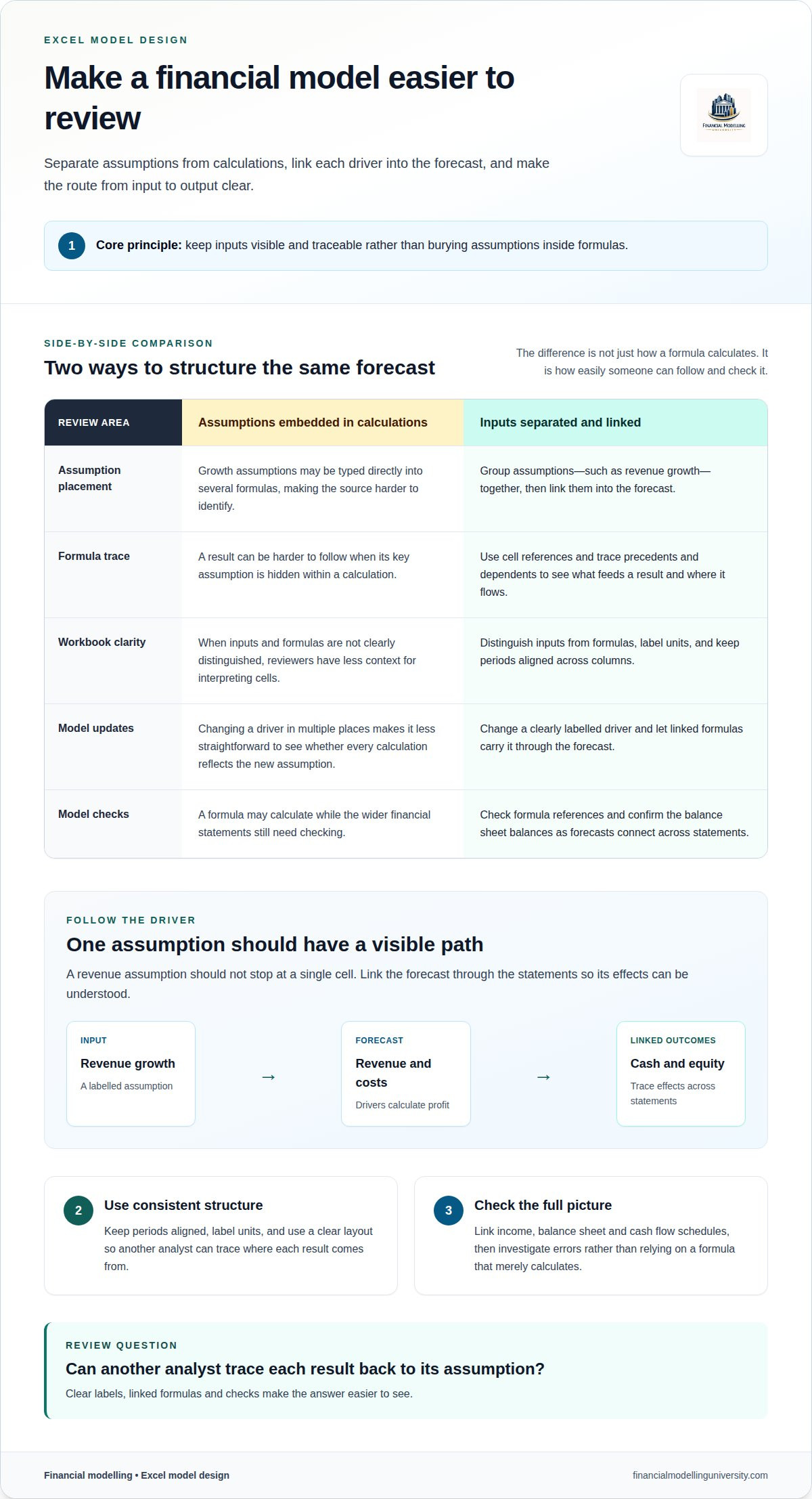
A formula can calculate correctly and still leave a model difficult to review. Separate inputs from calculations, label units and use consistent layouts so another analyst can trace each result. For example, group revenue growth assumptions together, then link them to the forecast instead of typing growth directly into several formulas. This makes each output’s source easier to identify.
Build technical fluency with cell references, SUM, IF and basic date formulas. Trace precedents and dependents to see which cells feed a result and where it flows. These habits make formula errors easier to isolate and prepare a workbook for review.
Excel modeling also depends on disciplined formatting. Distinguish inputs from formulas, keep periods aligned across columns and avoid hard-coding assumptions inside calculations. A street-style model may use colour conventions, but clear labels and traceable formulas matter more than colour alone. Add a concise instructions tab when a corporate model has multiple users, so analysts can identify units, timing and key input cells.
What prerequisites or Excel skills are needed for a financial modeling course? No prior finance experience is needed, though basic knowledge is helpful. You should be comfortable entering data, using cell references, copying formulas and navigating worksheets. Advanced VBA isn’t required for foundational modeling; practise linking cells and checking formula references before tackling a larger workbook.
Excel and PowerPoint support different tasks. Excel handles analysis, forecasts and sensitivity tables; PowerPoint presents key drivers, valuation and risks in a concise corporate finance package. For example, use a sensitivity table to compare valuation outcomes, then explain the main assumption behind the difference on a slide. Compare a program’s exercises, technical coverage and instructor guidance. A useful course should give you structured practice with both calculations and clear communication, whether delivered online or through institutions’ training programmes.
Corporate valuation training should connect enterprise value, equity value and trading multiples. Enterprise value reflects the value of the operating business, while equity value belongs to shareholders after debt and other claims. Compare a company’s EV/EBITDA multiple with relevant peers, then explain differences in growth, margins and risk. For an investment banking interview, be ready to say why a multiple fits the company and what could make the comparison misleading.
Build a study plan around the role’s technical demands. One suggested allocation devotes 15% of study time to valuation, including enterprise value, equity value and trading multiples; another 20% to debt modelling and LBOs. Treat these as planning guides, not fixed rules. Students targeting corporate finance may prioritise DCF analysis, while private equity candidates need to explain how debt, cash generation and exit value affect investor returns.
How long does it take to complete an investment banking modeling course? Some courses are designed for completion in 7 days, while course FAQs may describe 1-2 weeks. Those timelines depend on the course structure and practice required; building a solid foundation from scratch can take longer. Set aside time to complete exercises and explain your model aloud, rather than measuring readiness by lesson completion alone.
A timed case tests how you organise information, make decisions and communicate under pressure. Start by reading the task carefully. Identify the requested output, available data, required format and any assumptions you must make. Then divide your time between building, checking and presenting the result, rather than spending the whole assessment on spreadsheet formatting.
Suppose a case provides a company profile, operating data and brief instructions. Create a clear working layout, distinguish supplied inputs from your own assumptions, and label estimates. Build only the analysis needed to answer the prompt. A focused result with traceable logic is more useful than extra schedules that don’t support the decision.
Before submitting, review the model systematically. Check that formulas copy consistently across periods, units match and outputs respond when a key assumption changes. Trace an important result back to its source cells. If a figure looks unexpected, inspect the formula and its inputs rather than changing the output manually. Note any limitation that could affect your conclusion.
Present the finding as a short decision brief. State what the analysis indicates, name the main driver and explain a material risk or limitation. Separate facts from assumptions so the interviewer can see where judgement entered the work. If new information changes an assumption, describe which outputs should move and why. That explanation demonstrates control of the analysis, not just familiarity with Excel.
Practise speaking through completed exercises without reading cell formulas aloud. Explain the task, your method, your checks and the decision your work supports. Then invite a follow-up question and defend the assumption most likely to change your conclusion. Repeating this routine develops clear answers for technical interviews and turns each case into a practical learning exercise.
Financial Modelling University offers online training for learners developing practical financial modelling skills. Its comprehensive Project Finance Modeling course provides advanced instruction. For related modelling practice, the LBO Financial Models and DCF & Valuation online courses cover different aspects of transaction analysis and business valuation to support your job search.
Choose a learning path that fits the models you want to build. Project finance focuses on project cash flows and funding, while LBO modelling examines leveraged transactions and completing an investment banking financial modeling course can help bridge your experience gap. Each course includes step-by-step video lessons, practical exercises and downloadable Excel models and templates.
Your next move is to turn modelling practice into work you can explain clearly. Choose a company, form a view on its performance and practise defending your assumptions. That discipline can help you discuss your analysis with precision, even before you have direct finance experience.
An investment banking financial modeling course can provide structured practice for developing that capability. Financial Modelling University offers LBO Financial Models and DCF & Valuation online courses; its Real Estate Models course is upcoming. Match your learning path to the modelling work you want to pursue, then apply each technique to a case study you can present in an interview.
Explore financial modelling courses and choose a focused next step. Keep building, checking and explaining your analysis. Each completed model gives you stronger evidence of your readiness to contribute in finance.
A course commonly covers accounting analysis, Excel model construction, valuation and transaction modelling. Check whether the syllabus moves from a company’s reported figures to a forecast, then tests how assumptions affect value or returns. For example, look for exercises that require you to explain why a change in working capital affects cash differently from operating profit. That tests understanding, not formula recall.
There’s no single best course for every learner; choose based on your target role and the models you need to build. Compare syllabus depth, practical exercises, learning format and course materials. Financial Modelling University offers self-paced online courses in LBO Financial Models and DCF & Valuation. Assess them against your goals rather than assuming any course guarantees a recruiting advantage. No prior finance experience is needed, though basic knowledge is helpful.
Some courses cover both valuation and LBO modelling, while others focus on one subject. Financial Modelling University offers separate self-paced DCF & Valuation and LBO Financial Models online courses. Review the course content for the tasks you want to practise, such as testing DCF assumptions or tracing how debt repayment affects LBO returns. Separate courses let you focus on each method.
Yes, practical modelling study can help you prepare to discuss finance concepts and demonstrate Excel ability. Use each exercise to practise explaining the objective, key assumptions and conclusion in clear language. Then connect your work to interview questions about valuation or transaction mechanics. Training supports preparation, but you’ll still need to tailor your examples to the role and communicate your reasoning under questioning.
Look for detailed reviews that describe the course material and learning experience, rather than relying on star ratings alone. Assess whether the instructor’s stated background relates to the topics taught, and inspect the syllabus and sample exercises. For career outcomes, look for specific evidence and distinguish it from general testimonials. Each FMU course provides a certificate of completion that you can display on your CV or LinkedIn profile; it records course completion, not employment.
Each FMU course provides a certificate of completion that you can display on your CV or LinkedIn profile. The certificate records completed training; it is not automatically equivalent to a professional credential. Consider whether the course content and certificate fit your learning goals.