


What if your ability to build a flawless LBO model is actually the primary obstacle to your next promotion? You’ve spent years in the execution loop, perfecting every DCF and staying until 3 AM to ensure the pitch book is pixel-perfect. However, the leap from investment banking analyst to associate isn’t a reward for your stamina; it’s a fundamental shift from data execution to strategic architecture. With associate total compensation now reaching up to $500,000 in 2026, the stakes for this transition have never been higher.
You likely feel the pressure of the compressed 2.5-year promotion timeline and the nagging anxiety of whether you need an MBA to move up. We’re here to bridge that gap. This blueprint delivers a clear roadmap to master the technical and strategic shifts required for mid-level leadership. You’ll learn how to stop “doing” the work and start “reviewing” it like a seasoned pro. We’ll explore the evolving regulatory landscape, the shift toward dual registration models, and the specific management skills you need to command respect from both juniors and MDs alike.
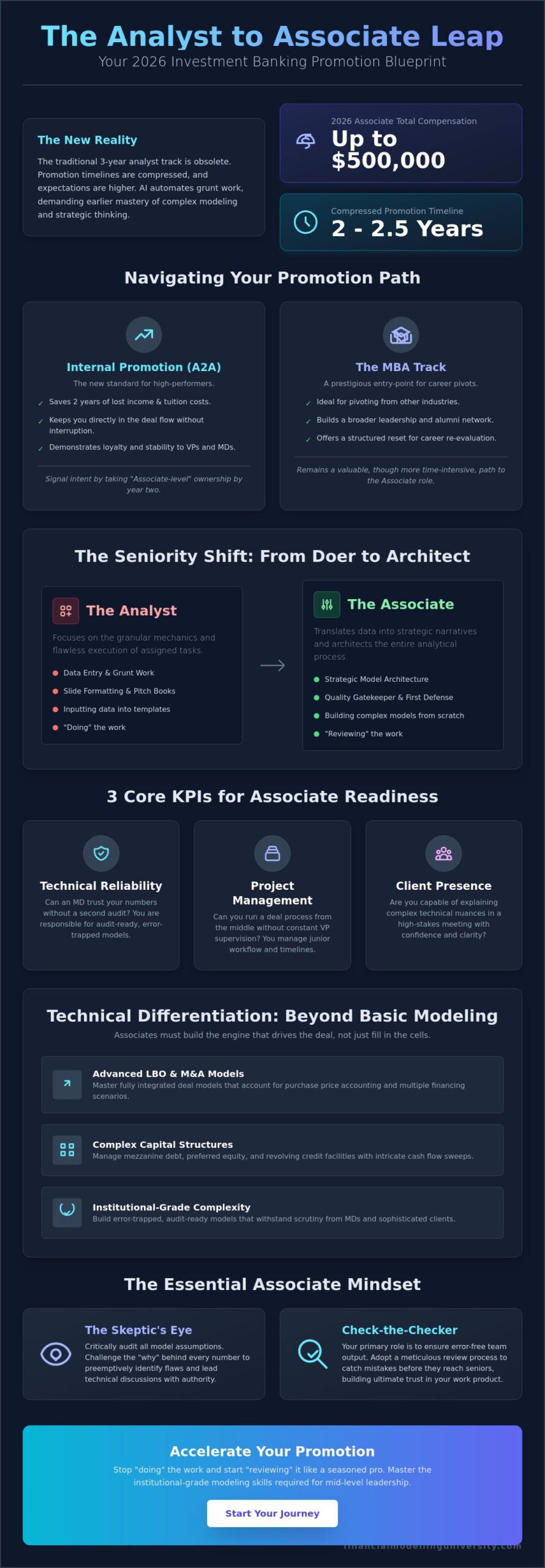
The associate role serves as the critical bridge in any elite deal team. While analysts focus on the granular mechanics of data entry and slide formatting, associates must translate that data into a coherent strategic narrative for senior leadership. This transition from investment banking analyst to associate requires a fundamental shift in perspective. You are no longer just a “doer”; you are the primary gatekeeper of quality and the first line of strategic defense. For a broader context on these roles and their place in the financial ecosystem, consult this Investment Banking Industry Overview.
By 2026, the traditional three-year analyst stint has largely evaporated. Many bulge bracket and elite boutique firms have compressed the timeline to 2 or 2.5 years to retain top talent. AI has automated much of the low-level “grunt work,” such as data scraping and basic slide formatting. This shift doesn’t make the job easier. It simply accelerates your expected technical maturity. You’re now required to master complex LBO and M&A modeling much earlier in your tenure. We’re also seeing a rise in “Specialist Associates” who deep-dive into sector-specific niches like FinTech or Renewables rather than remaining generalists. Mastery of the investment banking analyst to associate jump now requires specific domain expertise alongside general modeling prowess.
Banks evaluate associate readiness through three core KPIs:
Transitioning from investment banking analyst to associate requires a shift from technical execution to technical architecture. While an analyst might be proficient at inputting historical data into a pre-existing template, an associate must possess the vision to build that template from scratch. This involves designing the logic that governs how various tranches of debt interact or how complex tax synergies flow through a merger model. You’re no longer just filling cells; you’re building the engine that drives the deal.
Institutional-grade complexity is the standard at this level. You aren’t just running a simple five-year DCF; you’re building models that are audit-ready and error-trapped for immediate scrutiny by Managing Directors and sophisticated clients. If a model breaks during a live meeting, the blame falls squarely on the associate. Mastering this level of precision is the fastest way to complete the investment banking analyst to associate transition. To bridge this gap, many professionals leverage a Financial Modeling Course Online to master these senior-level workflows before they’re expected to perform them under pressure.
Associates are responsible for the heavy lifting in transaction modeling. This means managing complex capital structures, including mezzanine debt, preferred equity, and revolving credit facilities with intricate cash sweeps. You must move beyond basic 3-statement models and master fully integrated deal models that account for purchase price accounting and various financing scenarios. Understanding Private Equity Financial Modeling is essential here; associates often need to view a deal through the lens of a sponsor to provide valuable advice to their MDs. Success in these roles depends on your ability to handle multiple scenarios without compromising the model’s integrity.
Your models must be resilient. When an MD asks a “what-if” question about a 50-basis-point interest rate hike or a 10% revenue miss, you cannot afford to spend twenty minutes re-linking cells. Associate-level modeling is defined as the ability to forecast strategic outcomes and quantify risk, not just calculate historical averages. This requires mastering Excel for Finance tools like data tables, goal seek, and automated sensitivity analysis. If you’re ready to move beyond the basics, securing an FMU All-Access Pass provides the technical foundation needed to command the room.
The transition from investment banking analyst to associate represents a move from being a “Model Doer” to a “Model Architect.” At the analyst level, your success is measured by your speed and accuracy in execution. As an associate, your value lies in your ability to ensure the integrity of the entire technical process. You must adopt a “Check-the-Checker” mindset. This means you’re no longer just responsible for your own work; you’re fully accountable for every formula and assumption produced by the analysts under your supervision. If a mistake reaches the MD, it’s your failure, not the analyst’s.
Developing a “Skeptic’s Eye” is the hallmark of a senior-ready professional. You don’t just accept data room inputs at face value. Instead, you challenge management’s EBITDA adjustments and stress-test the terminal value assumptions before they ever reach the VP’s desk. You also become the primary owner of the Model Log and version control. In a high-stakes deal environment, losing track of the most current iteration is a catastrophic failure. Proper technical foresight allows you to reduce “Deal Fatigue” by anticipating MD requests and building models that can handle changes without requiring a 4 AM rebuild.
Effective leadership requires providing constructive technical feedback without descending into micromanagement. Set clear standards for formatting and logical flow at the start of every project. If the analyst understands the “why” behind the model structure, they’ll produce higher-quality output with fewer errors. Your job is also to protect the team from unnecessary “fire drills.” By managing upward and clarifying expectations early, you filter out the noise and keep the analyst focused on high-impact tasks. This leadership maturity is a core KPI for the investment banking analyst to associate promotion.
Associate-level models must be client-ready from the first draft. This requires a shift toward modular model designs. Instead of building rigid, single-use spreadsheets, you should create flexible architectures that allow for quick sector adjustments or changes in deal structure. Mastering Excel for Finance is critical for creating these reusable institutional templates. When you build for scalability, you don’t just save time on the current deal; you build a technical reputation that marks you as a future leader in the firm. This architectural foresight is what separates a high-performing associate from a career analyst.
Your promotion to associate marks the end of your tenure as a back-office support function. You’re now expected to join the “travel team.” This means you’re in the room during management presentations and board meetings, representing the technical integrity of the deal. While the Managing Director handles the relationship and the high-level negotiation, you serve as the “Technical Expert.” You must bridge the gap between raw data and executive strategy, ensuring that every cell in your model supports a broader investment thesis. The investment banking analyst to associate transition is complete only when you can stop talking about formulas and start talking about value drivers.
Developing a sector-specific thesis is what separates a mid-level leader from a junior technician. You shouldn’t just present a pitch book; you should provide a perspective on where the industry is moving. This requires you to synthesize complex market data into a coherent narrative that the client’s executive team can act upon. You aren’t just providing a valuation; you’re providing a strategic roadmap.
Success in a management presentation requires translating complex Investment Banking Financial Modeling into actionable CEO insights. A Chief Executive doesn’t care about your Excel shortcuts; they care about how a 5% shift in market share impacts their terminal value. You must also prepare for technical objections from client-side CFOs. These professionals will grill you on your WACC assumptions and capital structure choices. Handling these questions with confidence requires a deep, intuitive understanding of your model’s mechanics. Master the “Executive Summary” format by keeping your verbal and written communications punchy, direct, and results-oriented.
Effective associates employ a “Pre-emptive Strike” mindset. Don’t wait for your MD to ask for a sensitivity analysis on interest rate hikes; have it ready before the meeting starts. Upward management is about anticipating needs and removing friction from the senior team’s workflow. If a deadline is unrealistic, don’t just say “no.” Instead, offer technical alternatives. Explain how a simplified model can provide the necessary insights today while the full-scale architecture is completed by tomorrow. This approach positions you as a “Safe Pair of Hands,” allowing senior bankers to focus on closing the deal while you command the technical process. If you’re ready to master the high-stakes modeling required for these meetings, enroll in our Investment Banking Financial Modeling Course today.
To succeed in client-facing roles, focus on these three communication pillars:
Senior bankers don’t reward longevity; they reward the ability to lead a technical process without constant supervision. Generic tutorials might help you pass an entry-level interview, but they won’t help you survive a 2 AM model audit by a skeptical VP. Financial Modelling University (FMU) provides the institutional-grade rigor required to navigate the investment banking analyst to associate transition. Our curriculum is built on the same standards used by elite firms, moving you beyond simple execution and into the role of a strategic architect.
The difference lies in the architecture. While other platforms provide simplified spreadsheets, we provide the exact templates and logic flows used in billion-dollar deal rooms. One FMU student recently utilized these advanced techniques to secure an internal A2A promotion at a top-tier bulge bracket firm. By demonstrating a “Check-the-Checker” mindset and building models that handled complex debt tranches with zero errors, they proved their readiness for the associate desk months ahead of schedule. Mastery is about removing doubt from the senior team’s mind.
Professional mastery requires a broad technical toolkit. With our curriculum, you gain lifetime access to specialized tracks, including our Real Estate Financial Modeling and M&A modules. These aren’t just videos; they’re comprehensive deep-dives into institutional deal-making. We also offer one-to-one mentoring to refine your technical pitch and promotion strategy. You’ll earn industry-recognized certificates that validate your ability to handle senior-level responsibilities, giving you the quantitative proof of your expertise during your next performance review.
FMU isn’t just a series of tutorials; it’s a university experience designed for those who demand excellence. You’ll join an elite network of 25,000+ finance professionals who are already performing at the top of their fields. This community provides the social proof and peer support necessary to maintain your momentum in a high-pressure environment. Stop practicing on simplified data and start building models that command respect from Managing Directors. The investment banking analyst to associate jump is the most significant hurdle in your career. Don’t leave it to chance. Enroll in the FMU All-Access Pass today and finalize your journey toward becoming an industry expert.
Securing the jump from investment banking analyst to associate requires more than just surviving the 80-hour work week. You must evolve from a technician into an architect who commands the technical process and leads with strategic authority. This transition hinges on your ability to audit complex LBO structures, manage junior output with precision, and translate raw data into high-impact client narratives. When you master these senior-level pillars, you remove friction from the deal team and signal your readiness for mid-level leadership.
Don’t leave your career trajectory to chance. Join 25,000+ finance professionals who have transformed their performance through the FMU University experience. With institutional-grade Excel templates and globally recognized certifications, you’ll gain the quantitative proof of your expertise. It’s time to stop executing and start architecting. Master Financial Modeling Like the Pros with FMU All-Access and take control of your professional future today. Your seat at the associate desk is waiting.
It typically takes 2 to 2.5 years to complete the transition in the current market. Many bulge bracket and elite boutique firms have compressed the traditional three-year timeline to incentivize retention. This accelerated path requires you to demonstrate technical maturity and leadership capacity much earlier than in previous cycles, making early mastery of senior-level modeling essential for your promotion.
No, an MBA is not a strict requirement for high-performing analysts. The “A2A” internal promotion path has become the preferred route for many firms because it retains professionals who already understand the firm’s specific deal logic and culture. While MBA entry remains a valid pivot for career changers, internal candidates often reach the associate desk with superior technical execution skills and internal trust.
Based on 2026 data, a first-year associate earns a base salary of $175,000, which scales to $225,000 by the third year. Total compensation, including bonuses, typically ranges from $265,000 to $500,000. Top-tier associates at elite boutique firms often command the higher end of this range, frequently receiving a larger portion of their bonus in cash compared to bulge bracket banks.
Analysts focus on granular execution, such as data entry, basic model building, and slide formatting. Associates operate as the “Technical Expert” and project manager for the deal team. Your daily tasks shift from “doing” the work to “reviewing” it, ensuring the integrity of the analyst’s output and translating technical data into strategic insights for the Managing Director and the client.
To prove readiness for the investment banking analyst to associate jump, you must adopt a “Check-the-Checker” mindset. Start managing the workflow of junior analysts and auditing their work for errors before it reaches the VP. You’ve reached associate-level maturity when the senior team can trust your model’s logic and your strategic judgment without requiring a second audit of your files.
The investment banking analyst to associate transition is often more structured at bulge bracket banks, which may have larger MBA associate classes. Elite boutiques typically offer more responsibility earlier and may provide higher compensation with all-cash bonuses. Regardless of the firm size, the technical requirement for institutional-grade modeling remains the standard for anyone seeking a mid-level leadership role.
You must master complex LBO modeling and integrated M&A structures that account for intricate capital tranches and purchase price accounting. Associates are expected to build resilient scenario analysis tools that can survive real-time stress testing during client meetings. Your models must be modular and scalable, allowing for rapid adjustments to deal terms or market assumptions without breaking the underlying logic.
Associates typically exit to middle-market private equity, growth equity, or corporate development roles at major corporations. While on-cycle private equity recruiting is primarily focused on second-year analysts, associates find significant opportunities in strategic leadership roles. Your experience managing deal processes and reviewing complex architectures makes you a high-value candidate for firms seeking professionals who can lead a transaction team immediately.