

In 2026, checking a box for your regulatory credits isn’t a career strategy; it’s a slow path to professional obsolescence. While the NASAA model rule now mandates 12 hours of annual continuing education for financial analysts in over 20 states, these requirements focus on the floor of compliance, not the ceiling of performance. You likely feel the pressure as AI-integrated modeling makes traditional spreadsheets feel like relics, yet most available training feels like a repetitive exercise with zero ROI. It’s frustrating to spend hours on mandatory ethics credits while your technical edge atrophies in a high-pressure environment without mentorship.
We’re here to change that trajectory. This guide moves beyond the $1,025 CFP exam fees and basic regulatory filings to help you master the high-stakes technical skills that define elite finance careers. You’ll discover how to build institutional-grade LBO and M&A models that actually impress recruiters and justify a seat at the table in private equity. We’ll preview the specific path to technical superiority, from mastering complex DCF valuations to using the FMU All-Access Pass to Master Financial Modeling Like the Pros and secure the $240,000 median pay associated with top-tier investment management roles.
Technical Continuing Education is the proactive pursuit of advanced modeling and valuation skills that separate industry leaders from the rank and file. By 2026, the market demands more than the theoretical knowledge provided by the Chartered Financial Analyst (CFA) program or standard regulatory licenses. These credentials prove you can pass a test, but they don’t prove you can build a three-statement model from scratch during a live deal. True mastery requires a commitment to learning that mirrors the speed of the global markets.
We distinguish between “Box-Ticking CE,” the passive completion of mandatory compliance hours, and “Value-Add CE,” the aggressive acquisition of technical superiority. While compliance keeps your seat, technical superiority earns your bonus. The modern skill gap in junior banking exists where analysts possess the academic credentials to discuss valuation theory but lack the technical repetitions required to build institutional-grade models under live-deal pressure.
Regulatory bodies like FINRA now require annual credits, but these often focus on ethics and administrative rules rather than deal execution. This creates a false sense of security for many professionals. You’re “compliant” but technically stagnant. As AI-integrated modeling tools become standard in 2026, the bar for what constitutes an entry-level skill has shifted significantly. Knowing how to navigate a spreadsheet isn’t enough anymore; you must know how to audit and optimize AI-generated outputs to ensure institutional-grade accuracy. Relying on basic continuing education for financial analysts to stay relevant is a losing strategy in a high-stakes environment.
The move from Analyst to Associate is no longer a matter of simple tenure. It’s a matter of technical output and the ability to handle complex deal structures without hand-holding. In the competitive worlds of Private Equity and M&A, recruiters look for “ready-to-work” proficiency. They don’t have the luxury of time to mentor you on the basics of an LBO or a complex DCF valuation. By focusing your continuing education for financial analysts on specialized modeling and real-world application, you position yourself as a plug-and-play asset for elite firms. These organizations prioritize speed and precision, and they reward those who can deliver results from day one.
The 2026 technical landscape demands a pivot toward four specific pillars: Advanced Valuation, Deal Structuring, Automation, and Sector Specialization. While the CFA Institute’s Professional Learning program encourages ongoing development, elite practitioners prioritize the mastery of Excel for finance as the foundational language of the industry. It’s no longer enough to just “know” Excel; you must build models that are dynamic, audit-ready, and clean enough for a Managing Director to review without a manual. Clean modeling isn’t just an aesthetic choice. It’s a risk management necessity that ensures your assumptions are transparent and your formulas are robust under stress.
Standard 3-statement models are the baseline for any junior role. To advance, you must master complex M&A accretion and dilution analysis that accounts for synergies, transaction costs, and varied financing structures. Implementing sensitivity analysis and Monte Carlo simulations within your Excel workbooks allows you to quantify risk in a way that static models cannot. These advanced techniques transform a simple spreadsheet into a powerful decision-making tool. DCF valuation remains the gold standard of the industry because it provides a rigorous, fundamentals-based assessment of intrinsic value that transcends temporary market sentiment.
Mastering private equity financial modeling is the primary hurdle for those seeking to move to the buy-side. This requires an intimate understanding of debt waterfalls, revolving credit facilities, and equity cushions that protect the sponsor’s IRR. LBO proficiency acts as the ultimate gatekeeper skill; it demonstrates that you can think like an owner rather than just an advisor. Professional continuing education for financial analysts that focuses on these high-stakes models is what separates the elite from the average. If you’re ready to bridge the gap between theory and execution, consider exploring the specialized curriculum at Financial Modelling University to accelerate your career.
Choosing between a $150,000 MBA and a $5,000 technical certification requires a cold analysis of ROI. In 2026, the “Time-to-Utility” ratio has become the most critical metric for career advancement. A two-year Master’s degree offers prestige but often lags behind the immediate technical demands of a high-pressure deal environment. In contrast, targeted financial modeling course online options allow you to master institutional-grade LBO or M&A models in weeks, not years. This agility is vital when you’re competing for roles where the technical interview is the primary filter.
Bulge Bracket banks and elite Private Equity firms have shifted their focus. While a top-tier degree remains a powerful signal, it’s no longer a substitute for technical superiority. Recruiters in 2026 prioritize candidates who can demonstrate “day-one” utility. If you can’t build a dynamic debt waterfall or audit a complex DCF, the brand name on your diploma won’t save you. They respect certifications that are backed by rigorous, real-world application and proven industry trust. This shift makes strategic continuing education for financial analysts a mandatory investment for those aiming for the C-suite.
Online platforms move at the speed of the market. While university textbooks might still be discussing 2024 trends, elite technical courses are already integrating 2026 AI-modeling workflows. You gain access to downloadable, reusable Excel templates that you can deploy immediately in your professional practice. This practical application is the essence of effective continuing education for financial analysts. It’s about building a library of assets, not just a list of credentials. You don’t just learn the theory; you acquire the blueprint for execution.
A Master’s degree, particularly from an M7 program, still holds significant brand value. It’s the ultimate tool for a total career pivot or for accessing exclusive alumni networks that aren’t available elsewhere. However, you should view these programs as a complement to your technical training, not a replacement. Even while meeting mandatory FINRA’s Continuing Education Requirements or attending a physical campus, your primary edge remains your technical output. Don’t rely on the networking advantage alone; ensure your modeling skills match the prestige of your institution to secure the highest total compensation.
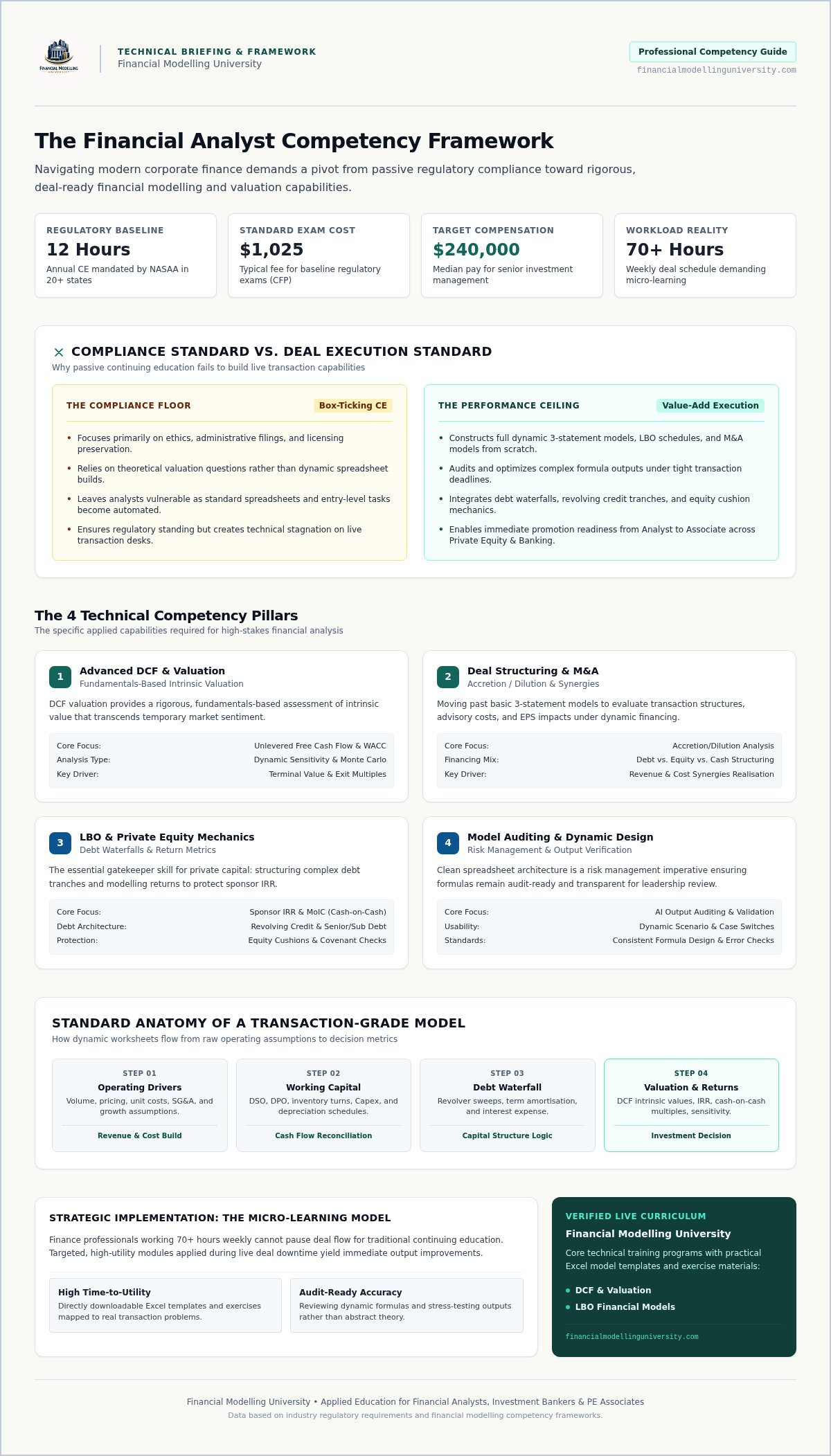
Success in high-stakes finance requires high-density learning. You can’t wait for a quiet weekend that never arrives. Instead, adopt a micro-learning approach by breaking complex topics like debt sculpting or tax equity into 15-minute modules. This ensures your continuing education for financial analysts remains consistent even during a 90-hour work week. Use the downtime between deal turns to sharpen your edge rather than scrolling through news feeds. High-performance analysts treat every spare moment as an opportunity to refine their technical toolkit.
Project-based learning using real-world case studies is the fastest way to bridge the gap between theory and execution. When you engage with a model that mirrors an actual transaction, you develop the muscle memory required for live-deal pressure. This practical application transforms abstract concepts into concrete skills you can deploy immediately. Effective continuing education for financial analysts is not about passive consumption; it’s about active implementation and rigorous repetition.
Align your technical study with your current mandate. If you’re working on a private equity deal, focus your energy on LBO mechanics. This creates an immediate feedback loop. You apply what you learn to the live model on your screen. Use your firm’s existing institutional-grade models as reverse-engineering templates. Deconstruct the formulas to understand the logic behind the layout. Build a personal library of institutional-grade Excel hacks and shortcuts that you can carry from one deal to the next. This strategic alignment turns every live deal into a technical masterclass.
Technical skill is only half the battle. You need an elite mentor who has survived the trenches of investment banking to guide your progression. 1-to-1 career mentoring provides a specific blueprint for junior professionals to navigate complex technical hurdles and internal firm politics. Live Q&A sessions are invaluable for troubleshooting model errors that would otherwise stall your workflow for hours. Building a technical network outside your immediate firm provides perspective on industry-standard best practices that your current team might overlook. If you want to accelerate this process, you can Master Financial Modeling Like the Pros through the FMU All-Access Pass.
Choosing the right path for continuing education for financial analysts determines whether you remain in a support role or move into the front-office deal team. Financial Modelling University (FMU) isn’t a collection of surface-level tutorials; it’s a rigorous, structured experience designed to replicate the intensity of the world’s top investment banks. The FMU All-Access Pass serves as the definitive resource for investment banking financial modeling, providing the technical depth required to handle high-stakes transactions in 2026 and beyond.
The curriculum spans the entire spectrum of high-finance verticals. Whether you’re mastering the intricacies of a DCF Valuation Course or the complex debt structures found in our Project Finance & Infrastructure Modeling Course, we provide the blueprint for every major asset class. Our global recognition among top-tier firms ensures that your certificate carries the weight of verified technical superiority. In an industry where trust is the primary currency, FMU provides the quantitative hallmark of excellence that recruiters respect.
FMU bridges the gap between academic theory and the trading floor by focusing on execution rather than just observation. We provide downloadable Excel templates used by elite practitioners, ensuring your work meets institutional standards from day one. Every course is designed by former banking and private equity professionals who understand the specific demands of the current market. You don’t just learn how to build a model; you learn how to defend your assumptions under the scrutiny of an investment committee. This practical focus makes our continuing education for financial analysts the most efficient way to build a professional-grade toolkit.
Technical mastery is a lifelong pursuit, which is why we offer lifetime access and continuous curriculum updates. As the industry evolves toward AI-integrated workflows, your skills will remain at the cutting edge. Our 1-to-1 career mentoring program ensures you have a seasoned mentor to guide your progression and troubleshoot complex technical challenges that arise during live deals. Join 25,000+ finance professionals who have used our proven methods to transform their careers and increase their total compensation. It’s time to stop ticking boxes with generic credits and start building an elite career. Master Financial Modeling Like the Pros with FMU and secure your future in high finance.
In 2026, the distinction between a career that plateaus and one that scales is your technical output. We’ve established that regulatory compliance is merely the baseline for entry. To thrive in investment banking or private equity, you must move beyond box-ticking and embrace a more aggressive form of continuing education for financial analysts. By prioritizing institutional-grade modeling and high-utility certifications, you’ll bypass the massive opportunity costs of traditional graduate programs while building a toolkit that elite firms actually value.
Financial Modelling University provides the blueprint for this transformation. Trusted by 25,000+ finance professionals, our curriculum offers globally recognized institutional-grade certificates and 1-to-1 career mentoring from industry experts who’ve already navigated the high-stakes world you’re entering. Don’t let your skills become outdated by AI-integrated modeling or stagnant regulatory requirements. Take control of your trajectory and Master Financial Modeling Like the Pros – Enroll at FMU Today. Your path to professional mastery is structured, disciplined, and ready for you to begin.
The most effective options prioritize technical mastery over simple compliance. You should focus on institutional-grade training in LBO modeling, M&A accretion/dilution analysis, and sector-specific valuations for SaaS or Renewables. With the U.S. Bureau of Labor Statistics projecting 942,500 annual job openings in finance through 2034, standing out requires more than a degree. Technical superiority is the only way to secure elite roles in a competitive market.
Yes, elite firms recognize and value certifications that demonstrate immediate, “day-one” technical utility. Recruiters at Bulge Bracket banks and top-tier private equity firms prioritize candidates who can build complex models without extensive oversight. FMU is trusted by 25,000+ finance professionals, providing the quantitative proof of excellence that industry leaders respect. Your ability to execute institutional-grade work is more important than the medium of your instruction.
The CFA Institute recommends that charterholders complete 20 hours of Professional Learning (PL) annually. This voluntary standard includes at least two hours of ethics training to maintain professional edge and industry trust. While not a mandatory requirement for maintaining the charter, elite practitioners treat these 20 hours as a minimum threshold. Consistent upskilling ensures you remain relevant as AI-integrated modeling shifts the technical landscape.
A Master’s degree offers significant brand value and networking opportunities, but technical modeling courses provide a superior “Time-to-Utility” ratio. If your goal is to land a seat at an investment bank or private equity firm, technical superiority is often the primary filter. Mastering these high-stakes skills can lead to the $240,000 median pay reported for investment managers in 2026. A degree should complement your technical toolkit, not replace it.
Private equity firms demand mastery of complex debt waterfalls, equity cushions, and advanced LBO mechanics. You must also be proficient in sensitivity analysis and Monte Carlo simulations to quantify risk effectively. As the industry moves toward specialized verticals, the ability to build dynamic models for Infrastructure or Project Finance is a major competitive advantage. These skills act as the ultimate gatekeeper for those seeking a move to the buy-side.
Adopt a micro-learning strategy by breaking your training into 15-minute modules that fit into deal downtime. Aligning continuing education for financial analysts with your current live mandates allows you to apply new skills immediately to your work. This creates a feedback loop that reinforces learning without requiring massive blocks of free time. High-performance analysts treat every quiet moment in the deal cycle as an opportunity for technical refinement.
Regulatory bodies like FINRA and the SEC provide free updates on compliance, ethics, and industry rules. While these resources are excellent for maintaining your license, they rarely provide the technical depth required for career transformation. Free resources are the floor of your education, but professional mastery requires institutional-grade tools and templates. To perform at the level of elite practitioners, you must invest in training that mirrors real-world deal intensity.