


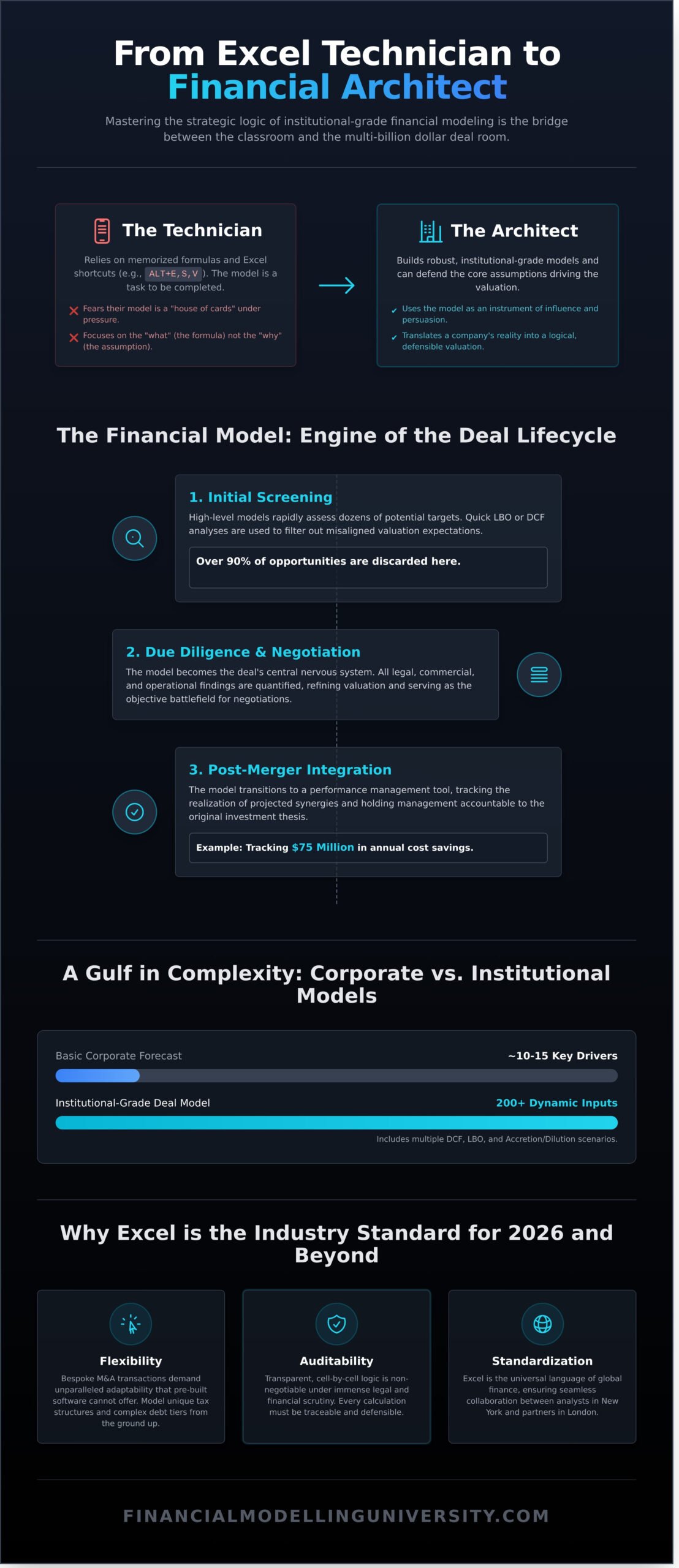
Your Excel shortcuts are worthless. That muscle memory for ALT + E, S, V won’t save you when a Managing Director challenges the core assumptions of your valuation, and the multi-billion dollar deal hangs in the balance. It’s a brutal truth in a world where countless aspiring analysts believe mastery of investment banking financial modeling is just a matter of memorizing keystrokes. You’ve likely felt that anxiety in a technical interview, the fear that your model is a house of cards, just one question away from total collapse. This is the chasm between the classroom and the deal room.
This guide isn’t another list of formulas; it’s a strategic blueprint designed to move you from a mere technician to a financial architect. We will deconstruct the quantitative logic that underpins high-stakes M&A, giving you the unshakeable confidence to build robust, institutional-grade models from a blank sheet and defend them under pressure. We’ll dissect the core mechanics of DCF, LBO, and M&A models, focusing not on the *what*, but the strategic *why* that secures elite finance roles and guarantees job security in the competitive landscape of 2026 and beyond.
At its core, investment banking financial modeling is the disciplined process of building a dynamic, integrated forecast of a company’s future financial performance. It’s the quantitative engine that powers every major strategic decision, from a leveraged buyout (LBO) to an initial public offering (IPO). This isn’t about simple spreadsheet jockeying; it’s about translating a company’s entire operational and strategic reality into a logical, defensible valuation. For those seeking to understand the fundamentals, exploring the question of What is Financial Modeling? provides a foundational overview. However, in the high-stakes environment of a bulge-bracket bank, a robust model is more than a tool. It is the definitive gateway to elite professional status, the very language of capital allocation.
Mastery of this craft marks the critical transition from a technical analyst to a strategic architect within a deal team. A junior banker’s value is measured by the precision and integrity of their three-statement model. An Associate or Vice President, however, is valued for their ability to use that same model to pressure-test a deal thesis, identify hidden risks, and frame a compelling narrative for the client and investment committee. The model becomes the primary instrument of influence. This is where institutional-grade models diverge sharply from basic corporate budgeting spreadsheets. A corporate forecast might track 10-15 key drivers for internal planning; a deal model for a $5 billion acquisition will have over 200 dynamic inputs, running multiple DCF, LBO, and accretion/dilution scenarios simultaneously.
A financial model is not a static document; it is a living blueprint that evolves with the transaction. Its function is central to every phase of a deal, providing the quantitative justification for billions of dollars in capital deployment.
Despite the proliferation of specialized fintech software, Microsoft Excel’s dominance in investment banking is absolute and unlikely to change. Its persistence is not due to inertia but to three non-negotiable industry requirements: flexibility, standardization, and auditability.
The bespoke nature of M&A transactions demands unparalleled flexibility. A software with pre-built templates cannot accommodate the unique complexities of a cross-border merger with intricate tax considerations or a private equity deal with a multi-tiered debt structure. Excel’s transparent, cell-by-cell logic allows bankers to build from the ground up, ensuring the model perfectly reflects the deal’s unique architecture. This transparency is also the foundation of auditability. In a transaction with immense legal and financial scrutiny, every single calculation must be traceable. Finally, Excel serves as the universal language across global finance. A model built by an analyst in New York must be instantly comprehensible and adaptable by a private equity partner in London, ensuring seamless collaboration on a global scale.
The integrated three-statement model is the bedrock of professional valuation. It’s not an academic exercise; it’s the core analytical engine that underpins every M&A, LBO, and equity research report. Mastery here separates analysts who drive deals from those who merely process numbers. The entire structure is built on a single, non-negotiable principle: dynamic integration. The Income Statement, Balance Sheet, and Cash Flow Statement must be meticulously linked, creating a living representation of a company’s financial health.
This dynamic architecture means a change in a single assumption, like a 1% increase in revenue growth, must flow seamlessly and accurately through the entire model. Net Income from the Income Statement feeds Retained Earnings on the Balance Sheet and serves as the starting point for the Cash Flow Statement. The ending cash balance from the Cash Flow Statement, in turn, becomes the cash balance on the next period’s Balance Sheet, ensuring it always balances. This level of rigorous construction is central to what industry leaders consider best practice, a concept further detailed in IBM’s overview on Financial Modeling Explained. Anything less is unacceptable.
Within this framework, hard-coding is the fatal sin of investment banking financial modeling. Inputting a calculated value as a static number breaks the model’s logic, invites errors, and renders scenario analysis impossible. A managing director must be able to test different assumptions on the fly. If your model can’t handle that pressure, it has failed.
Projections begin with the top line. Analysts typically choose between two core methodologies. A top-down forecast starts with a total addressable market (TAM), say the $250 billion global cybersecurity market, and projects revenue based on an assumed market share. In contrast, a bottom-up forecast builds from operational KPIs, such as projecting a retailer’s sales by multiplying 1,500 stores by a projected $2.2 million in sales per store. The bottom-up approach is overwhelmingly preferred for its granular precision.
Cash flow is king, and these supporting schedules are where you model its operational drivers. Net Working Capital (NWC) is calculated to capture the cash used or generated from daily operations. For example, projecting Days Sales Outstanding (DSO) to decrease from 45 to 42 days will show a source of cash. Conversely, a growing company often requires significant cash investment in NWC. The depreciation schedule is a waterfall model that links the Capital Expenditure (CapEx) forecast to Property, Plant & Equipment (PP&E) on the Balance Sheet and depreciation expense on the Income Statement. Dissecting maintenance versus growth CapEx is critical for an accurate Free Cash Flow build. Mastering these schedules is a non-negotiable skill; our guide on How to Build a 3-Statement Model: Step-by-Step provides the necessary blueprint.
Ultimately, an institutional-grade model is defined by its robustness, flexibility, and precision. It’s a dynamic tool built to withstand intense scrutiny and empower strategic decision-making. This disciplined approach is what defines professional investment banking financial modeling and forms the foundation for a high-performance career in finance.
Mastering the technical mechanics of a three-statement model is the prerequisite. Excelling in high-stakes finance demands a complete command of the three primary deal models: Discounted Cash Flow (DCF), Leveraged Buyout (LBO), and Mergers & Acquisitions (M&A). These aren’t interchangeable tools; they are specialized frameworks designed to answer fundamentally different strategic questions. An elite analyst doesn’t just know how to build them; they know precisely when and why to deploy each one.
A DCF valuation is the purist’s approach, designed to determine a company’s intrinsic value based solely on its ability to generate cash. The model projects unlevered Free Cash Flow to the Firm (FCFF) over a 5-10 year period and then calculates a terminal value. The precision of this analysis hinges on the discount rate. A mere 50 basis point change in the Weighted Average Cost of Capital (WACC) can swing the final enterprise value by 10-15%, making it the most scrutinized assumption in any institutional-grade valuation. For a deeper breakdown, explore The Core of Valuation: A Deep Dive into DCF Analysis.
Private equity firms don’t primarily care about intrinsic value; they care about their return on invested capital. The LBO model is their weapon of choice, built to determine the maximum price a financial sponsor can pay while still hitting a target Internal Rate of Return (IRR). A robust LBO model begins with a detailed sources and uses table, outlining exactly how the deal is funded. The output isn’t a single value, but rather a matrix of potential returns based on different debt levels and exit multiples. The goal is clear: hit a target IRR, typically 20% or higher, and a Money on Money (MoM) multiple of at least 2.5x over a 3-5 year hold period.
When a corporate acquirer evaluates a target, the central question shifts from standalone value to combined strategic fit. An M&A model, often called an accretion/dilution model, analyzes the financial impact of the proposed transaction on the acquirer’s Earnings Per Share (EPS). A deal is “accretive” if the pro-forma EPS of the combined company is higher than the acquirer’s standalone EPS. This analysis is heavily dependent on modeling synergies, which requires a disciplined approach. You must build out scenarios, from a conservative case assuming only 5% G&A cost savings to an aggressive case layering in 10% revenue synergies. This is the core of strategic investment banking financial modeling. To build this critical skill, see our guide on M&A Modeling: The Strategic Guide to Institutional-Grade Merger Analysis.
Ultimately, these three frameworks form the analytical trinity of corporate finance. A DCF provides a baseline valuation, an LBO establishes a valuation floor from a financial sponsor’s perspective, and an M&A model quantifies the strategic rationale for a corporate buyer. Your ability to build, interpret, and defend all three is what separates a competent analyst from an indispensable one.
In the world of high-stakes M&A and LBO transactions, your financial model is not merely a spreadsheet; it’s a direct reflection of your analytical rigor and professional credibility. A junior analyst builds a model that works once. An elite practitioner builds a dynamic, error-proof machine that can be pressure-tested by a Managing Director and defended under scrutiny. The difference is a rigorous framework built on institutional-grade best practices.
This directly addresses the single most common objection from aspiring analysts: “How do I know my model is correct?” The answer isn’t a magic button. Confidence is forged through process. It’s built by adopting a systematic approach to model architecture that prioritizes transparency, auditability, and simplicity. The hallmark of a senior modeler isn’t a complex, 15-line nested formula; it’s a model so clear that any user can trace the logic from input to output in under 60 seconds. This is the “BASE” principle: build models that are Big, Auditable, Simple, and Error-checked.
A defensible model begins with its architecture. Your workbook should be logically segregated with dedicated tabs for inputs, calculations, and outputs. This structure isn’t arbitrary; it’s a risk management protocol. All hard-coded assumptions (blue font) live on the input sheet. All formulas (black font) live on calculation sheets. This prevents accidental overwrites of key drivers. The most critical component is a “Checks” section, where you confirm the integrity of the model. A balance sheet that doesn’t balance to exactly $0.00 is the number one red flag. Finally, a professional analyst never hides rows; they group them. Hiding rows breaks formula continuity and is a notorious source of errors that can kill a deal’s credibility.
A static model is academically interesting but commercially useless. The core of professional investment banking financial modeling is creating dynamic tools for decision-making. This is achieved through robust scenario and sensitivity analysis. Use data tables to test how valuation metrics, like a DCF-derived share price, react to simultaneous changes in two key variables, such as the WACC (from 8.0% to 12.0%) and the terminal growth rate (from 2.0% to 3.0%). To toggle between core operating cases, use a `CHOOSE` function linked to a single dropdown cell. This allows any user to instantly switch the entire model from a Base Case to an Upside Case (e.g., 20% revenue growth, 200bps margin expansion) or a Downside Case (e.g., 5% revenue decline, 150bps margin compression). Sensitivity analysis is the ultimate stress-test of your deal logic, revealing the precise breaking point of your investment thesis.
Executing at this level is what separates a competent analyst from an indispensable one. It’s this mastery of dynamic, error-proof construction that ensures job security and accelerates your career trajectory. Mastering these institutional-grade standards is non-negotiable. See how our elite training builds these habits from day one in the Advanced Financial Modeler Certification.
Academic finance theory provides a foundation, but it doesn’t build careers. A 2023 industry survey revealed that over 85% of junior analysts felt their university education was insufficient for the rigorous technical demands of their first year. The gap between understanding a discounted cash flow in a textbook and building a dynamic, multi-scenario DCF model for a live deal at 2:00 AM is immense. This is where institutional-grade practitioner training becomes non-negotiable. It’s the critical bridge from theoretical knowledge to the high-stakes, real-world application of investment banking financial modeling, where precision dictates outcomes and speed is currency.
The FMU All-Access Pass is not a course; it’s a comprehensive blueprint for career acceleration. In a market where, according to a Q4 2023 outlook from Goldman Sachs, M&A deal volume is projected to rebound by over 15% through 2025, technical deficiency is a liability. The analysts and associates who can flawlessly execute complex models are not just valuable; they are indispensable. This technical mastery is the definitive gateway to job security. It’s the ability to build robust, error-free models under extreme pressure that separates the top 1% of performers from the rest. This is the skill set that protects your role during market downturns and positions you for promotion during upswings.
Beyond the technical curriculum, our program provides a strategic advantage few others can offer: direct, 1-on-1 career mentoring from seasoned investment professionals. These are not academics; they are former VPs and Directors from firms like J.P. Morgan, KKR, and Blackstone who have navigated the very career path you are on. They provide tactical advice on everything from structuring your resume to navigating complex case studies and articulating your deal experience. This is the insider’s guide to securing offers and fast-tracking your career trajectory.
Our curriculum is engineered to build competency from the ground up. You begin with mastering 150+ essential Excel shortcuts before progressing methodically through three-statement modeling, valuation, and ultimately, complex LBO and M&A accretion/dilution analysis. This is reinforced with a library of over 50 downloadable, bank-ready templates, allowing you to apply what you’ve learned directly. Upon completion, you earn a globally recognized certification that validates your elite skill set to recruiters worldwide.
The hiring window for 2026 finance roles opens in early 2025. The time to forge an undeniable technical edge is now. Waiting means competing against a more prepared candidate pool. Securing a six-figure role in this competitive environment isn’t about luck; it’s a pragmatic process of acquiring a high-performance skill set that commands a premium. Your investment today is the direct path to becoming a top-tier candidate tomorrow.
Unlock the FMU All-Access Pass and Transform Your Career
You now understand that elite financial models are far more than spreadsheets; they are the strategic architecture behind every major M&A, LBO, and capital markets transaction. True proficiency moves beyond simply linking the three statements. It demands the construction of dynamic, error-free frameworks for complex valuations that withstand intense scrutiny from managing directors. Mastering the discipline of investment banking financial modeling is the non-negotiable skill that separates the analyst from the associate and ultimately defines your career trajectory in high finance.
Theory is not enough. Execution is everything. That’s why professionals from over 145 top financial institutions trust our curriculum to gain their competitive edge. It’s your turn to stop just learning and start executing. Master Elite Financial Modeling with the FMU All-Access Pass to gain immediate access to our entire library of downloadable, institutional-grade Excel templates and secure 1-on-1 career mentoring from industry experts who have closed the deals you’re targeting.
The market rewards precision and strategic insight. Your career will be built on the quality of your work. Build it to last.
Financial modeling is challenging, but it’s an attainable skill built on discipline, not genius. The two primary hurdles for any beginner are a robust understanding of accounting principles and achieving elite-level speed in Excel. Success requires structured practice. Expect to invest 40-60 hours of dedicated study to build your first institutional-grade three-statement model, which is the foundational competency for a career in high finance.
The best courses in 2026 will be taught by former bulge-bracket practitioners and updated within the last six months to reflect market shifts and new accounting standards like IFRS 18. An elite program dedicates over 50% of its curriculum to complex DCF, M&A, and LBO models using case studies from recent transactions. The true benchmark of a top course is a certification recognized by recruiters at firms like Goldman Sachs and Centerview Partners.
Mastering investment banking financial modeling is a multi-stage process. Foundational proficiency, like building a clean three-statement model, takes 40-60 hours of focused work. Reaching an analyst-level speed and accuracy for complex DCF or merger models requires approximately 200 hours. True mastery, the ability to build a dynamic LBO model for a live deal under extreme pressure, demands over 500 hours of practice and on-the-job application.
The three indispensable models are the Three-Statement Model, the Discounted Cash Flow (DCF) Model, and the Leveraged Buyout (LBO) Model. The Three-Statement Model is the bedrock, linking the income statement, balance sheet, and cash flow statement. The DCF is the primary tool for intrinsic valuation in M&A advisory, while the LBO model is critical for analyzing private equity transactions and determining potential investor returns like IRR and MoIC.
You should invest in a paid course to build a career in high finance. Free resources can introduce basic concepts, but they lack the structured path and practitioner insights required to compete for elite roles. A premium, paid program provides a clear ROI by accelerating your job-readiness by at least 6-12 months. It’s an investment in career velocity and the precision skills that hiring managers are actively testing for. For those seeking to understand the foundational concepts before committing to advanced training, exploring what is financial modelling in the context of institutional-grade analysis provides the strategic framework needed to make an informed decision.
The core difference is purpose. Investment banking models are built to advise clients on valuation and transactions, often focusing on DCF and merger analysis. Private equity modeling is laser-focused on the LBO. PE models are far more detailed, with granular debt schedules, cash flow sweeps, and sponsor return calculations (IRR) because they are the primary tool used to make a principal investment decision. IB models support the deal; PE models drive it.
Absolute mastery of keyboard shortcuts is the non-negotiable foundation for speed. The most critical functions are INDEX and MATCH for superior flexibility over VLOOKUP, and CHOOSE for building dynamic scenarios. Proficiency with data tables for sensitivity analysis is essential for stress-testing your assumptions. Finally, understanding how to use a circularity switch via Excel’s iteration settings is crucial for building complex models with integrated debt schedules.