


Intellectual property is no longer a secondary consideration in corporate finance. For many companies, patents, trademarks, and proprietary technologies are key drivers of revenue, competitive positioning, and long-term growth. As a result, investors and analysts increasingly need structured approaches to evaluating intellectual property and understanding its financial impact.
Over the past few decades, corporate value has shifted dramatically from physical assets to intangible ones. In 1975, intangible assets represented only 17% of the market value of companies in the S&P 500. By 2020, that figure had risen to around 90%, reflecting the growing importance of assets such as intellectual property, software, and brand value.
This shift means that patents, trademarks, and proprietary technologies are now central to how companies generate competitive advantage and long-term revenue.
As a result, understanding how to value intellectual property has become an essential skill for investors, analysts, and corporate finance professionals seeking to measure true intellectual property value, an essential skill for investors, analysts, and corporate finance professionals seeking to measure true intellectual property value and follow structured financial modeling career paths in investment banking, private equity, and corporate finance. and make informed financial decisions.

Determining intellectual property value requires analyzing the economic benefits that an asset can generate and the risks associated with those benefits.
Unlike physical assets, the value of intellectual property is not based on its production cost alone. It depends on how effectively the asset can support revenue generation, strengthen market position, or create licensing opportunities.
Several key factors influence ip valuation in financial analysis:
When evaluating intellectual property, analysts must consider how these factors interact. Strong legal protection combined with a large market opportunity can significantly increase intellectual property value, while technological obsolescence or limited market adoption can reduce it.

Companies perform ip valuation in several financial and strategic situations. In most cases, the objective is to determine the financial contribution of intellectual assets and support decision making in transactions or financial reporting.
The table below outlines common situations where evaluating intellectual property becomes necessary.
| Situation | Why IP Valuation Is Required |
| Mergers and acquisitions | Buyers and sellers must determine how much of the transaction value comes from patents, trademarks, technology, or other intangible assets. |
| Venture capital and startup funding | Investors often evaluate intellectual property to understand whether the company’s innovation provides a sustainable competitive advantage. |
| Licensing and royalty agreements | Companies must determine appropriate royalty rates and licensing fees based on the expected intellectual property value. |
| Asset backed financing | In some cases, intellectual property can be used as collateral, which requires a formal ip valuation. |
| Financial reporting and accounting | Accounting standards may require companies to recognize and measure intangible assets during acquisitions or restructuring. |
| Tax and transfer pricing | Multinational companies often need to determine the value of intellectual property transferred between subsidiaries. |
Understanding these situations helps analysts determine how to value intellectual property within the context of broader financial transactions. In practice, valuing intellectual property is rarely done in isolation and is usually part of a larger corporate finance or investment analysis process.
Intellectual property has become a central component of modern corporate valuation. In many industries, intangible assets such as patents, trademarks, proprietary technology, and software contribute more to enterprise value than physical assets.
This shift has important implications for financial analysis. Traditional valuation models focused heavily on tangible assets such as equipment, inventory, and real estate.
Today, analysts must also account for intangible assets when assessing company value. As a result, evaluating intellectual property is often necessary to understand how a business generates future cash flows.
Several factors explain why intellectual property value has become increasingly important in finance:
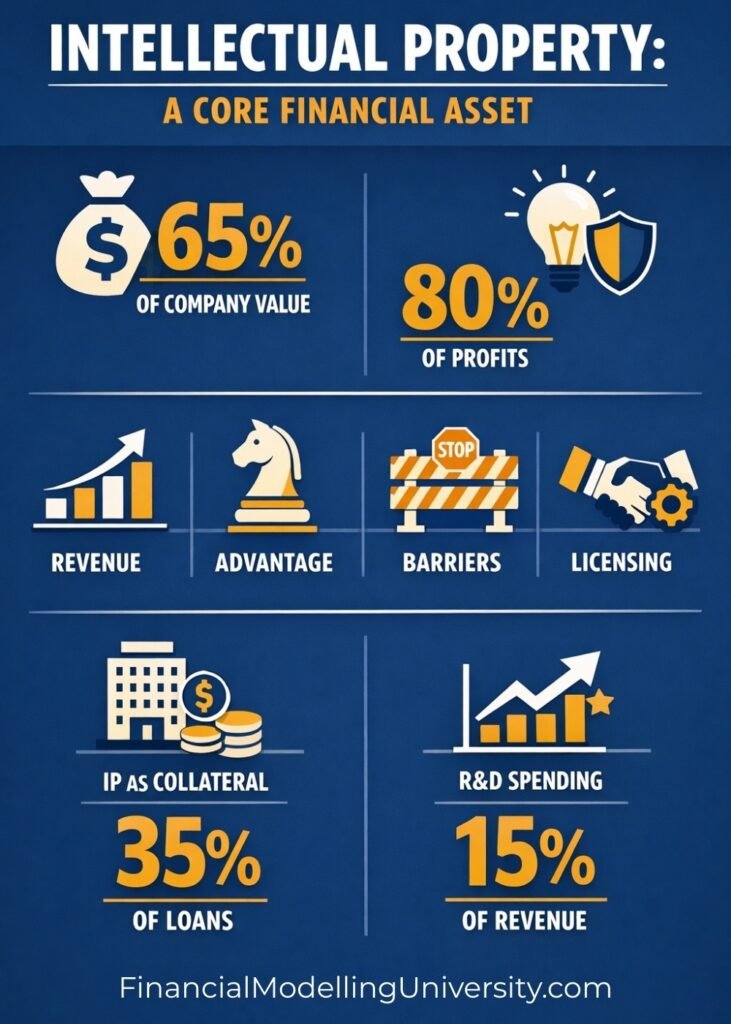
Because of these dynamics, ip valuation has become an important part of corporate finance, investment analysis, and financial modeling.
Understanding how intellectual property contributes to revenue growth and market positioning helps analysts determine how to value intellectual property more accurately.
Financial professionals typically rely on three primary approaches (these approaches are often implemented using standard financial modeling structures used across corporate finance) when valuing intellectual property.
Each method estimates intellectual property value from a different perspective and requires different types of financial data.
In practice, analysts often use more than one approach to cross-check assumptions and produce a more reliable ip valuation.
| Valuation Method | Core Principle | Typical Use Case |
| Income approach | Estimates value based on the future cash flows generated by the intellectual property, discounted to present value. | Patents, software, and technologies that generate predictable revenue streams. |
| Market approach | Determines value by comparing the intellectual property with similar assets that have been sold or licensed in the market. | Trademarks, licensing agreements, and industries with available transaction data. |
| Cost approach | Estimates the cost required to recreate or replace the intellectual property asset. | Early stage technologies or internally developed innovations with limited revenue history. |

The income approach is one of the most widely used methods when valuing intellectual property. It estimates intellectual property value based on the future economic benefits the asset is expected to generate.
These benefits are typically measured through projected cash flows, licensing income, or cost savings that result from owning the intellectual property.
The core principle of this method is similar to traditional corporate valuation techniques. Future income generated by the intellectual property is projected over its expected economic life and then discounted to present value.
Common techniques used within the income approach include:
When evaluating intellectual property using the income approach, analysts must carefully estimate several variables:
Because these inputs rely on financial forecasts and market assumptions, the accuracy of the final IP valuation depends heavily on the quality of the underlying financial modeling.
In practice, building reliable models for valuing intellectual property requires a strong understanding of discounted cash flow techniques, scenario analysis, and risk adjustments, and performance frameworks such as DuPont analysis for breaking down return on equity.
Professionals looking to strengthen these skills can benefit from a structured financial modeling and valuation course, especially when applying these methods in real investment and transaction scenarios.

The market approach determines intellectual property value by comparing an asset to similar intellectual property that has been sold, licensed, or transferred in the marketplace. Instead of forecasting future cash flows, this method relies on observed transaction data to estimate what buyers are willing to pay for comparable assets.
When evaluating intellectual property using the market approach, analysts typically examine:
If reliable comparable transactions exist, this approach can provide a realistic indication of market pricing.
Intellectual property assets are often unique, and many licensing agreements remain confidential. As a result, detailed transaction data is not always available.

Instead of focusing on future income or comparable market transactions, this method measures the investment necessary to develop the same intellectual property again.
When applying this approach, analysts typically consider:
The cost method is most commonly used when intellectual property has not yet generated revenue or when reliable market data is unavailable.
Development cost does not always reflect the economic value of an asset. Some intellectual property may be inexpensive to develop but generate significant revenue, while other projects may require large investments but fail to achieve commercial success.






One Response
Interesting Article