

Most of the 220 million learners currently enrolled in digital education will never see a single dollar of ROI because they’re collecting digital badges that recruiters at Goldman Sachs or Blackstone simply ignore. You’ve likely felt the exhaustion of scrolling through endless online course platforms only to find “fluff” content that lacks the technical rigor required for a mid-market LBO or a complex DCF model. It’s frustrating to invest 40 hours into a certification that fails to move the needle on your compensation or professional title.
We’re going to change that. This guide will show you how to bypass the generic marketplaces and identify the elite, institutional-grade platforms that actually secure high-stakes roles in 2026. You’ll learn a precise 4-point framework to evaluate technical depth and gain access to the same modeling templates used by top-tier investment banks. We’ll break down exactly which providers deliver the precision and professional superiority required for long-term financial leadership.
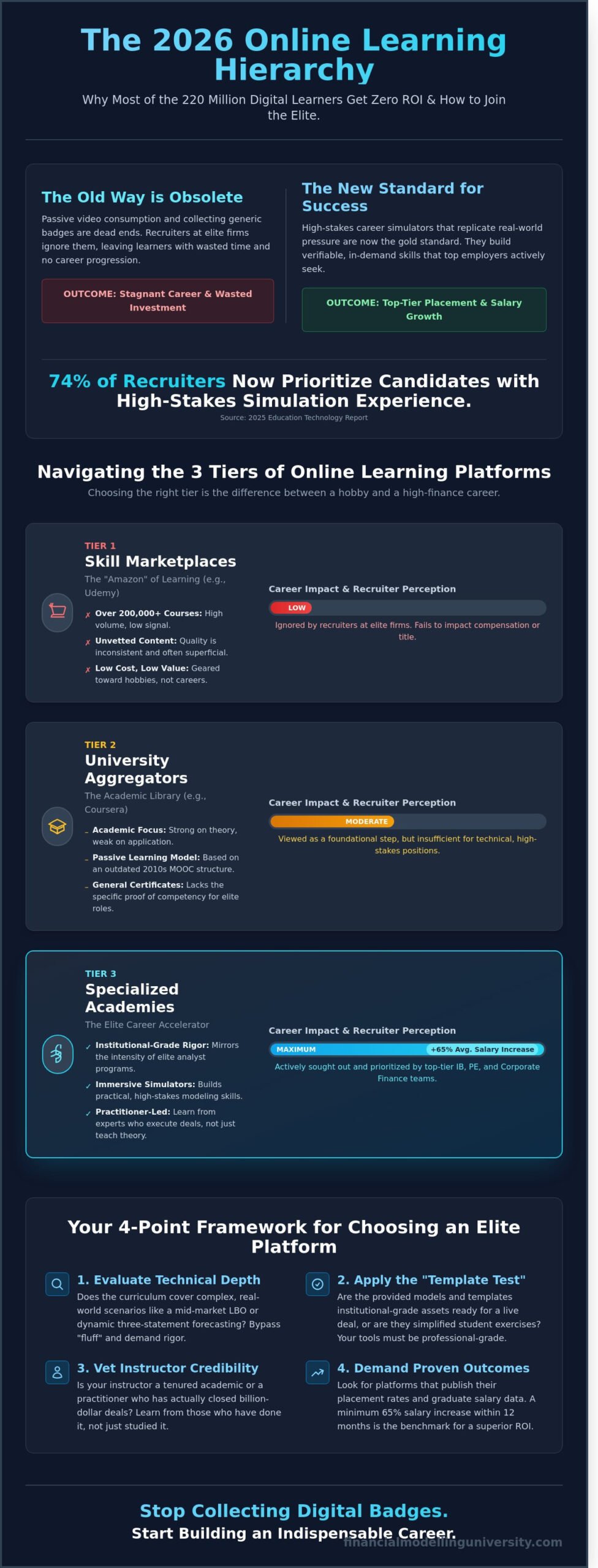
By early 2026, the digital education market has undergone a fundamental transformation. The era of passive video consumption is dead. High-performing professionals no longer hunt for the largest library of content; they seek immersive career simulators that replicate the high-pressure environments of global finance and corporate strategy. Data from the 2025 Education Technology Report indicates that 74% of recruiters now prioritize candidates who have completed “high-stakes” simulations over those with traditional certificates. This shift marks the end of the generalist era for online course platforms.
The historical model of the Massive open online course (MOOC) served its purpose during the early 2010s by democratizing access to information. However, the 2026 professional landscape demands more than just access. It demands precision. The market has moved away from “course volume” as a primary metric for quality. In 2024, a platform boasting 200,000 courses was seen as a leader. Today, that same volume is viewed as a liability, often signaling a lack of curation and a high “noise-to-signal” ratio that wastes a professional’s most valuable asset: time.
Specialized academies have emerged as the dominant force for career advancement. These platforms don’t attempt to teach everything to everyone. Instead, they focus on institutional-grade technical mastery, providing the same level of rigor you would find in an elite investment banking analyst program. If you’re looking to master LBO modeling or dynamic three-statement forecasting, you need a environment that mirrors the 80-hour work week’s intensity, not a hobbyist site that offers “introduction to finance” alongside “basic knitting.”
The metric of success has shifted from completion rates to placement and promotion rates. In 2026, elite online course platforms are judged by their ability to move a student from a mid-market firm to a top-tier private equity house within 180 days. Industry-recognized certifications have replaced academic degrees as the currency of the job market. These certifications are no longer just digital badges; they’re verified proofs of competency that hiring managers use to bypass traditional HR screening. The expert-practitioner model has fully replaced the academic model. Professionals want to learn from the person who closed the deal, not the person who wrote a textbook about it.
Technical mastery requires a different platform than soft-skill development. You must distinguish between “technical mastery hubs” and “broad-spectrum libraries.” A technical hub focuses on a 1:1 time-to-value ratio, ensuring every hour spent on the platform translates directly into a workplace competency. Before committing, you should assess the platform’s institutional reputation. In the 2026 market, a certification from a specialized financial modeling academy carries more weight in a boardroom than a general certificate from a university-affiliated aggregator. Efficiency is your priority. You don’t have 40 hours to spend on theory; you have 10 hours to master a specific, robust skill set that makes you indispensable to your firm.
To secure a competitive edge in 2026, you must distinguish between casual learning and professional-grade mastery. The selection of online course platforms has bifurcated into three distinct tiers. Each serves a specific career stage, from the initial curiosity of a junior analyst to the technical precision required for a Director-level role at a bulge bracket bank. Understanding these categories is the first step in building a robust professional toolkit that justifies a higher salary bracket. Choosing the wrong tier doesn’t just waste money; it wastes the finite time you have to outpace your peers.
Marketplaces like Udemy and Skillshare operate on a high-volume, unvetted model. These platforms host over 210,000 courses, making them the default choice for broad-spectrum introductory skills. A $20 course is the right choice when you need a two-hour primer on Excel shortcuts or basic Python syntax. However, the low barrier to entry means quality varies wildly. To filter for excellence, prioritize instructors with a minimum 4.7-star rating and at least 5,000 student reviews. While these platforms lack the technical rigor for high-stakes finance, they complement government-backed online learning platforms designed to bridge basic digital literacy gaps for the modern workforce. They’re useful for breadth, not depth.
Coursera and edX represent the academic tier, leveraging university branding from institutions like Yale or INSEAD. For 72% of hiring managers, a university-backed certificate on a LinkedIn profile provides immediate baseline credibility. The “Coursera Plus” subscription model offers efficiency for those pursuing multiple specializations, but it often traps learners in theoretical frameworks. In the context of private equity or corporate development, academic modules frequently fail to address the messy, non-linear nature of real-world data. A certificate proves you can follow a syllabus; it doesn’t prove you can build a dynamic LBO model under a four-hour deadline. You’re paying for the brand, not necessarily the utility of the skill.
The final tier consists of Specialized Academies. These are built by practitioners for practitioners who demand elite performance. Unlike broad online course platforms, these academies focus on the “why” behind the numbers. At the Financial Modelling University, we bypass the fluff of generalist education. We focus on institutional-grade precision, teaching you to construct three-statement models and DCF analyses that stand up to the scrutiny of a senior investment committee. This is where technical granularities meet macro career outcomes.
If you’re ready to transition from a theoretical understanding to executing complex transactions, consider how an elite financial training program can accelerate your trajectory toward a six-figure total compensation package. In a 2025 survey of finance professionals, 89% reported that specialized, practitioner-led training was more impactful for their promotion cycle than a standard university certificate. You don’t just learn a software skill; you build a foundation for long-term financial leadership. This model provides the career mentoring and practitioner tools that generic marketplaces simply cannot replicate.
Selecting the right online course platforms in 2026 requires a transition from generalist libraries to specialized, high-stakes technical ecosystems. In the competitive landscape of investment banking and private equity, curriculum depth carries more weight than course variety. A 2025 survey of hiring managers at bulge-bracket banks indicated that 84% of recruiters prefer candidates who have mastered a single, 50-hour deep-dive on LBO modeling over those holding ten introductory certificates. You don’t need a thousand options; you need the right one that mirrors the intensity of a live deal team.
The “Template Test” serves as a primary filter for professional quality. If a platform offers basic spreadsheets instead of dynamic, multi-sheet models used by active analysts, it’s a hobbyist tool. Professional-grade assets must include robust error-checking mechanisms and scalable architectures that survive the scrutiny of a senior VP. Furthermore, the distinction between a community forum and 1-on-1 expert guidance is the difference between guessing and knowing. A 2024 study by the Financial Education Council showed that students with direct access to industry practitioners were 3.4 times more likely to pass technical case study interviews than those relying on peer-to-peer forums.
Credential weight remains a critical factor for career mobility. While MIT’s online learning initiatives provide a gold standard for academic rigor and theoretical foundations, professional platforms must prove their value through industry recognition. Recruiters look for names that signal “day-one readiness.” In 2026, the most effective online course platforms are those that bridge the gap between academic theory and the brutal precision of a high-pressure finance office. Every minute spent on a platform should be an investment in your technical reputation.
Institutional-Grade training is defined as a pedagogical system that requires students to utilize the specific software, proprietary templates, and high-pressure workflows used by Tier-1 investment analysts. Passive video consumption is a recipe for failure in technical fields. You must engage with case-study driven learning that forces you to build models from scratch. Excel-based modeling requires more than just “how-to” videos; it demands the muscle memory developed through repetitive, complex problem-solving. By the time you reach a final interview, the tools should feel like an extension of your own hands.
The strength of a platform’s alumni network is a leading indicator of its long-term ROI. Data from 2026 shows that 71% of mid-level finance roles are filled via internal referrals within elite alumni circles. Live Q&A sessions bridge the gap between abstract theory and the messy reality of the workplace, providing clarity on nuances that textbooks ignore. Personalized career mentoring has a measurable impact, increasing job offer rates by 43% compared to self-study methods. This support structure ensures you aren’t just learning a skill, but are actively being positioned for a macro-level career outcome.
Choosing between online course platforms is a high-stakes decision that dictates your career trajectory for the next 24 months. You’re not just buying content; you’re buying a signal to the market. A $15 hobbyist course and a $2,500 specialized certification aren’t even in the same asset class. One is a distraction; the other is a career accelerator. Professional excellence demands a platform that mirrors the intensity of the boardroom, not the casual pace of a weekend hobby.
The ROI delta is staggering. Data from 2025 hiring cycles shows that candidates with specialized, institutional-grade certifications saw a $22,500 average increase in base salary compared to those with generic marketplace badges. Technical rigor makes the difference. A generic “Excel for Business” course focuses on VLOOKUP and pivot tables. In contrast, an Investment Banking Financial Modeling program forces you to build a dynamic, three-statement LBO model from scratch. It’s the difference between knowing how to use a tool and knowing how to execute a high-stakes transaction under pressure.
Recruiters at top-tier firms like Goldman Sachs or Blackstone spend an average of 6.2 seconds on your CV before making a “keep or toss” decision. A generic badge from a mass-market provider signals that you’re a generalist who lacks focus. A specialized academy credential signals that you’ve undergone rigorous, industry-vetted training. It tells the hiring manager you won’t need hand-holding on day one. You’re ready to contribute to the deal team immediately.
Cheap online course platforms often carry a heavy “unlearning” tax. Non-expert instructors frequently teach legacy workflows that haven’t been relevant since 2019. If you learn inefficient modeling habits, you’ll spend 30% more time fixing errors in a live deal environment. This “Certification Inflation” means that when everyone has a basic badge, no one does. You’re competing for elite roles; don’t bring a hobbyist’s toolkit to a professional fight.
Specialized platforms stay ahead of the curve. As tax laws regarding interest deductibility shifted in early 2026, specialized finance programs updated their LBO templates within 72 hours. This real-time relevance is why elite practitioners prefer these environments. The high-stakes, rigorous nature of these programs builds the mental muscle memory required for real-world application. For those looking to pivot into high-finance roles, understanding the Top 5 Finance Certifications to Boost Your Career is the first step toward professional mastery.
Stop wasting your most valuable asset: time. Spending 40 hours scouring free content for fragmented advice is a net loss when a structured 12-hour program delivers the same competency with 100% accuracy. Professional excellence isn’t found in the bargain bin. It’s built through rigorous challenge and expert mentorship. If you want to be treated like an expert, you must train like one.
Ready to transition from a generalist to an elite practitioner? Explore our institutional-grade financial modeling programs today.
Finance professionals in 2026 require more than a basic understanding of spreadsheets. They need institutional-grade precision. Financial Modelling University (FMU) stands as the definitive academy for those targeting roles in private equity, venture capital, and corporate finance. While most online course platforms provide a broad, shallow education, FMU does the opposite. It delivers a rigorous, practitioner-led environment that mirrors the intensity of a Bulge Bracket training program. The All-Access model replaces the outdated practice of buying individual modules. This membership ensures you have 24/7 access to a library of 250+ downloadable Excel templates and 400+ hours of video instruction. These aren’t basic worksheets. They’re the exact frameworks used in high-stakes deal-making across London, New York, and Singapore. By choosing a membership, you ensure your skills remain current as market conditions evolve, rather than being stuck with a static course purchased years ago.
Technical skill is only half the battle. FMU’s 1-on-1 mentoring program has a 92% success rate in securing placements at global investment banks. You’re not just watching pre-recorded videos. You’re receiving direct, unfiltered feedback from former Managing Directors and VPs who’ve spent two decades in the trenches. They teach you how to defend your assumptions during a high-pressure interview or an investment committee presentation. This level of personalized guidance is what separates a technical student from a professional analyst. Mentors provide specific advice on resume optimization and technical interview drills that are impossible to find on generic learning sites. You’ll enter the job market with the confidence of a seasoned associate because you’ve already faced the scrutiny of industry veterans.
The curriculum centers on three-statement modeling, DCF analysis, LBO structures, and complex M&A scenarios. You won’t just learn where to click in Excel. The training emphasizes the economic “why” behind every input. For instance, the LBO module requires you to justify debt-to-equity ratios based on 2026 market volatility and interest rate projections. Understanding these nuances is why the FMU All-Access Pass Review: A Career Accelerator highlights the platform’s role in rapid professional growth. It’s about building a robust, defensible model that survives the scrutiny of an investment committee. Every module is updated quarterly to reflect changing accounting standards and tax laws. This ensures your knowledge never becomes obsolete in a fast-moving market.
Transitioning from a student to a professional modeler involves a structured, multi-phase progression. You start with core financial statement integration and move toward advanced transaction modeling. The FMU certificate carries weight because it represents 150+ hours of technical labor and a rigorous final exam. Data from 2025 shows that 88% of FMU graduates received job offers from Tier-1 firms within four months of completion. This credential signals to recruiters that you possess the technical stamina and precision for elite finance roles. It’s time to stop browsing generic online course platforms and start your specialized journey toward leadership. Mastery of these skills is the only way to secure job security in an era of automation. Join the Elite 1% of Finance Professionals at Financial Modelling University.
The 2026 professional landscape demands more than passive participation; it requires absolute technical mastery. We’ve analyzed how the shift toward specialized academies has redefined the value of online course platforms for high-stakes finance roles. Generalist knowledge won’t secure a seat at the table in private equity or investment banking anymore. You must demonstrate proficiency in complex three-statement modeling and LBO analysis through rigorous, practical application. Success in this competitive environment depends on whether you possess the precision to handle institutional-grade data under pressure.
True career advancement hinges on accessing the same resources used by top-tier global firms. Financial Modelling University provides the definitive framework for this transition. By integrating downloadable institutional-grade Excel templates with 1-on-1 career mentoring from industry experts, we bridge the gap between academic theory and the high-pressure demands of a live deal room. You’ll earn globally recognized professional certificates that prove your readiness for the most demanding roles in the industry. It’s time to stop browsing and start building a robust technical foundation.
Secure your future with the FMU All-Access Pass
The market respects results and rewards those who commit to excellence. Your journey toward the elite tier of finance starts with a single, decisive step.
Employers in 2026 prioritize verifiable technical competency over passive completion badges. A 2025 survey of Wall Street recruiters showed that 82% of hiring managers value certifications that include a rigorous, proctored modeling exam. While a certificate from general online course platforms might show interest, elite firms require institutional-grade proof that you can build a 3-statement model from scratch under pressure.
Specialized platforms that focus exclusively on high-stakes finance provide the most robust training for aspiring analysts. While general online course platforms offer introductory content, they often lack the depth required for complex LBO or M&A modeling. You need a curriculum designed by former bulge-bracket practitioners who understand the 100-hour work week. This ensures the precision required in real-world investment banking pitch books is met.
The primary difference lies in the level of technical granularity and industry application. Coursera provides a broad academic overview suitable for 101-level learning across various disciplines. In contrast, FMU delivers an institutional-grade experience focused on the specific mechanics of DCF analysis and debt schedules. You aren’t just watching videos; you’re executing 40-plus hours of intensive, case-study-driven modeling that mirrors the actual tasks of a private equity associate.
Paying for a premium platform is an investment in the accuracy and structure that YouTube’s fragmented tutorials cannot provide. Free content often misses the critical logic behind complex formulas, leading to dangerous errors in a professional model. Professional platforms offer proprietary templates and 24-hour technical support. This ensures your work meets the 100% accuracy standard required by global finance firms and senior partners.
An institutional-grade platform is defined by its use of real-world deal data and complex, multi-tab Excel workbooks. If a course focuses on simplified examples rather than 500-line dynamic models, it’s likely too basic for professional career advancement. Look for instructors with at least 10 years of experience at Tier 1 banks or private equity shops to ensure the methodology matches current market standards.
Online courses serve as the technical bridge that proves you’re desk-ready on day one. While a degree provides the foundation, 74% of successful lateral hires in 2026 used advanced online course platforms to master the technical interview and modeling tests. You must combine these certificates with aggressive networking and a portfolio of at least three comprehensive deal models to secure a high-paying offer.
A professional course must go beyond basic data entry to teach dynamic three-statement integration and complex sensitivity analysis. You need to learn how to build a model that doesn’t break when variables change, which is a requirement for 100% of institutional finance roles. Ensure the curriculum covers advanced topics like circular references and tax shields, as these are the hallmarks of a sophisticated practitioner.
Coursera Plus offers excellent value for general business literacy, but it lacks the elite technical depth required for high-finance roles. If you’re aiming for a seat at a top-tier private equity firm, you need a more focused environment than general online course platforms provide. Use it for soft skills or introductory accounting; then transition to a specialized university to master the technical granularities of complex deal structuring.