


Most private equity candidates can build a functional model, but 85% of associates fail to explain why a specific capital structure actually generates alpha. You likely recognize that a professional leveraged buyout analysis is far more than a mechanical exercise in Excel; it’s a high-stakes assessment of a company’s debt capacity and cash flow resilience. You’ve probably felt the frustration of staring at complex debt tranches or second-guessing the difference between a 3.0x MOIC and a 25% IRR when the exit timing shifts by 12 months.
This guide promises to bridge that gap by teaching you the exact analytical frameworks used by elite investment professionals to evaluate potential acquisitions. You’ll learn how to identify the three primary value drivers that turn a mediocre business into a prime LBO candidate and how to structure a Sources and Uses table with surgical precision. We’ll break down the mechanics of debt paydown, multiple expansion, and operational improvements so you can walk into any private equity technical interview with the confidence of a seasoned practitioner. This is your roadmap to mastering institutional-grade modeling and securing your position in the competitive world of high finance.
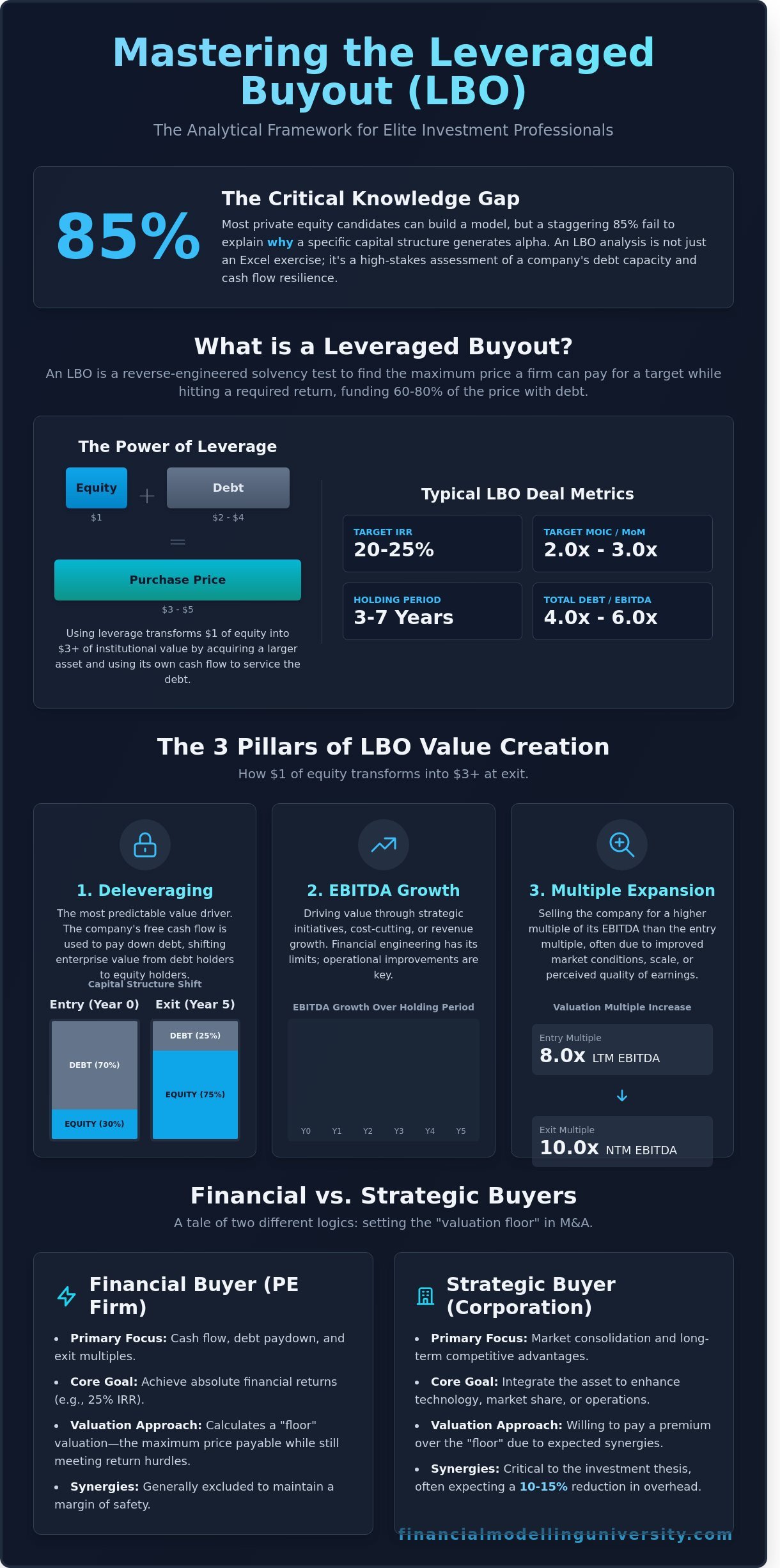
Leveraged buyout analysis is a specialized valuation framework used to determine the maximum price a financial sponsor can pay for a target company while achieving a specific internal rate of return (IRR). Unlike traditional valuation methods that look at intrinsic worth, an LBO model functions as a reverse-engineered solvency test. It calculates how much debt a business can support based on its historical cash flows and projected EBITDA margins. By funding 60% to 80% of the acquisition price with borrowed capital, investors use the company’s own cash flow to pay down debt, effectively shifting the enterprise value into equity value over a 5-year period.
The core mechanism relies on the power of leverage to magnify equity returns. While a standard Discounted Cash Flow (DCF) analysis focuses on the present value of future cash flows, leveraged buyout analysis is centered on the “floor” valuation. This is the price level where the investment meets the minimum acceptable return threshold for a private equity firm, typically ranging from 20% to 25% IRR. The financial sponsor acts as the catalyst, structuring the deal to optimize the capital stack and drive operational efficiencies that exceed the cost of debt. This requires a robust understanding of three-statement modeling to ensure the target’s balance sheet can withstand the interest burden.
The primary goal is to solve for the entry multiple. Analysts must determine the highest possible purchase price that still allows for a 2.0x to 3.0x Multiple of Money (MoM) at exit. This requires a rigorous assessment of debt capacity; most institutional-grade deals target a Total Debt to EBITDA ratio between 4.0x and 6.0x. You’re not just modeling numbers; you’re evaluating the feasibility of a 3 to 7 year holding period and the practical reality of various exit strategies, such as an Initial Public Offering (IPO) or a secondary sale to another sponsor.
Financial buyers and strategic buyers operate on different planes of logic. A strategic buyer, such as a Fortune 500 corporation, often pays a premium because they anticipate operational synergies, including a 10% to 15% reduction in overhead costs. In a pure financial leveraged buyout analysis, these synergies are often excluded to maintain a margin of safety. This creates a “valuation floor” in M&A auctions. If a strategic buyer can’t outbid the LBO valuation, the private equity firm wins the asset. The distinction lies in the hurdle: PE firms seek absolute financial returns, while corporates seek long-term competitive advantages through market share or technology integration.
Success in leveraged buyout analysis isn’t a byproduct of luck; it’s the result of precisely identifying how $1 of entry equity transforms into $3 or more at exit. While novice analysts focus solely on the debt quantum, elite practitioners dissect value creation into three distinct levers. The relationship between leverage and the Internal Rate of Return (IRR) is purely mathematical. By using non-recourse debt to fund the majority of an acquisition, any increase in enterprise value or reduction in net debt disproportionately accrues to the equity holders. However, the timing of the exit remains as vital as the entry valuation. A stellar five-year operational performance can be eroded by a poorly timed sale during a market downturn where liquidity dries up and multiples compress.
Deleveraging is the most predictable component of the LBO model. As the portfolio company generates free cash flow, it’s contractually obligated to pay down the principal balance of its senior debt. This process shifts the capital structure from debt-heavy to equity-heavy over a typical five-year holding period. It’s effectively a “forced savings” mechanism. Even if the company’s total enterprise value remains stagnant at $500 million, reducing debt from $300 million to $100 million triples the sponsor’s equity value. Mastering the mechanics of complex debt schedules is a prerequisite for building any institutional-grade financial model used by top-tier private equity firms.
Financial engineering has its limits, making operational value-add the hallmark of sophisticated investment strategies. Sponsors drive value by aggressive margin expansion, often targeting a 200 to 500 basis point improvement through procurement savings, pricing optimizations, or headcount rationalization. Management teams are usually incentivized with an equity option pool, typically ranging from 10% to 15% of the fully diluted shares, ensuring their interests align with the sponsor’s exit goals. EBITDA growth stands as the most sustainable driver of long-term LBO success because it represents fundamental business health rather than capital structure manipulation.
Multiple expansion occurs when a sponsor sells a business at a higher EBITDA multiple than the entry price. This often results from a sector re-rating or a decrease in the equity risk premium. Relying on this lever is inherently risky; it’s essentially a bet on market sentiment which the sponsor cannot control. To mitigate this risk, many firms employ a “buy-and-build” strategy. By acquiring smaller “add-on” companies at 5x or 6x EBITDA and integrating them into a platform that trades at 10x, the sponsor creates immediate arbitrage value. A robust leveraged buyout analysis must stress-test the exit multiple to ensure the deal remains viable even if the market contracts by 1.0x or 2.0x during the holding period.
A disciplined leveraged buyout analysis separates elite associates from those who simply move numbers around a spreadsheet. This framework follows a linear, rigorous progression from entry valuation to the final exit return calculation. You can’t skip steps. Every institutional-grade model begins with a precise “Sources and Uses” schedule. This table represents the foundation of the entire transaction. Without it, your model lacks the integrity required for an investment committee presentation. It’s the mechanism that ensures the deal is fully funded and the opening balance sheet is correctly capitalized.
Precision begins with the Total Acquisition Cost. You’re calculating the enterprise value plus transaction fees and debt issuance costs. In a standard $500 million deal, transaction and financing fees might add $15 million to your total capital requirement. Balancing the debt-to-equity ratio is your next hurdle. While a 7.0x Debt/EBITDA ratio might maximize projected returns, it risks a covenant breach if cash flow dips by even 8%. You must layer the capital stack strategically. This involves using senior secured debt for low-cost stability, alongside high-yield bonds or mezzanine debt for flexibility, despite their higher interest rates.
The Sources and Uses table is the model’s anchor. Sources detail exactly where capital originates. This includes new bank debt, sponsor equity, and management rollover. Management rollover is a critical signal; it ensures the target’s leadership stays aligned with the private equity firm’s goals. Uses define where that capital goes. This includes the purchase price of the equity, refinancing existing debt, and paying out M&A advisors. The golden rule is absolute: your Sources must equal your Uses to the cent. If they don’t, your balance sheet won’t balance. Mastering this specific mechanic is the first priority when you learn how to build an LBO model that withstands professional scrutiny.
Finalizing your leveraged buyout analysis requires calculating the Internal Rate of Return (IRR) and Multiple of Invested Capital (MOIC). These metrics serve different masters.
Private equity firms must track both to satisfy Limited Partners (LPs). A 40% IRR is less impressive if it’s achieved in six months with a 1.2x MOIC. LPs need to deploy large capital amounts over longer horizons, meaning a 2.5x MOIC over five years often carries more weight than a quick, small-scale win.
Success in institutional private equity isn’t found in the upside alone. It’s forged in the rigorous protection of the downside. Not every business survives a high-leverage transaction. Professional leveraged buyout analysis requires you to filter for specific financial profiles that can withstand the weight of a multi-tranche debt structure. The biggest misconception in the industry is that high debt equals high risk. This isn’t true. Risk is a function of cash flow volatility, not just the quantum of leverage. A company with a 98% customer retention rate and 20% EBITDA margins can comfortably service a 6.5x leverage ratio where a cyclical commodity business would fail at 3.0x.
Elite practitioners look for businesses that operate like toll bridges in their respective industries. You need steady, predictable cash flows to meet quarterly interest payments without fail. A premier candidate demonstrates a cash flow conversion ratio exceeding 85%, ensuring that paper profits translate into actual liquidity for debt amortization. Look for these indicators:
Your model’s only as good as its weakest assumption. Institutional decision-making relies on multi-variable data tables to visualize how the Internal Rate of Return (IRR) fluctuates when exit multiples compress or revenue growth stalls. You can’t just build a Base Case and call it a day. A professional leveraged buyout analysis must include a Downside Case reflecting a 15% drop in organic growth or a 100-basis point expansion in exit yields. If the IRR remains above 12% in a recessionary scenario, the deal has legs.
Debt covenants represent the most critical constraint in these models. If your Net Debt to EBITDA ratio breaches a 5.5x maintenance covenant during a recessionary year, the equity holders lose control. You’re modeling to ensure the business stays solvent during a 24-month downturn, not just when the sun is shining. Mastery of these sensitivities is what separates a junior analyst from a director-level strategist. You’ll need to master institutional-grade LBO modeling to navigate these complex risk profiles and secure your seat at the investment committee table.
Theoretical knowledge is your entry fee. It’s the baseline expectation in an industry where only 1% of applicants secure offers at elite firms. Institutional-grade execution is what actually gets you the job. Proficiency in leveraged buyout analysis serves as the ultimate litmus test in the private equity interview process. It reveals whether you can handle the technical rigor of a $500 million transaction or if you’ll crumble under the pressure of a live deal environment. You must transition from being an Excel monkey who blindly inputs data to a strategic architect who understands the levers of IRR. This mastery is the core focus of our private equity financial modeling pillar, which bridges the gap between academic theory and the high-stakes reality of the buy-side.
Expect senior deal team members to look past your ability to calculate a basic MOIC. They’ll ask how a 75 basis point expansion in entry multiples affects your exit strategy if EBITDA growth stalls at 3% annually. You need to discuss the investment thesis with the same clarity as a Principal or Managing Director. Speed is useful, but the “why” behind the numbers carries more weight in the final hiring decision. In a review of 150 successful associate placements, the top candidates were those who could articulate how specific debt covenants impact operational flexibility. You’re building a narrative, not just a spreadsheet. If you can’t explain why you chose a specific seniority for the mezzanine layer, your technical speed won’t save you.
Our private equity modeling training simulates the intense deal environments found at top-tier funds. We provide downloadable, institutional-grade Excel templates that remove the guesswork from your leveraged buyout analysis. These tools are the same caliber as those used by analysts at global investment banks. You’ll learn to construct robust, dynamic models that handle complex tax structures and multiple debt tranches with precision. This training isn’t just about passing a test; it’s about developing the professional superiority required for a lifelong career in finance. Enroll in the LBO Modeling Course to gain the elite skills necessary to secure your dream role and join the ranks of high-performance investment professionals.
Transitioning from basic theory to institutional-grade execution requires a relentless focus on the three pillars of value creation. You’ve seen how precise deleveraging and operational improvements drive 25% or higher IRR targets, and how rigorous stress-testing protects capital in volatile markets. Mastering leveraged buyout analysis isn’t just a technical requirement; it’s the professional barrier that separates high-stakes dealmakers from the rest of the field. Precision in your three-statement modeling and debt scheduling builds the confidence needed to advise on multi-billion dollar transactions.
The path to the top 1% of finance professionals demands a structured approach to skill acquisition. Financial Modelling University provides the exact tools used by the top 10 global private equity firms. You’ll gain access to downloadable Excel templates, receive 1-on-1 career mentoring from veterans with 15+ years of industry experience, and earn a globally recognized certification in Private Equity Modeling. Don’t leave your career progression to chance when you can build a foundation of technical superiority today.
Master Institutional-Grade LBO Analysis with Financial Modelling University
Internal Rate of Return (IRR) measures the annual percentage growth of an investment, while Multiple of Invested Capital (MOIC) tracks the total cash return regardless of time. A 2.0x MOIC delivered in 3 years yields a 26% IRR; however, that same 2.0x over 5 years drops the IRR to 15%. Professional leveraged buyout analysis requires balancing both metrics to satisfy limited partners who demand a minimum 20% annual return. Speed of capital return is the deciding factor here.
EBITDA acts as a standardized proxy for operating cash flow available to service debt before accounting for taxes or capital structure. It allows analysts to compare companies across different tax jurisdictions and leverage profiles. In most institutional deals, entry valuations range from 8.0x to 12.0x EBITDA. This metric provides the baseline for calculating interest coverage ratios, which must typically remain above 2.0x to ensure the company doesn’t default on its senior loans.
Modern LBOs typically utilize debt to fund 50% to 70% of the total purchase price. This usually results in a leverage multiple of 4.0x to 6.0x EBITDA. In 2023, higher interest rates forced equity contributions upward, sometimes reaching 50% of the capital stack to maintain a viable Debt Service Coverage Ratio. Senior secured debt usually makes up 50% of the total debt, while mezzanine or high-yield bonds fill the remaining gap.
Existing debt is almost always refinanced and paid off at the close of the transaction using proceeds from the new debt and equity. This process is called “clearing the capital stack.” Most credit agreements contain “Change of Control” provisions that require immediate repayment if the company is sold. Failure to retire these old obligations would prevent the new private equity owner from securing the first-priority liens required by senior lenders in 100% of institutional deals.
Companies with negative cash flow are rarely viable candidates because they lack the funds to meet mandatory interest payments. A rigorous leveraged buyout analysis requires a minimum free cash flow margin of 10% to support a 5.0x leverage ratio. While distressed funds might target these firms, they usually require an immediate 20% reduction in operating expenses to reach break-even. Without predictable cash flow, the risk of technical default within the first 12 months is too high.
A management rollover occurs when the existing executive team reinvests 10% to 25% of their sale proceeds into the new equity of the deal. This ensures leadership stays aligned with the private equity sponsor’s 5-year exit plan. It reduces the total cash equity the sponsor must provide at closing. Typically, the CEO and CFO will retain a combined 3% to 7% stake in the post-LBO entity, creating a powerful incentive to drive operational efficiencies and margin expansion.
LBO analysis determines the maximum price a financial sponsor can pay to achieve a specific target IRR, while a DCF calculates intrinsic value based on the present value of future cash flows. LBO models function as “floor valuations” focused on debt capacity and exit multiples. DCF models utilize a Weighted Average Cost of Capital (WACC) often between 8% and 12%. In contrast, LBO models use a cost of equity hurdle that starts at 20%.
The three primary exit strategies are secondary buyouts, strategic sales, and Initial Public Offerings (IPOs). In 2022, secondary buyouts to other private equity firms accounted for 40% of all realizations. Strategic sales to corporate buyers often command a 15% premium due to expected synergies. While an IPO offers the highest potential valuation, it only represents about 5% of exits due to the 6 to 12 months of regulatory scrutiny and market volatility involved.