

In the high-stakes world of infrastructure, a single circular reference or a miscalculated debt sculpt isn’t just a spreadsheet error; it’s a deal breaker. Seeking professional project finance modeling training is no longer optional for those who want to lead renewable or mining transactions. You’ve likely felt the frustration of multi-tranche debt facilities that won’t balance or the confusion of shifting from corporate finance to project-level mechanics. You know that bankable models require more than just math; they require rigorous risk architecture.
At Financial Modelling University, we believe your career deserves more than just tutorials. Our curriculum is designed to transform you into an elite practitioner capable of structuring institutional-grade deals for the 2026 market. With data center power demand projected by the IEA to nearly double by 2030, the need for experts who can model massive digital and energy infrastructure is at an all-time high. We’ll show you how to Master Financial Modeling Like the Pros, moving from basic inputs to advanced debt sculpting and SOFR-linked calculations. This guide previews the technical path to earning your FMU certification and commanding the respect of industry leaders.
Project finance modeling is the creation of a dynamic, long-term cash flow tool specifically designed for a Special Purpose Vehicle (SPV). Unlike standard corporate models that analyze a company’s historical performance, a project model is entirely forward-looking and asset-specific. It serves as the primary decision-making engine for multi-million dollar infrastructure assets, from offshore wind farms to toll roads. Mastering this discipline requires more than just Excel proficiency; it requires a deep understanding of What is Project Finance and how legal contracts dictate financial outcomes.
The fundamental shift lies in the credit story. Corporate finance relies on the balance sheet and full recourse to the parent company’s assets. Project finance is non-recourse, meaning lenders look exclusively to the project’s generated cash flow for debt repayment. Because these assets often have lifespans of 20 to 30 years, the modeling horizon is significantly longer than the 5-year windows typical in M&A or standard corporate planning. The SPV is the central entity in a project finance model, acting as a ring-fenced legal structure that holds all project-specific assets and liabilities. This isolation ensures that the project’s risks don’t contaminate the sponsor’s balance sheet.
This isn’t a generalist skill for the average accountant. It’s built for those operating at the highest levels of global capital deployment. High-performance project finance modeling training is essential for several key roles:
Investing in your technical toolkit ensures you can speak the language of institutional lenders and sponsors with absolute confidence. It’s the difference between being a participant in a deal and being the one who structures it.
Build a model that reflects the physical reality of the asset. Project finance analysts must differentiate between Greenfield vs. Brownfield Frameworks to capture risk accurately. The timeline is your foundation. Use monthly periods for the construction phase to track precision CAPEX and shift to semi-annual or annual periods for operations. This dual-timeline approach ensures you don’t lose granularity where it matters most while keeping the model efficient over a 30-year horizon.
In greenfield deals, the construction phase is high-risk. You’ll model CAPEX using S-curves to reflect the non-linear nature of spending. Interest During Construction (IDC) must be capitalized correctly, adding to the total project cost. The EPC (Engineering, Procurement, and Construction) contract is your primary shield; your model should reflect its fixed-price or turnkey nature to satisfy lenders. Ensure a seamless “Handover” by automating the transition from construction drawdowns to operational revenue without manual overrides.
Brownfield deals focus on optimization rather than construction. You’ll normalize historical performance to project future cash flows with higher certainty. If the asset includes lease-like components, such as a port with terminal leases, you’ll benefit from applying real estate financial modeling principles to handle tenant-specific risk. Refinancing is a key lever here. Model the debt recapitalization to return capital to sponsors once construction risk is removed and the asset is de-risked. If you’re ready to build these structures yourself, consider the Project Finance & Infrastructure Modeling Course to master these professional mechanics.
Standard “vanilla” debt modeling is a recipe for failure in infrastructure finance. While a corporate loan might assume equal principal repayments, project finance requires a more sophisticated approach. This is due to the inherent seasonality and volatility of asset-level cash flows. According to this authoritative definition of project finance, the debt is sized and repaid primarily from the project’s own cash flow. Debt sculpting is the process of matching principal and interest payments to the specific cash flow profile of the asset to maintain a stable Debt Service Coverage Ratio (DSCR).
One of the biggest hurdles in any project finance modeling training is managing the resulting circular references. Because the interest expense depends on the debt size, and the debt size is determined by the sculpted repayment, Excel gets stuck in a loop. Professionals solve this using VBA-based break-circ macros or copy-paste loops to ensure the model converges on a stable solution. For those still building their foundational skills, mastering Excel for finance is an essential prerequisite before tackling these advanced VBA mechanics.
To execute a professional debt sculpt, follow this disciplined workflow:
CFADS is the most critical metric for any infrastructure lender.
Bankable models must do more than just sculpt debt; they must protect the lender through rigorous structural protections. This involves modeling the Loan Life Coverage Ratio (LLCR) and Project Life Coverage Ratio (PLCR) to assess long-term solvency beyond the current period. You must also build automated “Cash Sweeps” that redirect surplus cash to debt repayment if performance dips below certain thresholds. Dividend Stoppers are equally vital, preventing sponsors from taking cash out of the SPV if the DSCR falls below a locked level. Finally, master the mechanics of the Debt Service Reserve Account (DSRA), ensuring it’s fully funded from the first day of operations to provide a liquidity buffer during lean periods. Mastering these triggers is a core component of elite project finance modeling training at FMU.
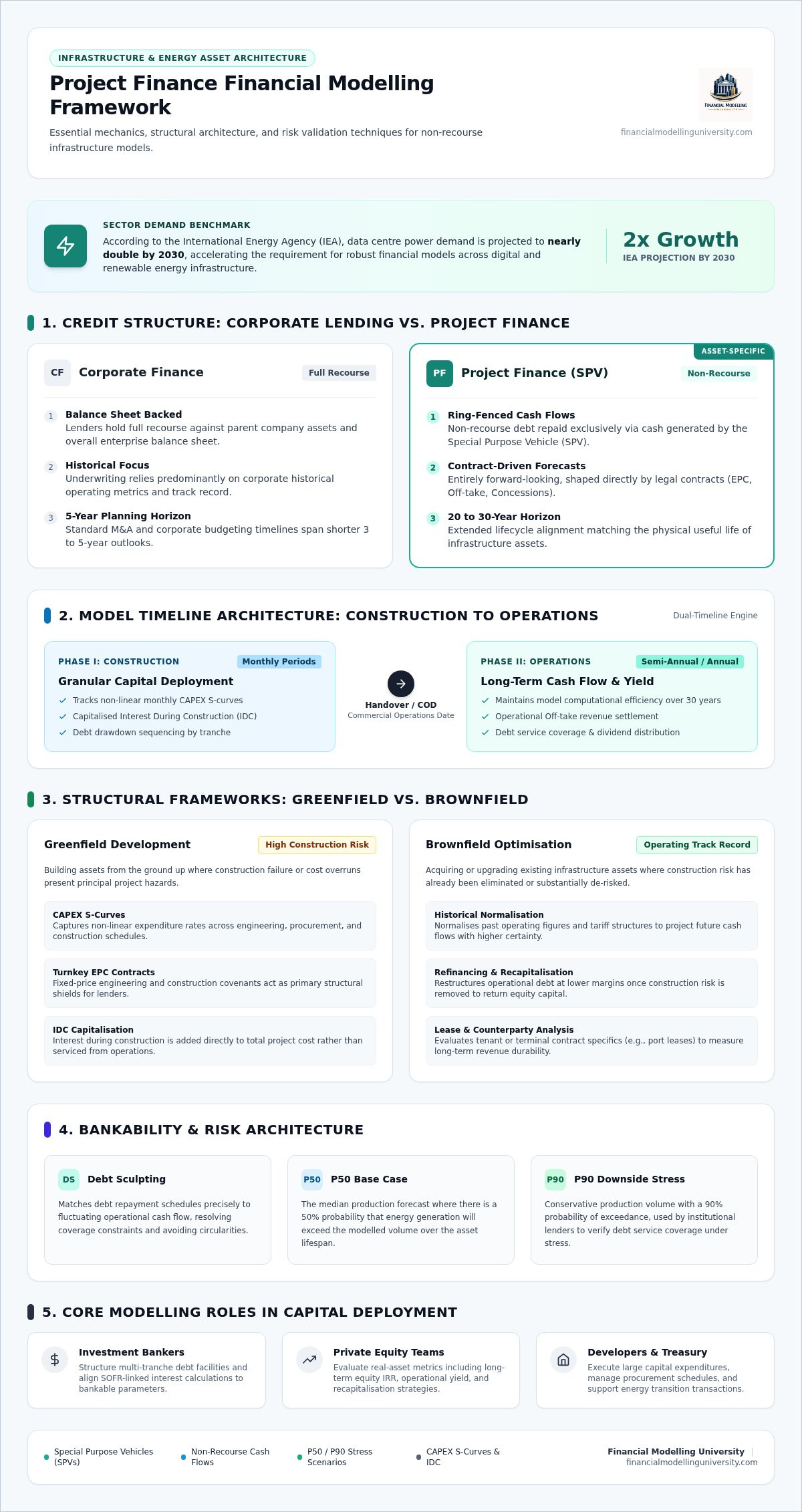
A model that merely functions is not the same as a bankable model. In the institutional world, bankability is the standard by which your work is judged. It means your model can withstand the rigorous due diligence of a lender’s technical and legal advisors. Your project finance modeling training must focus on this transition from a sponsor’s “Base Case” to a lender’s “Downside Case.” You are building a tool that proves the Special Purpose Vehicle (SPV) can survive the worst-case scenario while still meeting its debt obligations.
Lenders rarely size debt based on P50 production estimates. They focus on the P90 scenario, representing a conservative threshold with a 90% probability of exceedance. If your model doesn’t demonstrate a healthy Debt Service Coverage Ratio (DSCR) under P90 stress, the deal is dead. Beyond production, you must identify the project’s “Breaking Point.” Use sensitivity analysis to find exactly how much the Secured Overnight Financing Rate (SOFR) can rise, or how much O&M costs can escalate, before the cash flow waterfall fails to cover interest payments. With 90-day SOFR averages sitting at 3.63629% as of June 2026, understanding interest rate sensitivity is a non-negotiable skill for any modern analyst.
Build a robust scenario toggle that allows users to switch between Base, Upside, and Lender cases with a single click. This isn’t just about changing one variable; it’s about modeling correlated macro risks. You must account for inflation fluctuations, interest rate swaps, and currency volatility in a single, unified framework. Analyze the impact of a “Delay in Start-up” (DSU). A six-month construction delay can decimate a project IRR and trigger a breach of financial covenants before operations even begin. Mastering these complexities is why professionals choose to Master Financial Modeling Like the Pros through our specialized curriculum.
Professional models are built to be audited. Adhere to the FAST modeling standard: Flexible, Appropriate, Structured, and Transparent. This ensures that any third-party audit firm can trace your logic without discovering hidden macros or hardcoded “plugs.” Every institutional-grade model requires a dedicated “Checks” tab where you monitor balance sheet integrity and cash flow consistency. If your balance sheet doesn’t balance in every period, your model is useless to an Investment Committee. We teach you to build these safeguards from the start, ensuring your model is the most reliable document in the data room.
Mastering the architectural precision of infrastructure deals requires more than a casual tutorial. It demands an institutional-grade education that mirrors the intensity of a top-tier investment bank. The Project Finance & Infrastructure Modeling Course at Financial Modelling University (FMU) is engineered for those who refuse to settle for mediocrity. Our signature approach allows you to Master Financial Modeling Like the Pros, providing the exact blueprints used by the 25,000+ finance professionals who trust FMU for their career transformation. While this course focuses on asset-level cash flows, those seeking a broader command of capital markets should explore our Investment Banking Financial Modeling pillar.
You don’t just watch; you build. Our project finance modeling training provides downloadable, institutional-grade Excel templates used in actual multi-billion dollar transactions. These aren’t simplified exercises. They are the same frameworks used for greenfield solar farms and brownfield transport hubs. You’ll progress through step-by-step video lessons covering everything from CAPEX S-curves to advanced debt sculpting. Upon completion, you’ll receive a globally recognized certification and access to one-to-one career mentoring to ensure your technical skills translate into professional prestige.
Professional mastery is a continuous pursuit, not a one-time event. The FMU All-Access Pass ensures you stay at the forefront of industry standards as they evolve. You’ll gain exclusive access to live Q&A sessions with industry experts who have closed massive infrastructure deals. This is your opportunity to ask specific questions about real-world deal hurdles and receive guidance from elite mentors. Beyond the technical content, you’ll join an elite community of finance professionals worldwide, fostering a network that spans every major financial hub. Stop practicing on simplified models and start building for the real world. Enroll in the Project Finance & Infrastructure Modeling Course Today and claim your place among the industry’s elite.
The global energy transition and the surge in digital infrastructure demand have created a massive requirement for elite financial architects. You now understand that bankable models require more than just logical formulas; they require a deep mastery of non-recourse debt sculpting, P90 stress testing, and transparent SPV frameworks. This level of technical precision is what separates industry leaders from average analysts in the high-stakes world of infrastructure finance.
Securing the right project finance modeling training is the most direct path to professional prestige in 2026. Financial Modelling University provides the institutional-grade templates and technical rigor needed to execute billion-dollar deals with absolute confidence. Join the 25,000+ finance professionals who have already transformed their careers through our proven curriculum. With one-to-one career mentoring included, you aren’t just learning a skill; you are following a blueprint for success. It is time to Master Financial Modeling Like the Pros and lead the next generation of global deals.
Master Project Finance Modeling with FMU University
The path to industry mastery is disciplined and highly structured. Start building your legacy today.
The most effective method is through disciplined, hands-on application using institutional-grade templates. You cannot master this field by watching passive tutorials; you must build complex cash flow waterfalls and debt schedules from a blank sheet. High-quality project finance modeling training provides the structured environment needed to replicate real-world deal mechanics and audit-ready standards.
Project finance centers on a single, ring-fenced asset within a Special Purpose Vehicle rather than an entire corporation’s balance sheet. While standard M&A models focus on enterprise value and 5-year forecasts, project models focus on long-term cash flows over 20 to 30 years. The credit story shifts from corporate recourse to the specific ability of the project to service its own debt.
The Debt Service Coverage Ratio (DSCR) is the primary metric used by lenders to assess annual repayment capacity. You must also master the Loan Life Coverage Ratio (LLCR) and Project Life Coverage Ratio (PLCR), which evaluate the project’s solvency over the entire duration of the loan. These ratios dictate the “bankability” of the deal and determine the maximum debt capacity the asset can support.
Yes, mastering basic VBA is essential for resolving the circular references inherent in debt sculpting and funding calculations. You don’t need to be a coder, but you must know how to write and implement “break-circ” macros. These macros ensure the model converges on a stable solution when interest expenses and debt sizing are interdependent.
Foundational mastery typically requires 40 to 60 hours of rigorous, technical study. However, reaching an elite level requires applying these skills to live transactions over several months. Consistent practice with professional project finance modeling training accelerates this timeline by exposing you to complex scenarios like multi-tranche debt and tax equity structures.
Renewable energy, mining, and transport infrastructure are the traditional pillars of this discipline. In 2026, digital infrastructure has become equally critical as AI demand drives a projected doubling of data center power consumption by 2030. Any asset characterized by high CAPEX and long-term, predictable cash flows relies on these modeling frameworks.
A recognized certification from an institution like FMU serves as a powerful signal of technical competence to elite recruiters. It proves you can handle the architectural precision required by infrastructure funds and investment banks. This specialized credential differentiates you from generalists and positions you for high-prestige roles in the global energy and transport transitions.
You must match the total debt service in each period to the Cash Flow Available for Debt Service (CFADS) to maintain a target DSCR. This involves calculating the present value of the allowable debt service stream, discounted at the cost of debt, to size the initial loan. This ensures that principal and interest payments fluctuate in tandem with the project’s seasonal revenue profile.