

If you can’t build a dynamic 3-statement model from a blank Excel sheet in under 60 minutes, does that digital badge on your LinkedIn profile actually matter? Finding the best financial modeling certification 2026 isn’t about collecting generic PDF certificates. It’s about surviving the technical gauntlet of an elite investment banking or private equity interview where every formula is scrutinized. Most professionals are rightfully skeptical of “certificate mills” that promise mastery but leave them sweating when a Senior Associate asks to sensitize an LBO model on the fly.
We agree that the gap between theoretical knowledge and audit-ready execution has never been wider. You need more than a line item on your resume; you need the technical prestige to build complex DCF and M&A models from scratch under intense pressure. This guide identifies which credentials offer genuine technical mastery and the highest career ROI in the current landscape. We’ll analyze the elite programs dominating the market, from industry-standard professional training to global foundational certifications, helping you choose the definitive path to professional mastery.
The technical bar in high finance has reached a new peak. In 2026, basic Excel literacy is no longer a competitive advantage; it’s a baseline requirement. Elite firms now demand institutional-grade model architecture that prioritizes transparency, scalability, and structural integrity. Recruiters at bulge-bracket banks and top-tier private equity shops have shifted their focus. They don’t just want to see if you can calculate a terminal value. They want to see “audit-ready” models. This means your work must be clean enough for a Senior Associate to review in minutes and robust enough to support a multi-billion dollar investment committee memo.
When exploring What is Financial Modeling?, you’ll find it described as the bedrock of corporate decision-making. However, the rise of AI in 2026 has changed the practitioner’s role. While AI can automate formula entry or basic data cleaning, it can’t interpret the strategic “why” behind a complex LBO structure or a nuanced capital stack. Understanding the underlying mechanics is more critical than ever. If you can’t manually bridge the gap between a balance sheet and a cash flow statement, you’re a liability in a high-stakes environment. Choosing the best financial modeling certification 2026 requires identifying programs that teach this deep architectural logic rather than just software shortcuts.
Distinguishing between a true professional certification and a simple completion badge is vital for your career trajectory. A completion badge says you watched a video. A professional certification from an elite institution like FMU proves you’ve survived a rigorous technical filter. It signals to the market that you possess the discipline and precision required to perform at the highest level. You’re not just a user; you’re a master of the craft.
Bulge-bracket banks have significantly updated their technical testing protocols for 2026. They’ve moved away from standardized templates, opting instead for blank-sheet assessments that force candidates to build from scratch. Generalist finance degrees are losing weight as firms prioritize specific, proven skill-sets. To secure an offer, you must move beyond the surface-level definition of what is financial modeling. You need to demonstrate that you can handle sector-specific complexities, from renewable energy project finance to intricate M&A consolidations, without breaking the model logic.
Accuracy is the entry fee, but speed and flexibility are the differentiators. Your models must adhere to institutional protocols like the FAST standard to ensure consistency across global teams. They must be flexible enough for multi-scenario stress testing, allowing users to toggle key assumptions and see real-time impacts on IRR or accretion/dilution. Mastering professional excel for finance techniques is about more than just avoiding the mouse. It’s about building a structured language that communicates value clearly to senior decision-makers. This level of precision is exactly what sets the best financial modeling certification 2026 apart from the rest of the market.
The hierarchy of financial credentials has shifted significantly. In 2026, the market separates generalist certificates from elite, practitioner-led training. To determine the best financial modeling certification 2026, we evaluate providers on three specific pillars: technical rigor, instructor pedigree, and the ability to produce audit-ready models. While academic institutions offer prestige, boutique providers often deliver the “blank sheet” mastery required by top-tier investment banks and private equity firms. The emergence of high-intensity, boutique certifications has created a new standard for elite practitioners who need to perform on day one without the crutch of standardized templates.
Legacy professional bundles have long served as the historical benchmark for incoming analyst classes. These programs are designed to help new hires survive their first year on the desk by providing a broad overview of valuation and modeling. They’re often trusted by major corporate clients to train thousands of analysts simultaneously. Mass-market foundational tracks are another popular path, particularly for those seeking a broad introduction to corporate finance and FP&A. These certifications provide a solid foundation but can sometimes feel less specialized for high-stakes deal-making where every minute counts.
Financial Modelling University (FMU) has emerged as the elite choice for professionals who demand more than a survey course. FMU focuses on high-intensity, deal-focused modeling where every formula must stand up to institutional scrutiny. This is the practitioner’s choice. You’re not just learning from an academic; you’re learning from mentors who have closed the deals you’re modeling. For a broader look at the credential landscape, the Financial Management Association’s Certification Overview offers helpful context on how these specialized paths fit into the wider world of finance.
Brand prestige still carries weight in a competitive job market. Programs from Ivy League business schools look impressive on a resume and signal a baseline of intelligence. However, in 2026, the gap between academic theory and practical Excel application is wider than ever. Recruiters know that a university certificate doesn’t always translate to building a complex LBO model from scratch under a two-hour deadline. Institutional-grade training from professional institutes prioritizes speed, accuracy, and flexibility over theoretical concepts.
When you assess a financial modeling course online, look for curriculum depth. Does it include advanced VBA? Does it cover project finance or just basic DCF? The most effective certifications in 2026 are those that force you to build without templates. If you’re ready to elevate your technical prestige, consider the FMU All-Access Pass to master the same frameworks used by the industry’s top 1%.
A certification is a liability if it doesn’t translate into a higher paycheck or a faster promotion. In the high-stakes world of elite finance, firms pay for certainty. They want to know that when they hand you a complex dataset, you can return an error-free, institutional-grade model without hand-holding. Securing the best financial modeling certification 2026 provides that certainty by verifying your ability to handle intense technical workloads. This professional prestige directly impacts your starting salary and year-end bonus potential. It signals to HR and hiring managers that you’re already trained, reducing their internal costs and positioning you as a plug-and-play asset.
Beyond the digital badge, the real value lies in the technical assets you acquire. High-end programs provide downloadable, audit-ready Excel templates that serve as your professional toolkit for years. These aren’t basic spreadsheets; they’re the same blueprints used by the top 1% of practitioners on live deals. When you leverage these templates, you’re not just working faster; you’re working with the precision of a seasoned pro. Social proof is equally vital. Your LinkedIn profile and CV should reflect more than a course name. They should showcase your technical prestige through verified skills that command respect from senior deal-makers.
Don’t just complete a course; build a technical work portfolio. Treat your final models as evidence of your capability. During an interview, being able to demonstrate your investment banking financial modeling skills through a live demo is a game-changer. Ensure your portfolio includes models with dynamic scenario analysis, allowing you to toggle sensitivity drivers on the fly. This level of sophistication proves you understand the strategic “why” behind the numbers, moving you from a data entry role to a strategic architect.
One-to-one mentoring is the “secret sauce” of elite programs. Pre-recorded videos are a starting point, but they can’t answer the nuanced questions that arise during a complex LBO build. Career mentoring bridges the gap between learning a skill and getting hired. At FMU, you’re not just a student; you’re part of an elite cohort. Networking within these groups connects you with 25,000+ finance professionals who understand the value of technical mastery. This community provides the industry trust and insider insights that generic platforms simply can’t replicate. Master financial modeling like the pros by learning from those who have already mastered the game.
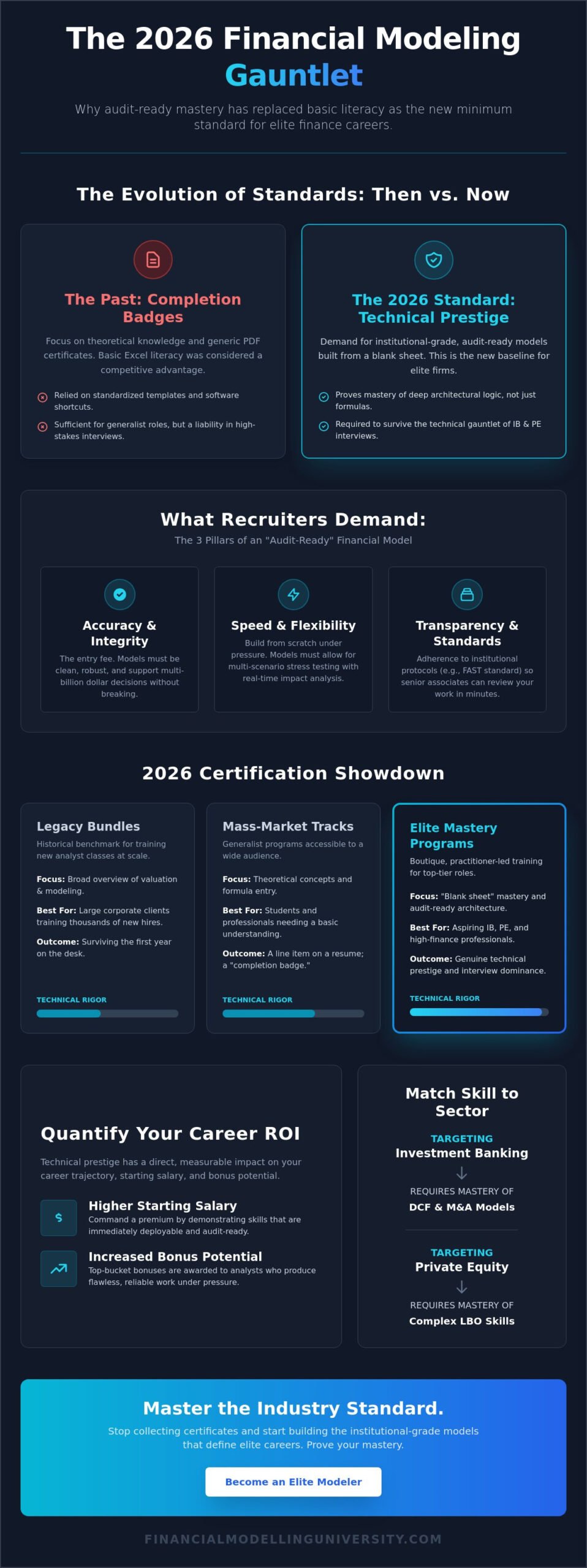
Generic training is the enemy of career progression. In 2026, the market doesn’t reward generalists; it rewards specialists who can handle the unique technical demands of their specific desk. The best financial modeling certification 2026 for an Investment Banking Analyst is fundamentally different from the one required by a Private Equity Associate or a Real Estate Developer. You must choose a path that maps directly to the deal structures you’ll encounter daily. If your certification doesn’t cover the specific nuances of your target sector, it’s just a line item that savvy recruiters will ignore during technical interviews.
Investment banking roles demand absolute mastery of three-statement modeling, DCF valuation, and M&A accretion/dilution analysis. You’re expected to build these models with surgical precision and extreme speed. Conversely, project finance requires a deep understanding of long-term infrastructure assets, focusing heavily on debt sizing, sculpting, and complex cash flow waterfalls. Understanding these distinctions is the first step toward achieving professional mastery. Don’t waste time on broad survey courses if your goal is to dominate a high-stakes niche.
The buy-side technical bar is exceptionally high. Elite private equity financial modeling requires more than just knowing how a levered buyout works. You must be able to build a full, institutional-grade LBO model from scratch, often within a high-pressure 4-hour modeling test. Calculations for Internal Rate of Return (IRR) and Multiple of Invested Capital (MOIC) must be second nature. Your models need to handle complex entry and exit assumptions, various debt tranches, and management equity incentive plans without breaking. Mastery here signals that you can think like an owner, not just an advisor.
General certifications often fail when they encounter the specialized logic of real estate and infrastructure. In real estate financial modeling, you’ll deal with joint venture waterfalls, promote structures, and development pro-formas that standard corporate models don’t address. Similarly, project finance practitioners must master Debt Service Coverage Ratios (DSCR) and debt sculpting to ensure the viability of long-term assets. Choosing a certification with niche-specific modules ensures you’re prepared for these unique challenges. If you’re ready to specialize, explore the FMU All-Access Pass to secure the technical blueprints for your specific career path.
Choosing the best financial modeling certification 2026 is a strategic career decision that requires looking beyond the badge. Financial Modelling University (FMU) stands as the practitioner’s choice because it bridges the gap between academic theory and the high-pressure reality of a bulge-bracket desk. We don’t believe in learning from generalist instructors. Our ‘Elite Mentor’ approach ensures you learn from professionals who have actually closed the deals you’re modeling. They provide the blueprint for success because they’ve lived it in the trenches of investment banking and private equity. This isn’t just a series of tutorials; it’s a university experience designed to transform your career trajectory.
The FMU All-Access Pass is the definitive tool for long-term career growth. It grants you lifetime mastery across all sectors, from M&A and LBO modeling to specialized project finance and real estate modules. As the market evolves, your skills must scale accordingly. Having permanent access to institutional-grade resources ensures you’re never caught off guard by a new deal structure or a complex technical challenge. You’re not just buying a course; you’re securing a permanent seat at the table with the industry’s top 1%.
What separates FMU from generic platforms is our commitment to technical prestige. We provide the exact downloadable templates used by elite firms, ensuring your work is audit-ready from day one. Accuracy is non-negotiable. Beyond the technical assets, we offer one-to-one career mentoring to help you secure your next role and navigate the nuances of the hiring process. When you join FMU, you enter a 25,000+ strong professional network of finance experts. This community provides the industry trust and peer support necessary to thrive in high-stakes environments. You’re learning the proven methods that top-tier firms demand.
Your journey begins with the Investment Banking Financial Modeling Course, where you’ll master the foundational three-statement and DCF frameworks. From there, you’ll scale your skills with the VBA for Financial Modeling Course and Advanced DCF Valuation modules to handle even the most complex data structures. This logical progression ensures you build a robust, unbreakable skill set. Don’t settle for mediocre training when you can learn from the best in the business. Take the final step toward your career transformation today. Master Financial Modeling Like the Pros with FMU and claim your place among the elite practitioners of 2026.
The technical standards for elite finance have reached a new peak. Recruiters no longer value simple participation badges. They demand audit-ready precision and the ability to build complex LBO or DCF models from a blank sheet under intense pressure. To succeed, you must align your training with your specific career trajectory, ensuring your technical skills match the specialized needs of your target desk. Choosing the best financial modeling certification 2026 is about more than just a line item on your resume. It’s about achieving the technical prestige required to perform at the level of the industry’s top 1%.
Financial Modelling University provides the definitive blueprint for this transformation. Our practitioner-led curriculum is trusted by 25,000+ finance professionals who understand that real-world application beats academic theory every time. You’ll gain access to the same institutional-grade Excel templates used by elite firms, supported by one-to-one mentoring to bridge the gap between learning and hiring. Don’t leave your career progression to chance. Master Financial Modeling Like the Pros with FMU and start building your legacy today. Your path to the top starts with a single, disciplined step toward technical mastery.
Yes, a certification is worth the investment if it validates your ability to build audit-ready models from scratch. In a market saturated with general finance degrees, technical prestige serves as a critical filter for recruiters at elite firms. It demonstrates that you possess the discipline and precision required to handle live deal flow without extensive internal training. You’re buying certainty for your future employer.
The best financial modeling certification 2026 for investment banking is one that focuses on three-statement modeling, DCF valuation, and M&A analysis. While legacy programs often provide a broad overview, FMU provides the practitioner-led depth required for high-stakes deal-making. Choose a program that utilizes institutional-grade templates and blank-sheet testing to mirror actual banking tasks performed at the associate level.
A certificate alone rarely secures an offer at a top-tier firm, but it significantly increases your chances by verifying your technical competence. It bridges the gap between theoretical academic knowledge and the practical skills demanded on the job. Use your certification to build a professional portfolio of models that you can demonstrate during the interview process to prove you’re desk-ready from day one.
Most comprehensive programs require between 100 and 200 hours of focused study to achieve true mastery. While some providers offer crash courses, elite practitioners know that building complex LBO and project finance models takes consistent practice. Expect to spend several months refining your speed and accuracy if you’re starting from a blank sheet and aiming for institutional standards.
Foundational platforms offer a broad introduction suitable for general corporate finance and FP&A roles. FMU is a specialized experience focused on elite, practitioner-led mastery for investment banking and private equity. While mass-market providers give a wide survey of topics, FMU prioritizes deep technical rigor and mentorship from professionals who have closed multi-billion dollar deals in the real world.
Yes, bulge-bracket banks and elite boutique firms widely recognize and even utilize online certifications for their internal training. Many global banks partner with industry-standard providers to train their incoming analyst classes. Recruiters prioritize your ability to pass their technical modeling tests over the physical location where you learned the skills, provided the curriculum is trusted by the industry.
Excel remains the undisputed language of the deal and the primary tool for the best financial modeling certification 2026 tracks. While Python is valuable for large-scale data analysis and quantitative roles, Excel’s flexibility and transparency make it the industry standard for valuation and deal structuring. Master Excel first to ensure you can communicate effectively with senior decision-makers in a deal-driven environment.
Top-tier professional certifications fall within a range that reflects their technical depth and instructor pedigree. Prices vary based on whether you’re purchasing a single course or an all-access pass. Consider the career ROI and the value of institutional-grade templates when evaluating the cost. These professional assets often pay for themselves through the career transformation experienced by our 25,000+ finance professionals.