

In 2026, the average salary for professionals who’ve mastered technical analysis is $258,000, with elite practitioners earning up to $991,000. You understand that access to the top jobs that use financial modeling depends entirely on your ability to speak the language of institutional capital. Yet, many ambitious professionals remain stuck; they’re unsure which vertical fits their skill set or terrified of failing a technical interview. It’s frustrating to have the ambition but lack the specific roadmap for the technical software and model requirements demanded by the industry’s top firms.
This guide provides the clarity you need to bridge that gap. You’ll discover the most lucrative career paths and learn exactly how to master the technical requirements for each. We’ll preview the specific models used in investment banking, private equity, and project finance, from complex LBO structures to DCF valuations. This is your structured roadmap to professional mastery. Trusted by 25,000+ finance professionals, Financial Modelling University provides the blueprint to help you perform at the level of elite industry pros and master financial modeling like the pros.
Mastering the numbers is the only way to the top of the finance pyramid. In 2026, the industry doesn’t just want data; it wants foresight. What is Financial Modeling? At its core, it’s the numerical representation of a company’s past, present, and future performance. While basic accounting focuses on recording what’s already happened, strategic forecasting requires you to project what will happen next under volatile economic conditions. This shift is why jobs that use financial modeling are the most sought-after roles in modern finance.
Elite practitioners don’t build “good enough” models. They build institutional-grade tools that are error-free, dynamic, and ready for intense scrutiny. Despite the rise of AI and specialized software, Excel remains the industry standard. It’s the canvas where logic is audited and assumptions are tested. AI can automate tasks, but it can’t replace the nuanced accountability required for a multi-billion dollar deal. To perform like a pro, you must master the technical rigor that separates a hobbyist from a master.
Every professional-grade model starts with a clean foundation. You must master historical data analysis and cleanup techniques to ensure your starting point is accurate. From there, you build the engine: the assumptions and drivers. These are the variables that dictate how the business scales. Finally, you integrate the Three-Statement Model. Linking the income statement, balance sheet, and cash flow statement is the non-negotiable foundation for all advanced analysis, including LBO models and DCF valuations.
In high-stakes environments, models aren’t just spreadsheets; they’re decision-making engines. Executives use them to justify massive capital deployments and multi-billion dollar acquisitions. You’ll spend significant time on sensitivity and scenario analysis to manage risk and predict outcomes under different market stresses. This level of precision is why jobs that use financial modeling command such high prestige and compensation. Financial modeling is the bridge between raw data and strategic capital allocation. It transforms abstract numbers into a concrete roadmap for growth and institutional success.
Transactional finance is where the most aggressive capital moves happen. These are the premier jobs that use financial modeling to dictate the terms of multi-billion dollar acquisitions and fund the next generation of tech giants. Unlike operational roles that manage existing budgets, transactional roles focus on the “deal.” You’re either advising on a sale, buying a company outright, or valuing a startup for a Series A round. It’s a high-pressure environment where a single formula error can derail a career. Given the average salary for modeling experts in 2026 is $258,000, the stakes for technical accuracy are incredibly high.
Investment Banking (IB) serves as the front line for M&A and capital raising. Analysts and associates spend the majority of their time in Excel, building pitch books and valuation models that determine the fate of high-stakes corporate transactions. You must master Accretion/Dilution models to determine if a merger creates value for shareholders. You’ll also perfect the DCF valuation and Public Comps to triangulate a company’s worth. If you want to break into this field, you need to master investment banking financial modeling to survive the grueling technical rounds.
Private Equity (PE) takes modeling a step further. It isn’t just about valuation; it’s about engineering returns through debt. PE professionals use LBO models to calculate how much leverage a business can sustain while still delivering a high Internal Rate of Return (IRR) and Money on Money (MoM) multiples. You’ll focus on complex debt schedules, tax shields, and exit multiples. The rigor of PE technical interviews is legendary. They often require 4-hour modeling tests that simulate real deal scenarios. Professional private equity financial modeling skills are your only ticket into these elite firms.
Venture Capital (VC) and Equity Research also belong to this high-stakes category. VC modeling requires forecasting growth for early-stage startups that often have no revenue. It’s about modeling “what-if” scenarios for high-risk bets. Equity Research, on the other hand, provides the market with “Buy/Hold/Sell” recommendations based on sell-side models. Both are competitive jobs that use financial modeling to influence market sentiment and capital flow. To prepare for these roles, you might consider the FMU All-Access Pass to master every technical vertical.
While transactional roles focus on the immediate deal, internal corporate functions manage the long-term trajectory of the firm. These are critical jobs that use financial modeling to turn board-level strategy into operational reality. Corporate Development and Financial Planning & Analysis (FP&A) teams serve as the central nervous system of a major corporation. They don’t just record past performance. They dictate future capital allocation. In 2026, the shift toward strategic forecasting means these roles require the same technical precision once reserved for Wall Street.
Corporate Development functions as the in-house investment bank for major corporations. You’ll focus on buy-side acquisitions and strategic partnerships that align with the company’s long-term vision. The modeling here is intense. You must estimate synergies and post-merger performance to ensure an acquisition is accretive. Because the stakes involve the firm’s own balance sheet, these teams often hire directly from top-tier investment banks. You need to build models that account for complex integration timelines and operational risks that external advisors might overlook.
FP&A is the bridge between accounting and the C-Suite. Your primary tool is variance analysis. You’ll compare actual results against the budget to help executives pivot strategy in real time. This role demands mastery of rolling forecasts and long-range planning models. You aren’t just looking at the next quarter; you’re modeling the next five years of growth. The importance of excel for finance cannot be overstated here. It’s the engine for daily operational reporting and the foundation for every strategic recommendation you make to the CFO.
Beyond these core functions, Treasury and Risk Management roles utilize modeling to manage liquidity and currency fluctuations. Every global firm needs experts to model cash flow volatility. Similarly, Commercial Banking professionals perform credit modeling and debt capacity analysis for mid-market firms. These are essential jobs that use financial modeling to ensure businesses remain solvent and funded. Whether you’re analyzing a loan or managing a corporate hedge, your ability to build institutional-grade models is your greatest career asset. Master these skills through FMU to ensure you’re performing at the level of elite industry practitioners.
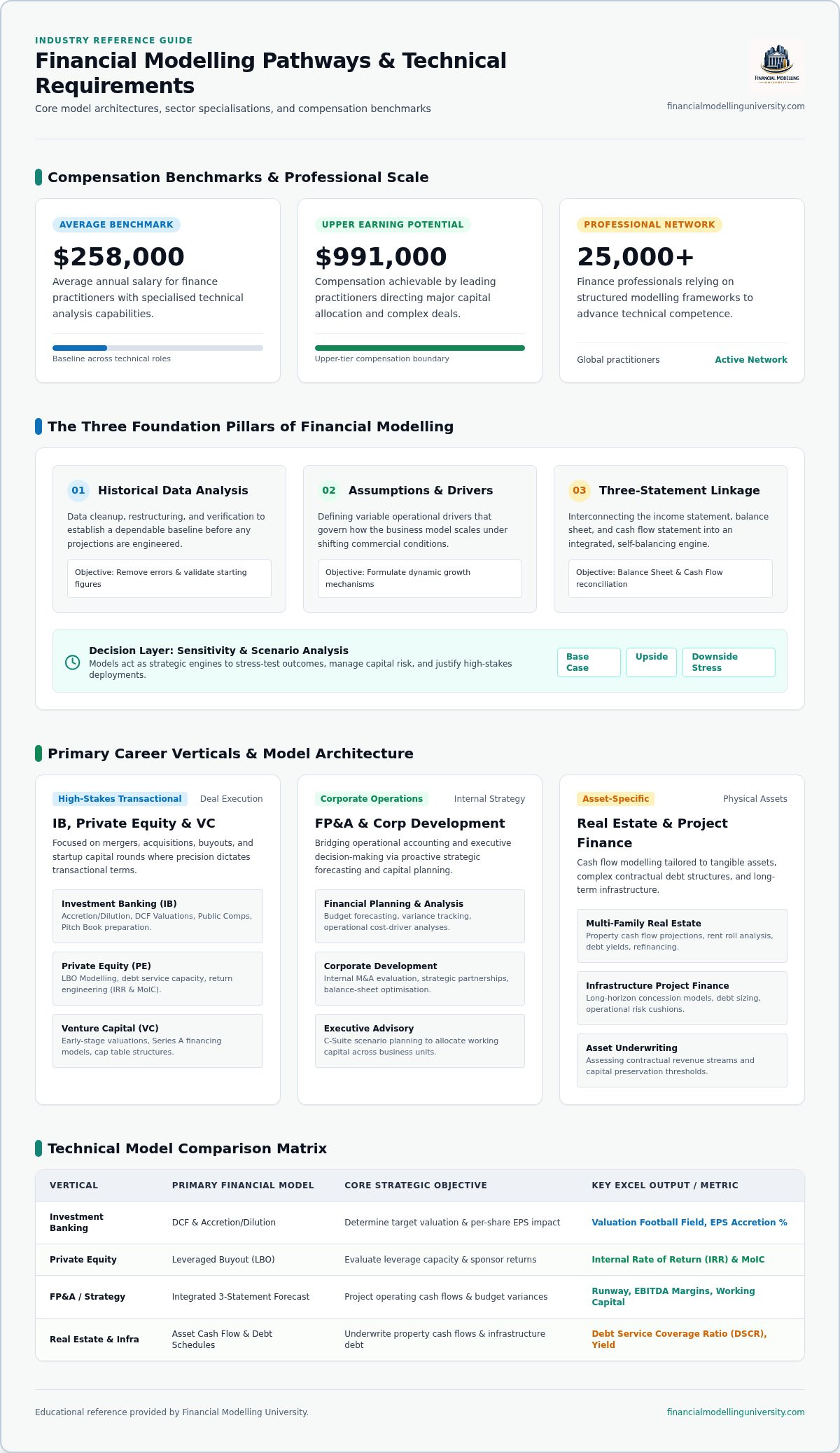
Beyond corporate headquarters and trading floors, some of the most lucrative jobs that use financial modeling exist in the physical world. Real estate and infrastructure represent massive capital allocations that require specialized technical frameworks. Unlike a standard corporate DCF, modeling for physical assets involves predicting cash flows over decades and managing complex debt structures. These roles demand a high degree of precision because the underlying assets are often “ring-fenced.” This means the project’s debt is non-recourse and relies solely on the asset’s performance to repay lenders. To perform at this level, you must transition from generalist skills to asset-specific mastery.
Real estate development and investment firms focus on multi-family, office, and industrial assets. To succeed here, you must master real estate financial modeling, which includes building complex waterfalls and promote structures. These models determine how profits are split between general partners and limited partners once specific return hurdles are met. You’ll also need to model joint venture (JV) structures and analyze interest rate sensitivity. In 2026, understanding how fluctuating rates impact cap rates and property valuations is a critical skill for any institutional asset manager. Don’t settle for basic templates; learn to build these from scratch to ensure your analysis is institutional-grade.
Project finance deals with the massive scale of power plants, toll roads, and renewable energy grids. These models are unique due to their 20 to 40 year horizons. You’ll build complex debt sculptures to ensure the project can service its obligations throughout its entire lifecycle. Tax equity models are also standard, especially as firms drive the global energy transition. These roles are essential for professionals who want to combine technical rigor with real-world impact. If you want to master these specialized techniques, enroll in the Project Finance & Infrastructure Modeling Course to gain an elite advantage over the competition.
Asset management rounds out this sector by focusing on optimizing returns for institutional portfolios. Whether you’re managing a REIT or a sovereign wealth fund, your ability to model lease rollovers and capital expenditures is vital. These jobs that use financial modeling offer a blend of technical challenge and tangible results. By mastering these asset-specific models, you position yourself as an expert in a field where specialized knowledge commands a significant premium in the 2026 market. Master financial modeling like the pros and secure your place in these high-stakes verticals.
Securing the most lucrative jobs that use financial modeling requires a transition from theoretical knowledge to clinical execution. In a market where senior treasury managers and BI analysts see salary growth between 3.5% and 3.6% annually, the competition for elite seats is fierce. You don’t just need to know the formulas; you must prove you can build under pressure. This roadmap outlines the exact steps to transform your technical profile and command the prestige of an industry master.
The technical interview is the ultimate filter for high-finance candidates. 90% of elite finance interviews now include a technical modeling component, ranging from 30-minute “quick builds” in the office to 4-hour “take-home” case studies. To succeed, you must structure your models for maximum auditability. Use consistent color-coding, such as blue for inputs and black for formulas, and avoid hardcoding at all costs. Clarity is just as important as accuracy. If a senior associate can’t follow your logic in sixty seconds, your model has failed the test.
Financial Modelling University (FMU) bridges the gap between academic theory and boardroom reality. We provide downloadable Excel templates used by top-tier analysts at global investment banks. Our approach includes one-to-one career mentoring, ensuring you don’t just learn the software but also the strategic logic behind the numbers. In a job market where 963,500 business and finance openings are projected annually through 2032, a globally recognized FMU certificate provides the prestige you need to stand out. Master financial modeling like the pros and take command of your career trajectory today. These are the jobs that use financial modeling to shape the global economy, and we provide the blueprint to help you lead them.
Mastering the mechanics of institutional-grade models is the single most effective way to elevate your professional standing. You now have a clear roadmap across transactional, corporate, and asset-specific verticals. From engineering LBO returns to driving multi-billion dollar corporate strategies, the jobs that use financial modeling represent the pinnacle of institutional finance. Don’t let technical uncertainty or a fear of rigorous interviews stall your progress. Success in this field requires a blend of academic rigor and practical, real-world application.
It’s time to bridge the gap between where you are and where the industry’s elite perform. Trusted by 25,000+ finance professionals, our curriculum is designed by former Bulge Bracket bankers to give you a definitive competitive edge. Gain access to downloadable institutional-grade Excel templates and start building your professional portfolio today. Master Financial Modeling Like the Pros with FMU University and secure your seat at the table. Your path to professional mastery is structured, logical, and begins with a commitment to excellence.
No, you don’t strictly need a finance degree to land one of the many jobs that use financial modeling. While a background in economics or business is common, recruiters in 2026 increasingly value technical certifications and a robust portfolio of institutional-grade models. Demonstrating that you can build a clean LBO or DCF valuation often carries more weight than your undergraduate major during a technical interview.
Microsoft Excel remains the non-negotiable industry standard for core model building. However, elite professionals now augment their workflow with Power BI and Tableau for data visualization, alongside Python for handling massive datasets. Specialized FP&A platforms like Anaplan are common in corporate roles, but the fundamental logic and auditing always happen within Excel’s grid.
The average salary for professionals with advanced modeling skills is $258,000 as of April 2026, according to data from 6figr.com. This figure varies across different jobs that use financial modeling, with elite roles in private equity reaching total compensation packages near $991,000. Senior managers in treasury and business intelligence also see strong growth, typically earning between $111,750 and $121,250.
Becoming a professional modeler typically requires several months of intensive, structured practice. Most industry experts recommend at least 300 to 500 hours of hands-on experience building various model types from scratch. Using a structured curriculum like those offered at FMU can accelerate this timeline by providing proven templates and insider guidance from former bulge bracket bankers.
AI is not replacing financial modelers; it’s augmenting their efficiency. In 2026, AI tools handle data cleaning and basic forecasting, but human experts are required to set strategic assumptions and interpret complex risk scenarios. Mastering AI integration is now a core requirement for those who want to perform at the level of elite industry practitioners and maintain their competitive edge.
A financial analyst generally focuses on interpreting reports and historical data to provide business insights. A financial modeler is a technical specialist who builds the dynamic, numerical engines used to project future performance and value companies. While the roles overlap, modeling is a more technical, construction-oriented discipline that requires a deeper mastery of Excel and valuation theory.
Remote work is highly accessible for modeling-heavy roles in FP&A, equity research, and corporate development. While investment banking and private equity firms often favor hybrid structures for deal-making, the technical nature of modeling allows for significant geographic flexibility. Many pros now manage multi-billion dollar portfolios and project finance deals from decentralized locations without sacrificing technical precision.
Private Equity and Investment Banking remain the highest-paying sectors for elite modeling talent due to performance-based bonuses and carried interest. These transactional roles offer significant compensation tied to deal flow. However, specialized fields like project finance and corporate development also offer high-status compensation for those who master asset-specific technical requirements and institutional-grade modeling standards.