

Your financial modeling course isn’t a line item on an expense report. It’s a career asset, and the smartest finance professionals treat it exactly that way. If you’ve been quietly wondering whether the ROI of a financial modeling course is real or just marketing copy, you’re asking the right question. And the honest answer is: it depends entirely on the caliber of training you choose.
You already know the frustration. You’re technically competent, you work hard, but something is holding you back from the front-office roles and the compensation that should come with your ambition. Generic online tutorials recycle surface-level theory. Technical interviews at firms like JP Morgan expose the gaps. And stagnating in a mid-office role while peers advance is a specific kind of professional pain that no amount of motivation alone will fix.
This article cuts through the noise. You’ll discover how an elite financial modeling certification translates into measurable salary growth, faster promotions, and the kind of institutional-grade technical mastery that separates candidates who get offers from those who don’t. We’ll break down the real career dividends, from LBO and DCF competency to globally recognized credentials, so you can make a precise, informed decision about your next move.
Financial modeling has become the operative language of capital allocation. It’s how investment banks stress-test acquisitions, how private equity firms underwrite returns, and how corporate development teams justify billion-dollar strategic pivots. In 2026, fluency in that language isn’t a differentiator. It’s the entry requirement.
The delta between where you are and where elite finance roles sit is almost always technical. Not motivational. Not relational. Technical. And understanding that gap is the first step toward calculating the real roi of a financial modeling course with any precision.
Demand for analysts capable of handling complex M&A and LBO scenarios has accelerated sharply, while the supply of genuinely qualified candidates has not kept pace. The reason is structural. AI tools have absorbed the repetitive, low-judgment tasks that once occupied junior analyst hours: data pulls, formatting, basic sensitivity tables. What remains is the work that requires architectural thinking, the ability to build a dynamic, assumption-driven model from first principles and defend every line of it in a live deal room.
This is precisely why basic Excel proficiency no longer registers as a credential. Hiring managers at bulge-bracket and elite boutique firms aren’t screening for spreadsheet literacy. They’re screening for candidates who can structure institutional-grade models under pressure. The Investment Banking Financial Modeling Course Guide maps this transition in detail, outlining the specific competencies that now separate shortlisted candidates from the rest of the applicant pool.
Generic online tutorials don’t bridge this gap. They describe it.
Academic finance teaches you formulas. Transactional finance demands that you build live, dynamic models that hold up when deal assumptions shift mid-process. That’s a fundamentally different skill. A DCF you learned in a classroom is static. A DCF built for a real acquisition is layered with scenario toggles, operational drivers, and sensitivity outputs that a managing director can interrogate in real time.
The professionals who thrive in these environments operate with what practitioners call a “Strategic Architect” mindset. They don’t just populate templates. They design model logic, anticipate where assumptions will be challenged, and communicate outputs with conviction. Developing that mindset requires training built around real transactions, not textbook exercises.
That’s the core premise behind measuring the roi of a financial modeling course properly: the return isn’t just the credential. It’s the compounding career trajectory that institutional-grade technical mastery makes possible.
Career decisions deserve the same analytical rigor you’d apply to an acquisition model. So let’s run the numbers on the roi of a financial modeling course properly, not with vague gestures toward “better prospects,” but with the specific financial logic that separates a sound investment from wishful thinking.
According to the financial analyst salary and job outlook data published by the U.S. Bureau of Labor Statistics, the median annual wage for financial analysts sits at $99,890, but that median obscures an enormous spread. The delta between a mid-market analyst and a Tier 1 placement isn’t marginal. It’s structural, and technical certification is one of the clearest variables that explains it.
A junior analyst moving from a regional firm to a bulge-bracket or elite boutique bank after targeted upskilling can realistically expect a base salary increase of $30,000 to $50,000 annually, before performance bonuses are factored in.
Excel-literate graduates entering the market compete on volume. Analysts holding a recognized credential from a program like FMU compete on demonstrated competency. That distinction matters at the screening stage. In specialized verticals, the premium is even sharper. Private equity firms and real estate investment platforms specifically filter for candidates who can build sector-specific models from scratch, whether that’s an LBO with a leveraged buyout waterfall or a real estate development model with phased equity draws. Generic training doesn’t produce those skills. Specialized courses in Private Equity Financial Modeling and Real Estate Financial Modeling do.
Base salary is only part of the equation. Performance bonuses at investment banks and PE firms are directly tied to analyst ranking, and ranking is driven by output quality. An analyst whose models are technically accurate, clearly structured, and audit-ready under deal pressure consistently scores higher in performance reviews. That difference in ranking can translate to a bonus variance of 20% to 40% of base salary between a mid-ranked and top-ranked analyst cohort. Technical mastery isn’t just a hiring credential. It compounds annually through performance-linked compensation.
Six months of free tutorials carries a hidden cost most candidates don’t calculate: delayed progression. Every month spent outside a Tier 1 environment is a month of deal exposure, network access, and performance-review cycles you don’t accumulate. Six weeks in a structured, mentored program compresses that learning curve sharply. The payback period on a professional course fee, measured against even a single year’s salary premium, is typically well under twelve months. That’s not a marketing claim. That’s arithmetic.
If you’re ready to model your own career trajectory with the same precision, exploring the FMU All-Access Pass gives you the broadest foundation to do exactly that.
Salary premiums and bonus multipliers are measurable. But the full roi of a financial modeling course extends into territory that doesn’t show up on a compensation statement, at least not directly. The professionals who compound their returns fastest understand that technical mastery creates a cascade of qualitative advantages that shape every stage of a finance career.
There’s a specific moment in a technical interview that separates candidates who get offers from those who get polite rejections: the DCF walkthrough. When a managing director asks you to defend your discount rate assumptions or explain how you’ve treated the terminal value, your answer reveals whether you’ve built models or merely studied them. Candidates trained to institutional standards don’t just answer correctly. They answer fluently, using the same conceptual vocabulary the MD uses. That fluency signals something beyond competence. It signals readiness.
The psychological edge is equally significant. Knowing your model is structurally sound, audit-ready, and built to withstand scrutiny changes how you present it. Confidence in a live deal-room environment isn’t a personality trait. It’s a technical byproduct. When you’ve stress-tested your own assumptions and know exactly where the sensitivities lie, there’s nothing to be defensive about.
Speed is a career asset that rarely appears in job descriptions but drives promotion decisions constantly. A task that takes a junior analyst two hours to complete takes an expert twenty minutes, not because the expert works faster, but because they’ve internalized the techniques covered in programs like mastering Excel for Finance that eliminate redundant steps entirely. That efficiency gap compounds. Analysts who consistently deliver clean, accurate outputs ahead of schedule earn visibility. Visibility accelerates promotion cycles.
There’s also a risk dimension that’s easy to underestimate. The Bureau of Labor Statistics financial analyst salary data tracks employment growth, but it doesn’t capture the career-ending impact of a model error that surfaces in front of a client. Formula mistakes, broken links, and circular reference failures aren’t just embarrassing. In a live deal context, they destroy credibility that can take years to rebuild. Institutional-grade training specifically targets error reduction as a professional discipline, not an afterthought.
Beyond individual efficiency, FMU’s network of 25,000+ finance professionals represents a compounding asset in its own right. Access to peers navigating the same career transitions, combined with downloadable institutional-grade templates that are ready to deploy from day one, means the return on your training begins before your first performance review cycle closes.
A certificate of completion from a generic platform signals that you finished a course. A portfolio of professional models, a community of senior practitioners, and the technical fluency to defend every assumption under pressure signals that you’re ready to perform.
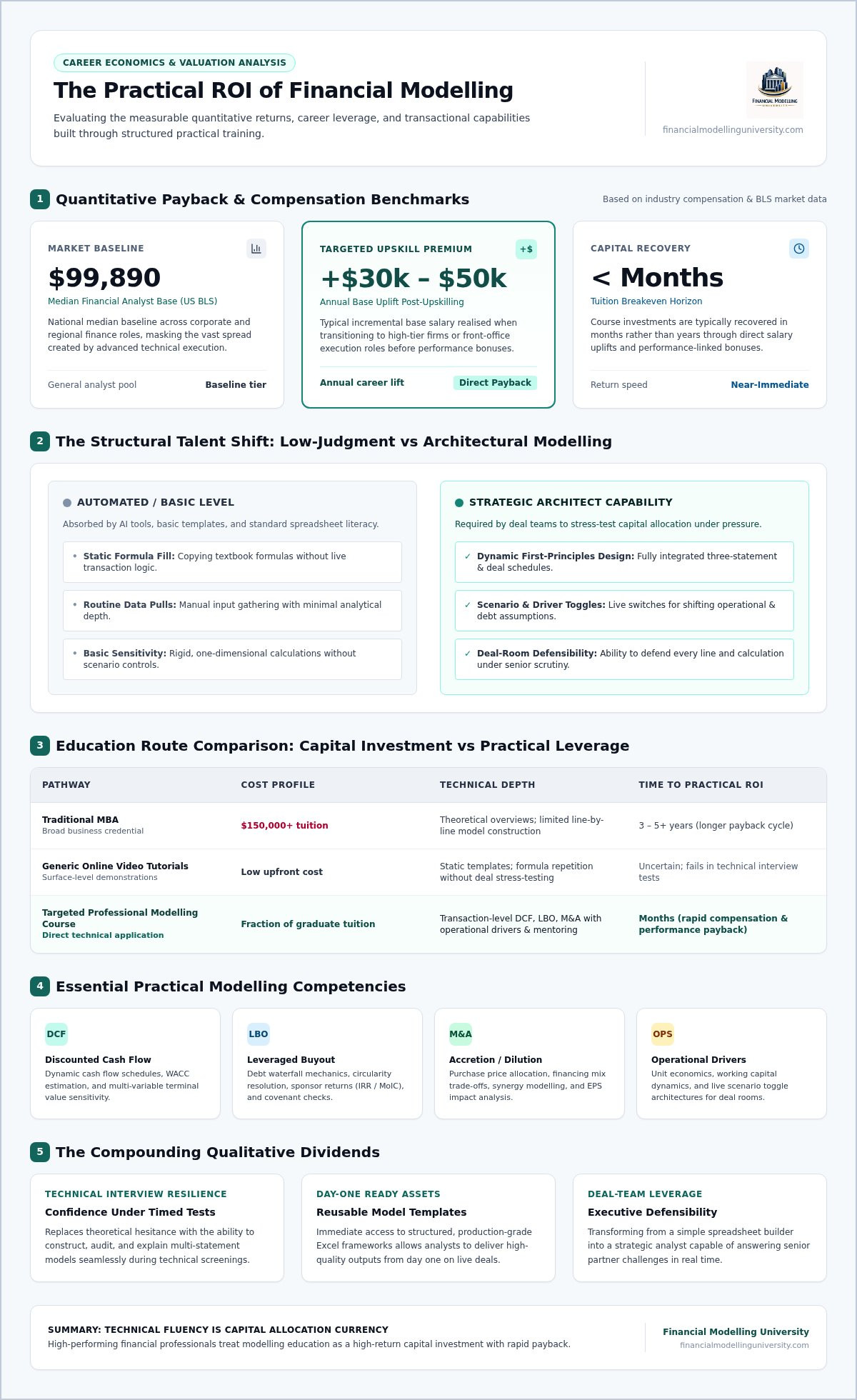
Run the numbers honestly. A full-time MBA at a target school costs north of $150,000 in tuition alone, before living expenses, foregone salary, and two years of deal exposure you don’t accumulate while sitting in a lecture hall. A Master in Finance at a respected European institution runs $40,000 to $80,000 and takes twelve to eighteen months. A specialized professional course sits at a fraction of either figure. When you’re evaluating the roi of a financial modeling course against these alternatives, the IRR calculation isn’t even close.
That’s not a dismissal of graduate education. An MBA from Wharton or LBS opens specific doors that no online credential replicates, particularly at the MD and partner level where relationship networks matter as much as technical output. But for an analyst or associate targeting a move into investment banking, private equity, or real estate finance within the next twelve months, a two-year degree is the wrong instrument for the job. It’s a sledgehammer when you need a scalpel.
The “just-in-time” advantage of specialized training is decisive at this career stage. A general Master’s program covers corporate finance, econometrics, derivatives, and portfolio theory across two semesters. Useful, broad, and largely theoretical. A dedicated Real Estate Financial Modeling course delivers exactly the technical depth a REPE hiring manager is screening for, in weeks rather than years. The capital outlay is lower. The time cost is lower. The career impact is immediate.
FMU’s architecture addresses a genuine gap in the market: the space between academic rigor and practical speed. A general Master’s curriculum is designed for breadth. A dedicated Private Equity Financial Modeling course is designed for precision. The latter covers leveraged buyout mechanics, returns attribution, waterfall structures, and management case analysis at the depth a PE associate actually needs on day one. No elective padding. No irrelevant theory. Just the architecture of institutional-grade models, built and defended under expert supervision.
The credentialing landscape has shifted. Recruiters at specialist finance search firms increasingly describe the same pattern: a candidate with a strong “proof of work” portfolio, completed models they can walk through, sector-specific outputs they can defend, consistently outperforms a candidate whose resume lists a prestigious degree but can’t structure a clean LBO from scratch in an interview. Verified technical skill has become its own credential. A certificate matters less than the model behind it.
This is the misconception worth dismantling directly: a degree from a target school is one path into a Tier 1 firm. Demonstrated, institutional-grade technical mastery is another. And for professionals already in the workforce, the second path is faster, cheaper, and increasingly respected by the people making hiring decisions.
If you’re ready to build that proof-of-work portfolio, the FMU All-Access Pass gives you the full spectrum of institutional-grade modeling training across every major finance vertical.
Acquiring technical skills is the baseline. Converting those skills into a six-figure salary or a promotion requires a strategic approach to the post-course phase. To maximize the roi of a financial modeling course, you must transition from a student mindset to a practitioner mindset. This means moving beyond passive consumption of video modules and into active application. The return on your investment isn’t just about what you know; it’s about what you can prove you can do under pressure.
One-to-one career mentoring from industry experts is often the catalyst for this transformation. Technical proficiency gets you through the door, but mentoring helps you navigate the nuances of the recruitment process at elite firms. It’s about learning how to pitch your technical story, defend your model logic during a stress test, and position your background to fit the specific needs of a Private Equity or Investment Banking desk. This personalized feedback loop turns a general education into a targeted career weapon.
Your LinkedIn profile should reflect this new technical authority. Don’t just list a certification. Highlight specific competencies like “Institutional-grade LBO modeling” or “Advanced DCF valuation with scenario analysis.” Recruiters at top-tier banks search for specific technical keywords. Make sure your profile is optimized to be found. A verified credential from a trusted industry name acts as a trust signal that bypasses the skepticism often directed at generic online learners.
Use the downloadable institutional-grade Excel templates provided in your course to build a personal “Deal Book.” This is your proof of work. When an interviewer asks about your experience, you shouldn’t just talk about theory. You should be able to present a clean, audit-ready model for a hypothetical or past transaction. This demonstrates you have moved past the “Excel-literate” stage and into the “Strategic Architect” phase discussed earlier.
This portfolio approach proves you don’t just know how to use Excel; you know how to use it to drive investment decisions. It’s the ultimate evidence for any hiring manager that you can handle the technical demands of the role from your first hour on the job.
Financial Modelling University is not a series of generic tutorials. It’s an elite training ground designed for professionals who demand results-oriented mastery. By focusing on academic rigor and real-world application, we provide the blueprint for your career transformation. We’ve helped 25,000+ finance professionals bridge the gap between where they are and where they want to be. The roi of a financial modeling course is ultimately measured by the trajectory of your professional life. Choose the path that leads to the top.
Master Financial Modeling Like the Pros with FMU
The decision to invest in your technical depth is a decision to outpace the market. We’ve analyzed how the roi of a financial modeling course manifests in six-figure salary benchmarks, accelerated promotion cycles, and a level of technical credibility that degrees alone cannot provide. By choosing institutional-grade training over generic tutorials, you’re not just learning Excel; you’re mastering the architectural logic of capital.
Join the 25,000+ finance professionals who have already chosen the FMU path. With downloadable institutional-grade templates and one-to-one career mentoring included, you gain the exact blueprint used by elite industry practitioners. Stop stagnating in mid-office roles and start performing at the level the front office demands. Your career trajectory is a function of your technical mastery. Own the architecture, secure the offer, and lead the transaction.
Master Financial Modeling Like the Pros – Enroll at FMU Today
Yes, and the reason is practical rather than academic. A finance degree teaches you valuation theory. A professional modeling certification proves you can execute that theory under deal pressure. Hiring managers at bulge-bracket firms and PE shops aren’t questioning your conceptual foundation; they’re testing whether you can build a clean, dynamic LBO from scratch in a live interview. A degree and a professional certification aren’t redundant. They address entirely different competency signals.
Think of it this way: your degree opens the application. Your technical portfolio closes the offer.
The salary uplift depends on where you’re moving from and which sector you’re targeting. Analysts transitioning from regional or mid-market firms into bulge-bracket or elite boutique environments after targeted upskilling have seen base salary increases in the range of $30,000 to $50,000 annually, before performance bonuses. Specialized verticals like private equity and real estate finance carry additional premiums for candidates who can demonstrate sector-specific modeling depth rather than generic Excel proficiency.
The roi of a financial modeling course compounds further through annual bonus cycles, where top-ranked analysts consistently outperform mid-ranked peers by a meaningful margin in performance-linked compensation.
Tier 1 firms don’t hire certificates; they hire demonstrated competency. What matters to a Goldman Sachs or JP Morgan technical interviewer is whether you can walk through a DCF with conviction, defend your terminal value assumptions, and structure an M&A model without prompting. A certificate from a rigorous, institutional-grade program signals preparation, but the proof-of-work portfolio you build during training is what actually moves the needle in a live screening process.
Recruiters at specialist finance search firms increasingly report that candidates who present clean, audit-ready models outperform those who can only cite credentials without the technical output to back them up.
The payback period is shorter than most candidates expect. When you measure a professional course fee against even a partial-year salary premium from a Tier 1 placement, the arithmetic typically resolves well within twelve months. Factor in the bonus multiplier from improved analyst rankings and the compounding effect of earlier entry into a front-office environment, and the investment case becomes straightforward. The hidden cost most candidates underestimate is the opportunity cost of not upskilling, specifically the deal exposure and performance review cycles lost during months of slower self-directed learning.
Free resources can introduce concepts, but they don’t close the gap that elite firms are screening for. Generic tutorials describe how a DCF works. Institutional-grade training builds the actual model architecture, stress-tests the assumptions, and develops the fluency to defend every output in front of a managing director. The roi of a financial modeling course comes from that gap between knowing and performing. Free content keeps you in the first category; structured, mentored training moves you into the second.
If your target is a mid-office role with modest technical demands, free resources may be sufficient. If you’re targeting investment banking, private equity, or real estate finance at a competitive firm, they aren’t.
Private equity is arguably where technical modeling depth creates the sharpest competitive separation. PE firms filter for candidates who can build leveraged buyout models with waterfall structures, returns attribution, and management case analysis from first principles, not candidates who can describe how an LBO works. A dedicated Private Equity Financial Modeling course builds exactly those skills at the depth a PE associate needs on day one, which is why specialized training consistently outperforms generalist credentials at this career stage.
The ability to present a clean, defensible LBO in an interview isn’t just a technical test. It’s a signal that you understand how PE firms think about capital and returns, which is the conversation they actually want to have with a new hire.
The skills commanding the highest premium in 2026 are architectural rather than mechanical. Hiring managers want analysts who can design dynamic, assumption-driven models from first principles, not populate pre-built templates. Specifically: integrated three-statement models, LBO mechanics with debt schedule construction, DCF with multi-scenario sensitivity analysis, and M&A accretion/dilution analysis. Sector-specific fluency in real estate development models and project finance structures is increasingly valued as firms seek analysts who don’t require vertical-specific ramp-up time.
AI tools have absorbed repetitive formatting and data-pull tasks, which means the remaining analyst work is almost entirely judgment-intensive model architecture. That’s precisely where institutional-grade training delivers its clearest return.
The decision maps directly to your career target. If you’re pursuing a specific vertical, say a real estate private equity role or an LBO-focused PE position, a single specialized course delivers the precise depth that hiring manager is screening for. If you’re early in your career trajectory, targeting multiple verticals simultaneously, or want to signal versatility across M&A, infrastructure, and real estate finance, the FMU All-Access Pass gives you the full institutional-grade curriculum across every major finance discipline.
The All-Access Pass also functions as a long-term professional resource. As your career evolves and you move across sectors or deal types, the training library grows with you rather than becoming a single-use credential.