


What if a sculpted schedule meets its target DSCR but still cannot repay the loan by maturity? In a debt sculpting project finance DSCR model, the target ratio sets a limit on scheduled debt service for each period. It does not prove that the opening debt is supportable or that the balance reaches zero on time. The challenge is aligning cash flow, interest and principal without hiding errors in Excel circularity.
If you’re unsure how forecast cash flow available for debt service (CFADS, cash remaining after operating costs, tax, working capital movements and capital expenditure) becomes permitted debt service, start with the core relationship: debt service equals CFADS divided by the target debt service coverage ratio (DSCR). This article works through that calculation with hypothetical figures, then builds the repayment logic from interest to principal and closing debt. You’ll also see how to reconcile the schedule, manage interest circularity and test assumptions such as repayment timing and the tail between final repayment and the end of the project’s revenue period.
A project can generate plenty of cash over its life yet struggle to meet repayments in a weak operating period. Debt sculpting shapes scheduled principal repayments around forecast cash flow available for debt service (CFADS), rather than requiring the same principal repayment every period. The aim is to align repayment timing with the project’s cash generation. It does not, by itself, prove that the proposed loan is financeable.
CFADS is the cash available to pay interest and principal. Its calculation depends on the model’s defined cash flow waterfall. A model might start with EBITDA, then deduct cash taxes, working capital outflows and capital expenditure, with other adjustments where relevant. Define the calculation and period basis before using it. Debt service usually means scheduled interest plus principal due in the same period.
DSCR = CFADS ÷ debt service. If hypothetical annual CFADS is £120,000 and annual debt service is £100,000, actual DSCR is 1.20x. The target DSCR is a separate assumption used to set permitted debt service; actual DSCR is calculated from modelled cash flows and scheduled payments. Keep the distinction clear when interpreting a project finance model.
With equal principal, the borrower repays the same principal amount each period. Total debt service then changes as interest declines, but the principal amount does not adapt to forecast cash generation. Sculpting instead uses the DSCR target to derive a debt service limit from each period’s CFADS, then allocates that amount between interest and principal.
For example, higher forecast CFADS can support more principal repayment in a period, while lower CFADS leaves less room after interest. This can better match repayment timing to the project’s forecast profile, but it does not remove operating or forecast risk. A target DSCR is a modelling constraint, not evidence that the debt amount, tenor or final repayment is achievable. Check those separately.
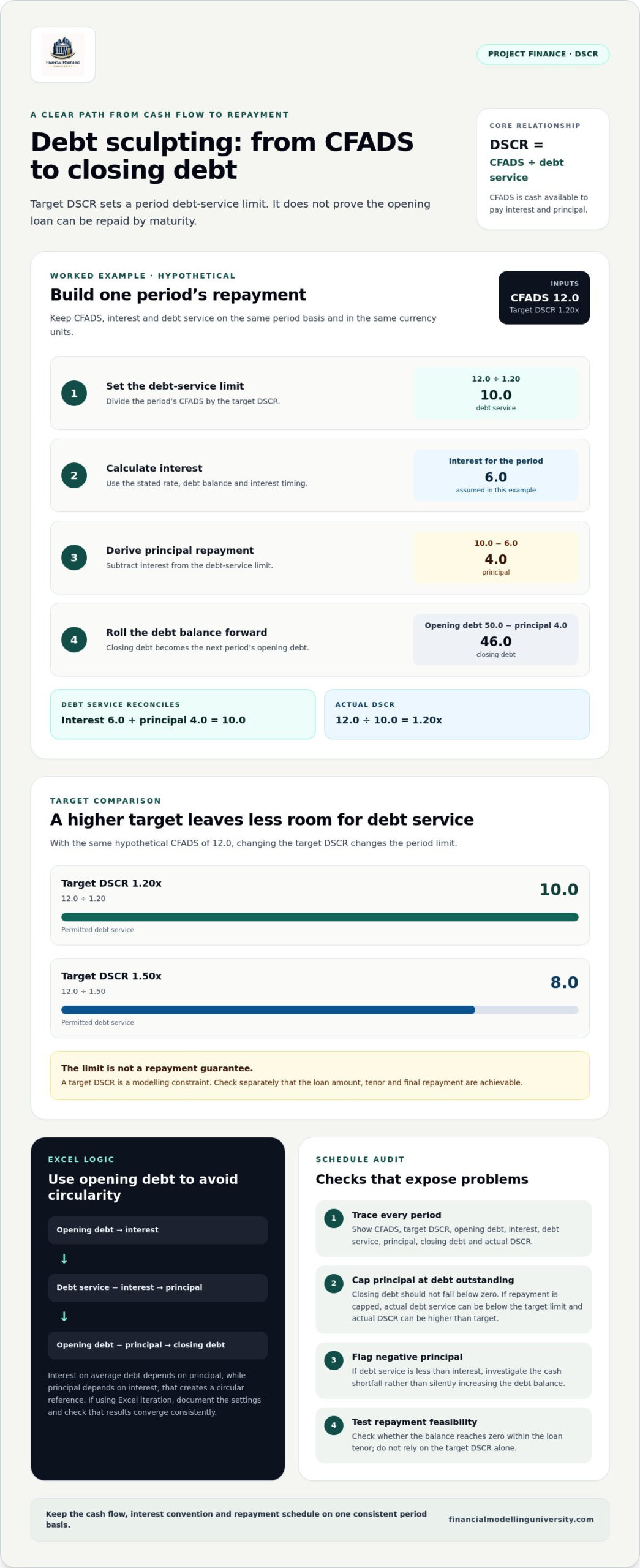
Once CFADS and a period target are set, calculate the maximum scheduled debt service for that period, then deduct interest to find principal repayment. The sequence matters: principal depends on interest, and interest depends on the opening debt balance and the rate convention.
Use the same time period and currency units throughout. In this hypothetical one-period example, CFADS is 12.0 currency units and the target DSCR is 1.20x:
The schedule reconciles as follows. Opening debt is assumed to be 50.0 currency units; closing debt is 50.0 − 4.0 = 46.0. Debt service also reconciles: interest of 6.0 plus principal of 4.0 equals 10.0. Actual DSCR is 12.0 ÷ 10.0 = 1.20x. These figures illustrate the debt sculpting project finance DSCR calculation; they are not a forecast for a real project.
In Excel, carry each period’s closing debt into the next period as opening debt. Limit principal to the debt outstanding before repayment, so closing debt cannot fall below zero. If calculated debt service is less than interest, the formula produces a negative principal amount. Flag this as a cash shortfall to investigate, rather than treating it as a repayment or silently allowing the debt balance to increase.
A higher target DSCR allows less debt service against the same CFADS. For example, with CFADS of 12.0, a 1.50x target permits 8.0 of debt service, compared with 10.0 at 1.20x. If period targets vary, enter them as explicit assumptions and document why. Do not assume targets vary automatically.
Build the schedule so each period can be traced from forecast cash flow to closing debt. A clear layout makes timing mismatches and formula errors easier to spot. Set the interest convention before deriving principal, and use the same period basis for CFADS, interest and debt service.
Use one row per period, with these columns:
Calculate debt service as CFADS divided by target DSCR, interest using the stated rate and timing, and principal as debt service less interest. Closing debt equals opening debt less principal. Recalculate actual DSCR as CFADS divided by modelled interest plus principal. If principal is capped because the remaining debt is lower than the calculated repayment, actual debt service will be below the target limit and actual DSCR may be higher than the target. A debt sculpting project finance DSCR schedule should make these relationships visible, not bury them in a single formula.
Calculating interest on opening debt avoids circularity: opening debt determines interest, then debt service less interest determines principal. If interest uses average debt, it depends on principal, while principal depends on interest. That creates a circular reference. Choose and document the interest convention; if the model relies on Excel iteration, document the iteration settings and check that results converge consistently.
Test every period, not just the final balance. Confirm each opening balance equals the previous closing balance, principal is non-negative and no greater than opening debt, and closing debt equals opening debt less principal. Flag mismatched currency units, signs or periods. Compare actual DSCR with the target and identify any debt remaining at scheduled maturity. A target miss or residual balance needs investigation, not concealment through hard-coded adjustments.
Keep the checks formula-driven and visible beside the schedule. A reviewer should be able to trace a flagged period back to its source assumptions and identify whether the issue comes from cash flow, interest timing or repayment logic.
A schedule can reconcile perfectly and still support too much debt. Debt capacity may also be limited by debt-to-capital constraints, loan tenor, required repayment terms or other financing conditions. Treat these as separate tests alongside the DSCR calculation. The debt sculpting project finance DSCR relationship sets scheduled debt service from cash flow and a target; it does not establish how much debt a lender will accept.
A modelled DSCR target does not remove forecast risk, operating disruption or changes in financing assumptions. It describes the relationship between modelled CFADS and scheduled payments in each period. A schedule can meet its target yet leave debt outstanding at maturity, exceed a debt-to-capital limit or fail another financing condition. Separate correct schedule arithmetic from overall debt capacity and lender acceptance.
Run linked sensitivities. Reduce CFADS to reflect a downside operating case, then recalculate permitted debt service, interest, principal and closing debt period by period. A higher target DSCR also reduces permitted debt service for a given CFADS. If less principal is repaid as a result, check whether debt remains at maturity. Do not force a zero closing balance if forecast cash flows cannot support it.
Model a debt service reserve account (DSRA), fees or multiple debt tranches only where relevant to the financing structure, and state each as a distinct assumption. A reserve can affect the cash available in the model; fees and tranche-specific terms can affect debt proceeds or repayment calculations. Keep them visible rather than embedding unexplained adjustments in CFADS or principal.
Review in sequence: validate operating and financing inputs, reconcile opening debt through interest, principal and closing debt, then run downside cases and inspect maturity repayment. Practise linking those assumptions and checks in an Excel model. Change one driver at a time so you can trace its effect through the schedule.
A debt schedule is most useful when it shows which assumptions drive repayment capacity. Connect each CFADS movement to an operating driver, then test how a change flows through debt service, principal and maturity balances. That turns debt sculpting project finance DSCR from a static calculation into a model you can challenge and explain.
Build a fresh case in Excel and make each assumption traceable. FMU course materials include downloadable Excel models or templates and practical exercises. The live catalogue includes LBO Financial Models and DCF & Valuation. Explore FMU’s financial modelling courses to continue developing your modelling skills.
Keep the logic transparent, test the assumptions that matter, and let the reconciliations show whether the schedule holds together. A disciplined review makes your analysis clearer and more reliable.
Not necessarily. A constant-DSCR profile is one possible sculpting assumption, not the only approach. In a debt sculpting project finance DSCR model, you might apply a uniform target, use period-specific targets or impose other explicit repayment constraints. For a seasonal asset, document why a period target changes, then report actual DSCR from forecast CFADS and scheduled payments rather than presenting the target as achieved.
A grace period delays principal repayment, but it does not automatically suspend interest. Set the first amortisation period, whether interest is paid or capitalised, and how capitalised interest changes the balance. If unpaid interest is added to debt, include it in the balance before calculating principal in the first repayment period. Reconcile debt at the end of the grace period before applying the sculpted profile.
No. Sculpting can align scheduled payments with forecast CFADS, but actual cash flow may differ. Run a downside case, such as delayed operations or lower production, and calculate actual DSCR for each affected period. Then compare the model’s calculation with the covenant definition in the financing documents. The documents may specify different testing dates or treatments, so do not assume the model ratio automatically matches the covenant test.
DSCR measures coverage over a defined period, while the loan life coverage ratio (LLCR) assesses forecast cash flow over the remaining loan life against outstanding debt. LLCR discounts that cash flow using the model’s specified rate and timing. A project could show adequate coverage in each near-term period but weaker loan-life coverage if later cash flows are lower. Keep the calculation horizon and discounting assumptions explicit.