

Most “advanced” finance certifications are nothing more than expensive vocabulary tests that crumble the moment you’re asked to build a dynamic LBO model from scratch. You’ve likely felt the frustration of finishing a course only to realize it didn’t prepare you for the intensity of a live deal or a technical interview. The industry doesn’t care about your participation trophy; it cares about your ability to build institutional-grade models under pressure. Finding the best online finance courses for professionals requires looking past generic tutorials and focusing on practitioner-led training that mirrors real-world banking workflows.
At Financial Modelling University, we believe theory is for students, but mastery is for those who lead the industry. This guide identifies the specific curriculum required to master complex DCF valuations and M&A modeling so you can perform at the level of elite industry practitioners. We’ll examine the essential technical paths, from private equity essentials to advanced VBA, ensuring your next career move is backed by undeniable technical expertise and the prestige of FMU certification. It’s time to stop watching tutorials and start building the models that drive global finance.
The 2026 finance recruitment environment has undergone a fundamental shift. General financial literacy is no longer a differentiator; it’s a commodity. Top-tier firms in investment banking and private equity now demand immediate technical contribution from day one. This reality has widened the “Skill Gap” between academic theory and the practical rigors of a live deal. Consequently, the best online finance courses for professionals have pivoted toward specialized technical mastery that traditional degrees simply don’t provide. Employers no longer value where you sat for four years; they value what you can build in four hours.
Technical proficiency is the primary gatekeeper in today’s hiring process. Modeling tests are now standard for almost every junior and mid-level role in investment banking and private equity. If you can’t build a dynamic three-statement model or a tiered waterfall under a tight time limit, you won’t get the offer. Mastery also accelerates promotion cycles by allowing junior professionals to handle higher-level responsibilities earlier in their tenure. Institutional-Grade Modeling is defined as the ability to construct error-free, dynamic, and audit-ready financial frameworks that meet the exacting standards of top-tier investment committees and global banks in 2026.
While generic platforms offer broad access to business content, they often lack the “insider” perspective required for high-stakes roles. Professional-grade programs focus on the specific nuances of deal structuring and valuation. By choosing the best online finance courses for professionals, you ensure your education translates directly to job performance. Financial Modelling University (FMU) bridges the gap between being a candidate and becoming a practitioner. It’s the difference between understanding a concept and executing a transaction.
Most rankings for the best online finance courses for professionals fail because they prioritize general accessibility over technical rigor. In the high-stakes environment of investment banking and private equity, “good enough” doesn’t exist. You need a curriculum that moves immediately beyond basic three-statement modeling into the complexities of LBO modeling and tiered waterfall structures. The true hallmark of excellence is whether the course utilizes real-world case studies from actual transactions rather than sterilized, theoretical examples found in a classroom.
Academic courses teach you how a formula works; practitioner-led training teaches you how to execute it under a deadline. Professional excellence requires keyboard-only Excel efficiency. If a course doesn’t force you to ditch the mouse, it isn’t preparing you for the reality of a bulge-bracket bullpen. Static PDF materials are now obsolete. Look for dynamic video walkthroughs where an instructor builds a model from a blank sheet. This transparency allows you to see the logic, the shortcuts, and the error-checking processes used by industry pros in real time.
Instructor pedigree is non-negotiable. The value of your training is directly tied to the experience of the person leading the modules. Demand instructors who have spent years at top-tier firms. They provide the “insider” nuances that differentiate a generic model from an institutional-grade one. High-quality resources, such as downloadable and dynamic Excel templates, should serve as the foundation of your professional learning library; you can also check out Peradus Store for a variety of digital books and professional courses. These tools are the assets you’ll carry into your next deal.
Technical mastery isn’t achieved in a vacuum. The best online finance courses for professionals provide robust support systems, including one-to-one career mentoring and live Q&A sessions. These interactions are critical when you encounter a modeling bottleneck or need to understand the strategic rationale behind a specific valuation. Building a network through elite student cohorts adds a layer of professional credibility that lasts long after you’ve earned your certificate. It transforms a simple course into a career-long asset.
Distinguishing between mass-market education platforms and elite technical programs is critical for your career trajectory. Generic providers often trade on volume, offering surface-level content that lacks the rigor of a live deal environment. In contrast, the best online finance courses for professionals are built around the “Wall Street Standard” of modeling, where every cell and link is optimized for speed and auditability. While a free course might teach you the components of a balance sheet, it won’t teach you how to balance a complex model under the pressure of a 2:00 AM deadline. The perceived savings of low-cost programs often vanish when compared to the lost salary and prestige of a missed offer at a top-tier firm. You’re not just paying for content; you’re investing in the technical certainty required to pass the industry’s most difficult modeling tests.
Mass-market courses are appropriate for those seeking general financial literacy without the intent of entering high-finance bullpens. If you’re an entrepreneur or a non-finance manager, these modules provide enough context to navigate basic financial statements. However, they aren’t designed for the technical vetting processes of global investment banks. A generic completion badge doesn’t carry weight with recruiters who are looking for evidence of institutional-grade technical proficiency. For those targeting roles in M&A or private equity, these platforms often serve as a distraction from the intensive training required to pass a modeling test.
Specialized programs like those at Financial Modelling University (FMU) bridge the gap between academic theory and practitioner execution. This curriculum focuses on high-stakes investment banking financial modeling, ensuring you can navigate everything from project finance to complex LBO structures. You’re learning from mentors who have already succeeded at the highest levels of the industry. This direct link to professional workflows is why specialized training is the preferred choice for 25,000+ finance professionals globally. When you choose a practitioner-led path, you aren’t just buying a course; you’re acquiring the technical edge that defines the industry’s elite performers.
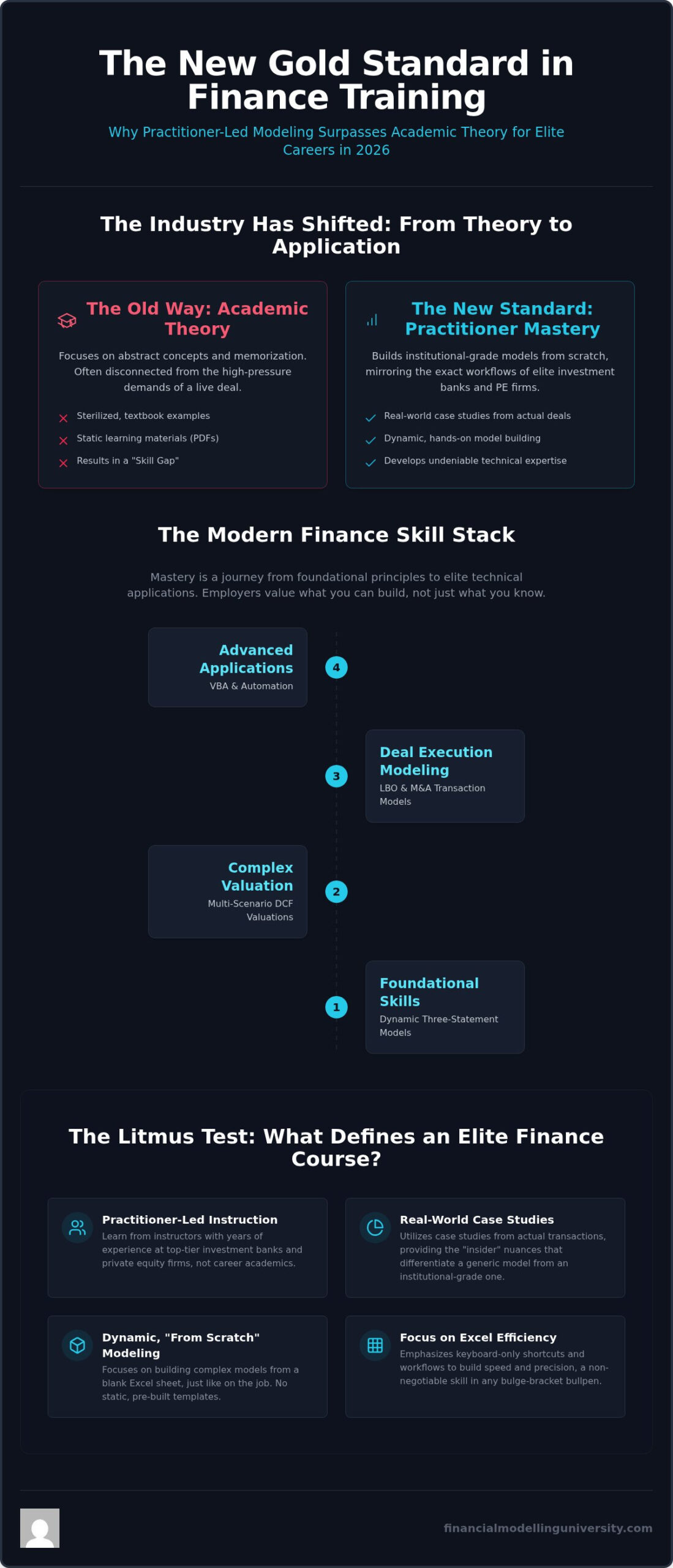
Mastering the deal lifecycle requires a structured progression from technical basics to sector-specific execution. The best online finance courses for professionals don’t just dump content; they provide a blueprint for career advancement. Your journey begins with Excel for finance and three-statement modeling. This is the bedrock of the industry. Without a fast, error-free foundation in spreadsheet mechanics, advanced valuation remains out of reach. Once you’ve mastered the basics, you must move into the valuation phase, conducting deep dives into DCF, trading comps, and precedent transactions to build a defensible investment thesis.
Advanced modules focus on the high-stakes world of LBO modeling and specialized sectors. Whether it’s project finance, infrastructure, or real estate, generic education fails to provide the granular detail required for these asset classes. The best online finance courses for professionals also prioritize automation. Leveraging VBA allows you to streamline professional workflows, reducing manual errors and increasing your output during peak deal cycles. This technical efficiency is what separates a standard analyst from a top-tier performer in a competitive 2026 market.
Success in investment banking hinges on your ability to produce high-quality M&A models and pitch books under extreme timelines. You’ll need to master the art of valuation when the pressure is highest. A comprehensive DCF valuation course is the essential cornerstone for any aspiring investment banker, providing the technical framework to defend a company’s intrinsic value during rigorous deal negotiations. This track ensures you’re ready for the bullpen from day one, equipped with the skills to handle buy-side and sell-side mandates with precision.
Transitioning to the buy-side demands a deeper understanding of capital structure and returns. You must focus on private equity financial modeling to stay competitive in the recruitment process. This involves mastering advanced LBO mechanics, including complex debt waterfalls, circularity switches, and IRR sensitivity analysis. Professionals targeting specific niches should also pursue real estate financial modeling to understand the unique cash flow drivers and joint venture structures of property-based investments. These specialized paths ensure your skillset remains relevant across the entire alternative investment landscape.
Gain the technical edge required to lead complex deals by exploring the professional curriculum at Financial Modelling University.
Financial Modelling University (FMU) stands as the definitive choice for practitioners who require more than just introductory tutorials. We’ve built an environment where academic rigor meets the high-stakes reality of global banking. While other platforms offer broad overviews, FMU provides the specialized technical depth necessary to survive a modeling test at a top-tier firm. It’s why we’re trusted by over 25,000 finance professionals who recognize that the best online finance courses for professionals must be built on the foundations of real-world deal execution. We don’t just teach you the math; we provide the blueprint for your career transformation.
Our curriculum doesn’t just explain concepts; it mirrors the actual tasks of an Investment Banking Associate. You’ll build dynamic models from a blank sheet, ensuring you understand every link, circularity switch, and debt waterfall. We provide one-to-one career mentoring to help you navigate the complexities of a career transition, offering the kind of “insider” guidance that generic MOOCs simply can’t provide. This personalized support ensures a high return on your educational investment. Our content is continuously updated to reflect 2026 market dynamics and shifting regulatory frameworks, ensuring your technical toolkit remains sharp and relevant in a fast-paced industry.
Earning an FMU certification is a signal to the market that you’ve mastered the technical edge required for elite performance. It’s a “University” experience designed to build professional credibility. Integrate your training into your LinkedIn profile and professional resume to demonstrate institutional-grade proficiency to recruiters and hiring managers. Beyond the technical skills, you’ll gain access to an elite student cohort. Leverage the FMU community for networking and job opportunities within the world’s most prestigious financial institutions. This network serves as a lifelong professional asset that extends far beyond the final module of your course.
The FMU All-Access Pass serves as your comprehensive library for career-long learning. It includes every module from basic Excel mechanics to advanced LBO and Project Finance modeling. You’ll also receive our full suite of downloadable, dynamic templates. These aren’t just learning aids; they’re professional assets you’ll use in your daily work to ensure precision and speed. It’s time to stop watching tutorials and start performing at the level of the industry’s top practitioners.
Enroll in the FMU All-Access Pass and Master Financial Modeling Like the Pros
The transition from financial literacy to technical mastery is the defining move of your professional career. You’ve seen why generic certifications often fail to meet the “Wall Street Standard” and how institutional-grade modeling serves as the ultimate gatekeeper in elite hiring. By prioritizing the best online finance courses for professionals, you ensure that every hour spent in Excel translates directly to deal-ready skills. FMU provides the blueprint used by over 25,000 professionals to master complex valuations and LBO structures with the precision of a bulge-bracket associate.
Success in 2026 requires more than just a degree; it demands the technical edge provided by elite practitioners from top-tier banks. With lifetime access to downloadable Excel templates and expert mentoring, you have the resources to outpace the competition. It’s time to stop studying theory and start executing transactions at the highest level. Your transformation into an industry expert begins with a commitment to technical discipline.
Master Financial Modeling Like the Pros with the FMU All-Access Pass
Practitioner-led programs that prioritize technical mastery, such as the FMU Investment Banking Financial Modeling Course, are the top choice for 2026. These programs mirror the exact workflows of bulge-bracket analysts, focusing on real-world deal execution rather than abstract economics. Choosing the best online finance courses for professionals ensures you develop the technical edge required to handle live transactions on day one. Mastery of these workflows is what distinguishes elite candidates in a competitive hiring environment.
Bulge-bracket banks recognize certifications that demonstrate institutional-grade technical proficiency. While a degree may secure an initial screening, your performance on a modeling test determines the final offer. Top-tier firms value candidates who’ve been vetted by industry experts and can build error-free frameworks under pressure. A specialized certificate from FMU signals to recruiters that you possess the practical skills required for high-stakes roles in investment banking and private equity.
You don’t need prior expertise because elite programs include a dedicated Excel for Finance Course to build your technical foundation. These modules teach you to ditch the mouse and utilize keyboard-only shortcuts for maximum efficiency. You’ll learn to construct complex formulas and dynamic links as you build models from scratch. This integrated approach ensures that even those with basic spreadsheet knowledge can reach a professional, institutional-grade level of proficiency within a structured timeframe.
Most professionals complete a specialized financial modeling track within 40 to 60 hours of focused study. This typically translates to four to eight weeks for those balancing training with a full-time career. The curriculum is designed for efficiency, stripping away theoretical fluff to focus on the technical tasks used in daily banking operations. Your progress depends on your commitment to mastering the intensive case studies and downloadable templates provided in the program.
A DCF valuation course focuses on determining the intrinsic value of a company through projected cash flows, while an LBO modeling course analyzes the returns of a debt-funded acquisition. Both modules are essential components of the best online finance courses for professionals. Mastery of DCF is critical for sell-side advisory, whereas LBO mechanics are the primary focus for buy-side private equity roles. Understanding both allows you to navigate any deal structure with confidence.
Technical mastery of LBO mechanics and debt waterfalls is the most effective way to secure a role in private equity. Recruitment in this sector is heavily weighted toward your performance in technical modeling tests. Online courses provide the institutional-grade training required to build complex frameworks that meet the exacting standards of investment committees. By demonstrating your ability to execute advanced valuations, you position yourself as a high-value candidate capable of immediate contribution.
The FMU All-Access Pass is an essential investment for professionals seeking to transition into more technical or senior-level roles. It provides a continuous technical edge through a comprehensive library of advanced modules and downloadable templates. As deal structures evolve in 2026, having lifetime access to updated practitioner-led content ensures your skills remain relevant. The pass also includes one-to-one mentoring, which is invaluable for solving specific modeling bottlenecks during live professional assignments.
Online finance courses provide a specialized technical ROI that traditional Master’s degrees often fail to deliver. While a degree offers a broad academic foundation, practitioner-led training focuses exclusively on the skills used in daily banking operations. In the 2026 job market, hiring managers prioritize candidates who can build audit-ready models over those with theoretical knowledge. Choosing a targeted program allows you to gain institutional-grade expertise in a fraction of the time and cost.