

Mentees in a structured program are five times more likely to be promoted than those navigating their path alone. In a 2026 market defined by tightened FCA conduct regulations and aggressive competition, these odds represent the difference between a mid-tier ceiling and a Tier-1 career. You’ve likely mastered the LBO mechanics and can build a DCF valuation with precision, yet the most prestigious roles at elite firms still feel out of reach. It’s a common frustration; technical excellence is the baseline, but it isn’t the finish line.
Strategic career mentoring transforms your modeling proficiency into a tactical advantage for high-stakes roles. This article provides the blueprint to move beyond generic advice and master the unwritten rules of investment banking and private equity. You’ll discover how to leverage technical validation from industry veterans to secure a roadmap to the world’s most elite firms. We’ll explore the specific maneuvers required to turn your FMU training into a catalyst for professional transformation.
In the high-stakes world of corporate finance, technical proficiency is no longer your competitive advantage; it’s your entry fee. By 2026, the industry has shifted from predictable, linear career paths to aggressive, tactical jumps. To secure a seat at a Tier-1 investment bank or a top-quartile private equity firm, you need more than a flawless LBO model. You need an insider blueprint. While foundational definitions describe what mentorship is as a professional relationship for growth, in elite finance, career mentoring is a calculated partnership designed to bypass traditional gatekeepers.
Generic career advice is a liability in 2026. If you’re aiming for Project Finance or Infrastructure, listening to a generalist coach will lead you to a dead end. Success requires hyper-specialization. Organizations now demand professionals who can navigate complex regulatory environments, such as the UK’s new FCA conduct rules effective September 1, 2026. Selecting the right financial modeling class is your first tactical move. It signals to mentors and firms that you’ve moved past surface-level learning and are ready for the technical rigors of elite deal-making.
AI has fundamentally altered the junior analyst’s workflow. Routine data entry and basic DCF valuation structures are now automated. This shift demands that analysts evolve into strategic architects almost immediately. Mentors bridge this gap by teaching the human-led intuition that algorithms cannot replicate. They show you how to interpret the “why” behind the numbers, transforming a spreadsheet into a persuasive investment thesis. Strategic career mentoring is the bridge between technical output and executive decision-making.
Elite finance moves too fast for generalists. You don’t just need a cheerleader; you need a “Dual-Track” mentor who functions as both a technical master and a career navigator. In the context of career mentoring, technical validation is the first hurdle you must clear. Before you ever step into a superday, an industry veteran must stress-test your LBO and DCF models. This isn’t about finding simple formula errors. It’s about ensuring your underlying assumptions hold up under the aggressive scrutiny of a senior associate or Managing Director who has seen thousands of deals fail on paper.
Strategic positioning is the second, equally vital track. Framing your experience for Private Equity (PE) requires a fundamentally different narrative than Investment Banking (IB). PE firms prioritize an “owner’s mindset” and long-term value creation, while IB focuses on transaction execution and market positioning. A mentor helps you pivot your story based on the specific seat you’re targeting. This feedback loop, where real-world deal experience sharpens your academic knowledge, is what separates elite practitioners from the rest of the candidate pool.
Automated graders can check if a cell reference is correct, but they can’t tell if your model is “street-ready.” Institutional-grade templates require a level of precision and cleanliness that standard courses often overlook. A mentor’s review of your excel for finance workbooks ensures you aren’t just calculating numbers, but effectively communicating a transaction’s risks. In 2026, this includes mastering complex debt sculpting and dynamic revolving credit facilities that reflect current market volatility. Refining these nuances through a specialized LBO Modeling Course provides the technical armor needed for the industry’s toughest technical tests.
Technical brilliance won’t save your career if you can’t manage MD expectations in a high-pressure deal room. Soft skills in finance are actually “hard” skills; they involve reading the room during a negotiation and knowing exactly when to contribute. Networking “Up” is another critical component. A mentor doesn’t just provide names; they introduce you to an institutional-grade network where your reputation precedes you. An elite mentor acts as the final gatekeeper, verifying an analyst’s deal-readiness through rigorous mock simulations before they ever face a major interview panel.
Coaching is tactical and skill-specific. It’s the short-term sprint needed to master a specific free financial modeling course module or a technical interview hurdle. It’s about “how” to build the model. Mentoring is relationship-based and long-term. It focuses on the “Architect” mindset—the ability to see the deal beyond the spreadsheet and understand the “why” of the transaction. Networking provides the breadth of connections, but the mentor provides the depth required to survive a Tier-1 firm’s culture. You don’t just need to know people; you need to know what to say when you’re in the room.
Generic career platforms fail investment professionals because they lack technical context. You can’t get LBO-specific advice from a generalist business coach who doesn’t understand debt sculpting or dynamic revolving credit. When evaluating online course platforms, the differentiator is the level of individual access to industry veterans. Waiting for “organic” mentorship is a high-risk strategy that often leads to stagnation. Data shows that 25% of mentees experience a salary grade change, compared to only 5% of those without a mentor. This makes the cost and ROI of paid mentoring easy to justify. If a mentor helps you secure a promotion—an outcome five times more likely for mentees—the investment pays for itself within the first quarter of your new role. Stop leaving your advancement to chance and start treating your career like the high-stakes investment it is.
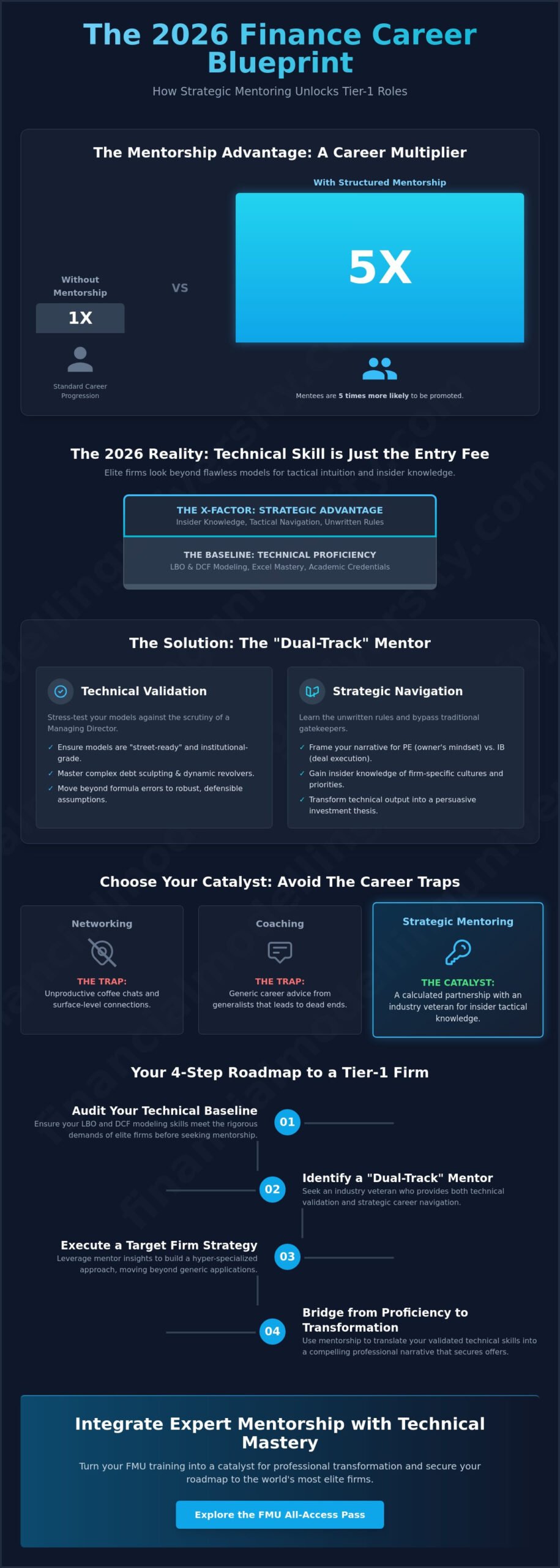
Breaking into a Tier-1 firm requires more than a polished resume; it demands a tactical execution plan. Your technical baseline is the foundation. A mentor scrutinizes your DCF, M&A, and LBO models to ensure they meet the institutional standards of firms like Morgan Stanley or Goldman Sachs. This audit identifies weaknesses before they become liabilities in a high-stakes interview. Once your technicals are verified, you must develop a “Target Firm” strategy. Career mentoring provides the insider knowledge necessary to understand which desks are expanding and which firm cultures align with your long-term trajectory.
Preparation then shifts to the “Deal Pitch.” You must move beyond describing a transaction to analyzing it like a VP or Director. This involves defending the strategic rationale, identifying synergy risks, and discussing valuation premiums with authority. Finally, a mentor guides you through post-offer navigation. This stage is critical for negotiating compensation and securing placement in a high-performing group. A mentor-led offer evaluation ensures you avoid career-stalling placements and maximize your trajectory from day one.
Top-tier banks utilize a technical gauntlet designed to break unprepared candidates. Mentors use actual past deal sheets to create realistic, high-pressure interview scenarios. You aren’t just practicing; you’re “Pressure Testing” your investment banking financial modeling skills against the industry’s toughest critics. This simulation helps you answer the “Why this firm?” question with specific, insider nuance that generic candidates lack. It shows you understand the firm’s recent deal flow and its specific position in the 2026 market.
The 2026 compensation landscape has evolved. Base salaries, bonuses, and carry structures are more complex than ever. A mentor helps you decipher these packages and understand the nuances of group-specific exit opportunities. Whether you’re looking at TMT, Healthcare, or FIG, different groups offer vastly different paths to Private Equity or corporate leadership. Evaluating these trade-offs requires an experienced eye. Before you sign any contract, consult with an industry expert to ensure your placement aligns with your ultimate career goals.
Standard online tutorials provide the “what” and “how” of financial modeling, but they often fail to deliver the “who” and “why” required for elite roles. Financial Modelling University (FMU) bridges this critical gap by integrating rigorous technical training with high-stakes career mentoring. We don’t just sell courses; we provide a blueprint for career transformation. The FMU All-Access Pass is the definitive vehicle for this evolution, combining our entire curriculum—from LBO modeling to M&A analysis—with direct, one-to-one access to industry veterans.
Our mentors are not generalist coaches; they are practitioners from the world’s most prestigious investment banks and private equity firms. They’ve sat in the seats you target and conducted the interviews you prepare for. This “University” experience ensures your development is structured, disciplined, and focused on long-term mastery rather than short-term survival. While one-off coaching sessions might help you polish a resume, FMU provides the continuous support needed to navigate the complexities of a 2026 finance career. We assume a baseline of intelligence and professional intent, focusing our efforts on elevating you to the level of an industry expert.
Direct access to our experts allows you to submit your workbooks for institutional-grade audits. Whether you’re refining an infrastructure model or a complex DCF valuation, our veterans ensure your technical output is street-ready. We integrate live Q&A sessions to address real-time career roadblocks, providing the tactical clarity required in fast-paced deal environments. This commitment to individual success is why 25,000+ finance professionals trust FMU for their financial modeling course online needs. We provide the technical validation that automated platforms simply cannot replicate.
The journey from a mid-tier analyst to an elite practitioner requires a shift in both technical execution and strategic mindset. FMU provides the framework for this transition. By joining our network, you gain more than just globally recognized certifications; you gain a lifetime affiliation with the industry’s most ambitious professionals. The unwritten rules of finance are no longer a barrier when you have an elite mentor providing the blueprint. Take command of your professional trajectory. Join the elite ranks of finance professionals at FMU and master financial modeling like the pros today.
The 2026 finance landscape is unforgiving to those without a clear tactical plan. You’ve seen how technical mastery in DCF and LBO modeling serves as your entry point, but it’s the strategic navigation that secures the offer at elite firms. Specialized career mentoring bridges the gap between being a proficient analyst and becoming an industry expert. By auditing your technical baseline and simulating the high-pressure environment of Tier-1 banks, you transform your potential into a verified, institutional-grade asset.
FMU provides the definitive ecosystem for this professional transformation. We offer globally recognized certifications and direct access to mentors from top-tier global investment banks. Trusted by 25,000+ finance professionals, our platform is designed for those who refuse to settle for mid-tier roles. Don’t leave your trajectory to chance or generic, non-technical advice. Secure Your Future with 1-on-1 Career Mentoring at FMU and start performing at the level of the industry’s best. Your path to mastery is ready. It’s time to execute.
Mentoring focuses on long-term strategic navigation while coaching targets specific technical skill gaps. In finance, a coach might help you master a complex Excel formula; a mentor helps you navigate the cultural nuances of a Tier-1 deal team. Career mentoring provides the “Architect” mindset needed to interpret deal strategic rationale, moving beyond the simple “how-to” of modeling tutorials.
Industry benchmarks for specialized finance mentorship in 2026 range from $300 to $450 per month for CFO-level guidance. Per-session rates for mid-career professionals often fall between €500 and €1,500 depending on the mentor’s seniority. These costs reflect the high ROI associated with the 25% salary grade change experienced by many mentees in structured programs according to 2026 industry research.
Career mentoring is highly effective for non-finance graduates because it prioritizes technical validation over academic credentials. Mentors help you build a “street-ready” portfolio of LBO and DCF models that prove your deal-readiness to recruiters. This tactical approach bypasses traditional gatekeepers by focusing on the specific technical hurdles of the 2026 hiring cycle rather than just your undergraduate major.
Finding a legitimate Private Equity or M&A mentor requires looking beyond generic networking platforms. Focus on specialized ecosystems like FMU where mentors are verified industry veterans from top-tier institutions. This ensures your guidance comes from someone with actual deal-sheet experience rather than a generalist career coach who lacks technical depth in complex valuation and institutional-grade modeling.
One-to-one access to industry experts is a core component of the FMU All-Access Pass. This pass integrates our entire curriculum with direct mentorship for model audits and career strategy sessions. It transforms a standard online learning experience into a comprehensive university-style path toward professional mastery, allowing you to pressure test your models with a veteran before an interview.
Most professionals see significant tactical results within three to six months of consistent engagement. While a single session can solve a specific technical roadblock, long-term career mentoring is required to master the unwritten rules of elite firms. Data indicates that mentees are five times more likely to be promoted than their unmentored peers, making a sustained relationship a strategic career investment.
Mentors provide firm-specific guidance by simulating the technical gauntlet of specific banks using past deal scenarios. They know the subtle differences in modeling expectations between firms like Goldman Sachs and Morgan Stanley. This pressure testing ensures your LBO and DCF templates are institutional-grade and that you can defend your assumptions under the scrutiny of a Managing Director.
A legitimate mentor must possess a verifiable track record of senior-level tenure at prestigious financial institutions. Verify their deal history and technical mastery in areas like debt sculpting or dynamic revolving credit facilities. Legitimate mentors focus on results-oriented outcomes, such as retention rates or promotion patterns, rather than providing vague professional advice or generic resume tips.