

What if the difference between a rejected application and a high-status associate role isn’t your degree, but the structural logic of your Excel architecture? Most aspiring analysts struggle with information overload from fragmented tutorials; they understand accounting theory but freeze when faced with a blank spreadsheet. If you want to know how to learn financial modeling effectively, you must stop memorizing shortcuts and start mastering the business architecture used by elite practitioners. It’s time to move beyond basic spreadsheets and Master Financial Modeling Like the Pros with the FMU blueprint for success.
Mastery begins with a foundation of three non-negotiable disciplines: Accounting, Finance Theory, and Excel Proficiency. We call this the “Holy Trinity.” If you want to know how to learn financial modeling, you have to accept that a spreadsheet is only as good as the logic behind it. You can’t model a transaction you don’t conceptually understand, and you can learn more about Finance Management to strengthen your underlying knowledge of financial systems. As noted by the MIT Press on Financial Modeling, technical precision requires a deep grasp of corporate finance principles before you ever touch a keyboard.
We agree that the fear of failing a technical interview is real, especially with the 2026 transition to AI-powered “Agent Mode” workflows and the new IFRS 18 reporting requirements. This article promises to deliver the exact roadmap used by industry insiders to build institutional-grade models and accelerate your career in investment banking or private equity. You’ll gain the confidence to build a model from scratch and earn a recognized certification that proves your technical mastery to Wall Street recruiters.
We’ll explore the essential technical stack, from mastering the May 2026 Excel Copilot integration to executing complex LBO and DCF valuations. You’ll learn how to connect accounting theory with rigorous Excel practice, ensuring you’re ready for the most demanding roles in the industry.
Financial modeling is the digital translation of a business’s operational reality into a predictive framework. It is the “hard skill” that separates elite analysts from generalists. While a generalist looks at a balance sheet as a historical record, a professional sees a set of dynamic variables. Understanding a comprehensive financial modeling overview is the first step in this professional transformation. It’s the difference between merely recording the past and architecting the future.
The landscape of 2026 has fundamentally shifted with the integration of AI and automation. Tools like Excel’s “Agent Mode” and the May 2026 Copilot updates now handle routine data entry and basic formula generation. This doesn’t make the modeler obsolete; it raises the stakes for structural logic. If you’re researching how to learn financial modeling today, you must focus on the design architecture that AI cannot replicate. AI can calculate, but it cannot strategize. Your value lies in your ability to build the engine that the AI merely fuels.
There is a massive gulf between “hobbyist” spreadsheets and the institutional-grade models used at firms like JP Morgan or Goldman Sachs. A hobbyist sheet is often a fragile web of hard-coded numbers and hidden errors. In contrast, an institutional model is a robust, audit-ready asset designed for scalability and transparency. It is built to be tested and stressed by senior partners, auditors, and regulators. Mastering the discipline of professional modeling ensures your work stands up to that level of scrutiny.
Models exist to quantify risk through rigorous scenario and sensitivity analysis. Whether you are evaluating a complex M&A transaction, raising capital, or navigating a strategic pivot, the model provides the mathematical clarity required to move forward. It allows you to test assumptions and visualize outcomes before a single dollar is committed. A financial model is a dynamic, living document rather than a static report.
Mastery is no longer optional for those in Investment Banking, Private Equity, or Corporate FP&A. The demand for precision has never been higher, especially with new standards like IFRS 18 requiring more detailed income statement subtotals. Even non-finance founders now require these skills to navigate venture capital rounds with sophisticated investors who demand technical transparency. When you commit to the FMU path, you learn to build the frameworks that define elite performance. If you want to know how to learn financial modeling, you must embrace the discipline of the pros to secure your place in the most prestigious rooms in finance.
Mastery begins with a foundation of three non-negotiable disciplines: Accounting, Finance Theory, and Excel Proficiency. We call this the “Holy Trinity.” If you want to know how to learn financial modeling, you have to accept that a spreadsheet is only as good as the logic behind it. You can’t model a transaction you don’t conceptually understand. As noted by the MIT Press on Financial Modeling, technical precision requires a deep grasp of corporate finance principles before you ever touch a keyboard.
Elite analysts live by the “No-Mouse” rule. Using a mouse in a technical interview is a signal of amateurism; speed is a proxy for mastery. To perform at this level, you need to internalize shortcuts until they’re muscle memory. This technical rigor is the baseline for all institutional-grade work. It’s the standard expected at top-tier firms where efficiency is just as valuable as accuracy.
You must understand how the three financial statements interlock. The Income Statement, Balance Sheet, and Cash Flow Statement aren’t isolated reports; they’re a single, integrated system. For instance, Net Income flows into Retained Earnings on the Balance Sheet and serves as the starting point for the Cash Flow Statement. A common pitfall that breaks models is the incorrect treatment of non-cash items like Depreciation and Amortization (D&A). If you don’t correctly link D&A back to the Balance Sheet through accumulated depreciation, your model won’t balance. It’s that simple.
Professional modeling requires a specific subset of Excel tools. You’ll need to master INDEX/MATCH and XLOOKUP for data retrieval, and OFFSET or CHOOSE for creating dynamic scenario toggles. Understanding these functions is a core part of how to learn financial modeling at an elite level. Formatting is equally critical. We use Blue for hard-coded inputs and Black for formulas. This standard allows any third party to audit your work instantly.
For those ready to accelerate, our Excel for Finance course provides the deep-dive technical training required for Wall Street. Once you’ve mastered the basics, you can explore VBA for financial modeling to automate repetitive tasks and build more robust LBO frameworks. If you’re serious about your career, consider the FMU All-Access Pass to master every stage of the roadmap and gain the competitive edge needed for the 2026 hiring cycle.
Success in high-stakes finance isn’t about random tutorial surfing. It’s about a disciplined, sequential progression through the technical layers of business architecture. If you’re serious about how to learn financial modeling, you must follow a structured path that builds complexity on top of a rock-solid foundation. We advocate for the “Build-from-Blank” method. Never rely on pre-filled templates during your training; if you didn’t build the cell references yourself, you don’t own the logic. This is the FMU standard for professional mastery.
The roadmap is divided into four critical stages. You start with the core engine, move into intrinsic valuation, master transaction mechanics, and finally specialize in sector-specific nuances. Each stage requires total technical immersion before you move to the next. This prevents the “Swiss cheese” knowledge gaps that often lead to failure during technical interviews at elite firms.
Your journey begins with the 3-statement model. This is the foundation of all valuation work. You’ll learn to forecast revenue and expenses by identifying historical drivers; you don’t just guess numbers, you build them from operational reality. Once the statements interlock perfectly, you transition into an intrinsic value masterclass. Our DCF Valuation Course teaches you the art of calculating WACC and selecting the correct Terminal Value multiple. Free Cash Flow (FCF) is the lifeblood of valuation. Mastering how to learn financial modeling at this stage means understanding exactly how every line item on the balance sheet eventually impacts the cash available to investors.
Stage 3 introduces the complexity of M&A and LBO modeling. You’ll move beyond simple forecasting into the world of Sources and Uses, Debt Waterfalls, and IRR calculations. This is where you learn to model the impact of capital structure on investment returns. For investment banking roles, you must master M&A accretion/dilution analysis to determine if a deal creates value for shareholders. Finally, Stage 4 focuses on industry nuances. For example, Real Estate Financial Modeling requires a completely different structural approach, focusing on joint venture waterfalls and lease-up schedules rather than standard corporate accounting. By following this roadmap, you ensure you’re ready for any institutional-grade challenge the 2026 market throws your way.
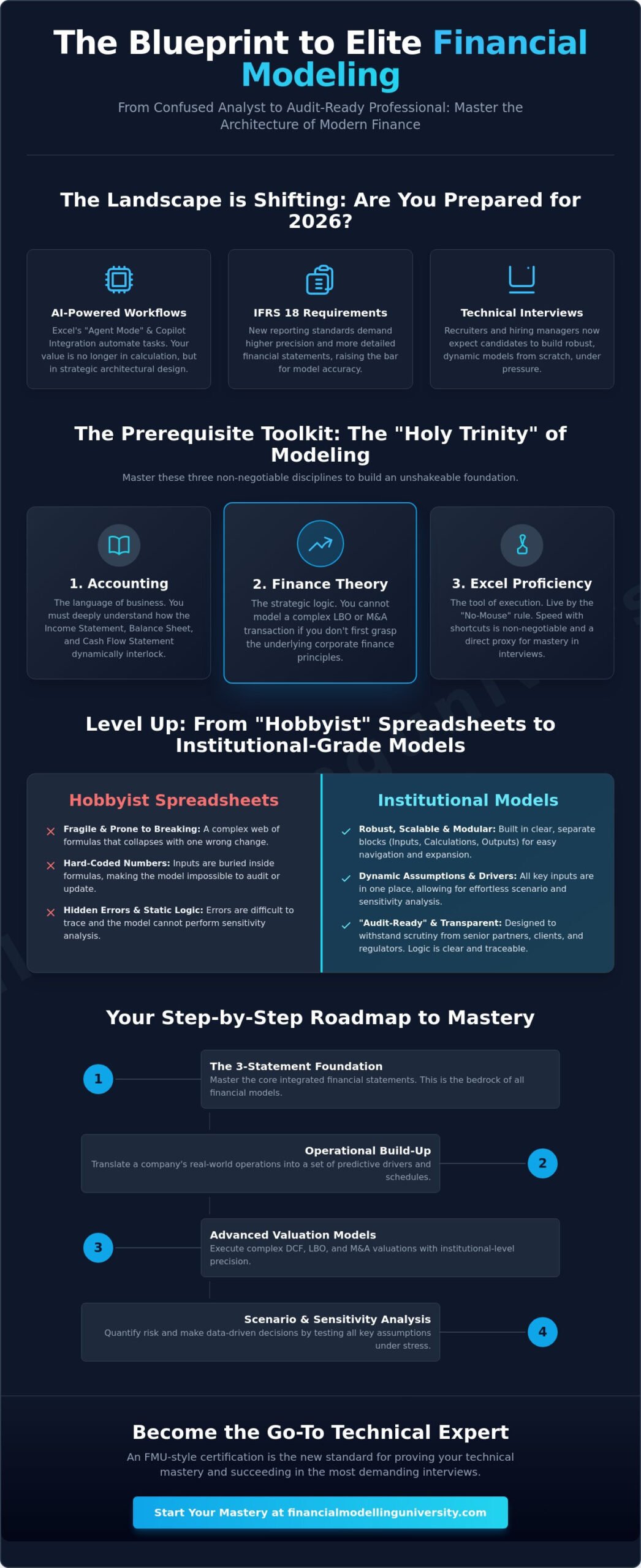
Professional modeling is not about complex math; it is about architectural clarity. You must adopt the “Audit-Ready” principle. This means a third party should be able to open your file and understand the entire logic flow without a single word of explanation from you. If your senior associate has to ask where an input comes from, the model is broken. This is a critical milestone in how to learn financial modeling at an elite level. You’re no longer just a spreadsheet user; you’re a financial architect building a high-stakes decision tool.
Modularity and scalability are the hallmarks of institutional design. Your model should handle a change from a 5-year forecast to a 10-year forecast without rebuilding the engine. Avoid the “Seven Deadly Sins” that plague amateur work and kill careers. Hardcoding values into formulas is the most frequent offense. Other sins include circular references without toggles, inconsistent sign conventions, and linking to external files that break when shared. At FMU, we enforce a standard of integrity that mirrors the expectations of top-tier investment banks.
Every professional model requires a dedicated “Checks” tab. This tab aggregates all internal integrity tests, ensuring the Balance Sheet always balances to zero across every period. Use IFERROR and data validation to prevent model “blow-ups” from unexpected inputs. However, simplicity is your greatest asset. The BASE principle (Beginning, Addition, Subtraction, Ending) ensures your roll-forward schedules remain transparent. When researching how to learn financial modeling, prioritize these integrity checks over fancy but fragile formulas. A model that balances is a model that builds trust.
Summary dashboards are essential for communicating with the C-Suite. These tabs should tell a high-level story, highlighting key IRR, Multiple of Money (MoM), or cash-on-cash return metrics. Use “Self-Documenting” labels to reduce friction for senior reviewers. As you transition from Investment Banking Financial Modeling to client-facing presentations, the visual polish of your work becomes a proxy for your professional competence. Clean formatting isn’t just about aesthetics; it’s about reducing the cognitive load on the decision-maker.
To master these institutional standards and ensure your work meets Wall Street expectations, enroll in the FMU All-Access Pass today and gain the blueprint for professional excellence.
Self-study often leads to fragmented knowledge and technical gaps. While free tutorials are abundant, they rarely provide the cohesive logic required for institutional-grade work. Choosing a structured, university-style platform is the most efficient strategy for anyone determining how to learn financial modeling for the high-stakes 2026 market. A globally recognized financial modeling certification now acts as a critical technical filter. It proves to recruiters that you can handle complex business architecture before you even step into the interview room.
The financial landscape moves at a relentless pace. With the implementation of IFRS 18 and the rise of AI-driven Excel “Agent Mode” workflows, static courses quickly become obsolete. The FMU All-Access Pass solves this by providing lifetime access to a curriculum that evolves alongside industry regulations. Our live Q&A sessions connect you with experts who have already achieved success in the rooms you’re trying to enter. Many top-tier firms now utilize our corporate training modules to standardize analyst skills, ensuring their teams maintain a consistent, professional standard of technical excellence.
Commit to a disciplined schedule to transform your career trajectory. Your first month should follow this rigorous technical progression:
The path to professional mastery is structured, logical, and highly disciplined. Don’t leave your career progression to chance. Join 25,000+ finance professionals and enroll in Financial Modelling University today to secure your future in elite finance.
The journey from a spreadsheet user to a financial architect requires more than technical knowledge. It demands a shift in mindset toward institutional standards and structural integrity. By mastering the foundational disciplines of accounting, finance, and Excel, you move beyond the limitations of fragmented tutorials. You have the roadmap; now you must execute the discipline required to build audit-ready models that withstand the scrutiny of senior partners and global regulators. Determining how to learn financial modeling effectively is the single most important investment you’ll make in your career trajectory.
Don’t leave your advancement to chance in a competitive 2026 market. Financial Modelling University provides the blueprint used by the industry’s elite. Our curriculum is trusted by 25,000+ finance professionals and includes institutional-grade templates to ensure your work meets Wall Street expectations. You’ll also benefit from one-to-one career mentoring from industry experts who have already mastered the high-stakes world of investment banking and private equity.
Master Financial Modeling Like the Pros—Explore FMU Courses
Your future in finance starts with the first cell of your next model. Commit to excellence and begin your transformation today.
Expect to invest between 100 and 150 hours of deliberate practice to reach a professional level of proficiency. This timeline assumes you are moving through a structured roadmap that covers everything from 3-statement mechanics to complex LBO and DCF valuation. Mastery isn’t just about understanding the formulas; it’s about developing the muscle memory required to build institutional-grade models under tight deadlines.
You don’t need advanced calculus or higher-level mathematics to succeed in this field. Financial modeling is built on a foundation of basic arithmetic, logical sequencing, and a deep understanding of accounting principles. The real challenge isn’t the math itself, but the ability to architect a complex business reality into a transparent, predictive digital framework.
YouTube offers fragmented tutorials, but it’s a highly inefficient way to gain professional mastery. Most free content lacks the “Audit-Ready” standards and structural logic required by elite firms. If you’re serious about how to learn financial modeling, you need a disciplined curriculum that provides the institutional templates and expert feedback necessary to pass a technical interview at a top-tier bank.
The best certification is one that prioritizes practical, hands-on application over academic theory. FMU certifications are recognized as the industry standard because they’re trusted by 25,000+ finance professionals and mirror the exact workflows used in private equity and investment banking. A globally recognized certification acts as a critical filter, proving to recruiters that you possess the job-ready skills they demand.
Excel remains the undisputed king of the deal-making world. While Python is excellent for data science and quantitative analysis, Excel is the language of financial architecture and client-facing presentations. The May 2026 Microsoft updates, including the new “Agent Mode” and Copilot integration, have only solidified Excel’s position as the primary tool for professional analysts.
Practice building a full 3-statement model and a DCF analysis from a blank spreadsheet in under 60 minutes. You must master the “No-Mouse” rule to demonstrate the speed and technical confidence expected in high-stakes environments. Be ready to defend every assumption in your model, as senior associates will audit your logic to test your grasp of finance theory.
Hardcoding inputs directly into formulas is the most frequent mistake, as it makes the model impossible to audit. Beginners also tend to ignore sign conventions and fail to include a “Checks” tab to ensure the balance sheet balances. These errors signal a lack of professional discipline and are often enough to end a candidate’s chances during the technical screening process.
A certification is a powerful differentiator that proves you have the technical mastery to contribute on day one. It can help you bypass the initial technical screen and build credibility with recruiters. However, you must pair your technical skills with aggressive networking and a polished LinkedIn portfolio to secure a role at an elite firm.