

Memorizing a 400-question guide won’t get you into Goldman Sachs or JP Morgan in 2026. Elite firms have moved beyond rote rehearsal, now demanding a level of mechanical intuition that generic guides simply can’t provide. You’ve likely spent hours scrolling through fragmented forums, feeling the weight of information overload while your investment banking technical interview prep remains stuck in the basics. It’s frustrating to master an Excel formula but struggle to explain the underlying valuation logic when the pressure is on in a high-stakes superday.
At FMU, we’ve helped over 25,000 finance professionals master the art of the technical round by focusing on institutional-grade modeling logic. This master guide provides the blueprint to bridge the gap between Excel mechanics and boardroom-level communication. We’ll break down the advanced LBO frameworks, complex M&A accounting, and the precise verbal delivery required to secure an offer at a top-bracket firm. Master financial modeling like the pros and replace anxiety with the disciplined confidence of an industry expert.
The technical interview has evolved into a high-stakes filtration system. It’s no longer enough to recite definitions from a PDF. In 2026, bulge bracket firms like Goldman Sachs and JP Morgan are prioritizing candidates who demonstrate “modeling intuition” from the very first interaction. This means your investment banking technical interview prep must move beyond rote memorization. You need to visualize the three financial statements as a living, breathing system. Interviewers want to see if you can build and interpret institutional-grade models in your head before you ever touch a keyboard.
We are seeing a definitive shift from basic accounting questions toward complex, multi-layered valuation scenarios. Interviewers aren’t just asking how a 10 dollar increase in depreciation affects the statements; they’re asking how that change ripples through Core Valuation Frameworks like a DCF or an LBO model. This requires a “Strategic Architect” mindset. You aren’t just an Excel user; you are a professional who understands the structural integrity of a deal. You must demonstrate the ability to manipulate variables and predict outcomes with the precision of a seasoned analyst.
The recruitment timeline has compressed significantly. Banks now deploy technical-heavy HireVue and Pymetrics assessments as the primary gatekeepers. These digital assessments test your ability to process information and build mental models under extreme time pressure. Don’t expect a slow build-up. In the current cycle, “fit” questions are increasingly embedded within technical scenarios. An interviewer might ask how you’d advise a client on a specific M&A deal, testing your technical logic and your professional judgment simultaneously. This integrated approach ensures only the most prepared candidates reach the final superday.
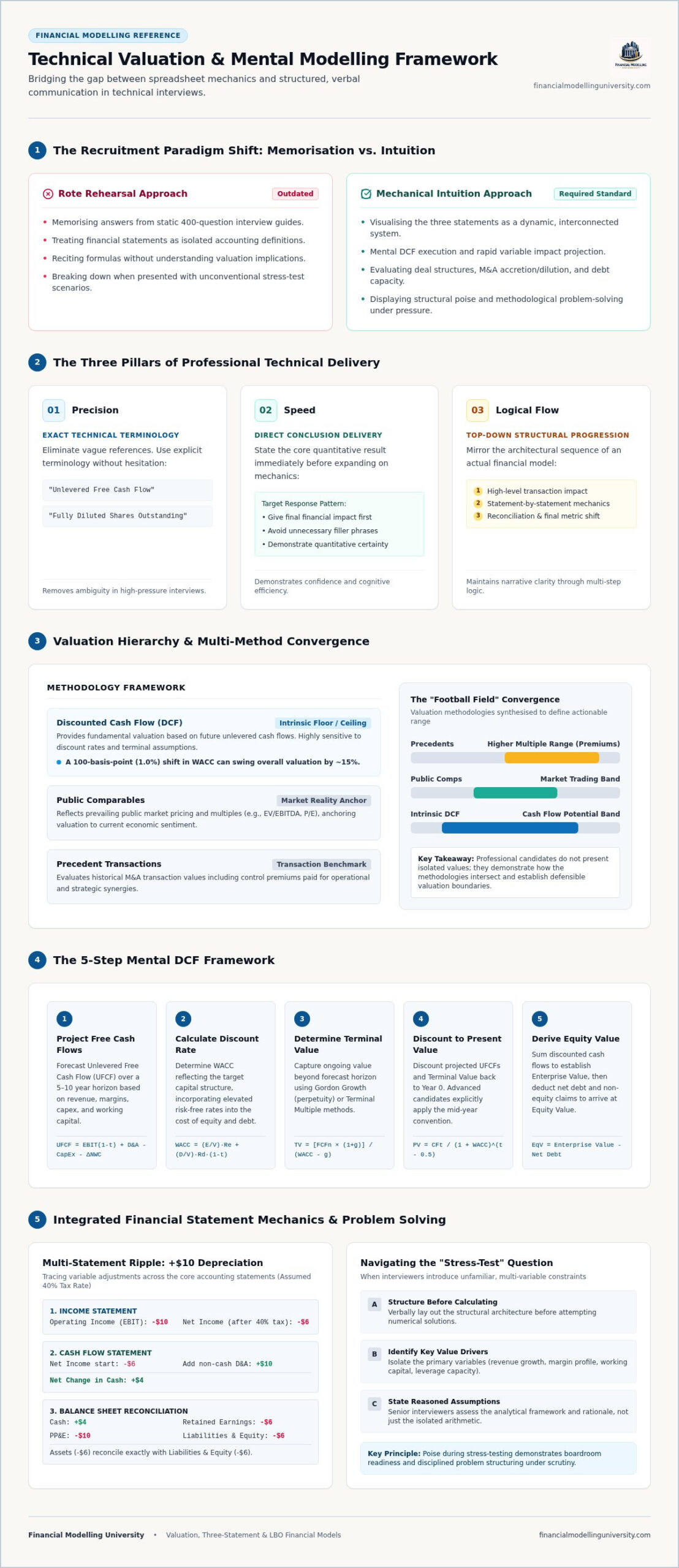
What separates a “good” candidate from an “institutional-grade” analyst is the flow of the response. A professional answer isn’t a list of facts. It’s a structured narrative that mirrors the logical progression of a financial model. To perform at this level, focus on three pillars:
If you encounter an “unanswerable” stress-test question, maintain your poise. The interviewer is testing your process, not just your final number. Show them how you’d structure the problem, identify the key variables, and reach a reasoned assumption. This disciplined approach is the hallmark of a true industry expert.
To excel in investment banking technical interview prep, you must treat valuation as more than a math exercise. It’s a strategic narrative backed by quantitative rigor. In the current 2026 environment, where interest rates remain a primary driver of deal activity, simply listing the three methodologies is insufficient. You need to understand the hierarchy of valuation. While a DCF provides an intrinsic “floor” or “ceiling” based on cash flows, Public Comps and Precedent Transactions anchor that value in market reality. Showing how these methods converge in a “football field” chart demonstrates the professional judgment banks demand.
High-interest environments have fundamentally changed how analysts approach WACC and Terminal Value. Interviewers now look for candidates who can discuss the impact of elevated risk-free rates on equity risk premiums and debt costs. If you can’t explain why a 100-basis-point shift in WACC might swing a valuation by 15 percent, you haven’t mastered the logic. Bridging this gap between academic theory and actual Investment Banking Financial Modeling is what separates elite candidates from the rest of the applicant pool.
Walking through a DCF verbally is the ultimate test of your mechanical intuition. Follow this 5-step master framework: project free cash flows, calculate a discount rate, determine the terminal value, discount everything to the present, and subtract net debt to find equity value. To truly impress, mention advanced nuances like the mid-year convention, which assumes cash flows are received evenly throughout the year rather than at year-end. Understanding stub periods is equally vital for mid-year deal dates. Success in Mastering the Technical Interview requires identifying which drivers, such as revenue growth or EBITDA margins, create the most sensitivity in your final output.
Selecting a peer group requires a sophisticated lens. Don’t just look at industry and size; analyze capital structure, growth profiles, and geographic exposure. In your technical answers, always clarify why Precedent Transactions typically yield higher values than Public Comps. The “control premium” paid by acquirers to gain 100 percent ownership is a non-negotiable concept in these discussions. When citing multiples, explain how you would normalize EBITDA by stripping out non-recurring items, restructuring costs, or stock-based compensation to ensure a “clean” comparison.
If you want to move beyond basic definitions and start thinking like a senior associate, consider refining your skills with a specialized DCF Valuation Course to master these complex mechanics.
While valuation provides the foundation, deal mechanics reveal your true potential as an analyst. In the 2026 recruitment cycle, M&A accretion/dilution and LBO analysis have become the primary filters for elite candidate selection. You aren’t just expected to know the formulas; you must demonstrate a mechanical intuition for how capital structure shifts impact shareholder value. This level of investment banking technical interview prep requires you to visualize the flow of funds across the balance sheet without the crutch of a spreadsheet. You must be able to explain why a deal is accretive or dilutive within seconds of receiving the deal terms.
Mastering the sources and uses table is a non-negotiable skill for high-stakes rounds. You should be able to construct this table mentally, balancing the purchase price and transaction fees against new debt, equity rolled over, and excess cash. This logic is the gateway to understanding the Institutional-Grade LBO, where the interplay between debt paydown and exit multiples determines the success of the investment. If you can’t walk through a sources and uses table with precision, you won’t survive the technical scrutiny of a bulge bracket superday.
The “breakeven” PE ratio is a frequent stress-test in modern interviews. You must understand that in an all-stock deal, the transaction is accretive if the acquirer’s PE is higher than the target’s PE. However, once cash and debt enter the mix, the math shifts to a comparison between the target’s earnings yield and the after-tax cost of debt or lost interest on cash. Hard synergies, such as cost savings from headcount reduction, are often viewed with more credibility than soft revenue synergies. When modeling these in your verbal responses, always apply a probability-of-success haircut to demonstrate professional conservatism.
The paper LBO is the ultimate test of your ability to think like a principal. You must master the five key drivers of returns: entry multiple, exit multiple, debt paydown, operational improvements (EBITDA growth), and time. Interviewers often ask you to estimate the Internal Rate of Return (IRR) or Multiple of Money (MoM) for a standard five-year hold. Use industry rules of thumb to stay fast: doubling your money in five years is approximately a 15 percent IRR, while tripling it is roughly 25 percent. While competitors suggest LBO logic is only for private equity, 2026 trends show these questions are now standard for investment banking candidates aiming for top-tier groups. For those seeking total mastery, our LBO Modeling Course provides the deep-dive training needed to handle these scenarios with absolute confidence.
Many candidates treat investment banking technical interview prep as a memory test, reciting answers from stale guides. This strategy collapses the moment an interviewer tweaks a single assumption. To perform at the elite level, you must adopt the “Visual Modeling” technique. This approach requires you to see the Excel cells shifting as you speak. By mastering Excel for Finance, you build the mental shortcuts necessary to process complex calculations without a screen. You aren’t just giving an answer; you’re describing a live model in real time.
Professional delivery relies on the “State, Explain, Contextualize” framework. First, state the direct impact of the variable change. Second, explain the accounting or financial mechanics behind that change. Third, contextualize the result within the broader deal environment. This structured delivery signals to the interviewer that you possess the disciplined mindset of an industry expert. It moves the conversation from a quiz to a high-level peer discussion.
The “Flow Through” method is your primary tool for statement-linkage questions. Consider a $10 increase in depreciation. You must walk the interviewer from the Income Statement (lower EBT, lower Net Income) through the Cash Flow Statement (adding back non-cash depreciation) and finally to the Balance Sheet. Precision is non-negotiable. A common trap involves working capital; remember that an increase in Accounts Receivable is a use of cash because it represents revenue earned but not yet collected. Maintaining the integrity of the balance sheet in a verbal explanation proves you understand the structural core of corporate finance.
Senior bankers value brevity and clarity. Eliminate filler words to project the authority of a senior analyst. When faced with “drill-down” questions about your WACC or growth assumptions, defend your logic with data-driven reasoning rather than backtracking. If you are interviewing for specialized groups, integrate sector-specific knowledge. For instance, referencing Real Estate Financial Modeling when discussing Cap Rates or Net Operating Income shows a depth of expertise that generic candidates lack.
Ready to transform your interview performance from scripted to sophisticated? Enroll in our Investment Banking Financial Modeling Course to master the logic behind the numbers and secure your offer.
Success in the final round requires more than a casual understanding of finance. It demands a level of mechanical precision that only comes from rigorous, application-based training. The FMU All-Access Pass provides the comprehensive architecture for this transformation. By moving through our curriculum, you don’t just survive the technical round; you dominate it. Our approach to investment banking technical interview prep ensures you’re ready to handle the most complex scenarios with the poise of a veteran analyst.
Globally recognized FMU certificates serve as a quantitative hallmark of your skills. They signal to recruiters at bulge bracket firms that you’ve been trained by industry experts using proven methods. This credibility is vital in the 2026 cycle, where competition for junior roles is at an all-time high. Beyond the offer, our training prepares you for Day 1 on the desk. You won’t be the analyst struggling with Excel shortcuts; you’ll be the one building institutional-grade models while others are still catching up.
Our DCF and LBO modules are the gold standard for high-stakes preparation. These aren’t generic tutorials. They are deep dives into the same frameworks used by elite practitioners. You’ll learn from industry experts who have navigated the very interviews you’re facing. Accessing downloadable Excel templates allows you to practice real-world scenarios until the logic becomes second nature. This hands-on experience is what separates FMU from generic interview platforms that lack deep, multi-sector modeling depth.
The week before your Superday, focus on this final checklist:
Mastering financial modeling early offers a long-term ROI that extends far beyond your first bonus. It establishes the foundation for a career in private equity, corporate development, or hedge funds. The 2026 recruitment cycle is demanding, but with the right blueprint, you can replace anxiety with total confidence. Join over 25,000 finance professionals who have used our curriculum to break into the world’s most prestigious banks. Don’t leave your career to chance. Choose the path of professional mastery and Master Financial Modeling Like the Pros.
The 2026 hiring cycle demands a shift from rote rehearsal to disciplined, mental modeling logic. To succeed, you must demonstrate the ability to bridge complex Excel mechanics with high-level verbal clarity during every technical round. Your investment banking technical interview prep is more than just preparation; it’s the foundation of your professional reputation. By internalizing institutional-grade frameworks for LBO and M&A modeling, you position yourself as a day-one asset rather than a trainee.
FMU provides the blueprint for this career transformation. Trusted by 25,000+ finance professionals, our university experience includes institutional-grade Excel templates and globally recognized certificates that command respect from bulge bracket recruiters. Don’t leave your superday performance to chance when you can train with the same rigor required on the job.
Master Investment Banking Like a Pro with FMU and step into your interview with the total confidence of an industry expert. Your ambition has brought you this far. Now, let’s secure the offer you’ve worked for.
The most common questions center on the three primary valuation methodologies, M&A accretion/dilution, and LBO return drivers. In 2026, interviewers prioritize your ability to discuss interest rate sensitivity and its impact on WACC and debt serviceability. You’ll likely face multi-step accounting questions that require you to track a single transaction through all three financial statements. Mastering these core concepts is the baseline for any elite candidate.
You can absolutely pass an interview without a finance degree. Elite banks look for logical reasoning and technical discipline regardless of your major. Many successful analysts come from liberal arts or engineering backgrounds. The key is proving you can perform at the level of a finance professional. Specialized courses bridge the knowledge gap, providing the technical vocabulary and modeling skills needed to compete with finance majors.
A paper LBO is a mental exercise where you calculate the IRR or MoM of a transaction without a computer. Interviewers use it to see if you understand the fundamental drivers of private equity returns. You must quickly process entry and exit multiples, debt paydown, and EBITDA growth. It proves you have the “principal mindset” required to evaluate deals like a seasoned industry professional.
Start with Net Income at the top of the Cash Flow Statement. Adjust for non-cash items and working capital to arrive at the change in cash. This figure flows into the Cash asset on the Balance Sheet. Finally, show how Net Income links to Retained Earnings within Shareholders’ Equity. This “Flow Through” method demonstrates that you understand the structural integrity of a company’s financial health.
Certification is a powerful tool for building candidate credibility. It provides a quantitative hallmark of your skills that is trusted by 25,000+ finance professionals globally. Having a certificate from a recognized university experience proves you’ve mastered institutional-grade Excel templates and logic. It separates your resume from the thousands of applicants who only rely on generic, free guides found on fragmented forums.
AI has shifted the technical screening process to the very beginning of the recruitment cycle. Banks use AI-driven HireVue and Pymetrics assessments to filter for technical logic and cognitive traits before you ever meet a human. This means your preparation must be sharper and more immediate. The focus has moved from simple data entry to your ability to explain the “why” behind complex financial outcomes.
Don’t guess or invent a number. Instead, be transparent and walk the interviewer through the logic you would use to find the answer. State your assumptions clearly and identify the key variables involved. This approach shows you have the disciplined, results-driven mindset of an analyst. Poise under pressure is often more important to an interviewer than getting every decimal point correct on a first pass.