


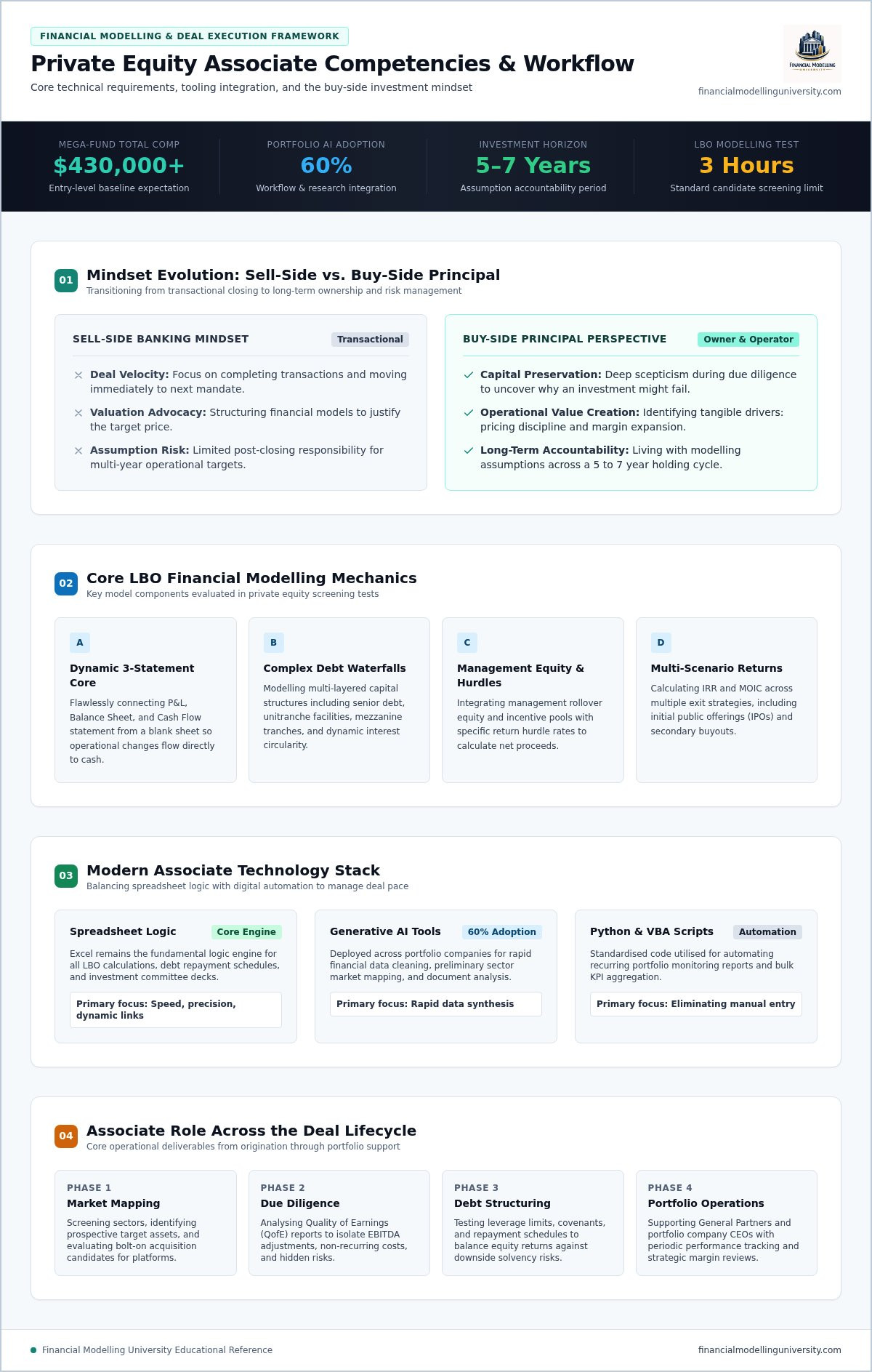
With total compensation packages at mega-funds now reaching over $430,000, the performance floor for entry-level talent has shifted. Technical proficiency is no longer a differentiator; it’s the baseline. To secure a seat at an elite firm, your private equity associate skills must extend beyond basic Excel formulas into the realm of institutional-grade LBO modeling and operational value creation.
You’ve likely felt the pressure of the 2026 recruiting cycle, where AI integration is a 60% adoption reality across portfolio companies. It’s natural to feel anxious about transitioning from sell-side modeling to the rigorous demands of a buy-side investment committee. This guide ensures you master the exact competencies required to pass the most grueling modeling tests and develop true deal intuition. We’ll explore the impact of the 2026 INVEST Act, the mechanics of complex debt structures, and the digital fluency needed to drive margin expansion in a high-stakes environment. At FMU, we provide the blueprint to help you master financial modeling like the pros and command the respect of industry veterans.
The private equity associate is the engine room of the deal lifecycle. You’re responsible for the heavy lifting of financial modeling, due diligence, and portfolio monitoring. In the current private equity industry, your success depends on a radical shift in perspective. Unlike investment banking, where the goal is to close a deal and move on, private equity requires you to live with the consequences of your assumptions for five to seven years. Technical mastery is no longer a differentiator. It’s the bare minimum required to enter the room.
By 2026, the demand for specific private equity associate skills has evolved. Firms are moving away from pure financial engineering toward operational value creation. This means you need to understand how pricing discipline and margin expansion actually work on the ground. With total compensation packages for top-tier associates at mega-funds reaching over $430,000, firms expect you to be an expert from day one. You aren’t just a spreadsheet jockey; you’re a strategic partner in the investment process.
The modern associate’s toolkit has expanded significantly. While Excel for finance remains the core logic engine for every LBO, it’s no longer the only tool. Generative AI adoption has reached 60% across portfolio companies. You’ll use AI tools for rapid data cleaning and automated market research to stay competitive. Python and VBA are now standard for automating recurring portfolio reports. This allows you to focus on high-level analysis rather than manual data entry. If you can’t automate the mundane, you’ll struggle to keep up with the pace of 2026 deal flow.
Transitioning from the sell-side requires a psychological overhaul. You must trade your “deal-maker” hat for a “principal” perspective. This involves deep skepticism during financial due diligence. When reviewing a Quality of Earnings report, your job isn’t to justify the valuation. It’s to find the reasons why the investment might fail. You’re no longer just getting the deal done. You’re protecting capital. Mastery of private equity associate skills in 2026 means balancing aggressive growth targets with a disciplined approach to risk vs. return. You must think like an owner, because the performance of the fund depends on your ability to spot operational risks before they become liabilities.
Technical excellence isn’t an aspiration; it’s the expected standard for any professional entering the buy-side. While 2026 has introduced AI-driven data cleaning, the core of private equity associate skills remains the ability to construct a flawless, dynamic three-statement model from a blank sheet. You must link the P&L, Balance Sheet, and Cash Flow Statement with absolute precision, ensuring that every operational assumption flows through to the bottom line. This technical foundation allows you to defend your investment thesis when the pressure is highest.
Advanced private equity financial modeling now requires handling multi-layered capital structures that go far beyond simple senior debt. You’ll need to model mezzanine tranches, unitranche facilities, and complex management equity rolls with specific hurdle rates. These aren’t just academic exercises. They’re the real-world mechanics used to calculate returns in a high-interest environment. Integrating these elements into a cohesive model is what separates a banking analyst from a professional dealmaker.
An institutional-grade LBO model must be robust enough to survive rigorous stress testing. You must master circularity and debt scheduling to ensure interest expenses update dynamically as debt is paid down. Calculating IRR and MOIC across multiple exit scenarios, from IPOs to secondary buyouts, is essential for evaluating deal viability. The LBO modeling test remains the primary filter for top-tier PE firms. If you can’t build a functional model under a three-hour time limit, you won’t make it past the first round. For those looking to refine these specific technical workflows, the DCF valuation course principles provide the necessary framework for defending conservative exit multiples.
Buy-side valuation requires a level of conservatism rarely seen on the sell-side. When applying CFA Institute Private Equity Certificate standards, your DCF terminal value assumptions must reflect long-term reality rather than optimistic projections. Sensitivity analysis is your most powerful tool here. You must identify the “value drivers,” such as EBITDA margin expansion or working capital efficiency, that actually move the needle on returns. Understanding accretion and dilution in an M&A context is also vital when evaluating bolt-on acquisitions for portfolio companies. To truly master these workflows, consider the FMU All-Access Pass as your definitive technical toolkit.
Mastering the technical engine room is only half the battle. To excel, you must develop the commercial intuition to understand why a deal makes sense beyond the spreadsheet. Developing these private equity associate skills requires shifting from data entry to data interpretation. You’re responsible for identifying the “red flags” buried in Quality of Earnings (QofE) reports. Look for aggressive revenue recognition or one-time add-backs that are actually recurring operational costs. Your ability to challenge management’s assumptions during due diligence protects the fund’s capital and builds your credibility with senior partners.
Market mapping is another critical workflow where associates drive value. You aren’t just tracking competitors; you’re identifying potential bolt-on acquisition targets to execute a “buy-and-build” strategy. This requires a deep understanding of the competitive landscape and the ability to spot fragmented industries ripe for consolidation. Once a deal is closed, your role shifts to portfolio monitoring. You’ll work closely with management teams to track key performance indicators (KPIs) and ensure the value creation plan stays on schedule. If a portfolio company misses its margin targets, you must be the first to identify the root cause and propose a corrective path.
The Investment Memorandum is where your analysis becomes a narrative. You must synthesize thousands of data points into a concise, executive-level summary that addresses Investment Committee (IC) concerns before they’re even voiced. Don’t just list risks. Structure the risk section to show deep commercial awareness by providing specific mitigants for every potential downside. A professional memorandum doesn’t just present a deal; it defends an investment thesis with cold, hard logic. At FMU, we teach you to frame these arguments with the precision of an industry veteran.
Generalist roles are becoming rarer as firms demand deep domain knowledge. Specialized private equity associate skills in high-growth niches are exceptionally valuable. For instance, mastering real estate financial modeling allows you to pivot into institutional property investment, where metrics like cap rates and NOI dominate the conversation. Similarly, if you’re targeting tech-focused funds, you must be fluent in SaaS-specific metrics like churn rates and customer acquisition cost (CAC) ratios. Use this specialized knowledge to spot mispriced assets that generalist analysts might overlook. Whether it’s retail same-store sales or project finance debt-service coverage ratios, your sector expertise is your competitive edge.
Project management is another pillar of the associate’s role. You act as the air traffic controller during a deal close, coordinating a small army of lawyers, accountants, and environmental consultants. Mismanaging a single workstream can delay a closing or lead to a breach of contract. You must track every deliverable with granular detail, ensuring that the flow of information between parties is seamless. This level of coordination requires a disciplined approach to communication; you’re responsible for keeping the deal on track while senior partners focus on high-level negotiations.
The 2026 “on-cycle” recruiting timeline has become increasingly volatile, with the cycle starting later than in previous years. This unpredictability makes your relationship with headhunters more critical than ever. You must build long-term rapport with top-tier search firms long before the cycle kicks off. Prepare a punchy “deal sheet” that highlights your specific transaction experience, focusing on your contribution to the modeling and diligence process. Partners aren’t just looking for a spreadsheet expert; they’re looking for a “culture fit” who can represent the firm in front of management teams. Acing the interview means demonstrating that you can handle the lifestyle and the stakes of the buy-side.
Success within the firm depends on your ability to manage “up” to VPs and Principals. You must be the person who never makes a mistake in the model. In a small team, a single broken link or an incorrect debt formula can destroy your credibility instantly. Reliability is your primary currency. You must also learn to balance intense deal execution with ongoing portfolio management. This requires ruthless prioritization and the ability to switch contexts quickly. To ensure you have the technical confidence to back up your soft skills, you should master the institutional-grade workflows used by the pros.
Ultimately, the transition to associate is a move from being a “processor” to being a “professional.” You’re no longer just completing tasks; you’re managing outcomes. Developing these private equity associate skills allows you to move beyond the junior ranks and position yourself for a long-term career in the industry. Whether you’re coordinating a multi-billion dollar debt facility or explaining a margin miss to a GP, your professional poise is what will set you apart from the competition.
Transitioning from a banking analyst role to an elite private equity firm requires a complete recalibration of your technical and commercial toolkit. The FMU curriculum is engineered to facilitate this transformation by providing a structured, logical path to professional mastery. By earning a financial modeling certification, you signal to recruiters that your skills meet institutional-grade standards. This isn’t about theoretical knowledge; it’s about bridging the gap between academic finance and the high-stakes execution required in a 2026 deal room.
The FMU All-Access Pass serves as the definitive toolkit for your entire career. It offers lifetime access to our LBO, M&A, and sector-specific modeling courses, ensuring your private equity associate skills remain sharp as market conditions evolve. You’ll move beyond the basics of Excel to master the language of professional investment, positioning yourself as a top-tier candidate in any recruiting cycle. This comprehensive access allows you to pivot between sectors or deal types with the confidence of an industry veteran who has seen every iteration of the deal lifecycle.
Passing the modeling test is the ultimate gatekeeper in PE recruiting. Our intensive modules provide step-by-step guidance through the complex capital structures discussed earlier, including mezzanine debt and management equity rolls. You’ll gain access to the same downloadable Excel templates used by elite buy-side professionals at mega-funds. To ensure you’re ready for the pressure of the 2026 recruiting cycle, we provide timed simulations that mirror the actual tests administered by the industry. This disciplined approach ensures you can build a three-statement model under extreme time constraints without a single broken link.
FMU is more than a series of online tutorials. It’s a university experience trusted by over 25,000 finance professionals globally. You’ll leverage one-to-one career mentoring from industry experts who have already achieved success at elite firms. This mentorship helps you refine your PE interview strategy and develop the professional poise needed to manage GPs and portfolio CEOs effectively. When you join our community, you’re following a proven blueprint for career advancement. Don’t leave your professional transformation to chance when you can learn from those who have already mastered the game.
Master Financial Modeling Like the Pros with FMU University and secure your place among the next generation of industry leaders.
The landscape of the buy-side in 2026 demands a candidate who is both a technical architect and a commercial strategist. You’ve seen that mastering institutional-grade LBO models and developing deep investment intuition are non-negotiable requirements for elite firms. Success isn’t just about passing the modeling test; it’s about proving you can drive operational value in a high-stakes, AI-integrated environment. By refining your private equity associate skills, you position yourself as a high-status professional ready to lead complex deal lifecycles.
FMU provides the blueprint for this career transformation. Join a global community of 25,000+ finance professionals who have already secured their edge. With our globally recognized certification and elite LBO and M&A modeling templates, you’ll have the tools to perform at the level of industry veterans. It’s time to move beyond the spreadsheet and start thinking like a principal.
Master Private Equity Skills with the FMU All-Access Pass and transform your professional trajectory today. Your path to the top of the buy-side starts with a single, disciplined decision.
Institutional-grade financial modeling is the most critical technical skill, but it must be paired with investment intuition. You need the ability to look past the numbers to understand the operational levers that drive value. This combination of private equity associate skills ensures you can defend a thesis before an aggressive Investment Committee. Mastery of the LBO is the baseline; understanding the “why” behind the deal is what leads to promotion.
Investment banking models are marketing documents designed to maximize valuation for a sale. Private equity modeling is principal-side analysis focused on downside protection and return generation. You must prioritize debt paydown, cash flow conversion, and sensitivity analysis. Buy-side models are significantly more granular regarding capital structures, management equity rolls, and operational margin expansion than typical sell-side templates.
Digital fluency is mandatory in 2026 as generative AI adoption reaches 60% across portfolio companies. While Excel remains the core logic engine, Python and VBA are now standard for automating high-volume data cleaning and recurring portfolio reports. Mastering these tools allows you to spend less time on manual entry and more on strategic analysis, which is a major differentiator in high-prestige firms.
The standard LBO modeling test is a high-pressure, three-hour exercise starting from a blank spreadsheet. You’re required to build a full three-statement model, a complex debt waterfall, and a returns schedule. Success depends on speed, accuracy, and the ability to link operational assumptions to IRR and MOIC without breaking the model’s circularity. It’s the primary filter used to eliminate candidates at the start of the cycle.
Transitioning requires a shift from a transaction-based mindset to an ownership perspective. You must build relationships with specialized headhunters and prepare a deal sheet that highlights your specific modeling contributions. Practicing with institutional-grade LBO templates is the only way to ensure you can survive the technical vetting process used by elite mega-funds. Networking with current associates can also provide insight into firm-specific culture fit.
A CFA certification is not a strict requirement, but it serves as a powerful signal of technical discipline and analytical rigor. Many firms value the credential for its comprehensive coverage of valuation and financial statement analysis. While it won’t replace a flawless LBO modeling test, it strengthens your profile during the competitive “on-cycle” recruiting game by validating your commitment to professional mastery.
Firms evaluate commercial acumen through case studies where you must identify “red flags” in a target company’s Quality of Earnings report. They test your ability to look beyond the provided data to spot industry-specific risks, such as SaaS churn or retail margin compression. Your defense of an investment thesis reveals whether you think like a processor or a principal. They want to see that you understand how a business actually generates cash.