Every cup of coffee, tank of fuel, and gold bar in a vault traces back to a price set on a commodity exchange somewhere in the world.
Commodity trading is the mechanism behind that price, and it has quietly shaped global markets for centuries, long before stocks or bonds existed in their modern form.
Commodity trading means buying and selling raw materials, or financial contracts tied to those materials, with the goal of profiting from price movements.
Unlike a share of stock, which represents partial ownership of a company, a commodity is a physical good: a barrel of oil, a bushel of wheat, an ounce of gold.
The defining feature of commodities is standardisation. A tonne of copper graded to exchange specifications is treated as interchangeable with any other tonne of the same grade, regardless of where it was mined.
That uniformity is what makes it possible to trade these goods on organised exchanges rather than negotiating each transaction individually.
Most participants never touch the physical product. They gain exposure through derivatives, funds, or shares in companies that produce the underlying goods, which keeps the market accessible without the logistics of storage or delivery.
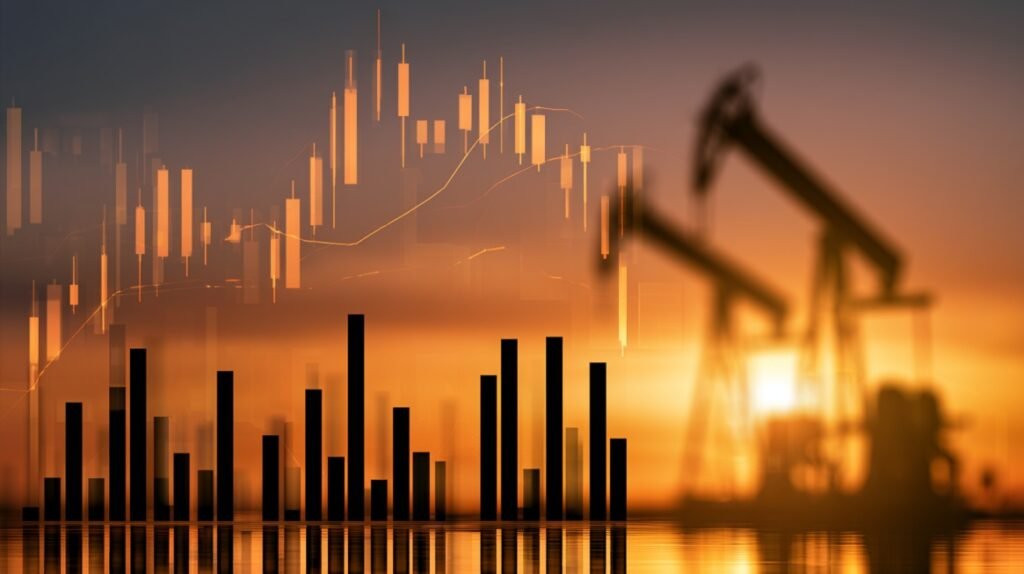
Traders generally group commodities into four broad categories, each governed by different supply and demand dynamics.
| Category | Examples | Primary Price Drivers |
| Energy | Crude oil, natural gas, gasoline | Geopolitics, OPEC decisions, seasonal demand |
| Metals | Gold, silver, copper, platinum | Inflation, interest rates, industrial demand |
| Agricultural | Wheat, corn, coffee, soybeans, cotton | Weather, harvest yields, trade policy |
| Livestock | Cattle, hogs | Feed costs, disease outbreaks, consumer demand |
Within this structure, commodities are also split into two broader groups. Hard commodities are extracted or mined, such as oil, gold, and copper. Soft commodities are grown or raised, such as coffee, wheat, and cattle.
Hard commodity prices tend to respond more to industrial demand and geopolitical events, while soft commodities are more exposed to weather and seasonal cycles.
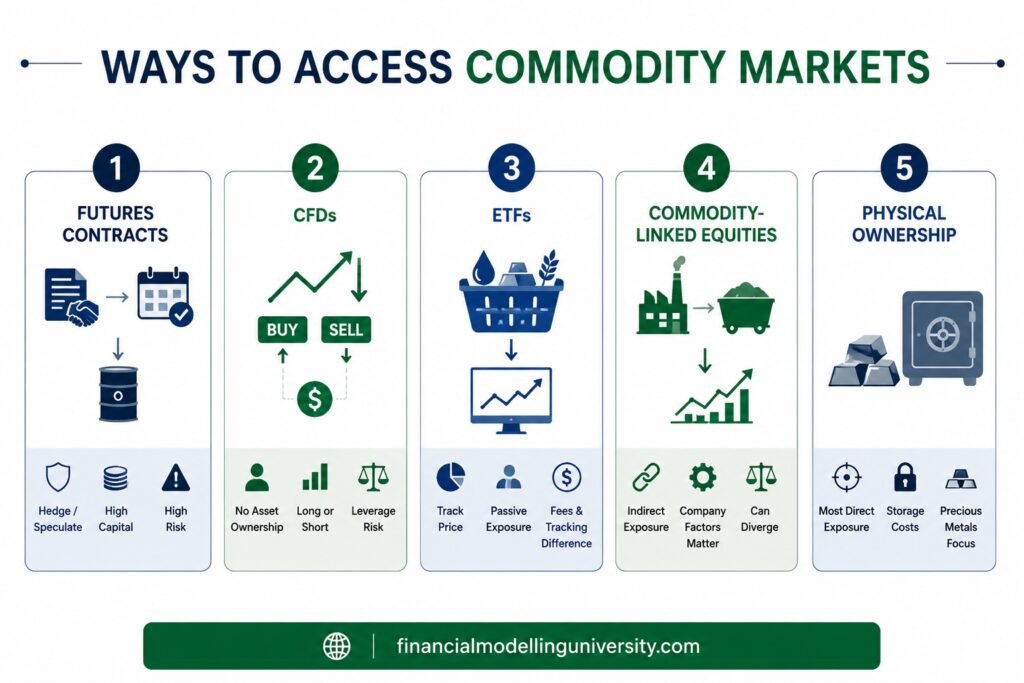
There is no single route into commodity trading. The right method depends on capital, time horizon, and appetite for complexity.
Futures contracts are agreements to buy or sell a set quantity of a commodity at a fixed price on a future date. They are the traditional instrument used by producers, manufacturers, and institutional traders to hedge or speculate, but they require significant capital and carry meaningful risk for anyone without experience managing margin requirements.
Contracts for Difference (CFDs) let traders speculate on price movement without owning the underlying asset. A trader takes a position based on whether they expect the price to rise or fall, and the profit or loss is calculated on the difference between opening and closing prices. CFDs are widely used by retail traders because they allow smaller position sizes and access to both rising and falling markets, though leverage means losses can also outpace the initial deposit.
Exchange-traded funds (ETFs) track the price of a single commodity or a basket of commodities and trade like ordinary shares. They suit investors who want exposure without actively managing positions, though fund performance can diverge slightly from the spot price due to fees and futures-rolling mechanics.
Commodity-linked equities are shares in companies that produce, process, or transport commodities, such as mining firms or energy producers. These stocks often move with the underlying commodity, but company-specific factors, such as production costs or management decisions, can cause the share price to diverge from the commodity itself.
Physical ownership remains the most direct method, typically limited to precious metals like gold and silver given the storage and insurance costs associated with other commodities.
Trading desks at major banks handle much of this activity on the institutional side, often within the same divisions that cover currencies and fixed income.
For readers interested in how these desks operate day to day, our guide on what sales and trading actually involves breaks down the roles, structure, and skills required.
For listed producers, comparable company analysis can help separate broad commodity exposure from company-specific valuation differences.
Commodity prices are ultimately a function of supply and demand, but several recurring forces shape how that balance shifts.
Each commodity responds to these forces differently and at different times, which is why building a view on one market rarely transfers cleanly to another.
Commodity trading offers real advantages, but none of them come without a corresponding trade-off.
Anyone assessing whether commodities fit a broader portfolio should weigh these factors against their own risk tolerance and time horizon before committing capital, and understand that a demo account or small starting position is a reasonable way to build familiarity with how a specific market behaves before scaling up.
A structured approach reduces the chance of costly early mistakes.
Commodity trading connects a portfolio to the physical forces that drive the global economy, from harvests to energy policy to industrial demand.
The instruments available today, from CFDs to ETFs to direct equities, make that exposure accessible without requiring anyone to store a barrel of oil or a bushel of wheat.
Success in this market comes less from predicting a single headline and more from understanding how supply, demand, and macroeconomic forces interact across each commodity category, then sizing positions accordingly.