


Most finance students can describe investment banking within minutes. Sales and trading gets a vague answer. The two divisions share the same building, often the same employer, but operate in completely different worlds.
This guide breaks down what S&T actually is, how the division is structured, who works in it, and what it takes to build a career there.
Sales and Trading (S&T) is the division of an investment bank responsible for buying and selling financial instruments on behalf of large institutional clients.
These instruments include stocks, bonds, currencies, commodities, and derivatives. Revenue comes from commissions, transaction fees, and the bid-ask spread the bank captures when making a market between buyers and sellers.

A typical S&T division operates across two primary asset class desks:
The reason large institutional clients need these desks comes down to volume. If you want to buy 100 shares of a stock, an online brokerage handles it in seconds.
If you want to buy 500 million shares, executing that carelessly will move the market against you.
S&T desks step in to break large orders into smaller tranches, set buying schedules, and connect buyers with sellers at target prices without disrupting the underlying price.
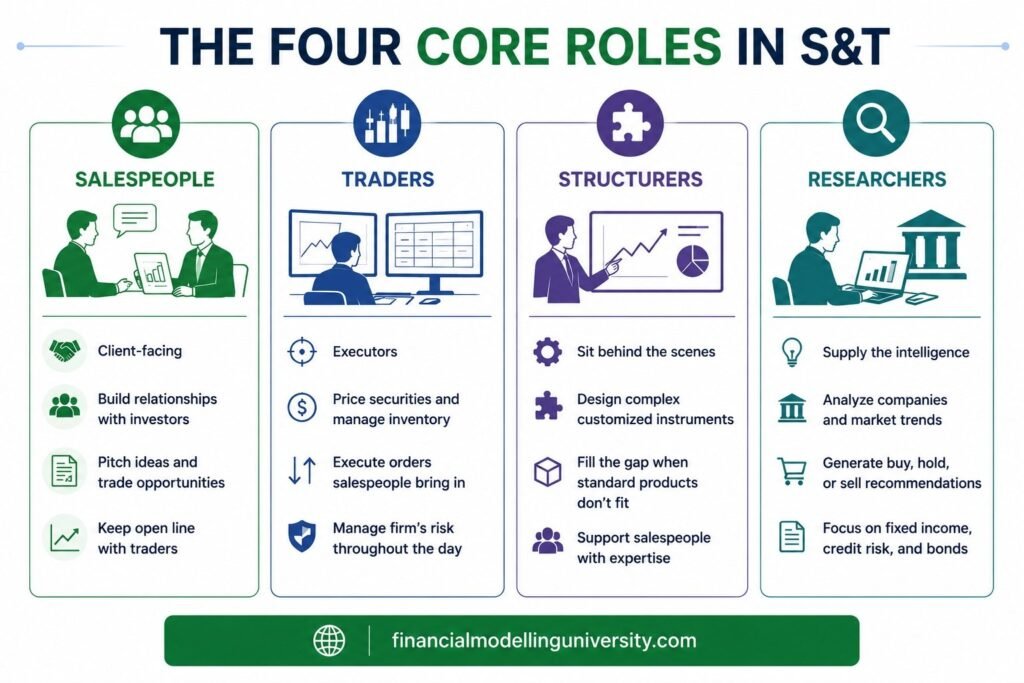
S&T is not a single job. The division runs on four distinct roles working in parallel.
Salespeople are the client-facing side. They build and maintain relationships with institutional investors such as hedge funds, pension funds, and mutual funds, pitch trade ideas, stay current on earnings reports and market conditions, and keep an open line between their clients and the traders executing on their behalf.
Traders are the executors. They price securities, manage the firm’s inventory of financial products, and execute the orders that salespeople bring in. They actively manage the firm’s risk exposure throughout the trading day.
Structurers sit behind the scenes. When a client needs a complex, customized instrument for hedging or a specific investment objective, structurers design it. They fill the gap when a standard product does not fit the client’s situation, and they support salespeople who may not have deep expertise in that particular product area.
Researchers supply the intelligence that salespeople use to pitch and traders use to position. Equity researchers analyze public companies and generate buy, hold, or sell recommendations.
Credit researchers focus on fixed income, examining debt instruments, credit risk, and bond market dynamics.
Not all trading desks operate the same way. There are three distinct models:
| Type | How it works | Risk to the firm | Typical profit source |
| Agency | Executes client orders as a pure intermediary | None | Commissions and fees |
| Proprietary | Trades the firm’s own capital for direct profit | High | Market gains |
| Flow | Hybrid; client orders flow through but desk also holds positions | Moderate | Spreads and positioning |
Following the 2008 financial crisis, the Volcker Rule (part of the Dodd-Frank Act) prohibited deposit-taking banks from engaging in prop trading.
True proprietary trading now lives primarily at independent prop firms and hedge funds. Most large banks today operate as flow and agency traders.

Both divisions sit inside the same institution, but the work is structurally different in almost every way.
| Sales & Trading | Investment Banking | |
| Market focus | Secondary market (existing securities) | Primary market (new issuances, M&A) |
| Time horizon | Daily and short-term | Months to years per deal |
| Client interaction | Frequent, brief, transaction-driven | Deep, long-term, advisory |
| Revenue source | Spreads, commissions, fees | Advisory and underwriting fees |
S&T measures its day in transactions. An IB deal can take six to twelve months from pitch to close. The skill sets overlap at the analytical level, but the day-to-day rhythm is entirely different.
At FMU, we cover the valuation fundamentals that connect both worlds. Our DCF & Valuation course covers the security pricing logic that applies across equity and fixed income desks.
For the buy-side perspective that S&T professionals regularly serve, our guide to private wealth management is a useful companion read.

The hierarchy in S&T follows the familiar investment banking ladder:
Compensation is performance-based and tied directly to market conditions. Junior analysts start in the low six-figure range. Senior traders and salespeople at top firms can earn well above $1 million in strong years.
The flip side is that weak market environments compress bonuses significantly, making S&T pay more volatile than a standard investment banking salary.
To last in this division, you need a specific combination of hard and soft skills:
Sales and trading is one of the most technically demanding roles in capital markets. The pace, the precision, and the direct link between performance and pay attract a specific type of professional.
Understanding how the division is structured, what each role contributes, and how it sits within the broader financial system is the right starting point before targeting a career here.
For those who want to build the quantitative foundation that S&T work demands, our equity research and valuation resources offer a practical place to start.