


The most elite analysts on Wall Street don’t type faster than you. They simply build differently. While many juniors lose 12 hours or more to a single model iteration, the pros use structural automation to deliver institutional-grade results in half the time. If you’ve ever felt the sting of a broken formula during a late-night sensitivity analysis, you know that manual data entry is the enemy of precision. Achieving faster valuation modeling isn’t about rushing; it’s about implementing a disciplined, keyboard-first framework that eliminates technical debt from your spreadsheets.
We understand the pressure of managing complex DCF and LBO models under tight deadlines. You want to move from being a spreadsheet operator to a strategic architect who commands the room. This guide provides the blueprint to master the high-velocity workflows used at the highest levels of finance. By adopting these proven methods, you can reduce your modeling time by 40-50% without sacrificing the accuracy that your reputation depends on.
In this professional guide, we’ll break down the architecture of velocity. You’ll learn to leverage the latest Excel Version 2606 features, integrate real-time 10-year Treasury yields currently at 4.38%, and build dynamic structures that handle shifting equity risk premiums with ease. It’s time to master financial modeling like the pros.
High-velocity finance isn’t a race of keystrokes; it’s a discipline of design. Elite analysts don’t just build a model. They engineer a system. True faster valuation modeling integrates rigid structural design with technical shortcuts to create a workspace where data flows logically. Without a robust architecture, you’re just building a house of cards that will collapse under the weight of the next sensitivity analysis. Speed is a byproduct of clarity, not just effort.
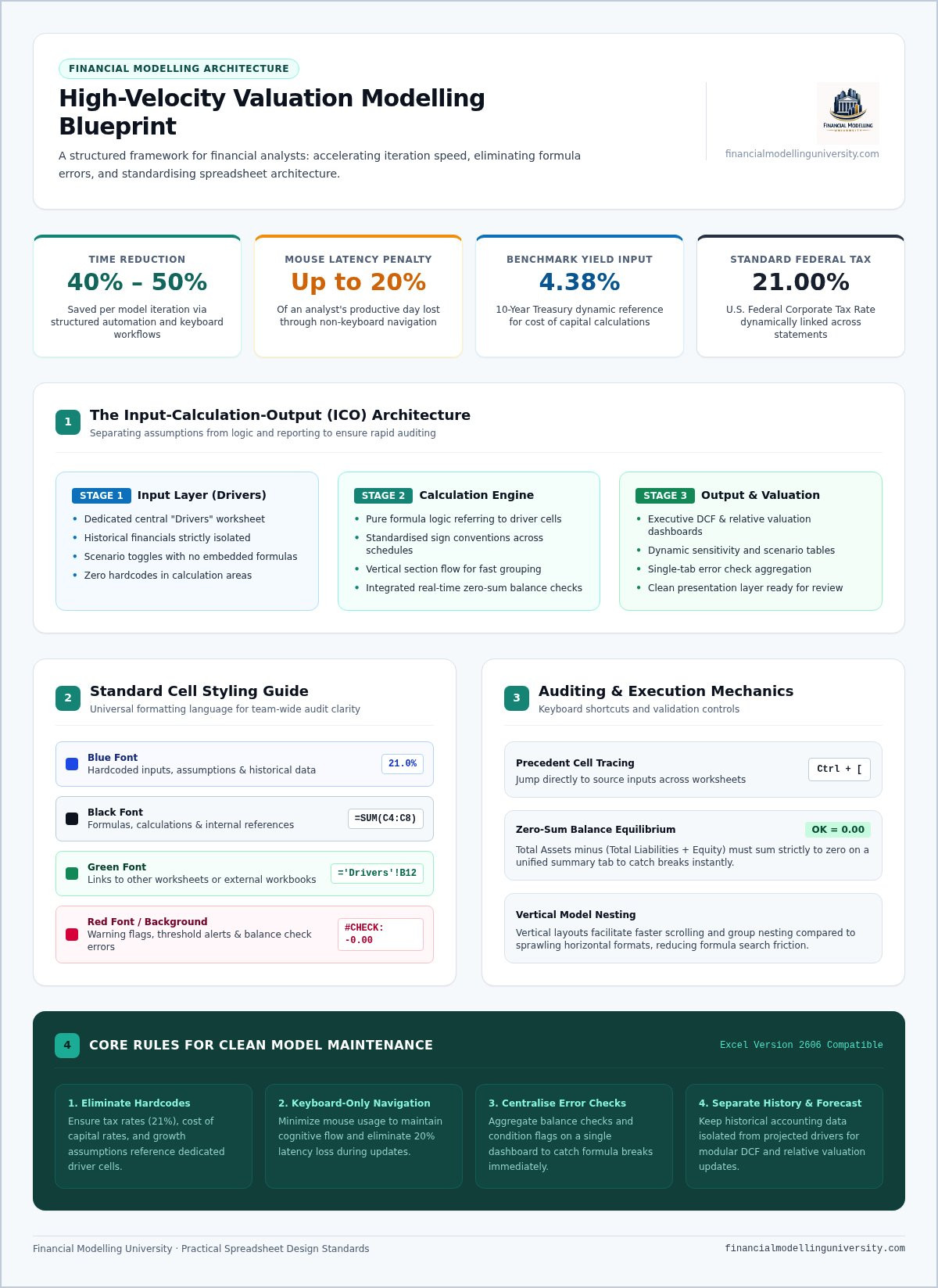
The foundation of this architecture is the Input-Calculation-Output (ICO) framework. This methodology separates raw data from the logic that processes it and the final presentation that summarizes it. By isolating these components, you eliminate the need to hunt through dozens of tabs to find a single variable. It’s a fundamental principle of financial modeling that ensures your work is scalable and transparent for rapid auditing and iteration.
Hardcoding is the primary killer of speed. Every time you type a number into a formula, you’re creating a speed trap for yourself. Institutional-grade models use dynamic links. If a variable changes, such as the current 21% U.S. Federal Corporate Tax Rate, the entire model should update instantly. Eliminating hardcodes isn’t just about accuracy; it’s about removing the friction that slows down iteration. Professional speed also requires a global style guide. You shouldn’t have to think about what a cell represents. You should know just by looking at it:
By adopting these standards, especially if you’re using the latest Excel Version 2606, you create a common language that allows for high-speed collaboration across your team.
Separating historical data from forward-looking assumptions is non-negotiable. Use dedicated “Drivers” tabs to centralize model control. This allows you to toggle between scenarios without digging into the core calculations. While some prefer horizontal models for their linear progression, vertical structures often allow for faster valuation modeling because they facilitate quicker scrolling and more intuitive group-nesting of sections. Choose a structure and stick to it religiously.
Every error you have to fix later is a tax on your efficiency. Build “Check” cells that sum to zero or verify that the balance sheet is in equilibrium. These should be aggregated on a single summary tab to catch errors in real-time. Don’t waste time hunting for broken links. Use native Excel auditing tools via shortcuts like Ctrl + [ to trace precedents. Standardizing sign conventions, such as keeping expenses negative or positive throughout the model, prevents the formula confusion that leads to late-night debugging sessions.
The mouse is a latency trap. In the high-stakes environment of an investment bank or private equity firm, touching your mouse is a physical signal of inefficiency. Industry data suggests that over-reliance on a mouse costs analysts up to 20% of their productive day. This isn’t just about saving seconds; it’s about maintaining a cognitive flow state. True faster valuation modeling requires a psychological shift where the keyboard becomes an extension of your intent. When you eliminate the reach for the mouse, you eliminate the micro-distractions that lead to formula errors.
Mastery begins with a “keyboard-only” mandate. Elite analysts often remove the physical mouse from their desk during training to force the development of muscle memory. This discipline ensures that every action, from navigating a 50-tab workbook to executing an advanced valuation modeling technique involving complex growth decays, happens at the speed of thought. To truly refine these mechanics, our Excel for Finance Course provides the rigorous drills necessary to reach these elite execution speeds.
You must hardwire three specific families of shortcuts into your subconscious. First, navigation: use Ctrl + Arrow keys to jump across data blocks and Ctrl + Page Up/Down to cycle through tabs. Second, data manipulation: Alt + E + S + V for Paste Special Values is the most used sequence in finance. Use Ctrl + D and Ctrl + R to “fill down” or “fill right” instantly. Finally, auditing: F2 opens a cell for editing, while Ctrl + [ allows you to jump to a formula’s precedent cell instantly. These are the building blocks of faster valuation modeling.
The Quick Access Toolbar (QAT) is your secret weapon for institutional-grade speed. By mapping your most frequent commands to the Alt + 1, Alt + 2, and Alt + 3 keys, you bypass the ribbon entirely. Start by adding “Paste Special,” “Trace Precedents,” and “Fill Color” to your QAT. This setup allows you to format a “Blue” hardcode or a “Yellow” driver cell in less than half a second. Transitioning to a 100% keyboard-driven workflow takes discipline, but most professionals achieve total mouse independence in under 30 days of focused practice.
Speed formatting is the final layer of this framework. You should be able to distinguish between a hardcoded input and a complex formula at a glance. Use a standardized color palette: blue for inputs, black for calculations, and green for external links. This visual shorthand, combined with a keyboard-first approach, transforms your model from a static document into a high-velocity engine built for the pressures of live deal execution.
Manual execution has its limits. Even the most proficient keyboard-first analyst eventually hits a ceiling. To break through, you must transition from manual inputs to automated systems. The integration of VBA for Financial Modeling and modern power tools is what separates high-velocity analysts from the rest of the pack. By automating repetitive data cycles, you achieve faster valuation modeling while virtually eliminating the human error inherent in manual entry.
Modern 2026 valuation models leverage Excel Version 2606 to its full potential. This includes using Dynamic Arrays like XLOOKUP and FILTER to create elastic data sets that expand or contract based on the target company’s profile. Instead of rebuilding a model for every deal, elite pros maintain a “Macro Library.” This is a curated collection of scripts for standardized formatting, unit conversion, and cleaning data exported from Bloomberg Terminal software version 198.3.81. These tools allow you to focus on the nuances of different business valuation methods rather than the mechanics of cell alignment.
Stop wasting hours scraping precedent transaction data. Power Query allows you to connect Excel directly to financial data APIs, pulling real-time updates for Comparable Company Analysis (CCA). This tool is essential for faster valuation modeling because it automates the normalization of disparate financial statements. It cleans, transforms, and loads data into your model with a single refresh. Given that 45% of companies now use machine learning for real-time financial forecasting, according to March 2026 industry reports, using Power Query to maintain a live data pipeline is no longer optional. It’s a requirement for institutional-grade mastery.
Speed in valuation isn’t just about how fast you can calculate free cash flow. It’s about how quickly your model reacts to new information. A “Plug-and-Play” DCF engine allows you to swap industry assumptions without rebuilding core logic. This is the essence of faster valuation modeling. By using self-healing formulas, such as dynamic ranges that incorporate new rows automatically, you avoid the broken references that plague junior analysts during late-night deal revisions. Your model must be an elastic system that scales with the complexity of the target.
Optimizing your Weighted Average Cost of Capital (WACC) calculation is another massive time-saver. Don’t hunt for data every time a new deal hits your desk. Link your model to a live macro-data sheet. With the 10-Year Treasury Yield currently at 4.38% and an Equity Risk Premium of 5.54% as of June 2026, your cost of equity should update the moment these market benchmarks shift. This structural agility allows you to move from raw data to a preliminary valuation in minutes, not hours.
The high-speed workflow handles mid-year acquisitions through a “Stub Year” fraction. This ensures your discounting is precise from day one. You should calculate Terminal Value using both the Exit Multiple and Gordon Growth methods simultaneously to provide a robust valuation range. Integrating these dynamic DCF Valuation Course principles ensures institutional accuracy while cutting your execution time in half. Accuracy and speed are no longer a trade-off; they’re a combined output of superior design.
Relative valuation shouldn’t be a separate exercise. Link your Comparable Company Analysis (CCA) directly to your DCF terminal value. This creates a feedback loop where market multiples inform your exit assumptions. Build a master “Comp Sheet” that pulls forward P/E and EV/EBITDA multiples via live data connections. Use median and mean toggles to instantly adjust your valuation ranges based on the peer group’s current performance. Finally, use automated “Football Field” charts to visualize the overlap between your DCF, CCA, and precedent transactions for a professional finish.
If you are ready to stop building static spreadsheets and start engineering dynamic financial engines, master these techniques by enrolling in our DCF Valuation Course today.
Speed is the ultimate currency in high-stakes finance. While technical shortcuts and structural design are essential, achieving true faster valuation modeling requires a shift from being a mere spreadsheet operator to becoming a financial architect. This transformation doesn’t happen in a vacuum. It requires a structured environment where bad modeling habits are dismantled and replaced with the rigorous, mouse-less workflows used by top-tier analysts. The FMU All-Access Pass provides this exact blueprint, offering a comprehensive path to professional mastery.
Our curriculum is built on the reality of the 2026 market. We don’t just teach theory; we provide downloadable, pre-optimized Excel templates for DCF, LBO, and M&A that are ready for immediate deployment. These aren’t generic files. They are institutional-grade engines designed to handle complex scenarios, such as the current divergence in revenue multiples where AI-native companies command 20x to 30x while SaaS multiples have stabilized between 5x and 7x ARR. By using these proven structures, you eliminate the “blank sheet” anxiety and start every deal with a 50% head start.
Mastering Private Equity Financial Modeling requires a level of precision that few online tutorials can match. Our speed-focused modules use real-world case studies that mirror the relentless pace of elite investment banks. We provide one-to-one mentoring to ensure you are executing at peak efficiency, breaking the habit of manual data entry that leads to broken formulas. With continuous updates to reflect the latest Excel Version 2606 features and Bloomberg Terminal software version 198.3.81, your skills will always remain at the industry frontier.
Transitioning to the level of an industry expert means more than just knowing formulas. It means earning a globally recognized certification that proves your ability to deliver results under pressure. In 2026’s competitive job market, this credential serves as a quantitative hallmark of your expertise. You’ll also gain access to the FMU community, a network of over 25,000 finance professionals where you can exchange peer-to-peer speed tips and build high-status connections. Stop wasting hours on broken models and start performing at the level of the pros. Enroll in our Investment Banking Financial Modeling Course today and take command of your career transformation.
Professional mastery in finance isn’t a byproduct of longer hours; it’s the result of superior engineering. We’ve detailed how the integration of structural discipline, mouse-less execution, and advanced automation creates the framework for elite performance. By moving from manual data entry to dynamic, self-healing systems, you reclaim your most valuable asset: time. Whether you’re optimizing a WACC calculation or automating 100+ DCF scenarios, the goal remains the same: precision at scale.
Achieving faster valuation modeling is the definitive skill that separates strategic architects from spreadsheet operators. It’s time to implement these high-velocity workflows and secure your place at the industry frontier. Trusted by 25,000+ finance professionals, Financial Modelling University offers the expert-led training and institutional-grade templates used by top-tier banks to drive real-world results.
Don’t let inefficient habits cap your career potential. Master Financial Modeling Like the Pros with FMU and start building with the confidence of an industry insider. Your transformation into a high-velocity analyst begins today.
Build your models using the Input-Calculation-Output (ICO) framework and integrated check cells. This structure isolates variables and catches imbalances in real-time. Use check cells on every tab that aggregate to a master “Errors” sheet. This disciplined approach ensures that faster valuation modeling doesn’t compromise the institutional integrity required by top-tier banks.
Focus on Alt-key sequences and formula auditing shortcuts to eliminate mouse latency. Master Alt + E + S + V for values and Ctrl + [ for tracing precedents. These mechanics allow you to navigate complex workbooks at the speed of thought. Hardwiring these into muscle memory can reclaim up to 20% of your productive day during live deal execution.
Use pre-optimized, institutional-grade templates to establish the architectural blueprint, then customize for deal-specific nuances. Starting from scratch on every transaction is an inefficient use of professional time. Elite analysts use standardized structures for DCF and LBO models to ensure consistency, scalability, and rapid auditing across the entire deal team.
VBA automates repetitive, high-volume tasks such as running complex sensitivity iterations and scenario toggles. Instead of manually updating inputs, a simple macro can execute 100+ scenarios in seconds. This level of automation is essential for meeting tight deadlines while providing the deep “what-if” analysis that Managing Directors expect during final negotiations.
Utilize native Data Tables for two-variable analysis or VBA-driven loops for multi-variable stress testing. For faster valuation modeling, avoid manual scenario entry at all costs. Set up a dedicated “Drivers” tab that controls the entire model, allowing you to cycle through Bull, Base, and Bear cases with a single keyboard toggle.
Implement Power Query to create live data pipelines from APIs and external financial databases. This tool automates the cleaning and normalization of disparate financial statements. It reduces data scrubbing time from hours to minutes, ensuring your model stays updated with the latest market benchmarks, such as the current 4.38% 10-year Treasury yield.
Hardcoding, excessive mouse usage, and circular references are the primary enemies of velocity. Hardcoding variables like the 21% U.S. Federal Corporate Tax Rate into formulas creates technical debt that slows down future iterations. Maintain a strict “no-hardcode” policy and use dynamic links to ensure your model remains agile and ready for immediate auditing.