


A base salary of $125,000 at a bulge bracket bank is no longer the reward for simply being “good at math.” In 2026, it’s the entry price for professionals who can navigate a high-stakes environment shaped by AI automation, T+1 settlement cycles, and complex Basel III capital requirements. You’ve likely felt the anxiety of wondering if your Excel skills are truly Wall Street ready or if you’ll freeze when a VP asks for a live LBO adjustment during a technical interview. It’s a common concern among the 25,000+ finance professionals who turn to FMU to bridge the gap between academic theory and real-world deal execution.
We agree that the barrier to entry has never been higher, but the path to mastery is structured and logical. This guide provides the definitive blueprint for the skills needed for investment banking this year, ensuring you can perform institutional-grade valuations with total confidence. You’ll learn exactly which financial models are used on the job and how to integrate modern data tools into traditional banking workflows. We’re moving beyond basic formulas to help you master financial modeling like the pros, starting with a clear checklist of the technical and strategic competencies required to break into the elite tiers of finance.
The modern investment banker is no longer a glorified calculator. As we enter 2026, the skills needed for investment banking have evolved into a hybrid capability that demands technical precision, narrative construction, and high-pressure execution. While a standard Overview of Investment Banking reveals a broad industry focused on capital raising and advisory, the reality for an elite analyst is much more granular. You’re expected to build a bridge between raw data and strategic decision-making in real time.
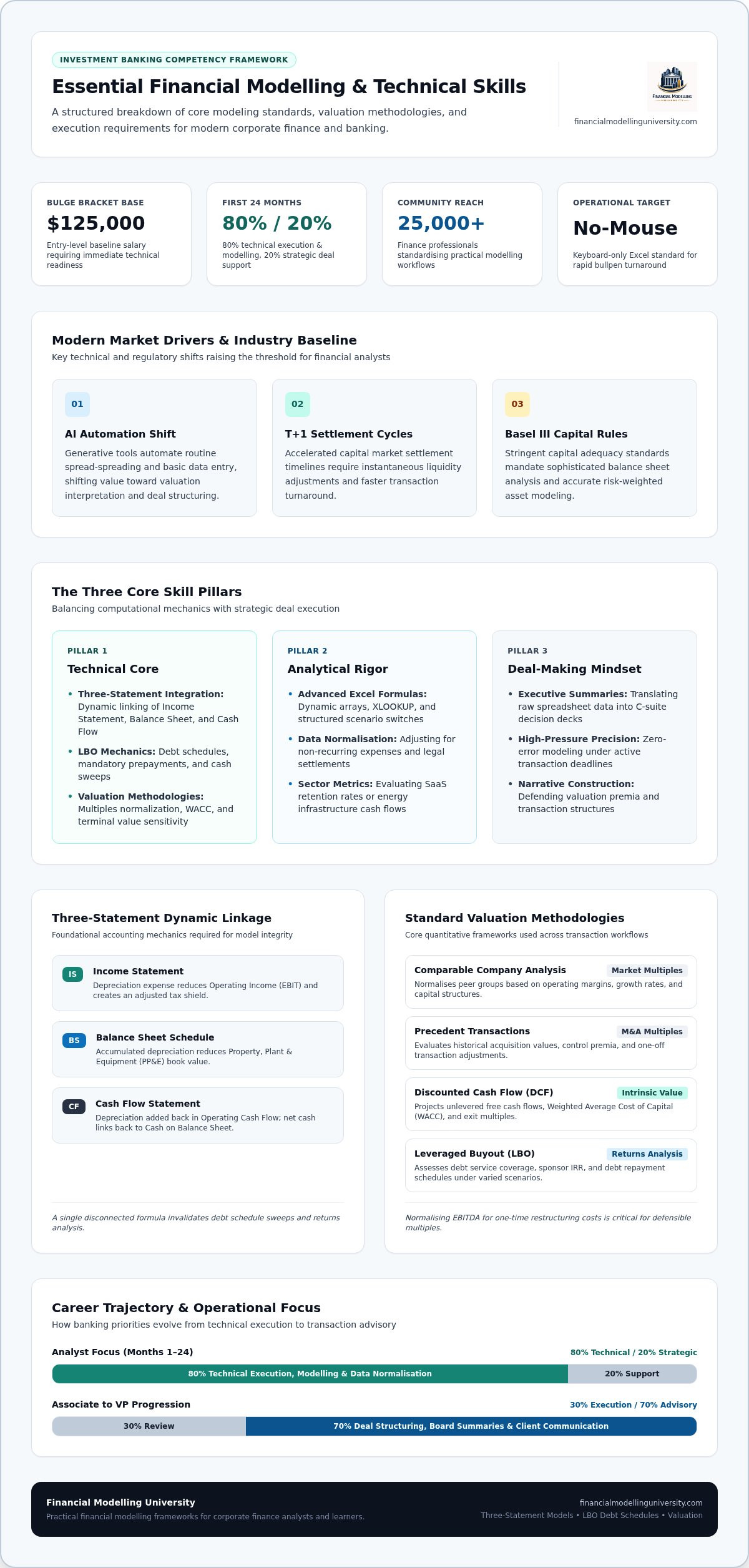
AI has fundamentally shifted the baseline. Generative tools now automate basic data entry and simple spread-spreading, which has actually increased the value of fundamental expertise. Senior bankers don’t need you to copy numbers. They need you to explain why those numbers suggest a specific valuation premium. This blueprint categorizes your path into three pillars: the Technical Core, Analytical Rigor, and the Deal-Making Mindset. Relying solely on a prestigious finance degree is a strategy of the past. Elite firms now prioritize “Day One” technical readiness over academic pedigree.
Think of hard technical skills as your ticket to the bullpen. For the first 24 months of your career, your value is measured by your ability to execute without errors. The “Analyst Reality” is roughly 80% technical execution and 20% strategic support. If you can’t build a clean LBO model or format a pitchbook under a midnight deadline, you won’t survive long enough to use your soft skills. However, as you move toward Associate and VP roles, your trajectory depends on resilience and communication. You must distill complex financial data into executive summaries that a CEO can act upon during a high-stakes board meeting.
Market volatility remains a constant, driving a demand for sophisticated risk modeling that goes beyond basic sensitivity analysis. Bulge bracket firms like JP Morgan and Goldman Sachs have raised the bar for new hires. They expect you to arrive with a mastery of institutional-grade tools and sector-specific knowledge. In a specialized market, understanding the nuances of SaaS metrics or energy infrastructure is just as vital as knowing how to balance a spreadsheet. Technical readiness is the only way to stand out in a pool of high-achieving candidates who all have impressive resumes but lack practical, “job-ready” execution skills.
Financial modeling is the primary language of Wall Street. It’s the mechanism through which an analyst translates a complex business narrative into a series of actionable, quantitative projections. Mastering these specific skills needed for investment banking separates high-performers from those who struggle during technical interviews. You don’t just need to know how to use Excel; you must understand the underlying accounting logic that drives every cell in a multi-sheet workbook.
The bedrock of all institutional analysis is the three-statement model. You must link the income statement, balance sheet, and cash flow statement with absolute integrity. A change in depreciation must flow through the income statement, adjust the tax shield, and correctly impact the property, plant, and equipment (PP&E) schedule on the balance sheet. Errors here aren’t just minor mistakes; they’re credibility killers that suggest a lack of fundamental rigor.
Valuation is as much an art as it is a science. You’ll spend a significant portion of your first year performing Comparable Public Companies (Comps) and Precedent Transactions analysis. Success requires more than just pulling multiples from a terminal. You must select the correct peer group based on growth profiles, margins, and capital structures. Adjusting for non-recurring items—such as one-time restructuring costs or legal settlements—is essential to normalize earnings and find the “true” trading multiple. If you’re ready to move beyond basic theory, start by mastering a DCF valuation course that mirrors institutional standards, focusing on WACC calculations and terminal value sensitivity.
Transaction modeling moves beyond static valuation to evaluate the mechanics of a deal. In Leveraged Buyout (LBO) modeling, you’ll structure complex debt tranches and calculate the Internal Rate of Return (IRR) based on various exit multiples. Even on the sell-side, private equity financial modeling skills are vital because they allow you to anticipate how a financial sponsor will view your client. Similarly, M&A accretion/dilution analysis helps you evaluate whether a merger creates value for the acquirer’s shareholders. You’ll need to model revenue and cost-side synergies with precision to determine the pro-forma impact on Earnings Per Share (EPS). These models are the workhorses of the industry, used daily by over 25,000 finance professionals who rely on FMU’s institutional-grade templates to execute high-stakes deals.
If you reach for your mouse in an investment banking bullpen, you’ve already lost the room. Speed is the primary currency of the analyst pool. It’s a direct proxy for technical competence. You must master the mechanics of the software to ensure your skills needed for investment banking translate into actual deal execution under high-pressure deadlines. Senior bankers don’t have the time to audit your formulas cell-by-cell; they need to trust your outputs instantly because your model is the foundation of a multi-billion dollar recommendation.
Professional modeling requires moving beyond basic arithmetic. You must master INDEX-MATCH for its flexibility in large datasets and OFFSET to build dynamic sensitivity tables that react to changing deal assumptions. Advanced array formulas are now essential for handling the massive data loads typical of 2026’s complex transactions. Data integrity is your shield. Build audit-friendly models using the industry-standard color-coding: blue for hard-coded inputs, black for formulas on the same sheet, and green for references to other sheets. This transparency allows a VP to trace your logic in seconds, which is the only way to build institutional trust.
Mastering the “no-mouse” standard is a non-negotiable rite of passage. You should be able to navigate, format, and build complex schedules using only keyboard shortcuts. Key sequences like ALT, H, O, I to autofit columns or CTRL, [ to trace precedents must become muscle memory. Workbook structure is equally critical. Every model should follow a logical flow: inputs, followed by calculations, and ending with board-ready outputs. Adhering to Excel for finance standards ensures your work is traceable and professional, a hallmark of the 25,000+ finance professionals trained by FMU.
VBA remains a powerful tool for automating repetitive tasks, such as generating hundreds of PDF reports or cleaning messy data exports from a Bloomberg Terminal. Use it to build robust scenario managers that allow senior team members to toggle between “Base,” “Upside,” and “Downside” cases with a single click. While Python is increasingly used for large-scale data science and scraping, Excel remains the undisputed king of deal structuring. Your goal is to use automation to eliminate “grunt work,” allowing you to focus on the high-value analytical rigor that drives successful deal execution.
Technical mastery is your entry ticket, but the deal-making mindset is what determines your career longevity. While previous sections focused on the technical skills needed for investment banking, this pillar addresses the psychological and interpersonal rigor required to survive the bullpen. In a high-stakes environment where a single “fat-finger” error can compromise a multi-billion dollar transaction, your attention to detail isn’t just a preference; it’s a professional mandate. One incorrect decimal point in an LBO model can lead to a disastrous valuation, destroying both the deal and your credibility in seconds.
The 80 to 100 hour work week is a reality that demands elite time management. It isn’t about just staying awake; it’s about strategic prioritization. You must learn to distinguish between “urgent” tasks and “critical” deal-drivers while operating under extreme sleep deprivation. Resilience is forged during the iterative feedback loops known as the “VP markup.” You’ll face brutal, red-penned critiques of your work that require you to check your ego at the door. Use this feedback to sharpen your analytical edge rather than viewing it as a setback. This disciplined approach to professional growth is why over 25,000 finance professionals trust FMU to guide their career transformation.
Integrity is the bedrock of the financial industry. You’ll handle sensitive, non-public information daily, making fiduciary duty and confidential data management paramount. Maintain a healthy sense of professional skepticism during the due diligence process. Don’t just accept management’s projections at face value; probe the assumptions and look for potential pitfalls. In banking, your long-term reputation far outweighs any short-term gain from a single deal. If you’re ready to master these professional standards, explore the FMU All-Access Pass to gain the technical and strategic mentorship required for elite performance.
Acquiring the right investment banking financial modeling expertise requires a structured path. You must move from basic competency to true mastery through continuous professional development. This isn’t a one-time effort. It’s a career-long commitment to technical excellence that separates the top 1% of analysts from the rest of the bullpen. By working with the same models used in actual transactions, you build the muscle memory required to handle the midnight deadlines and complex requests typical of elite finance roles.
Our “University” approach is built on three pillars: mentorship, validation, and resources. Gain one-to-one career mentoring from industry experts who have already navigated the high-stakes world of finance. This personalized guidance helps you bridge the gap between academic theory and Wall Street reality. Validate your expertise with globally recognized certification that signals your technical readiness to recruiters at elite firms. Additionally, your membership provides access to a lifetime library of updated financial modeling resources. This ensures your skills remain sharp as market regulations and digital tools evolve in 2026 and beyond.
Success in this field is highly disciplined. Start by auditing your current technical gaps; identify whether you struggle with LBO debt schedules, complex DCF sensitivity analysis, or advanced Excel shortcuts. Use the following 90-day plan to secure your professional future:
The path to the elite tier of finance is structured and purposeful. Master Financial Modeling Like the Pros with FMU All-Access and join over 25,000 finance professionals who have transformed their careers through our proven curriculum.
Breaking into Wall Street in 2026 requires more than a prestigious degree. You must demonstrate a hybrid capability of technical precision and strategic narrative. We’ve established that the skills needed for investment banking today center on institutional-grade modeling and the “no-mouse” Excel standard. These aren’t just academic exercises; they’re the daily tools of the trade that allow you to execute high-stakes transactions with absolute confidence. Your ability to distill complex data into a board-ready story is what will ultimately define your trajectory toward Vice President and beyond.
Don’t leave your career transformation to chance. Transition from a competent candidate to an industry master by leveraging the same resources used by 25,000+ finance professionals. With globally recognized certificates, institutional-grade Excel templates, and direct mentorship from elite industry practitioners, you’ll bridge the gap between theory and reality. Master Financial Modeling Like the Pros with FMU and start building your blueprint for professional mastery today. The bullpen is waiting for those who are prepared to lead.
The most important technical skills include three-statement financial modeling, DCF valuation, and transaction analysis such as LBO and M&A modeling. You must understand the accounting logic linking the income statement, balance sheet, and cash flow statement with absolute integrity. Elite firms expect you to perform these valuations with institutional-grade precision from your first day on the job.
You don’t need to be a software engineer, but mastering VBA is essential for automating repetitive tasks and building robust scenario managers. While Python is increasingly used for large-scale data manipulation, Excel remains the undisputed industry standard for deal structuring. Focus on mastering VBA first to eliminate “grunt work” before moving into more advanced data science tools.
A junior analyst is expected to operate at the “no-mouse” standard, navigating complex workbooks using only keyboard shortcuts. You must be proficient with advanced functions like INDEX-MATCH, OFFSET, and array formulas to manipulate data quickly. Speed in Excel is a direct proxy for your technical competence in the bullpen; if you’re reaching for your mouse, you’re already behind.
While a CFA or MBA adds prestige to your resume, financial modeling skills are the practical gatekeepers for your first 24 months. Recruiters prioritize “Day One” technical readiness over academic credentials because they need analysts who can execute immediately. You can’t build a multi-billion dollar deal with a degree alone; you need the proven ability to build institutional-grade models.
Master the three-statement model, a Discounted Cash Flow (DCF) valuation, and a basic Leveraged Buyout (LBO) model before any interview. You should also understand M&A accretion/dilution analysis to evaluate the strategic impact of a merger. These are the core skills needed for investment banking that will be tested during technical rounds to prove your analytical rigor.
Develop a disciplined self-auditing process by using checklists and institutional-grade templates to minimize “fat-finger” errors. Always trace your precedents and check that your balance sheet balances after every major adjustment to ensure model integrity. In high-stakes banking, your professional reputation is built on the absolute accuracy of your outputs and the reliability of your data.
Resilience and the ability to communicate a strategic narrative are the most valued soft skills during recruitment. You must handle iterative feedback loops with a growth mindset and distill complex data into clear “board-ready” summaries for senior leaders. Demonstrating that you can manage the 80 to 100 hour work week with strategic prioritization is equally vital for success.
AI has automated basic data entry and simple spreading, making fundamental analysis and strategic narrative more valuable than ever. The skills needed for investment banking have shifted from manual input to high-level error checking and explaining the “So What?” behind the numbers. Professionals must now focus on interpreting AI-generated data with expert skepticism and institutional-grade rigor.