

In 2026, the distance between a mid-level accounting role and an elite finance position is defined by one factor: your ability to architect institutional-grade models under extreme pressure. With bulge bracket analyst compensation climbing to $260,000 and mega-fund associates earning up to $450,000, the rewards for technical mastery are immense. However, most professionals remain stuck in low-level roles because they’re chasing the wrong certifications or fearing the technical interview. Navigating a successful financial modeling career path requires more than just knowing Excel; it requires a strategic roadmap.
You’ve likely felt the pressure of certification confusion or the anxiety of a blank workbook during a high-stakes modeling test. We’re here to eliminate that uncertainty. This guide delivers the precise technical roadmap you need to master IB, PE, and CorpDev roles. We’ll preview the essential skills for LBOs, DCF valuations, and M&A transactions that the industry demands today. It’s time to stop guessing and start performing at the level of an industry expert with the proven FMU approach. You’ll gain the confidence to pass any technical test and finally secure the prestige and compensation your ambition deserves.
In the high-stakes environment of 2026, Financial Modeling is no longer a niche skill; it’s the universal language of global capital. Whether you’re in London, New York, or Singapore, the ability to translate complex business operations into a structured, predictive Excel architecture is what separates elite practitioners from the pack. Market volatility in the first half of 2026 has exposed the fragility of basic spreadsheets. Precise forecasting is now the primary tool for risk mitigation and capital allocation. Firms aren’t looking for data entry clerks who simply “run the numbers.” They’re hunting for strategic architects who can build institutional-grade models that withstand stress tests and drive multi-billion dollar decisions. This technical mastery is your primary filter in finance interviews. If you can’t build a 3-statement model from scratch in 60 minutes, your financial modeling career path ends before it begins.
Mastering financial modeling is the catalyst that transforms a junior analyst into a senior associate. Junior staff focus on historical data. Elite professionals focus on the future. When you own the model, you own the narrative. You aren’t just presenting a slide deck; you’re explaining the levers of value creation. This transition from tactical execution to strategic “What-If” analysis is where the real compensation growth happens. In 2026, the demand for modelers who can integrate real-time market data and ESG metrics is at an all-time high. Performance at this level requires a shift from passive data entry to active strategic architecture.
A single, well-constructed model connects the entire financial ecosystem. It’s the bridge between the sell-side analyst’s valuation and the buy-side associate’s LBO thesis. In 2026, “good enough” is a liability. Institutional-grade standards are the baseline for trust. This is why the FMU Method emphasizes professional precision over shortcuts. We teach you to build models that are dynamic, error-proof, and transparent. This level of rigor is what the industry expects from its top 1% of talent. Every financial modeling career path leads to a crossroads: you can either be the person who reads the model or the expert who builds it. Choose the latter to command the prestige and compensation that follows elite-level performance.
The upper echelons of finance demand a specific technical pedigree. Whether you’re advising on a multi-billion dollar merger or deploying capital into a distressed asset, your model is your credibility. In 2026, the financial modeling career path through investment banking and private equity remains the most lucrative. However, it’s also the most competitive. Bulge bracket and elite boutique firms have raised the bar, using complex modeling tests as the ultimate filter for talent. If you can’t architect a deal from a blank sheet, you won’t survive the first round.
Investment banking is the crucible where technical skills are forged through relentless repetition. Total compensation for first-year analysts at top-tier firms now ranges from $180,000 to $260,000. To command these figures, you must master more than just basic Excel. You need deep expertise in 3-statement integration and complex accretion/dilution analysis. Our Investment Banking Financial Modeling Course is designed to bridge the gap between academic theory and this high-pressure reality. While analysts focus on the mechanics of DCF valuation, associates are expected to own the strategic narrative. They must defend WACC assumptions and terminal value multiples against intense managing director scrutiny. Speed and precision aren’t optional; they’re the baseline for survival.
Moving to the buy-side is a common goal, but the technical requirements are significantly more rigorous. Total compensation for first-year associates at mega-funds has climbed to between $350,000 and $450,000 in 2026. At this level, private equity financial modeling is the standard for professional excellence. You aren’t just valuing a company; you’re structuring the entire transaction. This involves building sophisticated debt schedules, calculating complex waterfall distributions, and running exhaustive IRR sensitivity tables. Technical superiority is the only way to successfully pivot from the sell-side to a premier private equity firm. If your model can’t handle a simple debt paydown toggle without breaking, you aren’t ready for the buy-side.
Venture capital and hedge funds offer equally prestigious paths with distinct modeling needs. VC associates, earning up to $200,000 pre-MBA, focus on modeling for extreme uncertainty and high-growth scalability. Hedge funds prioritize quantitative modeling and technical analysis at breakneck speeds to capitalize on minute market inefficiencies. Regardless of the specific sector, the underlying requirement remains the same: elite-level technical mastery. To start building your own institutional-grade portfolio, consider the FMU All-Access Pass for comprehensive training across every major finance path.
Elite finance exists far beyond the trading floors of Wall Street. For many, the most rewarding financial modeling career path leads directly into the corporate boardroom. In these roles, you transition from an external advisor to a strategic operator. You aren’t just building models for a client; you’re building them to guide your own firm’s multi-year growth. Corporate Development (CorpDev) and Financial Planning & Analysis (FP&A) represent the dual engines of internal strategy. While both rely on Excel, the technical application and the stakes of the output differ significantly. Mastering these differences is essential for anyone aiming to command a seat at the executive table.
Corporate Development is the internal M&A arm of a global enterprise. These professionals execute acquisitions, divestitures, and joint ventures that define a company’s future. Because these are transaction-based roles, CorpDev teams require the exact same technical toolkit as investment bankers. You must master complex accretion/dilution models and DCF valuations to justify massive capital deployment to the board. As of July 2026, Corporate Development analysts earn an average of $98,309, with significant upside for those who can architect institutional-grade deals. For firms expanding their physical footprint, real estate financial modeling is a critical competency. It allows the team to model site acquisitions and long-term lease obligations with the precision required for large-scale corporate expansion.
FP&A focuses on the operational engine of the business. In 2026, this role has moved past simple budgeting into strategic “What-If” scenario analysis. Analysts earning an average of $96,904 now use modeling to predict how shifting supply chains or fluctuating interest rates impact the bottom line. The shift toward cloud-based platforms like Anaplan hasn’t replaced Excel; it has raised the bar for how your models must integrate with larger data systems. You’re no longer just “running the numbers.” You’re providing the roadmap for the entire organization’s survival.
Management consultants at elite MBB firms use modeling to validate massive business transformations. Entry-level total compensation for these roles in 2026 ranges from $130,000 to $170,000. Their models must be flexible enough to handle diverse sector nuances. A SaaS-focused model prioritizes CAC and LTV metrics, while a manufacturing model focuses on CAPEX and inventory turnover. There is also a rising demand for Project Finance and Infrastructure modeling. These roles require modeling long-term asset management for projects that span decades. Master these specialized nuances to ensure you aren’t just a generalist; you become an indispensable technical specialist.
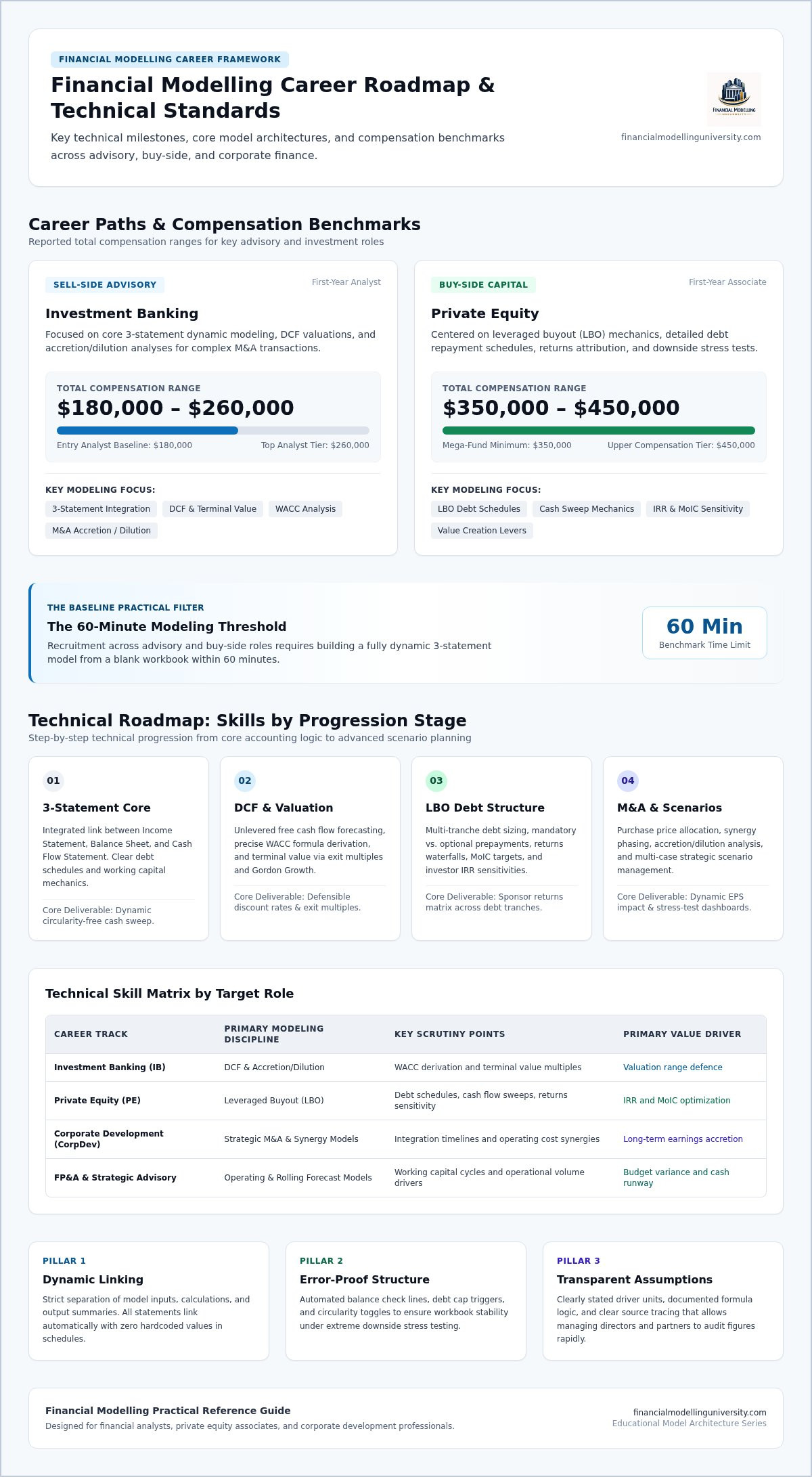
A successful financial modeling career path isn’t built on basic spreadsheet formulas. Most analysts hit a technical ceiling because they never move beyond simple data entry. Elite roles demand a disciplined progression through specific technical plateaus. In the high-stakes world of 2026 finance, your workbook is your reputation. If your model is slow, fragile, or lacks dynamic toggles, you’ll remain stuck in low-level accounting roles. Breaking through requires a structured roadmap that transitions you from a builder to a strategic architect.
In your first 24 months, speed and accuracy are the only metrics that matter. You must master 3-statement mechanics until they become second nature. This stage is about building the foundation with Excel for finance. Elite analysts adopt a “No-Mouse” philosophy to maximize efficiency during the 80-hour work weeks common in investment banking. Your goal is to produce clean, integrated models that “the pros” can audit in seconds. If you can’t build a circularity-free debt schedule under pressure, you aren’t ready for the next level. Precision at this stage is what earns you the trust of senior associates and VPs.
As you move into mid-level leadership, your role shifts from model builder to model auditor. You’re no longer just linking cells; you’re architecting complex transaction structures. This stage requires mastery of DCF valuations, sensitivity analysis, and the tax implications of M&A deals. You must use your models to influence C-suite decisions. A VP’s value lies in their ability to use a model to tell a story about risk and return. You’ll need to master dynamic scenario toggles that allow executives to see the impact of market shifts in real-time. At this level, technical superiority is the primary tool for driving Board-level strategy.
The advanced and expert stages involve mastering complex LBOs and automation. In 2026, 62% of quantitative finance listings require multi-year VBA or Python skills. Advanced modelers use these tools to automate repetitive tasks and build institutional-grade template architectures. Expert-level professionals often transition into one-to-one mentoring, passing on proven methods to the next generation of talent. To bridge the gap between your current role and these elite positions, secure your future with the FMU All-Access Pass for comprehensive, career-long technical training.
Elite performance in finance is never an accident; it’s the result of disciplined training with the right tools. FMU is the definitive “University” experience for those who refuse to be average analysts. While others settle for generic tutorials, our students engage with a curriculum built on academic rigor and real-world application. Navigating a high-stakes financial modeling career path requires more than just academic theory. You need the confidence that comes from performing at the level of elite industry practitioners. With a community trusted by over 25,000 finance professionals, the FMU certificate serves as a global signal of technical prestige. It tells recruiters you’ve been trained by the best to be the best.
The FMU All-Access Pass is the ultimate tool for those looking to pivot their financial modeling career path toward higher compensation and prestige. It provides a complete library of courses for every stage of your journey, from foundational Excel mechanics to complex LBO architecture. You gain direct access to mentors who’ve actually worked at top-tier firms. These industry insiders provide the one-to-one mentoring necessary to bridge the gap between being a model builder and a strategic architect. You aren’t just buying a course; you’re securing a catalyst for career transformation.
Our downloadable institutional-grade templates serve as a career “cheat code.” These aren’t basic spreadsheets; they’re the same structures used by Wall Street’s elite to drive multi-billion dollar decisions. Using these templates ensures your work meets the highest professional standards from day one. Additionally, our live Q&A sessions allow you to solve real-world work challenges with expert guidance. FMU alumni have successfully used these resources to break into BB Banks and Mega-Funds. They didn’t just pass the technical interview; they dominated it by demonstrating a level of mastery that generalists simply can’t match.
Professional mastery requires focus. Choose from our core tracks to align your training with your specific career goals:
This is the no-nonsense path to professional mastery. Stop guessing which skills matter and start building the technical roadmap that leads to the top of the industry. Your future in elite finance starts with a single decision to master the craft like a pro.
Explore FMU All-Access and Claim Your Career Transformation
Success in the high-stakes world of finance is reserved for those who can architect clarity from complexity. You’ve seen the roadmap from junior analyst mechanics to the strategic architecture required at the VP level. In 2026, the technical depth of your work is the only barrier between a mid-level role and an elite position. Choosing the right financial modeling career path means moving beyond basic tutorials and adopting institutional-grade standards that command respect in the boardroom.
FMU provides the exact blueprint used by the industry’s top practitioners to secure prestige and command higher compensation. Join 25,000+ finance professionals and gain access to our institutional-grade Excel templates and one-to-one career mentoring from industry experts. It’s time to stop guessing and start performing like a pro. Your transformation into an industry expert is within reach; take the lead and architect your future today.
Master Financial Modeling Like the Pros with FMU All-Access
Yes, it remains one of the most lucrative and stable trajectories in finance. As market volatility increases in 2026, firms prioritize precise forecasting over speculation. Mastery of this skill opens doors to bulge bracket banks and private equity firms where total compensation often exceeds $200,000 for entry-level roles.
Private Equity and Hedge Funds currently offer the highest compensation for elite modelers. First-year associates at private equity mega-funds earn between $350,000 and $450,000 in 2026. These roles demand mastery of the institutional-grade LBO and complex waterfall distributions to justify such high-stakes earnings.
While the CFA designation is a respected credential, it isn’t a substitute for technical modeling proficiency. Most elite finance interviews use a modeling test as the primary filter for candidates. You don’t need a CFA to secure a role if you can build a flawless 3-statement model and conduct a complex DCF valuation under pressure.
You can learn foundational mechanics in a few weeks, but achieving professional-grade mastery typically requires three to six months of disciplined application. This includes mastering the “no-mouse” Excel philosophy and building sector-specific models from scratch. Speed and accuracy are developed through repetition using institutional-grade templates provided by FMU.
Yes, modeling is the most effective bridge for transitioning from accounting to investment banking. Accounting focuses on historical data; investment banking focuses on future value. Mastering a financial modeling career path allows you to demonstrate the strategic mindset required to move from historical reporting to deal execution.
Microsoft Excel remains the foundational tool for every financial modeling career path. However, 62% of quantitative finance listings in 2026 now require multi-year VBA or Python skills. Elite professionals also integrate their models with cloud-based platforms like Anaplan for better version control and collaboration in large-scale corporate environments.
Financial modeling is more relevant than ever because AI acts as an accelerator, not a replacement. AI handles anomaly detection and rapid forecasting, but humans must still architect the strategic assumptions. Elite practitioners use AI to surface insights faster while maintaining control over the model’s integrity and narrative.