


Technical mastery is no longer your competitive advantage in 2026; it’s merely the price of admission. You likely understand the pressure of a “walk me through” scenario where stumbling over LBO mechanics or complex circularity can end a candidacy in seconds. It’s one thing to build a model in Excel, but it’s another to verbalize the strategic narrative that elite firms demand. Most candidates fail because they focus on the math while ignoring the underlying logic that proves they can think like a principal.
This guide provides the master framework you need to ace high-stakes financial modeling interview questions at top-tier investment banks and private equity shops. We’ve distilled the technical and strategic requirements into a structured blueprint that replaces anxiety with the confidence of an industry insider. You’ll learn to communicate your workflows with the precision of a seasoned pro, ensuring you’re recognized as a high-potential hire from the first interaction.
We’ll analyze the technical nuances of SOFR-based debt schedules, the 15% Corporate Alternative Minimum Tax, and the verbal logic required to link the three financial statements under pressure. You’ll also master the scenario and sensitivity analysis frameworks that have become mandatory for every elite case study in the current market.
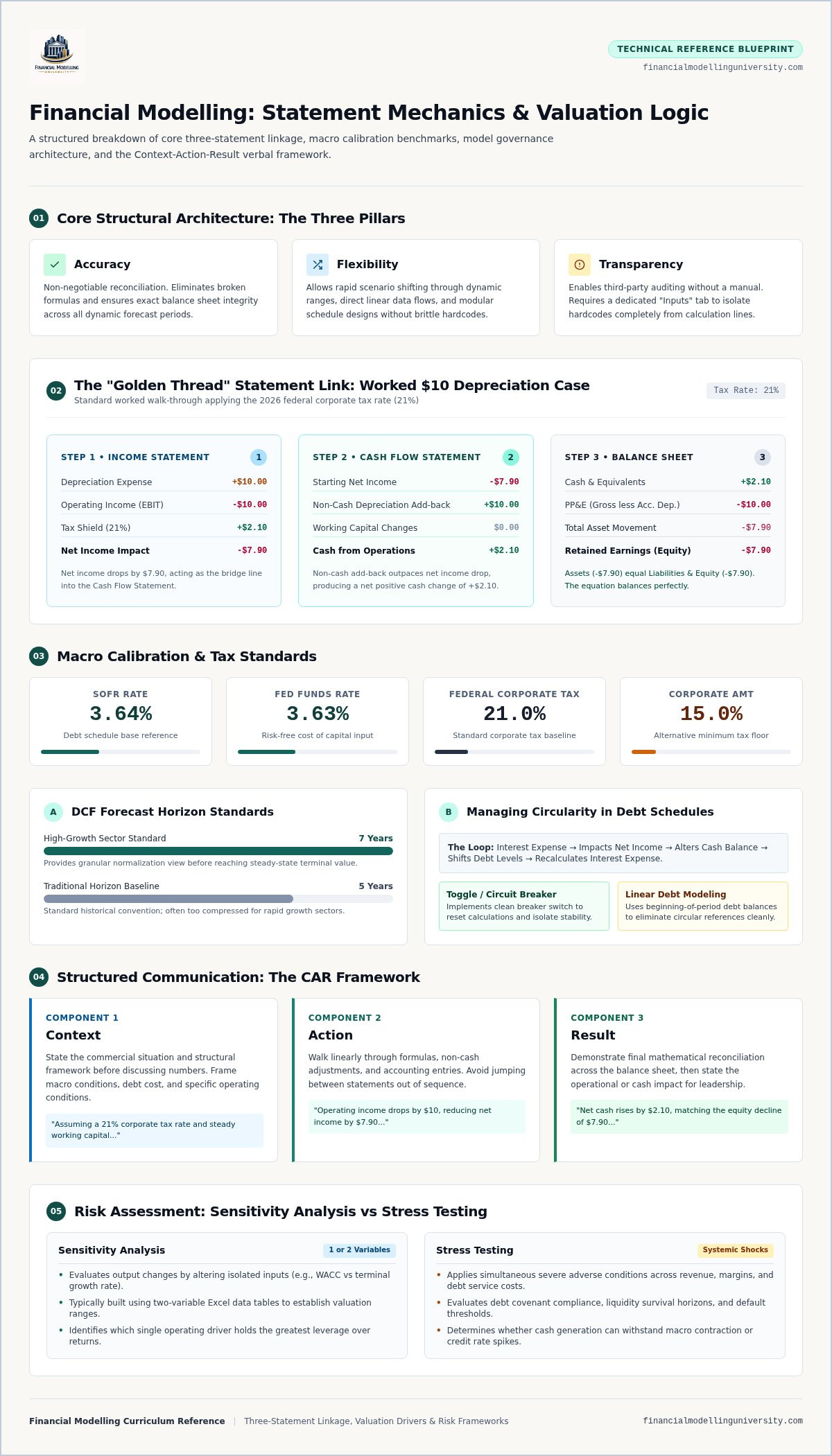
Elite candidates understand that a model’s value isn’t just in its output, but in its architecture. Before you open Excel, you must internalize the three pillars of institutional-grade work: accuracy, flexibility, and transparency. Accuracy is non-negotiable. Flexibility allows for rapid scenario shifting. Transparency ensures a third party can audit your logic without a manual. To truly understand What is Financial Modeling? in a professional context, you must view it as a dynamic system rather than a static spreadsheet.
The “Golden Thread” of any integrated model is the flow of Net Income. It originates on the Income Statement, serves as the starting line for the Cash Flow Statement, and eventually flows into Retained Earnings on the Balance Sheet. This link is the most frequent target of financial modeling interview questions because it tests your fundamental grasp of accrual accounting versus cash movements. Senior-level awareness also requires you to account for circularity. For instance, interest expense depends on debt levels, which depend on cash flow, which is impacted by interest expense. Mastering this loop is what separates a pro from an amateur.
Consider the classic depreciation example. If depreciation increases by $10, Operating Income drops by $10. Assuming the 2026 federal corporate tax rate of 21%, Net Income decreases by $7.90. On the Cash Flow Statement, that $7.90 Net Income is the starting point. You add back the $10 non-cash depreciation, resulting in a $2.10 increase in Cash from Operations. On the Balance Sheet, Cash is up $2.10, PP&E is down $10, and Retained Earnings is down $7.90. The equation balances perfectly. One common pitfall is forgetting the tax shield or failing to adjust the deferred tax asset; don’t make that mistake. The Cash Flow Statement serves as the definitive bridge, reconciling non-cash accruals and capital movements to determine the final cash balance required to balance the Balance Sheet.
Professional models must be scalable and disciplined. Use a dedicated “Inputs” tab to isolate hardcodes from calculations. Never bury a hardcoded number inside a formula. It’s a mistake that destroys transparency and trust. For 2026, the 7-year rule is becoming standard for high-growth sectors. While a 5-year DCF is traditional, extending to 7 years provides a more granular view of normalization before hitting terminal value. Avoid “spaghetti” logic by using direct, linear flows and dynamic ranges that accommodate growth. If your interest expense calculation creates circularity, handle it with a toggle or a clean circuit breaker to maintain model stability. When you prepare for financial modeling interview questions, demonstrating this level of structural discipline is just as important as getting the math right.
Valuation is where the strategic narrative meets the technical numbers. In the high-stakes 2026 market, elite candidates must do more than just build a functional model; they must defend every assumption against volatile macro conditions. Whether you’re calculating the intrinsic value of a growth-stage tech firm or determining the entry price for a complex buyout, your ability to handle sophisticated financial modeling interview questions determines your standing. Professional mastery requires a deep understanding of how cost of capital and shifting capital structures ripple through your terminal value assumptions.
When an interviewer asks how to calculate WACC, they’re looking for professional precision. Always emphasize using the market value of equity and debt rather than stale book values. With the federal funds rate at 3.63% and SOFR holding at 3.64% as of July 2026, your risk-free rate and cost of debt assumptions must reflect this current reality. A DCF is only as strong as its terminal value logic. You’ll need to justify whether you’re using the Exit Multiple method or the Perpetuity Growth method based on industry maturity. Professionals know that a DCF without a sensitivity analysis is a static guess. You must build data tables that test the impact of a 50-basis point shift in WACC or a 0.25x change in the exit multiple on the final enterprise value.
Private equity interviews frequently pivot to the “three levers” of value creation: EBITDA growth, multiple expansion, and debt paydown. You might be asked to perform a “Paper LBO,” which requires calculating a rough IRR mentally. If a company grows EBITDA from $100M to $150M over five years and pays down half its debt, you must quickly articulate the return profile. To master these institutional-grade mechanics, we suggest exploring the Private Equity Financial Modeling course. In M&A scenarios, focus heavily on accretion/dilution logic. A “cheap” target with a low P/E can still be dilutive if the cost of debt used to fund the deal is higher than the target’s earnings yield. Identifying these “deal killers” signals that you possess the strategic mindset of a high-potential hire.
Technical proficiency is only half the battle. The most challenging financial modeling interview questions don’t just test your ability to build a spreadsheet; they test your ability to narrate that spreadsheet to a Senior Associate or Managing Director. Elite candidates use the ‘Context-Action-Result’ (CAR) framework to structure their technical storytelling. This approach ensures you don’t get lost in the weeds of cell references and instead focus on the strategic value of the model. To project the necessary authority, you must master the technical nomenclature found in our Excel for Finance course, which serves as the foundational language for these high-stakes discussions.
The CAR framework follows a logical three-step progression. First, state the objective clearly. Whether you’re determining the intrinsic value of a target or assessing the viability of a project finance deal, define the “why” immediately. Second, detail the architecture. Walk the interviewer through the flow from raw inputs and drivers to the calculation engine and, finally, the output schedules. Third, highlight the critical assumptions. Identify the “So What?” by explaining how sensitivity to a specific driver, like terminal growth or cost of debt, dictates the final investment recommendation. This structured delivery proves you possess a principal’s mindset.
For junior roles, keep your answer to a crisp 60 seconds. Start with Net Income from the Income Statement, explain how it’s adjusted for non-cash items and working capital on the Cash Flow Statement, and conclude with how the ending cash balance links to the Balance Sheet. For Associate and VP positions, provide a 5-minute deep dive. Discuss the nuances of debt schedules, the impact of the 21% flat corporate tax rate on the tax shield, and the mechanics of deferred tax assets. If an interviewer interrupts with a pivot, acknowledge the question, answer it concisely, and then bridge back to your primary logic flow. Never lose your place in the architecture.
When narrating an M&A or LBO model, start with the strategic rationale. Is this a consolidation play or a vertical integration? Move quickly to the mechanics, specifically the Sources and Uses table. Explain the Purchase Price Allocation (PPA), the creation of Goodwill, and how you’ve modeled synergies. The final step is the output analysis. Focus on the pro-forma impact on EPS and the combined company’s credit profile. If the deal is dilutive, explain why the strategic benefits might outweigh the immediate earnings hit. This level of analysis signals that you are ready to perform at an institutional grade.
The technical landscape for 2026 has shifted. While linking statements and calculating WACC remain foundational, elite firms now prioritize your ability to build resilient models that survive extreme volatility. You’ll face financial modeling interview questions that probe your understanding of model integrity and your command of modern Excel functions. It’s no longer enough to build a static DCF; you must demonstrate that your architecture can handle “black swan” events through rigorous stress testing and sophisticated scenario management.
Understanding the distinction between sensitivity analysis and stress testing is vital. Sensitivity analysis tests the impact of incremental changes in a single variable, such as a 50-basis point shift in the discount rate. Stress testing, however, evaluates the model’s performance under extreme, multi-variable shifts—think of a simultaneous 25% revenue contraction and a total credit market freeze. In 2026, firms expect you to use Scenario Manager or “Case Switches” to toggle between these discrete strategic realities instantly. Pro-level candidates have also moved beyond legacy functions. XLOOKUP and FILTER are the new standards, replacing the clunkier VLOOKUP or INDEX/MATCH logic that once dominated the field.
Get the FMU All-Access Pass to master these 2026 technical standards and outshine the competition.
Building a robust “Case Switch” is a hallmark of an expert modeler. Use the CHOOSE or OFFSET functions to allow a user to toggle the entire model between Base, Upside, and Downside cases from a single input cell. While Monte Carlo simulations are powerful, they’re often overkill for a standard banking interview; mention them only if the role specifically involves complex risk desk operations. The “Garbage In, Garbage Out” principle remains the primary risk in sensitivity testing, as even the most sophisticated data table is worthless if the underlying drivers lack commercial reality.
Excel 365 has introduced LAMBDA and LET functions, which allow you to define custom variables and formulas for cleaner, more readable logic. When financial modeling interview questions turn toward AI, be prepared to discuss how you use LLMs for data cleaning or formula generation. The key is emphasizing auditability. If asked how you ensure AI-generated formulas are accurate, your answer must focus on manual cell-tracing and cross-verification against simplified “back of the envelope” math. Python in Excel is gaining traction, but for most investment banking roles, it remains a secondary skill compared to flawless Excel execution and structural discipline.
Success in elite finance requires a fundamental mindset shift. Stop viewing yourself as a student hoping for an opportunity. Start acting as a high-value solution to the firm’s immediate resource needs. The technical financial modeling interview questions you’ve mastered in the previous sections are the baseline. Winning the offer requires you to demonstrate that you can step onto a live deal team on day one without needing a manual. This level of readiness is what separates high-potential hires from the masses of applicants who merely “know Excel.”
Adopt a rigorous ‘Mock Interview’ protocol. Record your technical explanations and audit your verbal logic. Listen for hesitation when you describe the flow of a debt schedule or the nuances of a 21% corporate tax shield. Elite candidates also utilize a ‘Modeling Portfolio.’ Bringing a printed or digital sample of an institutional-grade LBO or DCF model is a definitive power move. It shifts the conversation from theoretical knowledge to proven execution. For those seeking the complete toolkit of institutional models and templates, the FMU All-Access Pass provides the blueprint for this professional transition.
In the competitive “Bulge Bracket” and mega-fund environment, third-party validation matters. An FMU certification carries weight because it signals you’ve been trained on institutional-grade workflows trusted by 25,000+ finance professionals. Use this technical edge during networking and informational interviews. Instead of asking generic questions about “culture,” discuss the impact of the current 3.64% SOFR rate on leveraged finance structures. This technical fluency builds immediate rapport with senior practitioners. Maintain this edge through the FMU University curriculum, which evolves alongside shifting GAAP and IFRS standards.
Success in the 2026 finance landscape requires more than just knowing how to link three statements. You’ve learned that elite candidates win by combining technical precision with a strategic narrative. Mastering financial modeling interview questions involves articulating the “why” behind every assumption, from SOFR-based debt schedules to the impact of the 15% Corporate Alternative Minimum Tax. By adopting the CAR framework and utilizing modern Excel 365 functions, you position yourself as a professional who’s ready for live deal execution on day one.
Professional mastery is a continuous journey. FMU provides the blueprint used by 25,000+ finance professionals to accelerate their careers. Our curriculum offers institutional-grade Excel templates and 1-on-1 career mentoring from industry experts who’ve already reached the levels you aspire to. Don’t leave your performance to chance when you can train with the industry standard. Master Financial Modeling Like the Pros with the FMU All-Access Pass and transform your technical skills into a permanent competitive advantage. Your path to the bulge bracket starts with disciplined preparation. We’ll see you in the University.
The “Walk me through a 3-statement model” remains the most frequent litmus test in any technical interview. It assesses your fundamental understanding of how financial statements interact and whether you can visualize the flow of data without looking at a screen. You must be able to explain the “Golden Thread” of Net Income as it moves from the Income Statement to the Cash Flow Statement and finally into the Balance Sheet with absolute clarity.
Preparation requires a focus on speed, accuracy, and structural discipline under time pressure. Practice building institutional-grade DCF and LBO models from scratch using only keyboard shortcuts to meet the “no-mouse” standard expected at elite firms. Ensure you can build dynamic scenario toggles and sensitivity tables that reflect the current 2026 interest rate environment, specifically focusing on SOFR-based debt schedules.
The primary difference lies in the timing of cash flows. The standard NPV function assumes that cash flows occur at equal, periodic intervals, which is rarely the case in real-world transactions. XNPV allows you to assign specific dates to each cash flow, providing the precision required for institutional modeling. In a professional context, always use XNPV to ensure your valuation accounts for the exact timing of capital movements.
Handle circularity by implementing a dedicated “circuit breaker” or circularity toggle. Circular references often occur when calculating interest expense based on average debt balances, which in turn affects the cash flow available to pay down that debt. A toggle allows you to break the loop manually to audit the model or prevent Excel from crashing during complex iterations, signaling a senior-level awareness of model stability.
Don’t use AI during a live technical interview or modeling test. While LLMs are excellent for preparation, data cleaning, or auditing complex LAMBDA functions, firms hire you for your independent technical judgment. Relying on AI during a high-stakes scenario suggests a lack of fundamental mastery. Use these tools to sharpen your skills beforehand, but demonstrate manual, flawless execution when the clock is running.
The three pillars of professional modeling are the strict isolation of inputs, consistent color-coding, and modular architecture. Always separate hardcoded assumptions into a dedicated “Inputs” tab to prevent “spaghetti” logic. Use the industry standard of blue for hardcodes and black for formulas. Finally, ensure your model flows logically from left to right and top to bottom to maintain transparency for third-party auditors.
Calculate Unlevered Free Cash Flow by starting with EBIT and tax-effecting it to arrive at EBIAT, also known as NOPAT. Add back non-cash charges like Depreciation and Amortization, then subtract Capital Expenditures and adjust for changes in Net Working Capital. This figure represents the cash available to all capital providers, which you then discount using WACC to determine the firm’s intrinsic enterprise value.
The Analyst Trifecta is the combination of technical speed, accounting precision, and strategic storytelling. It matters because technical skills alone are a commodity in the 2026 market. To excel in financial modeling interview questions, you must prove you can build the model quickly, ensure it’s error-free, and then narrate the results as a strategic advisor. This transformation from a “number cruncher” to a high-potential hire is what secures offers at top-tier firms.