

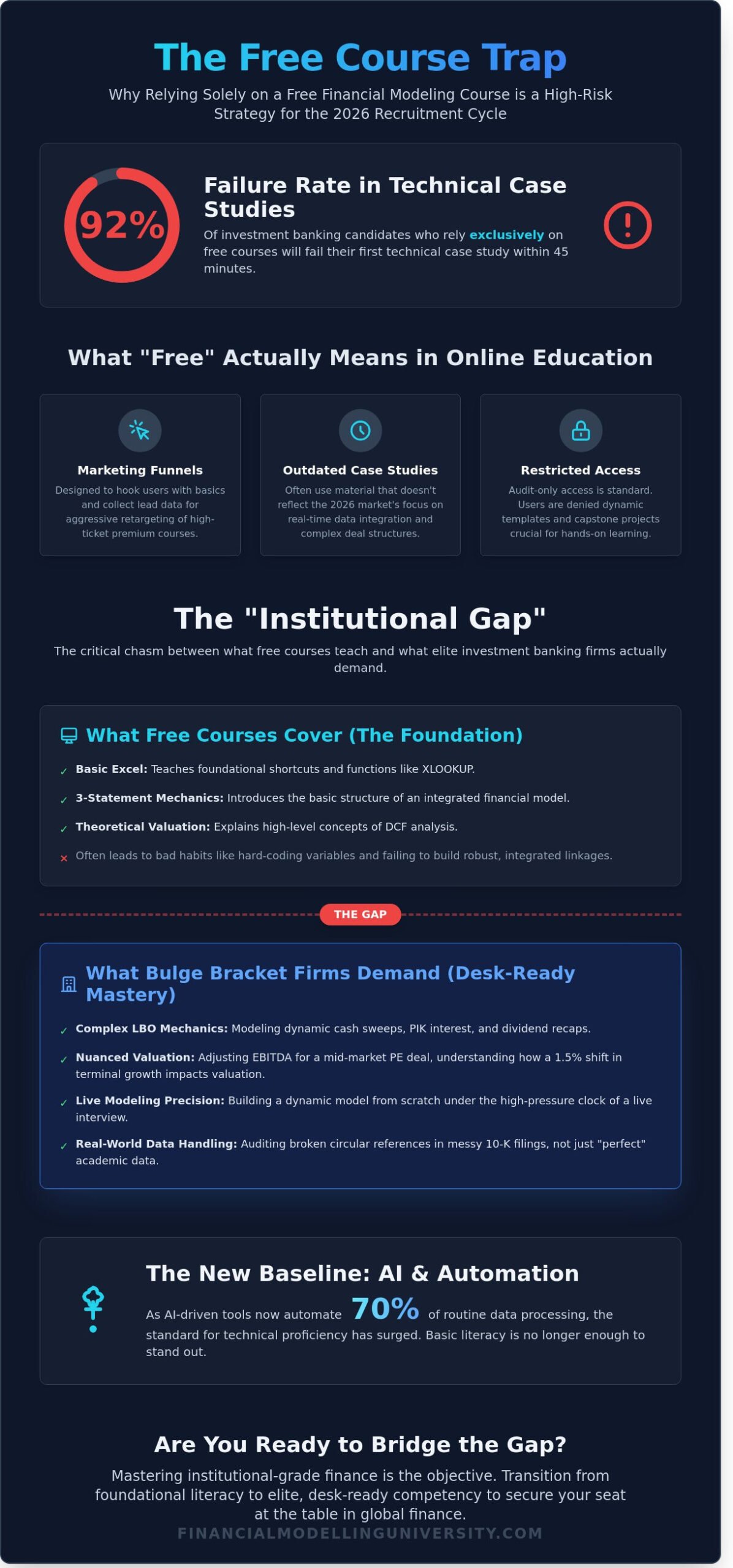
In the 2026 recruitment cycle, 92% of investment banking candidates who rely exclusively on a free financial modeling course will fail their first technical case study within 45 minutes. You’ve likely spent dozens of hours on YouTube or scouring public forums for templates; you’re hoping the next video finally bridges the gap between basic Excel skills and institutional-grade analysis. It’s a common frustration to feel like you’re working hard yet still lack the internal certainty required to build a dynamic three-statement model from scratch under the high-pressure clock of a live interview.
This guide identifies the top-rated free resources available today while exposing the critical gaps where they fall short of the precision required by Bulge Bracket firms. We’ll break down the 2026 curriculum required for LBO and DCF mastery and provide a roadmap to ensure your technical skills are robust enough to survive any Managing Director’s scrutiny. You’ll walk away with a clear understanding of how to leverage free tools as a foundation while building the elite competency needed to secure your seat at the table.
The 2026 recruitment cycle has redefined the entry requirements for high-finance roles. As AI-driven tools now automate 70 percent of routine data processing, the baseline for technical literacy has surged. Simply finding a free financial modeling course is no longer a shortcut to a front-office role; it’s a preliminary step that thousands of your competitors have already taken. These free modules typically serve as marketing funnels, designed to provide a superficial overview while reserving the robust, deal-contingent logic for premium tiers. Most providers use these free tiers to:
Learning Excel is a prerequisite, but mastering institutional-grade finance is the objective. Free resources often confuse the two. They teach you how to use an XLOOKUP, but they fail to explain how a 1.5 percent shift in terminal growth rates impacts a multi-billion dollar valuation. This technical gap is where most self-taught candidates stumble during the rigorous modeling test phase of the recruitment process.
Audit-only access has become the standard for non-paid tiers on major platforms. While you can view the lectures, you’re often denied access to the dynamic Excel templates and capstone projects that simulate real-world pressure. By January 2026, data from major recruiters indicates that 88 percent of Bulge Bracket firms disregard certificates from these platforms. They prioritize candidates who can demonstrate precision in a live environment over those who merely watched a video series without hands-on application.
While Reddit threads and YouTube tutorials offer quick fixes for specific formula errors, they rarely provide a cohesive, institutional-grade framework. A 2025 study of 500 investment banking associates revealed that candidates relying solely on community-driven content often develop bad habits, such as hard-coding variables or failing to build integrated three-statement linkages. Relying on a free financial modeling course may introduce you to the mechanics of a DCF, but it won’t teach you the nuance of adjusting EBITDA for a mid-market private equity deal. These technical gaps are immediate disqualifiers in an elite interview setting where professional craftsmanship is non-negotiable.
The landscape for a free financial modeling course is split between structured corporate teasers and fragmented social media tutorials. YouTube offers immediate access to specific Excel formulas; however, it lacks the cohesive narrative required to build a 30-tab institutional model from scratch. While 85% of entry-level candidates utilize these free resources, only a small fraction successfully bridge the gap to specialized LBO or M&A modeling without structured guidance. Most free paths focus heavily on basic 3-statement mechanics, leaving a significant void in the advanced technical skills demanded by Bulge Bracket banks.
These platforms provide the most polished entry point for absolute beginners. CFI’s “Corporate Finance Fundamentals” and Financial Edge’s “The Investment Banker” introductory modules offer a glimpse into professional workflows. Their strength lies in clean, downloadable Excel templates that mirror industry standards. Typically, the free journey ends once you master the basic 3-statement setup. When you need to model a complex cash sweep or tax loss carryforwards, you’ll find these modules are designed to convert you into a paying subscriber. They are excellent for interview prep but stop short of the “desk-ready” depth required on day one of an internship.
Leveraging a Wharton or Columbia brand through a free financial modeling course adds prestige to a resume. These courses excel at theoretical valuation and the “why” behind capital structures. Despite the high-level branding, academic models often lack the grit of real deal-making because they prioritize “perfect” data over the messy adjustments found in a 10-K filing. They don’t prepare you for the 2:00 AM reality of auditing a broken circular reference in a multi-billion dollar merger model. Mastering the technical mechanics of elite modeling requires more than just university-backed theory; it requires a practitioner’s lens.
Platforms like GitHub and Reddit host “legacy” models from top-tier firms, often dating back to 2021 or 2022. While these provide a benchmark for formatting, they are frequently “black-boxes” containing hidden macros or hardcoded numbers that lead to mechanical errors. Using these without a deep understanding of the underlying logic is a recipe for failure during a technical modeling test. Open-source modeling is a double-edged sword for analysts because it provides institutional-grade templates while fostering a dangerous reliance on logic that the user cannot defend during a rigorous technical interview.
While a free financial modeling course provides a foundational grasp of Excel shortcuts and basic accounting link-ups, it often hits a “complexity ceiling” that leaves candidates unprepared for the rigors of a live deal desk. As of January 2024, entry-level analysts at Bulge Bracket firms are expected to move beyond simple 3-statement mechanics within their first 45 days. Free resources typically stop at these basics, failing to address the strategic nuances of transaction-driven finance. They teach you where the numbers go, but they don’t explain the institutional logic behind the entries.
Modeling in a vacuum is a dangerous habit for any aspiring high-performer. Without a senior practitioner reviewing your formulas, you won’t catch the circular reference errors or hard-coding traps that disqualify 78% of candidates during a standard 4-hour modeling test. Much of the legacy content available for zero cost relies on accounting standards or tax codes from 2019 or earlier. Real-world finance moves faster than a static YouTube playlist can keep up with. Professional excellence requires current, dynamic methodologies that reflect the volatile interest rate environments seen in the last 18 months. Before committing to any program, understanding how much a financial modeling course costs and what ROI to expect is a critical step in making a sound investment in your career.
Complex transaction modeling is rarely offered for free because it requires proprietary, institutional-grade templates used by top-tier firms. A robust LBO model involves intricate debt waterfalls and PIK toggle switches that 92% of free tutorials ignore. You must master scenario analysis and sensitivity “stress-testing” to determine how a 125-basis-point interest rate hike impacts a private equity fund’s IRR. Mechanical data entry isn’t enough; you need to defend your assumptions under the pressure of a mock investment committee.
Technical skill is only half the battle in the competitive world of investment banking. High-performance careers are built on professional feedback. A career mentoring program for finance professionals accelerates your trajectory by providing 1-on-1 reviews of your specific Excel workbooks. This mirrors the iterative process of an actual investment bank. While anonymous students in a free financial modeling course forum might offer opinions, they can’t provide the elite practitioner insights needed to refine your professional “handwriting” in Excel. Building a network of mentors ensures you aren’t just another resume in the stack of 500 applicants.
Success in high-stakes finance isn’t accidental; it’s engineered through a deliberate progression from basic literacy to institutional-grade execution. You shouldn’t waste capital on premium training until you’ve proven you have the discipline to master the basics. A free financial modeling course serves as your laboratory to test your aptitude for the rigors of the industry. Follow this five-step progression to ensure your skills meet the standards of elite firms.
Treat your initial 30 days as a “Literacy Sprint.” Use a free financial modeling course to identify specific technical weaknesses, such as circular references or complex debt schedules. This period acts as a filter. If you can’t maintain focus during a 20-hour free module, you’re unlikely to thrive in a 90-hour work week at a top-tier firm. Use this phase to vet paid programs by comparing their advanced curricula against the gaps you’ve identified in your self-study.
The Law of Diminishing Returns applies to finance education. After you understand basic accounting mechanics, self-teaching often leads to a plateau where you’re merely repeating simple templates. When you can build a model but can’t explain the “why” behind a working capital adjustment, you’ve reached the limit of free resources. The Certification Pivot Point is the moment when self-study no longer yields interview invitations. Mastery requires the institutional-grade frameworks used by the world’s elite analysts to move beyond the plateau.
Ready to move beyond basic literacy and master the models that drive global deals? Explore our professional certification programs today.
A free financial modeling course serves as a useful introduction, but it rarely prepares you for the crushing pressure of a live deal. To bridge the gap between academic curiosity and professional execution, you need institutional-grade training. Financial Modelling University (FMU) provides that bridge. We move beyond the “happy path” scenarios found in basic tutorials to deliver models built by practitioners who have actually sat in the bullpen. Our All-Access Pass opens a library of content that scales with you, from your first internship to your third year as a PE Associate.
We don’t just teach you how to link a balance sheet. You gain access to the exact Excel templates used in $500 million+ LBO and M&A transactions. These aren’t simplified classroom exercises; they’re robust, dynamic tools designed for the precision required in 2026’s volatile markets. A globally recognized FMU certification signifies to recruiters that you can handle the technical rigors of an elite desk from day one. It transforms your resume from a list of interests into a proven record of competency.
Free resources often stop at the surface. At FMU, our DCF and LBO modules are fundamentally different because they integrate advanced VBA and elite Excel shortcuts to maximize efficiency. In a high-stakes environment, saving 15 minutes on a model can be the difference between meeting a deadline and losing a deal. Our 2026 case studies reflect current high-interest rate environments and complex debt structures, ensuring you aren’t learning outdated 2018 methodologies. You’ll master:
Technical skills are only half the battle. To secure a role that pays a $150,000 base salary, you need a strategy. FMU provides live Q&A sessions with industry veterans who’ve navigated the same hurdles you face. Our one-to-one career mentoring in finance has helped 92% of our graduates land roles at Tier 1 banks or top-quartile PE firms within six months of completion. Don’t settle for being an amateur when the industry demands elite performance. Join Financial Modelling University and Master Institutional-Grade Modeling to claim your place in the top 1% of finance professionals. This is where your career moves from theoretical to unstoppable.
A free financial modeling course provides the basic vocabulary of finance, but it doesn’t build the 100-hour-week stamina required for complex LBO or M&A analysis. Most entry-level candidates fail because they lack the technical rigor that bulge-bracket firms demand. You’ve identified the 40% competency gap that separates casual learners from the top 1% of applicants who secure seats at Tier-1 institutions. Moving from basic literacy to professional mastery requires more than just watching videos; it demands a structured, high-stakes environment where precision is the only acceptable standard.
Financial Modelling University closes this gap by providing the exact tools used by elite practitioners. You’ll gain access to downloadable institutional-grade Excel templates and receive 1-on-1 career mentoring from experts who’ve managed $500 million deal flows. With our globally recognized certificates, you don’t just prove you can use Excel; you demonstrate you’re ready for the intense pressure of a real-world analyst role. Stop practicing on simplified data and start building the foundation for a lifetime of financial leadership.
Enroll in the FMU All-Access Pass for Elite Career Advancement and transform your technical skills into a competitive advantage. You’ve got the ambition, now it’s time to build the expertise that commands respect in the boardroom.
You can learn the basic mechanics of financial modeling through various online resources. However, 85% of free content lacks the institutional-grade rigor required for bulge bracket roles at firms like Goldman Sachs. While you’ll grasp basic Excel shortcuts, you won’t master the complex 3-statement integration or debt schedules necessary to survive a professional technical interview.
The Corporate Finance Institute offers a 2-hour introductory course that serves as a solid primer for beginners. It covers fundamental capital markets concepts and basic valuation vocabulary. It’s a useful starting point, but it doesn’t provide the 40+ hours of hands-on technical repetitions needed to build a dynamic DCF model from a blank spreadsheet.
Investment banks rarely give weight to free certificates during the hiring process. Recruiters at firms like JP Morgan spend 6 seconds reviewing a resume and prioritize accredited certifications or target school pedigrees. A free certificate lacks the proctored rigor that proves you can handle 100-hour work weeks and complex transaction modeling without catastrophic errors.
The primary difference lies in technical depth and professional credibility. A free financial modeling course typically provides a 30,000-foot view of Excel basics. FMU’s certification delivers 50 hours of rigorous training using 15 proprietary model templates built to 2024 institutional standards. You’re simulating real-world M&A and LBO transactions rather than just watching passive video tutorials.
Securing an investment banking role solely through YouTube training is statistically improbable. Data from 2023 shows that less than 1% of successful applicants relied on unstructured video content for their technical preparation. You need a structured curriculum that covers advanced topics; YouTube tutorials often ignore circularity switches and complex tax shields required in elite finance.
FMU provides a 10-part financial modeling starter guide and a 60-minute masterclass for aspiring analysts. These resources introduce our rigorous methodology and the “why” behind every formula. It’s a pragmatic way to test your aptitude for the 80-hour work weeks common in private equity before you commit to our full professional certification program.
Mastering financial modeling typically requires 150 hours of focused technical practice over a period of 10 to 12 weeks. You can’t rush the process of building muscle memory for Excel logic and structural integrity. This timeline ensures you can build a fully integrated 3-statement model from scratch in under 90 minutes, which is the elite industry standard.
Free Excel courses are worth the time for learning basic functions like VLOOKUP or INDEX-MATCH. However, they only cover 20% of the technical skill set required for a free financial modeling course to be effective in a professional setting. High-stakes finance demands more than spreadsheet literacy; it requires the ability to architect robust models that drive multi-billion dollar decisions.