


A flawed valuation model is worse than no model at all because it provides a false sense of security for high-stakes capital decisions. You understand that the fcff calculation is the heartbeat of any professional DCF, yet the technical nuances often lead to terminal errors. It’s frustrating to reconcile the three financial statements when you’re unsure whether to apply the 21% federal corporate tax rate or a specific marginal rate. These precision-based hurdles are exactly what separate the amateurs from the industry experts.
You deserve a blueprint that mirrors the rigor required at top-tier investment banks. This guide provides the definitive, institutional-grade method for calculating Free Cash Flow to Firm to ensure your models are error-proof. We’ll move beyond basic textbook definitions to explore the logic behind every adjustment, from non-cash items to complex working capital shifts. You will gain the technical mastery needed to build dynamic models that command respect in any boardroom. Let’s break down the mechanics of professional-level valuation.
Free Cash Flow to the Firm (FCFF) represents the cash flow available to all of a company’s capital providers. This includes both debt holders and equity shareholders. Unlike other metrics that focus solely on what remains for owners, FCFF looks at the total cash generated by operations after accounting for necessary capital expenditures and working capital investments. It’s the raw financial output of the business assets themselves. Master the fcff calculation, and you gain the ability to value a business regardless of how it’s financed.
In the world of elite finance, we describe FCFF as “unlevered.” This means it ignores the effects of interest expense and debt repayment. By stripping away the capital structure, you can compare two companies with different leverage levels on an apples-to-apples basis. This is why FCFF is the gold standard for M&A transactions and institutional equity research. When a private equity firm evaluates a target, they look at FCFF first to determine what the asset can produce before they layer on their own specific debt structure.
Accounting earnings are often a poor proxy for value. Net income is frequently distorted by non-cash entries like depreciation, amortization, and one-time gains or losses. These items don’t reflect the actual liquidity moving through the business. A company can report record profits while simultaneously running out of cash because of heavy inventory builds or unpaid receivables. Relying on net income alone is a dangerous shortcut that professional analysts avoid.
Leverage also masks true operational health. High interest payments can make a stellar business look unprofitable on the bottom line, while a zero-debt firm might look stronger than it actually is. FCFF represents the purest view of a company’s ability to generate cash, independent of its capital structure. It cuts through the accounting noise to show you the real economic engine.
In a standard Valuation using discounted cash flows, FCFF serves as the numerator for the entire projection period. Because this cash flow belongs to both debt and equity holders, you must discount it using the Weighted Average Cost of Capital (WACC). This process yields the Enterprise Value (EV) of the firm. It’s a logical, disciplined progression that mirrors the way top-tier banks like JP Morgan or Goldman Sachs approach valuation.
Precision in your fcff calculation is non-negotiable. Small errors in your cash flow adjustments compound over a ten-year forecast, leading to massive discrepancies in your final Enterprise Value. If you want to perform at the level of elite practitioners, you must master the mechanics of mastering investment banking financial modeling to ensure your outputs are defensible and institutional-grade. This foundation allows you to build models that aren’t just academic exercises but catalysts for career transformation.
Professional analysts must reconcile their numbers across the three financial statements to ensure model integrity. Whether you start from the income statement or the cash flow statement, your fcff calculation must yield an identical result. This consistency is the mark of an FMU expert. Most practitioners use three primary starting points: EBIT, Net Income, or Cash Flow from Operations (CFO). While the EBIT approach is the institutional standard for investment banking, knowing how to reconcile all three is essential for auditing complex models.
This is the most common methodology used in professional valuation. The formula is: FCFF = [EBIT x (1 – Tax Rate)] + Depreciation & Amortization – CapEx – ΔWorking Capital. The term [EBIT x (1 – Tax Rate)] is known as NOPAT, or Net Operating Profit After Tax. It represents the theoretical profit of the company if it had no debt. When selecting a tax rate, use the 21% US federal corporate tax rate as your baseline for domestic entities. However, always incorporate state-level taxes to arrive at a precise marginal rate for forward-looking projections.
Starting from the bottom of the income statement requires specific adjustments to “unlever” the cash flow. The formula is: FCFF = Net Income + Non-Cash Charges + [Interest Expense x (1 – Tax Rate)] – CapEx – ΔWorking Capital. A common mistake among junior analysts is adding back the full interest expense. You must only add back the after-tax interest expense. Because interest is tax-deductible, it creates a “tax shield” that reduces the company’s actual tax outlay. Adding back the tax-shielded portion ensures you aren’t double-counting the benefit. If the firm has preferred shareholders, remember to add back preferred dividends as these are also a return to capital providers.
Structure your “Cash Flow Build” with absolute clarity to avoid terminal errors. Use consistent sign conventions; typically, CapEx and increases in Working Capital are shown as negative values to reflect a use of cash. According to the CFA Institute on Free Cash Flow Valuation, the reconciliation from CFO is the ultimate audit check. This involves adding back after-tax interest to Cash Flow from Operations and subtracting CapEx. Mastering these technical workflows is a prerequisite for roles at elite firms. If you want to refine these skills, our excel for finance course provides the institutional-grade templates used by industry pros. These tools ensure your models are defensible and structured for high-stakes decision-making.
Free Cash Flow to Equity (FCFE) represents the residual cash available only to common shareholders. While the fcff calculation provides an unlevered view of the entire business, FCFE is “levered” because it accounts for interest payments and net debt movements. If a firm issues $100 million in new bonds, that cash inflow increases FCFE but leaves FCFF unchanged. Conversely, mandatory debt repayments reduce FCFE. Because FCFF is independent of these financing decisions, it remains the industry standard for companies with volatile capital structures or those undergoing significant recapitalizations. It allows you to value the core operations without the noise of shifting debt levels.
Professional analysts choose their metric based on the firm’s capital stability and the specific goals of the valuation. Use FCFF when a company has significant leverage or is a target for an acquisition. This approach allows you to value the operating assets first and determine the optimal capital structure later. In contrast, FCFE is best suited for firms with a stable, target debt-to-equity ratio. This is particularly true for commercial banks and insurance companies, where interest expense is an operational item rather than a financing one. The following table summarizes the key distinctions between these two metrics:
Choosing the wrong metric often leads to a mismatch between the cash flow and the discount rate. If you discount FCFE by the WACC, your valuation will be fundamentally flawed. Precision in your fcff calculation ensures that your Enterprise Value is a robust reflection of the firm’s operational power before any financing costs are considered.
The choice of cash flow dictates the final valuation output. Discounting projected FCFF by the WACC yields the Enterprise Value (EV) of the firm. To find the value of the actual shares, you must subtract Net Debt, Minority Interest, and Preferred Stock from the EV. This “bridge” is a fundamental skill in private equity financial modeling. In an LBO context, understanding how debt paydown transfers value from lenders to equity holders over time is the key to calculating internal rates of return (IRR). You must master this reconciliation to move from a high-level business valuation to a specific per-share price target. This discipline is what separates junior analysts from senior associates who can defend their models in a professional committee.
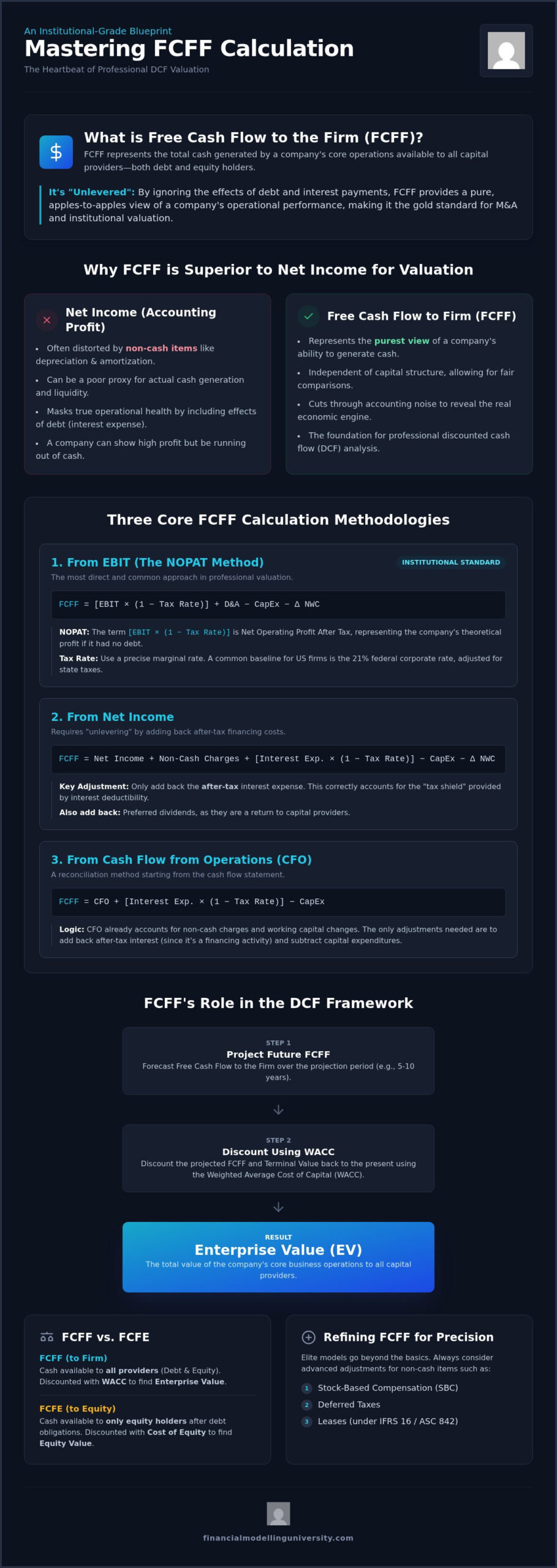
A basic fcff calculation found in a textbook rarely survives the scrutiny of a professional investment committee at a top-tier bank like JP Morgan. To perform at an elite level, you must account for “modeling friction” and accounting nuances that distort a firm’s true cash-generative power. Stock-Based Compensation (SBC) is a primary example. While SBC is technically a non-cash expense on the income statement, it represents a real economic cost through dilution. Professional analysts add SBC back to NOPAT to reflect cash flow but must adjust the diluted share count in the final equity value bridge. Deferred taxes should only be added back if the underlying timing differences aren’t expected to reverse during the forecast period.
Precision also requires normalizing for non-recurring items. Strip out one-time legal settlements, restructuring costs, or gains from asset sales. These items are peripheral to the core business and will lead to an inaccurate terminal value if left in the run-rate. You must also avoid the common “Working Capital Trap.” When calculating the change in Net Working Capital, you must exclude cash and any interest-bearing debt. Cash is a non-operating asset, and debt is a financing item. Including them in your fcff calculation will fundamentally break the unlevered nature of your DCF model.
Distinguish between maintenance CapEx and growth CapEx to understand the firm’s reinvestment requirements. Maintenance CapEx represents the spending needed to sustain current operations, while growth CapEx fuels future expansion. In tech-heavy valuations, you should capitalize R&D expenses rather than treating them as operating costs. This shift correctly identifies R&D as a long-term investment in intangible assets. Always perform a sanity check by comparing CapEx as a percentage of revenue against industry peers to ensure your projections remain grounded in reality.
Modern accounting standards now treat operating leases as debt-like obligations on the balance sheet. To maintain a consistent unlevered view, you must adjust EBIT by adding back the interest portion of the lease expense. This ensures your operational comparisons remain “apples-to-apples” across companies with different lease-versus-buy strategies. Failure to make this adjustment will result in an artificially low Enterprise Value. If you are ready to master these institutional-grade nuances, our DCF Valuation Course provides the advanced training needed to build professional-level models. This curriculum is designed to transform your technical skills into a strategic asset for your career.
Projecting the explicit forecast period is where your strategic assumptions meet financial reality. You must forecast revenue, operating margins, and reinvestment needs for a 5 to 10 year horizon. Each year’s fcff calculation serves as a critical building block for the final Enterprise Value. Once the explicit period is set, you must determine the Terminal Value (TV) using either the Gordon Growth Method or the Exit Multiple Method. This single figure often represents over 70% of the total valuation, making its accuracy paramount. Discount these future cash flows back to the Present Value (PV) using the Weighted Average Cost of Capital (WACC) to arrive at the firm’s intrinsic value.
Always conduct a “Sanity Check” by comparing your model’s FCFF Yield to industry peers. The FCFF Yield, calculated as FCFF divided by Enterprise Value, provides a reality check on your assumptions. If your yield is significantly lower than the sector average, your growth or margin assumptions may be overly optimistic. This level of rigor is what differentiates a professional analyst from a student. It ensures that your final valuation is not just a theoretical exercise but a defensible investment thesis.
The terminal year requires specific adjustments to ensure the model reflects a “steady state.” You must ensure that CapEx and Depreciation converge. If CapEx significantly exceeds Depreciation in perpetuity, you are implicitly assuming the company will grow its asset base forever, which is rarely sustainable in a mature phase. You must also normalize changes in Net Working Capital. A 1% change in the terminal growth rate or a slight miscalculation in the final year’s cash flow can swing the entire valuation by 15% or more. Precision in the final year of your fcff calculation is the difference between a robust model and a rejected proposal.
Building institutional-grade models requires more than just knowing a formula. It requires a disciplined, structured approach to financial architecture. Our DCF Valuation Course provides the blueprint for this mastery. You will learn to navigate the complexities of terminal value, WACC components, and advanced sensitivity analysis using the same workflows employed at elite banks. FMU’s downloadable templates are designed to help you avoid common calculation errors while maintaining the speed required in high-stakes environments.
Don’t leave your career progression to chance. Join 25,000+ finance professionals who have used our proven methods to elevate their technical expertise. It’s time to Master Financial Modeling Like the Pros and secure your place at the top of the industry. Perform at the level of elite practitioners and transform your financial modeling skills into a strategic career asset today.
Mastering the fcff calculation is not just a technical requirement; it’s a prerequisite for anyone serious about a career in elite finance. You’ve learned how to strip away the noise of capital structure to reveal a firm’s true operational health. By refining your adjustments for stock-based compensation and normalizing terminal year cash flows, you ensure your models are defensible under the scrutiny of an investment committee. These technical skills define the industry’s top performers and separate the experts from the amateurs.
The path to professional mastery demands a disciplined application of institutional-grade workflows. Our curriculum is built on the same rigor found at top-tier banks and is trusted by 25,000+ finance professionals. You gain access to downloadable institutional-grade Excel templates and receive 1-on-1 career mentoring from industry experts who have already achieved success in high-stakes environments. This is your blueprint for career transformation.
Now is the time to transform your technical skills into a strategic career catalyst. Enroll in the Investment Banking Financial Modeling Course to bridge the gap between academic theory and real-world application. Take the first step toward becoming the expert the industry trusts. We’re ready to help you perform at the highest level.
Operating Cash Flow (OCF) measures cash generated from core business activities before any reinvestment in the firm’s asset base. FCFF goes further by subtracting Capital Expenditures to show the cash truly available for distribution to all capital providers. While OCF is a liquidity metric, FCFF is a valuation metric. Professional analysts at elite firms prioritize FCFF because it accounts for the necessary spending required to maintain and grow the business operations over time.
You add back interest expense because FCFF is an unlevered metric designed to measure cash available to all capital providers, including lenders. Since interest is a return to debt holders, it must be included in the total pool. However, you only add back the after-tax interest expense. This adjustment accounts for the tax shield benefit the firm received on its income statement, ensuring your fcff calculation remains technically precise and theoretically sound.
Negative FCFF is common in high-growth companies or capital-intensive industries where reinvestment exceeds operating cash flow. It doesn’t necessarily indicate a failing business; rather, it often signals aggressive expansion. For valuation purposes, you must project the point at which the company achieves a steady state with positive cash flows. If FCFF remains negative indefinitely, the firm’s Enterprise Value will be mathematically impaired, necessitating a deeper look at the business model’s viability.
Forward-looking models require the marginal tax rate to reflect the tax burden on the next dollar of income. In the US, this is the 21% federal corporate rate plus state taxes. Using the historical effective tax rate is a common amateur mistake, as it often includes one-time credits that won’t persist. FMU experts always use the marginal rate to ensure the terminal value and forecast period remain defensible during rigorous investment committee reviews.
Capital Expenditures represent a direct cash outflow required to acquire or upgrade physical assets. Because these investments are essential for future revenue generation, they reduce the immediate cash available to capital providers. A high CapEx requirement lowers your final fcff calculation result. In a professional DCF, you must balance these outflows against the projected growth they produce. Misjudging this relationship is a primary cause of flawed valuations in capital-heavy sectors like infrastructure.
EBITDA is a dangerous proxy for FCFF because it completely ignores taxes, capital expenditures, and changes in working capital. While private equity associates use it for quick “back of the envelope” math, it’s not a substitute for institutional-grade modeling. EBITDA overstates the cash available to the firm, especially in industries with high tax burdens or significant maintenance CapEx. Professional analysts always perform a full reconciliation to ensure their valuation is anchored in actual liquidity.
The most frequent errors include adding back the full interest expense instead of the after-tax portion and failing to exclude cash from the working capital calculation. Many analysts also incorrectly pair FCFF with the Cost of Equity instead of the WACC. These terminal errors break the internal logic of the DCF. Mastering the technical nuances of the build is what separates junior analysts from the pros who command trust in the boardroom.
To calculate FCFF from the Statement of Cash Flows, start with Cash Flow from Operations (CFO). Add back the after-tax interest expense, as interest is usually already subtracted within the CFO section under US GAAP. Then, subtract Capital Expenditures, which are found in the Investing Activities section. This reconciliation acts as a vital audit check to ensure your income statement projections align with the firm’s actual historical cash movements and reinvestment patterns.