

Is your firm’s valuation accuracy dependent on the tribal knowledge of a single analyst, or is it protected by a standardized, institutional-grade framework? In an era where the OCC and Federal Reserve have tightened guidance on model risk management, relying on fragile, individual spreadsheets is no longer just inefficient; it’s a professional liability. You’ve likely experienced the frustration of “black box” models that break the moment they’re passed between team members, or junior analysts who lack the precision required for elite-level execution. At Financial Modelling University, we know that standardizing financial modeling for teams is the ultimate differentiator for high-performing firms.
You can transform your department’s output from a collection of individual crafts into a unified, auditable engine. This article provides the blueprint to install a consistent “Excel DNA” across your team, ensuring faster review times for leadership and a drastic reduction in formula errors. We’ll explore the transition from fragmented workflows to scalable frameworks that mirror the discipline of the world’s top investment banks and private equity shops.
Individual brilliance is often the greatest enemy of institutional scale. In the high-stakes environments of investment banking and private equity, a single analyst’s “creative” modeling style can jeopardize an entire deal. This is the spreadsheet silo problem. When financial modeling for teams lacks a unified language, the “Review Tax” becomes an unbearable burden. Senior leadership, specifically VPs and Directors, often find themselves spending half their review time simply deciphering a junior’s unique formatting choices rather than auditing the underlying assumptions. It’s an inefficient use of high-cost talent that doubles the workload across the board.
Risk management has reached a tipping point in 2026. With the updated interagency guidance on model risk management issued by the OCC, Federal Reserve, and FDIC in April 2026, the cost of “fragile” formulas is no longer just a missed deadline. It’s a regulatory and professional liability. A model that breaks when a new analyst takes over isn’t just a technical failure; it’s a breakdown in institutional discipline. Transitioning from individual craft to a standardized, institutional-grade language is the only way to ensure your firm remains competitive and compliant.
Fragility begins with poor habits that go unchecked in a siloed environment. Hard-coded numbers buried within complex formulas make it impossible to track the source of data. Circular references, while sometimes intentional in certain debt schedules, often signal a lack of structural foresight that erodes team-wide trust. If a model isn’t dynamic, it can’t handle the rapid sensitivity analysis required for high-stakes LBO or M&A valuations. True mastery requires a shared architecture that every team member can navigate instantly. Without this, your team is building on sand.
Many firms attempt to solve these issues by purchasing expensive FP&A platforms. While cloud-based tools offer centralized data, they remain subject to the “Garbage In, Garbage Out” reality. Software cannot fix a fundamental lack of financial logic or poor structural design. Excel remains the global industry standard for bespoke deal-making because it provides the flexibility required for complex, non-standardized valuations. That flexibility is a double-edged sword. Without human mastery and a rigorous protocol for financial modeling for teams, even the most expensive platform becomes a cluttered repository of unreliable data.
Uniform formatting is the most basic yet vital pillar. Every cell must communicate its purpose through standardized color-coding: blue for hard-coded inputs, black for formulas, and green for links to other sheets. This visual shorthand allows for instant auditability. Beyond colors, the model must utilize modular construction. By building models in discrete blocks, teams can swap out debt schedules or revenue drivers without rebuilding the entire architecture. To safeguard the integrity of the output, every institutional model must include a dedicated “Check” tab. These standardized error checks, or “check-sums,” should flag discrepancies in the balance sheet or cash flow statement across the entire workbook instantly.
A professional model requires a strict separation of inputs, calculations, and outputs. This structure ensures that a change in a single assumption flows logically through the calculations to the final summary without manual intervention. Mastering this layout is essential for anyone pursuing an Excel for Finance certification. It creates a shared technical vocabulary that eliminates guesswork. Analysts should also document assumptions directly within the model. Use cell notes or a dedicated “Assumptions” column to provide context for future team members who’ll inevitably inherit the file.
The era of “Final_v2_REALLY_FINAL.xlsx” must end. Institutional teams use structured naming conventions that include dates and initials to maintain a clear audit trail. When managing multi-user updates in a shared drive, establish a “Master Model” protocol. Only one lead analyst should have write-access to the primary file, while others work on “What-If” scenarios in separate, linked workbooks. This prevents the accidental corruption of the core valuation. For firms looking to standardize these behaviors across their entire junior cohort, the FMU All-Access Pass offers a comprehensive curriculum to instill these elite habits and ensure your team’s output remains beyond reproach.
Choosing the right environment for financial modeling for teams often feels like a choice between the infinite flexibility of Excel and the rigid control of SaaS platforms. Specialized platforms like Anaplan or Mosaic Tech offer centralized data and improved version control, but they often lack the granular control required for complex LBO or bespoke real estate deal-making. Elite teams don’t just pick a tool; they build a framework. A hybrid approach is the gold standard in 2026. Use standardized Excel models for the heavy lifting of bespoke valuations while leveraging centralized data stores to ensure everyone is pulling from the same “source of truth.”
Scalability is the moment financial modeling for teams transitions from a solo task to a multi-contributor workflow. You’ve outgrown individual spreadsheets when three different analysts need to update separate revenue schedules simultaneously without a clear protocol. This is where the skill gap becomes a bottleneck. To bridge this, a comprehensive Financial Modeling Course Online is essential. It provides the foundational logic that allows analysts to transition from “Excel users” to “system architects” who can navigate any platform with confidence.
When selecting team-based software, prioritize the “Ease of Audit” metric. If a new associate can’t trace the logic of a forecast within minutes, the platform is a liability, regardless of its features. Cloud-based solutions like Cube or Jirav offer better accessibility for remote teams, but they still require a disciplined user base to avoid data corruption. Integrations with VBA can automate repetitive tasks, but use them sparingly. You don’t want to create “black boxes” that only one person understands. True collaboration requires transparency across the entire department.
In the high-stakes world of bulge bracket banks, Investment Banking Financial Modeling remains rooted in Excel for a reason: speed. The “No-Mouse” culture isn’t just for show. It’s about driving efficiency through shared keyboard shortcuts that allow a team to iterate on a DCF valuation in real-time during a client call. This level of precision and speed is what separates the pros from the amateurs. It’s about maintaining institutional-grade standards even when the pressure is at its peak and the deal timeline is shrinking.
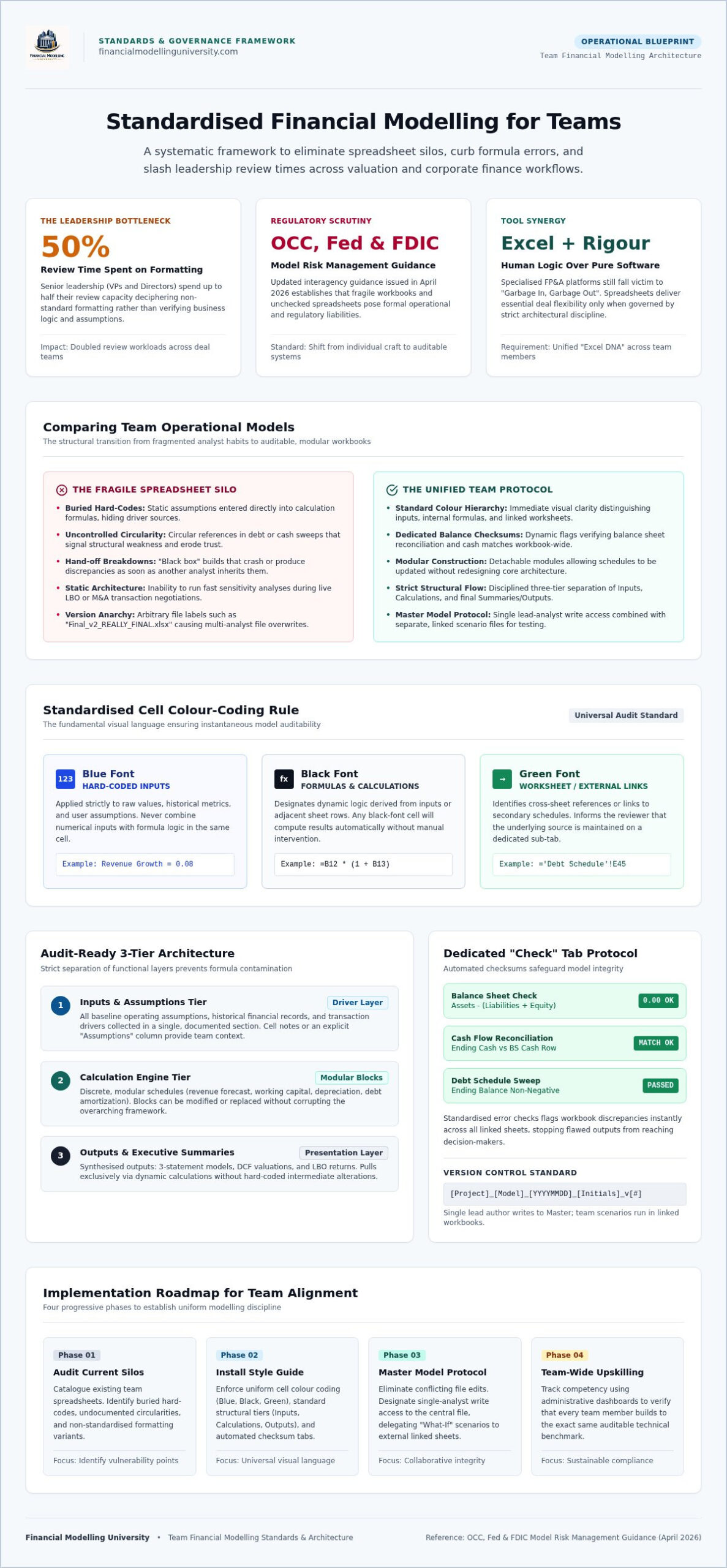
Standardizing financial modeling for teams requires more than a memo. It demands a structured rollout that transforms individual habits into institutional discipline. The first step is a cold-eyed audit of your existing model library. You’ll likely find inconsistent “Excel DNA” and “black box” formulas that only the original author understands. Use these gaps to build your case for change. Implementation follows a five-step roadmap:
Peer reviews shouldn’t be informal chats. They require a rigorous checklist that forces the auditor to verify the logic of every core schedule. Focus your feedback on the technical modeling structure. If an analyst uses a complex nested IF statement where a simple INDEX/MATCH would suffice, correct the habit immediately. For complex LBOs, use “Model Maps” to visualize how data flows from the operating model to the debt schedule and exit returns. This visual audit trail ensures that the model is robust enough for the most intense scrutiny. To bring your department up to this investment banking standard, explore our Corporate Group Training options today.
Generic tutorials often fail because they focus on isolated functions rather than the cohesive logic required for institutional-grade analysis. They teach you how to use Excel, but they don’t teach you how to think like a deal architect. In the competitive landscape of 2026, financial modeling for teams requires a curriculum that mirrors the intensity of a live deal room. FMU provides this through tailored learning paths that move your analysts from foundational DCF basics to advanced Private Equity Financial Modeling. By certifying mastery through our rigorous testing, you ensure every team member meets the FMU standard of professional excellence, trusted by over 25,000 finance professionals globally.
The transition from individual spreadsheet skills to a unified team framework is a cultural shift. It requires a mentor that understands the high stakes of investment banking and private equity. Our Corporate Group Training is designed to eliminate the “Spreadsheet Silo” problem permanently. When every analyst follows the same FMU-certified protocols, the “Review Tax” on senior leadership vanishes. Your VPs can spend their time on strategic deal-making instead of hunting for broken circular references in a junior’s fragmented model.
Managing a large cohort of analysts requires transparency and data-driven insights. The FMU Administrative Dashboard gives Team Leads real-time visibility into analyst progress, making it easy to identify “High-Po” talent through course completion metrics and assessment scores. You can customize the curriculum to align with your firm’s specific sector focus, whether that’s infrastructure, M&A, or real estate. Investing in this level of professional development doesn’t just improve your models; it reduces turnover by providing a clear path to career mastery for your most ambitious employees. By incorporating broader resources like WH eLearning for business compliance and workplace safety, you signal that your firm is committed to the highest standards of both technical and organizational discipline.
Standardization is impossible without the right foundational tools. FMU provides downloadable templates that serve as the blueprint for your firm’s internal style guide, ensuring that “Excel DNA” is consistent from day one. Our live Q&A sessions allow your team to get expert answers to complex deal questions that generic software platforms simply cannot address. The ROI of this professional mastery is undeniable. It results in faster deal cycles, fewer catastrophic formula errors, and the prestige associated with performing at an elite level. Implement the FMU standard today and transform your department into a unified engine of financial precision.
Transitioning from fragmented spreadsheets to a unified framework is the hallmark of an elite finance department. You’ve seen how standardized “Excel DNA” reduces the review tax on leadership and protects the firm from catastrophic valuation errors. By implementing a rigorous style guide and peer review workflow, you move beyond individual craft toward a scalable, institutional-grade engine. For leaders focused on long-term scaling, integrating these workflows with the strategic support of Full Potential ensures that technical precision translates directly into business growth. The future of financial modeling for teams depends on this technical discipline, ensuring that every output is auditable, precise, and professional.
Success in 2026 requires more than just better software; it requires a workforce that speaks the same technical language. FMU provides the blueprint for this transformation. Trusted by over 25,000 finance professionals, our platform offers the administrative dashboards and institutional-grade Excel templates necessary to monitor progress and verify mastery across your entire firm. Don’t leave your team’s accuracy to chance when you can install the industry’s most proven methodology.
Upskill your team with FMU Corporate Group Training and take the first step toward departmental mastery. Your journey to performing at the level of elite industry practitioners starts now.
Standardization requires a non-negotiable style guide and a shared technical architecture. Establish a central repository for “Master Templates” and enforce a unified color-coding system, such as Blue for inputs and Black for formulas. Use cloud-based collaboration tools to ensure real-time access while maintaining a single source of truth for all global data inputs across different time zones.
Prioritize modular construction and auditability in every workbook. Avoid “mega-formulas” by breaking complex calculations into logical, bite-sized steps across multiple cells to ensure transparency. These practices are foundational to financial modeling for teams because they reduce the risk of catastrophic errors. Every model should also include a dedicated “Check” tab with automated balance sheet and cash flow balancers.
Apply the “Grandma Test” to verify that a senior partner can follow the model’s logic in under 30 seconds. Leverage Excel’s native auditing tools, such as Trace Precedents and Trace Dependents, to visualize data flow. Focus your initial review on the “Assumptions” and “Output” tabs to verify the core logic before diving into the granular calculation sheets.
The most effective strategy is a hybrid model. Excel remains the global industry standard for bespoke deal-making and complex LBO valuations due to its unmatched flexibility. However, you should use specialized FP&A platforms for centralized data storage and high-level reporting. This combination provides the precision of a custom-built model with the scalability and version control of a cloud-based system.
Implement a structured upskilling program that moves beyond generic tutorials. Use case-study-based training that mirrors real-world transactions, such as M&A or project finance deals, to build practical experience. Certifying your junior cohort through a professional program ensures that every analyst meets a verifiable standard of mastery before they are entrusted with high-stakes client valuations or internal forecasts.
Establish a strict naming convention and a “Master File” protocol for all projects. Use a standardized format like “Project_Model_YYYYMMDD_Initials” and restrict write-access to a single lead analyst during critical update periods. For financial modeling for teams, leveraging shared drives with built-in version history allows you to track changes and revert to previous iterations if a formula is accidentally corrupted.
A style guide must define the color palette, font standards, and workbook structure. It should include rules for separating inputs, calculations, and outputs as a non-negotiable architectural requirement. Specify naming conventions for tabs and files to ensure every team member can navigate a colleague’s model instantly. This technical constitution eliminates the “black box” problem and ensures institutional-grade clarity across the firm.
Certification standardizes the “Excel DNA” of the entire department and eliminates inconsistent individual modeling styles. It provides managers with a quantitative benchmark for technical proficiency and identifies high-potential talent through completion data. By putting a team through a unified certification, you reduce model review times for leadership and build an institutional reputation for technical precision and reliability.