

This technical guide ensures you master the most challenging lbo model interview questions using a repeatable framework trusted by over 25,000 finance professionals. You will learn to internalize institutional-grade answers that demonstrate a deep understanding of how entry multiples and current interest rates impact IRR. We provide a comprehensive breakdown of the 2026 deal environment, including the shift toward private credit and the operational value creation strategies required to succeed today. By the end of this article, you will project the confidence of an industry insider who has built hundreds of models and navigated the most rigorous investment committees.
An Leveraged buyout (LBO) isn’t just a transaction; it’s a sophisticated financial engineering tool designed to amplify equity returns. At its heart, the LBO works by using a target company’s cash flow to service and pay down the debt used to acquire it. This process effectively transfers value from debt holders to equity holders over time. When you encounter lbo model interview questions, the interviewer is testing your ability to see beyond the spreadsheet and understand this fundamental shift in capital structure.
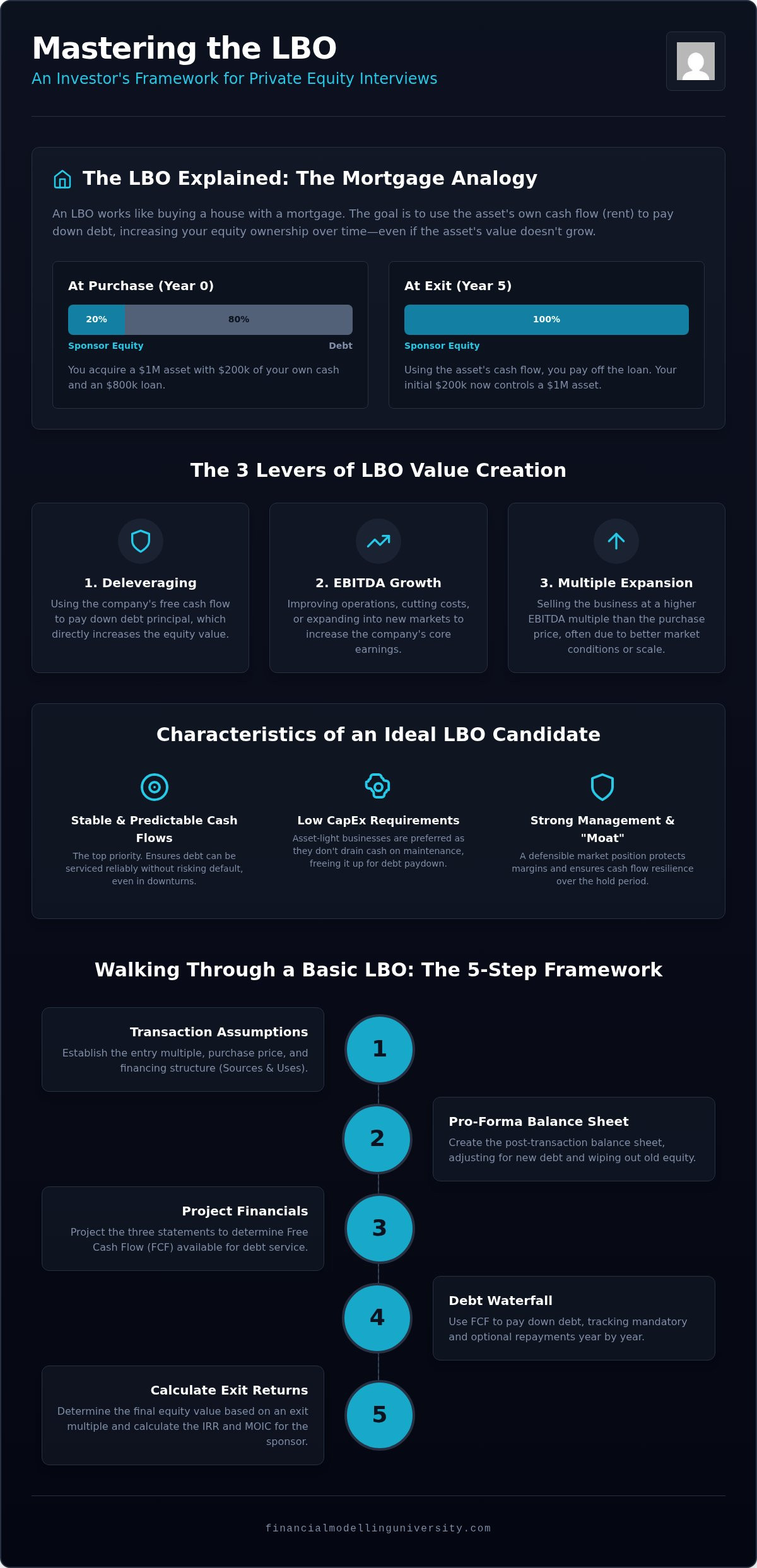
Think of an LBO as the corporate version of a residential mortgage. If you buy a $1 million home with $200,000 of your own cash and an $800,000 loan, you own 20% of the asset. If the home value stays flat but you pay off the entire mortgage using rental income, you now own 100% of a $1 million asset. Your initial $200,000 investment has quintupled without the asset’s price ever increasing. In a private equity context, debt repayment acts as a “forced savings account” for the sponsor. Every dollar of principal paid down increases the equity value of the business dollar-for-dollar.
Understanding the distinction between buyers is crucial for any aspiring associate. A financial buyer, such as a private equity firm, views the acquisition through the lens of IRR and MOIC. They focus on cash flow durability and exit timing to maximize investor returns. Conversely, a strategic buyer is typically a corporation looking for synergies, market share, or vertical integration. They often pay higher multiples because they can extract value through cost savings that a standalone PE firm cannot replicate.
To master lbo model interview questions, you must articulate how value is actually built during the hold period. Professionals focus on three distinct areas:
Not every company is suitable for high leverage. Elite professionals look for specific traits that ensure the debt can be serviced without compromising operations:
Mastering lbo model interview questions requires more than just knowing the formulas. You must demonstrate a disciplined, technical process that mirrors how professionals actually evaluate deals. When an interviewer asks you to “walk through an LBO,” they’re looking for a structured mental checklist. This framework moves from the initial transaction assumptions to the final return calculation, ensuring no technical step is overlooked.
The process begins with Step 1: Transaction Assumptions. Here, you establish the entry multiple and the purchase price. For a deep dive into how these assumptions look in practice, you can study this academic LBO model example which details the transition from entry to exit. Once the price is set, you move to Step 2: The Pro-Forma Balance Sheet, where you adjust the company’s capital structure. Step 3 involves projecting the three financial statements to determine the Free Cash Flow (FCF) available for debt service. In Step 4, you build the Debt Waterfall to track mandatory and optional repayments. Finally, Step 5 is the calculation of Exit Returns, where you determine the IRR and MOIC based on the final equity value.
The Sources and Uses table is the foundation of any LBO. It outlines where the capital is coming from and where it’s being spent. Sources include various debt tranches, such as senior secured loans or mezzanine debt, along with sponsor equity and any management rollover equity. Uses represent the purchase price of the company, the refinancing of existing debt, and transaction fees. A critical rule for any interview: Sources MUST always equal Uses. If they don’t, your model is fundamentally broken. If you want to move from theory to execution, our LBO Modeling Course provides the exact blueprints used by top-tier associates to master these tables under pressure.
The pro-forma adjustments are where many candidates stumble. This step involves the “write-up” of intangible assets and the creation of Goodwill to account for the premium paid over the book value. You must also eliminate the existing shareholders’ equity and replace it with the new sponsor equity. Transaction fees are typically expensed immediately, while financing costs are capitalized and amortized over the life of the debt. These adjustments ensure the balance sheet reflects the new capital structure on day one. Accuracy here is vital, as these figures flow directly into your depreciation and amortization schedules, impacting your future cash flow projections.
Mastering lbo model interview questions requires a deep understanding of how private equity firms measure success. You must distinguish between the Internal Rate of Return (IRR) and the Multiple on Invested Capital (MOIC). While Limited Partners (LPs) prioritize IRR to compare private equity performance against other asset classes, the General Partner (GP) often focuses on MOIC to maximize absolute dollar profit and carried interest. Understanding the interplay between these metrics is key to mastering LBO model mechanics during a technical interview.
Time is the most significant variable separating these two metrics. A 2.0x MOIC achieved in three years yields a significantly higher IRR than the same multiple achieved over five years. However, exiting too early can sometimes be a disadvantage if the firm cannot redeploy that capital into a similarly high-yielding investment. Sensitivity analysis is the tool used to stress-test these outcomes. In a professional model, a 1.0x change in the exit multiple can swing the IRR by hundreds of basis points, making it the most scrutinized variable in any investment committee memo.
Elite candidates don’t rely on Excel for every calculation. During “Paper LBO” tests, you should use mental benchmarks to estimate returns. Doubling your money (2.0x MOIC) in five years equates to approximately a 15% IRR. If you achieve that same 2.0x in only three years, the IRR jumps to roughly 26%. Tripling your money (3.0x MOIC) in five years results in a 25% IRR. Reciting these benchmarks demonstrates the level of “investor’s intuition” that separates associates from analysts.
In the 2026 market environment, interest rates play a pivotal role in deal structuring. With the 3-month SOFR at approximately 3.5%, all-in rates for senior debt typically range from 9% to 11%. This higher cost of capital directly impacts the Debt Service Coverage Ratio (DSCR), which measures a company’s ability to pay its interest and principal obligations. Higher rates compress the maximum leverage a company can sustain, often capping total debt at 4x to 6x EBITDA. For a more granular breakdown of these dynamics, explore FMU’s Private Equity Financial Modeling Course, where we analyze how shifting macro conditions dictate institutional-grade LBO structures.
Once you master the entry mechanics, lbo model interview questions often pivot toward portfolio management and value extraction. Advanced candidates must navigate scenarios where the capital structure evolves mid-hold. This includes dividend recapitalizations and strategic add-on acquisitions, both of which require a sophisticated understanding of cash flow durability and lender appetite in the 2026 credit market. These topics test whether you can think like a principal investor rather than just a model builder.
A dividend recapitalization occurs when a private equity firm issues new debt to pay a special dividend to its shareholders. On the balance sheet, this increases total leverage while simultaneously reducing the equity base. While this significantly boosts the Internal Rate of Return (IRR) by returning capital early in the hold period, it increases the company’s risk profile. In an environment where the 3-month SOFR is approximately 3.5%, lenders scrutinize these deals heavily. You must be prepared to defend the company’s ability to service this additional debt without compromising operational stability or breaching its covenants.
The “buy and build” strategy is a cornerstone of modern private equity. By using a platform company to acquire smaller competitors, firms benefit from multiple arbitrage. For example, if you acquire a small business at 6x EBITDA and integrate it into a platform valued at 10x, you instantly create value on the spread. This strategy is particularly effective in fragmented industries where scale leads to increased exit multiples. Tracking these complex roll-ups requires precision, making mastery of Excel for Finance essential for any associate managing a platform investment.
Beyond these strategies, you should understand the role of management rollover. PE firms typically require existing management to keep “skin in the game” by rolling over a portion of their equity into the new capital structure. This aligns incentives and reduces the initial cash equity the sponsor must provide. Additionally, be prepared to discuss Paid-In-Kind (PIK) interest. PIK mechanics allow interest to accrue to the principal balance rather than being paid in cash, preserving liquidity for growth at the cost of a ballooning debt balance. To master these institutional-grade technicals and secure your spot at a top-tier firm, enroll in our LBO Modeling Course today.
The 60-minute modeling test is the ultimate filter in the private equity hiring process. It’s designed to push your technical limits and reveal how you perform under extreme pressure. Success doesn’t just come from answering lbo model interview questions correctly; it comes from a surgical approach to Excel that balances speed with institutional-grade precision. You must prove that you can build a reliable, audit-ready model without the crutch of a pre-built template.
Most elite firms require a “clean sheet” approach. This means starting with a blank workbook and building every schedule from scratch. Your formatting must be flawless from the first cell. Use blue for hardcoded assumptions, black for formulas on the same sheet, and green for links to other tabs. This standardized color coding tells the interviewer you’ve been trained in a professional environment. If your model is a mess of black text, you’ve failed the test before the IRR is even calculated.
Don’t get lost in the weeds of minor OpEx line items. Focus your energy on the “Big Three” drivers: Revenue growth, EBITDA margins, and Debt Paydown. These variables dictate the vast majority of your returns. Once the model is linked, perform a quick “sanity check.” If your IRR is 85% or 2%, you likely have a broken link or a fundamental error in your entry/exit assumptions. A professional result typically falls between 15% and 30% for a standard deal.
The most common mistake is over-complicating the model. You don’t need a 500-row spreadsheet to impress an associate. Keep it simple, logical, and easy to follow. Other critical errors include:
Speed is a byproduct of repetition. To reach the level of an industry insider, you must practice under timed conditions using the same tools the pros use. Our LBO Modeling Course provides downloadable, industry-standard templates and step-by-step guidance to shave minutes off your build time. Remember, technical skills are merely the “ante” to get into the room. While the model proves you can do the work, your investor mindset and ability to defend your assumptions are what will actually win you the offer. Master the mechanics so you can focus on the story.
Mastering lbo model interview questions requires more than memorizing formulas; it demands a fundamental shift in how you view cash flow, leverage, and risk. By internalizing the 5-step framework and understanding the sensitivity of IRR to modern interest rates, you’ve moved beyond the level of a typical candidate. You now possess the structural blueprint used by elite private equity professionals to evaluate complex scenarios like dividend recaps and multiple arbitrage.
The technical test is simply the entry fee. Your ability to defend assumptions with the confidence of an industry insider is what secures the offer. Join 25,000+ finance professionals who have transformed their careers through our curriculum. Master the Institutional-Grade LBO Model with FMU University and gain access to downloadable institutional-grade Excel templates and expert career mentoring from industry pros. Don’t leave your career to chance. Put in the work, refine your intuition, and step into your next interview ready to perform at the highest level. You have the tools; now it’s time to execute.
The entry and exit multiples are the primary drivers of returns in any leveraged buyout. While operational improvements and debt paydown are essential, the price you pay and the price you receive dictate the mathematical ceiling of your IRR. Professional investors scrutinize these multiples because even a 0.5x contraction can wipe out years of EBITDA growth. You must explain this relationship clearly when answering lbo model interview questions to prove you understand value entry points.
Debt capacity is determined by the company’s ability to service interest and principal while maintaining a cushion for operations. In the 2026 market, total leverage is typically capped at 4x to 6x EBITDA, with senior debt making up 3x to 4x of that total. Lenders focus on the Debt Service Coverage Ratio (DSCR), ensuring it stays above 1.2x to 1.5x. You must evaluate the durability of cash flows to justify these leverage levels.
A “Paper LBO” is a mental or hand-written modeling exercise designed to test your technical intuition without Excel. You prepare by mastering mental math shortcuts, such as the “Rule of 72,” and memorizing return benchmarks. For instance, doubling your money in five years is a 15% IRR. Practice calculating debt paydown and exit equity value on a napkin to demonstrate the speed and precision required of an elite private equity associate.
High interest rates in 2026, with SOFR around 3.5%, directly compress the Free Cash Flow available for debt repayment. This increases the cost of capital and reduces the amount of leverage a sponsor can safely apply to a deal. Since leverage is a primary tool for return amplification, higher rates generally lead to lower IRRs unless the firm can achieve significant operational growth or buy at a lower entry multiple to offset the interest expense.
Firms may prioritize Multiple on Invested Capital (MOIC) over IRR when they want to maximize absolute dollar profit for their Limited Partners. While IRR accounts for the time value of money, MOIC determines the total carried interest the GP earns. If a fund has plenty of time left in its lifecycle, holding a high-quality asset longer to achieve a 3.0x MOIC is often more attractive than a quick flip for a high IRR but lower absolute profit.
On the transaction date, the target’s existing shareholders’ equity is eliminated and replaced by the sponsor’s equity contribution. New debt tranches are added to the liabilities section. On the assets side, the target’s assets are written up to fair market value, and any excess purchase price over that value is recorded as Goodwill. This reset creates the “Pro-Forma” balance sheet that serves as the starting point for your five year projection model.
Transaction fees are handled differently based on their nature. Advisory and legal fees are typically expensed immediately through the income statement, which reduces the sponsor’s initial equity contribution. Financing fees, however, are capitalized as a deferred asset on the balance sheet and amortized over the life of the debt. Understanding this accounting nuance is vital for maintaining an accurate cash flow model and ensures your Sources and Uses table stays in balance during the interview.